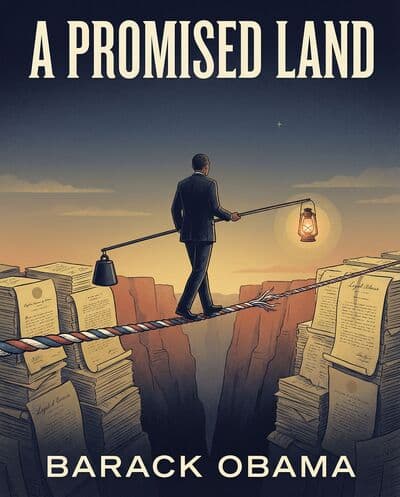
A Promised Land
by Barack Obama
Think about the last time you took a massive gamble on yourself. Maybe you quit a steady job to pursue a passion project, or you stood up to speak when everyone else was silent. You probably felt that frantic, thumping heartbeat—a mix of absolute terror and the shimmering hope that you were onto something bigger than yourself. Now, imagine that gamble isn't just about your career, but about the soul of a divided nation. Imagine trying to build a bridge across a canyon that seems to be widening by the hour. This is the weight of 'A Promised Land'. It’s the story of a man who stepped into the most powerful office on earth, only to find that the presidency is less like a throne and more like a high-wire act performed in a hurricane. For anyone who has ever looked at the world and thought, 'There has to be a better way,' this journey is for you. It’s a reflective, deeply human look at what happens when grand ideals meet the cold, hard wall of reality.
In Brief
Barack Obama's memoir traces his path from community organizer to president, revealing how idealism collides with political reality. Through the financial crisis, healthcare reform, and military decisions, he shows that governing means choosing the least bad option while keeping the long-term vision alive.
Key Ideas
Inspiration's Liability in Systemic Change
A leader's ability to inspire can become a liability when the public's symbolic expectations collide with the slow, messy reality of systemic change.
Constrained Power in Inherited Crises
The presidency is constrained by inherited crises and bureaucratic structures that often limit the executive's power to the 'least bad choice.'
Structural Vision Beyond News Cycles
Successful governance requires ignoring the volatility of news cycles to focus on long-term structural milestones like healthcare or climate frameworks.
Democratic Values Meet Transactional Reality
Foreign policy is a 'high wire' act where democratic values must constantly be weighed against the transactional needs of global stability.
The Human Cost of Command
The most significant burden of the office is the human cost of decisions, from military strikes to economic bailouts, which are felt personally by the leader.
Who Should Read This
Aspiring political leaders, policy students, and readers interested in the inner workings of presidential decision-making during America's most polarizing era
Summary
Introduction
Think about the last time you took a massive gamble on yourself. Maybe you quit a steady job to pursue a passion project, or you stood up to speak when everyone else was silent. You probably felt that frantic, thumping heartbeat—a mix of absolute terror and the shimmering hope that you were onto something bigger than yourself.
Now, imagine that gamble isn't just about your career, but about the soul of a divided nation. Imagine trying to build a bridge across a canyon that seems to be widening by the hour. This is the weight of 'A Promised Land'. It’s the story of a man who stepped into the most powerful office on earth, only to find that the presidency is less like a throne and more like a high-wire act performed in a hurricane. For anyone who has ever looked at the world and thought, 'There has to be a better way,' this journey is for you. It’s a reflective, deeply human look at what happens when grand ideals meet the cold, hard wall of reality.
The Audacity of the Bet
Imagine you’re standing in a small, drafty room in South Carolina. The rain is pouring outside, your campaign is sputtering, and you’re wondering if you’ve made a terrible mistake. Suddenly, a woman in the back starts a simple chant: 'Fired up, ready to go!' Within minutes, the room is vibrating. That moment right there? That’s the spark. It’s the belief that a single voice, tucked away in a corner of the world, can start a fire that changes everything.
Political success doesn't start with a spreadsheet or a polished policy paper. It starts with a bet—a foundational, almost reckless belief that we are not as divided as our geography or our skin color might suggest. When I first stepped onto the national stage, I was betting on the idea that an inclusive story could act as a bridge. I wanted to prove that the 'American Promise' wasn't just a dusty relic but a living, breathing contract we could all sign onto together.
But here’s the thing: that kind of idealism is expensive. It costs you the comfort of your own anonymity and subjects your life to the brutal mechanics of power. I remember a time after a humiliating defeat when my credit card was declined at a rental car counter. It was a sharp, tactile reminder that even while you’re reaching for the stars, the ground beneath your feet is often shifting.
We often think of leaders as having it all figured out, but the truth is much messier. The 'Joshua Generation' had to build on the work of those who came before them, all while navigating a 'protective pessimism' that many in the Black community carried for good reason. My bet wasn't that the path would be easy; it was that the path would be worth it.
So, you have to ask yourself: what is the story you’re telling? Are you trying to win an argument, or are you trying to build a community? Building the bridge is exhausting work, and as I soon found out, the view from the center of that bridge is often quite lonely. But once you’ve seen that room in South Carolina catch fire, you can't ever really look back.
The Weight of the Bubble
Imagine waking up and realizing you are no longer just a person; you are a monument. Suddenly, the simple act of taking a walk or buying a gallon of milk is a logistical operation involving armored Suburbans and men with earpieces. You’ve become a symbol, a vessel for the hopes and fears of millions, and in that process, the 'man' starts to disappear behind the 'office.'
There is a profound, almost theological weight to the presidency. It’s like living inside a gilded bell jar. You can see the world outside, but you can no longer touch it. I used to have this recurring dream where I was just an anonymous citizen again, walking through a city, sitting on a bench, unnoticed. It was a psychological escape from the claustrophobia of the bubble.
The public expects a miracle worker, but the institution often limits you to being a manager of crises. You are constantly balancing the symbolic expectations—the speeches, the ceremonies, the 'hope'—against the grinding reality of a bureaucracy that moves with the speed of a glacier. You start to feel the gravity of history pulling at your sleeves every time you sit in the Oval Office.
Maintaining a sense of self in this environment is the hardest task of all. You have to keep a part of your soul tucked away, safe from the polls and the pundits. If you’ve ever felt like your job was consuming your identity, multiply that by a billion. That’s the bubble. It protects you, yes, but it also separates you from the very people you’re trying to serve.
It’s where the 'man' and the 'monument' have their most difficult conversations. You realize that while you are the most powerful person in the room, you are also the most constrained. The transition from candidate to icon is a one-way street, and the toll is your own personal freedom.
Managing the Pitchforks
Have you ever been the only one standing between two groups of people who absolutely loathe each other? That was my reality during the financial collapse. On one side, you had bank CEOs who felt they were being unfairly targeted. On the other, you had a public that was—rightfully—ready to grab the pitchforks and storm the gates of Wall Street.
Leadership in a crisis is rarely about making the 'perfect' choice. Usually, it’s about choosing the 'least bad' option from a menu of disasters. We inherited an economy that was in a free fall, and the technocratic fix—the bailouts—felt like a bitter pill for everyone to swallow. I had to tell those CEOs that my administration was the only thing standing between them and the mob's rage.
It was a lonely burden. To save the system, we had to protect the very people who had broken it. This created a massive deficit of trust. When people see billions going to save banks while their own foreclosures are ignored, the social fabric starts to fray. Bipartisanship, which I had aimed for so earnestly, turned out to be a structural impossibility during this time.
Our Republican colleagues realized early on that total obstruction was their best political bet. If they didn't help, any failure was mine alone, and any success was 'partisan.' It was a cynical strategy, but a highly effective one. It taught me that in moments of systemic collapse, your moral storytelling is just as important as your policy.
If you don't explain the 'why'—the morality tale behind the hardship—people will fill the silence with their own anger. You have to be the stabilizer, the person who keeps the ship from tipping over, even when everyone on board is screaming at you. It’s not about being liked; it’s about ensuring the ship survives the storm.
The Long Game of Healthcare
Think about the most difficult project you’ve ever tackled. Now, imagine that half of your team is actively sabotaging you, the media is declaring it dead every Sunday morning, and the clock is ticking on your political life. That was the Affordable Care Act. It wasn't just a policy battle; it was a test of whether our government could still do big things.
To win, you have to be obsessed with the 'long view.' You have to ignore the daily volatility and stay focused on the structural milestones. We knew that bipartisanship was blocked, so we had to find a path through the internal friction of our own party. It was a legislative slog, a test of pure endurance.
I remember telling the team, 'Barack Hussein Obama. And I’m here with you in the Oval Office. Brother, I always feel lucky.' We needed that perspective because the setbacks were constant. There were moments when it seemed we would have to settle for a 'scaled-back' version, but we refused to give up on the ideal of universal coverage.
You have to use moral storytelling to keep the public engaged. You have to make the struggle about the mother who can't afford her child's medicine, not the latest filibuster rule. It’s about turning an abstract ideal into a tangible law that changes lives.
But here’s the reality: progress is incremental. You take the half-measure if it leads to the full measure later. You trade the perfect for the possible. It’s a messy, polarizing process that leaves plenty of scars, but when the pen finally touches the paper, you realize that the years of toil were just the down payment on a better future for millions.
The Tactile Cost of Command
Imagine sitting at a desk and feeling the texture of the paper beneath your fingers. This isn't just any paper; it’s a condolence letter to a family who lost a son or daughter in a war you are overseeing. You use your left hand to sign your name, and as you do, you recite their names like a silent prayer. This is the moment where the 'Commander in Chief' title stops being an honor and starts being an agonizing weight.
The domestic policy battles are loud and public, but the security decisions are quiet and heavy. You are balancing democratic values against the transactional, often cynical needs of global stability. Whether it was the troop surge in Afghanistan or the hunt for bin Laden, the human cost was always front and center in my mind.
You have to weigh the 'hard, cold truths' of international power dynamics against your own moral compass. Sometimes, you are forced to work with autocrats because the alternative is chaos. It’s a high-wire act where one slip doesn't just mean a bad headline; it means lives lost.
I remember a state dinner in Chile, smiling for the cameras while waiting for news about a downed jet in Libya. That’s the job. You maintain the public facade while carrying a secret world of life-and-death orders in your head.
It’s a reminder that global leadership is not a charm offensive; it’s a series of difficult compromises. You try to move the needle toward justice, but you realize that the world is a complex, often stubborn place. You do your best, you sign the letters, and you live with the consequences.
Breaking the Diplomatic Logjam
Picture this: a secret meeting of the world's most powerful leaders is happening behind closed doors, and you weren't invited. So, what do you do? You don't send a polite note. You and your Secretary of State literally crash the room. That’s what happened in Copenhagen. Diplomacy isn't always about tea and protocol; sometimes, it’s a physical, confrontational act.
We were fighting against a deep-seated geopolitical cynicism. Every country had a reason to wait, a reason to do nothing about the climate or nuclear proliferation. To break the logjam, you have to be willing to disrupt the script. You have to force people to look each other in the eye and make a deal.
It’s about chipping away at the inertia. You won't get a total solution—you’ll get a 'pail of water' on a massive fire. But if you keep pouring those pails, eventually the fire slows down. Whether it was navigating the 'Arab Spring' or dealing with the 'birther' nonsense at home while managing a war, you have to keep your eyes on the incremental progress.
The world doesn't change because of one grand gesture. It changes because of thousands of small, persistent pushes. You have to be willing to be the one doing the pushing, even when the diplomatic protocol says you should stay in your seat.
The Endurance of the Ideal
As you look around the White House, you see the grandiosity—the portraits, the history, the marble. But the most important things that happen there are the small, human interactions. It’s a wounded Marine saluting you from a hospital bed, even though he didn't vote for you. It’s the weathered hands of the White House gardener, Ed Thomas, reminding you of the quiet dignity of work.
You eventually realize that your agency as an individual is limited by the very structures you lead. Success isn't the elimination of conflict; it's the persistence of the effort. You are a runner in a relay race. You take the baton from the person before you, you run your heart out, and then you pass it on to the next person.
The institutional inertia is real, but so is the hope found in the next generation. You see it in the young organizers and the students who still believe the 'American Promise' is worth fighting for. The 'promised land' isn't a final destination of perfection that we reach once and for all; it’s the journey itself.
Beyond the Monument
So, where does this leave you? The presidency eventually ends, the motorcades stop, and the 'monument' fades back into the 'man.' But the responsibility doesn't expire. Democracy is not a spectator sport where you watch a leader perform; it is a shared responsibility of every citizen.
The contradictions of power will always exist. You will always have to balance your ideals with the messy reality of the world. But the call to action is to keep walking toward that horizon. The journey toward a more perfect union is long, and it's often uphill, but we are the ones who have to keep our feet moving.
Don't wait for a hero to save the day. Look at yourself and your community. The 'promised land' is something we build together, one brick at a time, through our persistence, our empathy, and our refusal to give up on each other. The race continues, and it’s your turn to run.
Notable Quotes
“Yes we can.”
— Barack Obama, The campaign rallying cry that became a symbol of collective political hope and grassroots momentum
“The best we can do is to try to align ourselves with what we feel is right and construct some meaning out of our confusion, and with grace and nerve play at each moment the hand we're dealt.”
— Barack Obama, Obama reflecting on the limits of presidential power and the need to act despite uncertainty
“If the people cannot trust their government to do the job for which it exists—to protect them and to promote their common welfare—all else is lost.”
— Barack Obama, On the essential contract between democratic government and its citizens
Frequently Asked Questions
- What is A Promised Land about?
- A Promised Land is Barack Obama's presidential memoir covering his early political career through the first term in office. It details the 2008 campaign, the financial crisis, passing the Affordable Care Act, and the bin Laden raid, offering an unusually candid look at the realities of governing.
- Is A Promised Land worth reading?
- Yes, especially if you want an insider's view of presidential decision-making. Obama writes with literary skill about the tension between idealism and pragmatism, making complex policy debates accessible. At 700+ pages it is long, but the narrative voice keeps it engaging throughout.
- What are the main themes of A Promised Land?
- The book explores the tension between political idealism and institutional constraints, the personal toll of leadership, the mechanics of bipartisan gridlock, and the weight of military command. It frames the presidency as a relay race rather than a destination.
- How long does it take to read A Promised Land?
- The full book is about 768 pages and takes most readers 15-20 hours. Our summary distills the key insights and narrative arc into an 18-minute read, covering Obama's core lessons about leadership, governance, and the cost of political ambition.
Related Book Summaries

Read the full summary of A Promised Land on InShort