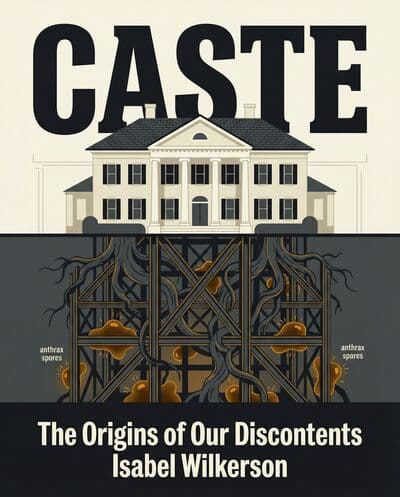
Caste: The Origins of Our Discontents
by Isabel Wilkerson
Think about the last time you walked into an old house. On the surface, the paint might look fresh, and the crown molding might catch your eye. But if you walk into the basement, you might notice a hairline crack in the foundation or a slight tilt to the floorboards. You weren't the one who built this house. You weren't there when the joists were laid or the cement was poured. Yet, here you are, living in it. You are the one who has to deal with the flickering lights and the drafty windows. More importantly, you are the one responsible for making sure the whole thing doesn't come crashing down on your head. Our society is that house. We often talk about our social frictions in terms of 'race,' but that’s just the paint on the walls. Beneath the surface lies a hidden architecture—a rigid skeleton that determines who gets to sit in the front row and who is relegated to the wings. Have you ever wondered why certain tensions seem to bubble up out of nowhere, like a ghost in the machine? To understand why our world feels the way it does, we have to look past the skin and into the bones. We have to understand the invisible power of caste.
In Brief
Isabel Wilkerson argues that America operates on a hidden caste system that goes deeper than race. By comparing the U.S. to India's caste hierarchy and Nazi Germany, she reveals how eight structural pillars—from divine will to dehumanization—maintain social ranking and damage everyone, including those at the top.
Key Ideas
Sacred Belief Systems Sustain Caste Hierarchies
Every caste system is supported by a specific infrastructure of belief including divine will, heritability, endogamy, and systematic dehumanization.
Hierarchy Stress Damages Health and Lifespans
The stress of maintaining or resisting social hierarchy causes physical 'weathering,' shortening life spans and damaging the health of the entire nation.
Threatened Dominance Fuels Deaths of Despair
Members of the upper caste often experience the progress of marginalized groups as an existential demotion, leading to 'deaths of despair' and self-sabotaging political choices.
Caste Creates Psychological Prison for Both
Caste creates a delusional group identity for the top and a survival-based psychological dependency at the bottom, trapping both in unearned roles.
Nazi Germany and Caste Share Origins
Nazi Germany and the Indian caste system share a direct, often academic, lineage with American racial laws, proving the universality of human ranking systems.
Who Should Read This
Social justice educators, policy makers working on systemic inequality, sociology students, and readers seeking a structural framework for understanding racial tension that goes beyond individual prejudice
Summary
Introduction
Think about the last time you walked into an old house. On the surface, the paint might look fresh, and the crown molding might catch your eye. But if you walk into the basement, you might notice a hairline crack in the foundation or a slight tilt to the floorboards. You weren't the one who built this house. You weren't there when the joists were laid or the cement was poured. Yet, here you are, living in it. You are the one who has to deal with the flickering lights and the drafty windows. More importantly, you are the one responsible for making sure the whole thing doesn't come crashing down on your head. Our society is that house. We often talk about our social frictions in terms of 'race,' but that’s just the paint on the walls. Beneath the surface lies a hidden architecture—a rigid skeleton that determines who gets to sit in the front row and who is relegated to the wings. Have you ever wondered why certain tensions seem to bubble up out of nowhere, like a ghost in the machine? To understand why our world feels the way it does, we have to look past the skin and into the bones. We have to understand the invisible power of caste.
The Old House: Understanding the Infrastructure of Caste
Imagine a world where a heatwave in a remote forest doesn't just melt ice, but wakes up a monster. That actually happened in Siberia recently. The permafrost thawed, and as it did, it released anthrax spores from a reindeer that had been dead for seventy-five years. The pathogen wasn't new; it was just waiting for the right environment to become lethal again. Most people think of our social divisions as something we've outgrown, but they are more like those dormant spores. When the political climate shifts, ancient hatreds we thought were buried deep in the soil suddenly find their way back into the air we breathe.
So why does this matter to you? Because we often confuse race with caste. Think of it like this: race is the primary color of your skin, the 'front' that the world sees first. But caste is the internal infrastructure. It is the grammar of our social lives—the wordless rules that tell us where we belong before we even open our mouths. If you've ever felt a strange tension in a room when someone 'out of place' walks in, you’ve felt the invisible hand of caste at work. It’s like a 'wordless usher' in a dark theater, using a tiny flashlight to guide people to seats they didn't realize were pre-assigned.
We like to think of ourselves as individuals, but we've all been born into a container. Centuries ago, people who were just 'English' or 'German' or 'Igbo' arrived on these shores and were suddenly rebranded as 'White' or 'Black.' This wasn't a biological discovery; it was an engineering project. It was a way to decide who would hold the tools and who would be the tools. Like the owners of that old house we mentioned, we have inherited a structural problem. You might not have personally laid the cracked foundation, but ignoring the bulge in the ceiling won't make the roof any lighter.
Learning to see the house for what it is—seeing the infrared light on the hidden cracks—is the first step toward repair. But what exactly are these cracks made of? To understand that, we have to look at the eight foundational pillars that keep the whole ceiling from falling. These are the rules of the game that no one ever taught you, but everyone seems to know by heart. Let's look at how they were built.
The Eight Pillars: The Foundations of Exclusion
Every great structure needs pillars to hold it up. In a caste system, these pillars aren't made of stone; they're made of beliefs so deep we mistake them for the laws of nature. The first pillar is Divine Will. Imagine being told that God Himself designed your place in line. In India, stories tell of humans being created from different parts of a deity’s body—some from the head, some from the feet. In the West, people twisted the story of Noah’s son to claim that certain lineages were born to be servants. It’s the ultimate 'hail mary' of social control: if God said it, who are you to argue?
Then there is Heritability. This is the idea that your status is a permanent birthmark. Unlike class, which is a ladder you can climb with a better job or a lucky break, caste is a floor you are stuck on. You can be a world-famous athlete or a brilliant surgeon, but the system still sees your caste profile first. It's the reason why a wealthy Black man can still be stopped and questioned in his own neighborhood. The system cares about the 'container' you were born in, not the contents of your character.
But how do you keep the castes from mixing? You use the pillar of Endogamy. This is just a fancy word for controlling who people love and marry. By banning 'mixing' for centuries, systems in the U.S. and India artificially created the very biological differences they claimed were there all along. It’s a way to make sure empathy doesn't bridge the gap. If you can't marry into 'the other side,' they stay 'other' forever. This is often policed through the fourth pillar: Purity versus Pollution. Have you ever seen a video of a white person getting angry because a Black person is using a 'neighborhood' pool? That’s not just a disagreement; it’s an ancient fear of 'taint.' In the past, even a shadow falling on the wrong person was seen as a spiritual stain.
Finally, the system is glued together by Dehumanization and Terror. To keep a sentient human being in a subordinate place, you have to first convince the rest of the world they aren't fully human. You mock their features, use 'scientific' data to prove they feel less pain, and then you use arbitrary cruelty to remind them who is in charge. It’s a performance of power that relies on the lowest group being a 'mudsill'—the piece of wood touching the dirt that bears the weight of the entire house. But here’s the kicker: this blueprint isn't unique to us. It’s been used across the globe with terrifying precision.
The Global Blueprint: Comparative Oppression
If you saw a set of blueprints for a bridge in New York and another for a bridge in Mumbai, you’d expect the engineering to look similar because gravity works the same way everywhere. Caste is the gravity of social hierarchy. When we look at the American South, the Indian varna system, and Nazi Germany, we aren't just looking at three different stories. We are looking at the same operating system running on different hardware.
Here’s a fact that might stop you in your tracks: in 1934, when Nazi lawyers were trying to figure out how to segregate Jewish people, they didn't just guess. They held a meeting to study the United States. They actually researched American Jim Crow laws as a model for their own Nuremberg Laws. They admired how Americans had successfully used the law to create a hierarchy out of thin air. In fact, some Nazi 'moderates' found American laws—like the 'one-drop rule'—to be too extreme, even for them. Let that sink in for a moment. The Third Reich looked at American racial policy and thought, 'This might be a bit too harsh for us.'
This shows us that caste isn't a localized glitch; it's a universal human pathogen. In India, the 'Dalits' were forced into roles as scavengers and laborers, roles they were told they deserved because of past-life sins. In America, the roles were different, but the psychological result was the same. In both places, the system tries to convince the people at the bottom that their misery is their own fault, or at least their inevitable destiny.
But wait, you might ask, why does this still happen if we know it's illogical? Because humans are wired to protect their status. Even when the system is clearly broken, those who feel they are 'on top' will fight to keep their spot, even if that spot is on a sinking ship. This leads to a strange kind of collective madness where people will actually vote against their own health and safety just to make sure they stay one rung above someone else. That’s the 'mudsill' theory in action, and it has a very real biological cost.
Status Threat and the Scapegoat
Imagine you’re waiting in a long, slow-moving line. You’ve been there for hours. Suddenly, you see someone cut in front of you. You’d be furious, right? Now, imagine that the person didn't actually cut in—the person was simply told they could finally enter the building through a different door. For those who have been waiting in the 'dominant' line, seeing someone else move forward feels like a personal demotion. This is 'Status Threat.'
In our society, whenever a group that has historically been at the bottom makes progress, the group at the top feels an existential panic. It’s what psychologists call 'collective narcissism.' When we see a Black president or a woman in a high-power role, for some, it feels like the natural order of the universe has been violated. This is why we see 'deaths of despair'—rising rates of suicide and addiction—among people who feel they are losing their unearned status. They would rather die of a terminal illness than support a healthcare system that might also help a 'welfare queen' or an immigrant. It is the definition of cutting off your nose to spite your face.
But it’s not just the top that is impacted. People at the bottom often develop what you could call 'subordinate Stockholm Syndrome.' To survive, you have to become an expert in the moods and whims of the people in power. You learn to smile through slights and swallow your anger because your safety depends on it. You might even start to believe some of the lies the system tells you about your own worth. It’s a psychological cage that traps everyone. The person at the top has to stay hyper-vigilant to keep their crown, and the person at the bottom has to stay hyper-vigilant to avoid the lash. No one is truly free in a house built on such tension. And as we’ll see next, your body knows it before your mind does.
The Biological Toll: The Body's Response to Caste
Have you ever felt your heart race when you see blue lights in your rearview mirror, even if you weren't speeding? Now imagine that feeling—that shot of cortisol and adrenaline—lasting for your entire life. Scientists call this 'weathering.' Just like a house on the coast gets battered by salt and wind until the wood rot sets in, the human body gets battered by the constant stress of being viewed as less than.
This isn't just a metaphor. When researchers look at the DNA of people in subordinate castes, they see that their 'telomeres'—the protective caps on the ends of our chromosomes—are shorter. They are literally aging faster on a cellular level because of the social environment they have to navigate. It’s why a healthy immigrant from Nigeria can move to the U. S. and, within one generation, develop high blood pressure that wasn't previously in his family tree. It’s not the genes; it’s the caste friction.
But here’s the surprising part: the toxin of caste affects the dominant group, too. The U.S. has lower life expectancy and higher infant mortality than almost any other wealthy nation. Why? Because we are so busy fighting over who deserves help that we refuse to build the social safety nets that would save us all. We are so afraid of 'polluting' the hierarchy that we’d rather auction off a Nobel Prize to pay for medical bills than have a system that treats everyone like a human being. Caste is a biological toxin that we are all drinking, and it’s making the entire nation sick. So how do we stop the poisoning? It starts with something much deeper than politics.
Radical Empathy and Radical Resistance
So, how do we begin to tear down these invisible walls? It starts with something called Radical Empathy. Now, this isn't just 'feeling' for someone. It’s the hard, intellectual work of trying to understand the world from a perspective you weren't born into. It’s like being a high-status person and realizing that the 'crown' you’re wearing is actually a heavy, poisonous mask that keeps you from seeing your own humanity.
Think about Albert Einstein. We know him as a genius of physics, but he was also a genius of empathy. When the great opera singer Marian Anderson was denied a hotel room in Princeton because of her race, Einstein didn't just send a polite letter. He invited her into his own home. He used his status to shield her from the ritual humiliations of the American caste system. He understood that his own freedom was tied up in her dignity.
I once heard a story about a high-caste man in India who compared his inherited status to a 'poisonous snake' he had been carrying around. He realized that to truly live, he had to shed that skin. He had to give up the unearned privilege of being 'superior' to find the joy of being equal. We often think that the dominant group is winning, but there is a profound cost to spending your whole life pretending you are better than your neighbor. It warps your soul.
Resisting caste isn't about guilt; it’s about accountability. It’s about looking at those cracks in the old house and saying, 'I didn't break this, but I am the one who is here now, and I refuse to let it stand.' It means having the courage to have those awkward conversations at the dinner table or the risk of standing up for a colleague in a meeting. It’s about choosing your humanity over your rank. Because once you see the system for the artificial construct it is, you can’t unsee it. And that’s where the real work begins.
The Awakening: Moving Beyond the Infrastructure
Imagine waking up one day and realizing that the walls of the room you've lived in your entire life are actually made of glass. You thought you were in a solid house, but you're actually in a cage—one that you’ve been helping to polish. The epiphany is that the cage only stays strong as long as we all agree to keep our places. The moment we start to walk out of our assigned roles, the infrastructure starts to tremble.
We have to move toward a world where 'merit' isn't just a buzzword used to justify the status quo, but a reality where every person’s essence is allowed to shine without being shoved into a 'container.' This means looking at our domestic policies not as partisan battles, but as structural repairs. Are we building a society that values the life of every resident, or are we still trying to shore up the mudsill?
There is a collective liberation that happens when we dismantle these hierarchies. When we stop wasting the potential of the people at the bottom, we unlock the next generation of scientists, artists, and leaders who can solve the problems we all face. A world without caste isn't just better for the marginalized; it's better for the winners of the old game, too. It’s a world where you don't have to be afraid of 'falling' because there is no 'bottom' to fall into.
The house we’ve inherited is old, and it has deep structural flaws. But we are the owners now. We have the infrared light. We can see where the foundation is crumbling. The question is: do we have the stomach for the renovation? Do we have the courage to build something better, something based on radical empathy rather than inherited rank? The pathogen of the past is out in the air, but we have the power to heal. It’s time to shed the old skin and find our true selves, together.
Notable Quotes
“Caste is the granting or withholding of respect, status, honor, attention, privileges, resources, benefit of the doubt, and human kindness to someone on the basis of their perceived rank or standing in the hierarchy.”
— Isabel Wilkerson, Wilkerson's working definition that distinguishes caste from race or class
“A caste system endures because it is often justified as divine will, originating from sacred text or the presumed laws of nature, reinforced throughout the culture and passed down through the generations.”
— Isabel Wilkerson, On how religious and cultural narratives prop up hierarchies across civilizations
“The most powerful country in the world has handed over a good part of its treasury to its richest citizens while leaving its most vulnerable to fend for themselves.”
— Isabel Wilkerson, On how caste-driven politics leads to policies that harm the majority while protecting the hierarchy
Frequently Asked Questions
- What is the main argument of Caste by Isabel Wilkerson?
- Wilkerson argues that America's racial hierarchy is best understood not as racism but as a caste system—an invisible ranking built on eight structural pillars including divine will, heritability, and endogamy. This framework explains why inequality persists despite legal progress and affects health outcomes for all Americans.
- Is Caste by Isabel Wilkerson worth reading?
- Yes, particularly if you want a structural lens on American inequality rather than an individual one. Wilkerson's comparative approach—linking the U.S. to India and Nazi Germany—is eye-opening. The book is well-researched and narrative-driven, making complex sociology accessible to general readers.
- How does Caste compare America to India and Nazi Germany?
- Wilkerson shows that all three systems use the same structural pillars: divine justification, inherited rank, controlled marriage, purity rules, and dehumanization. Nazi lawyers actually studied American Jim Crow laws when drafting the Nuremberg Laws, finding some American rules too extreme for their own system.
- What are the eight pillars of caste?
- The eight pillars are divine will, heritability, endogamy (controlled marriage), purity versus pollution, occupational hierarchy, dehumanization and stigma, terror and cruelty, and inherent superiority versus inferiority. Together they form the invisible infrastructure that maintains social ranking across generations.
Related Book Summaries


Read the full summary of Caste: The Origins of Our Discontents on InShort