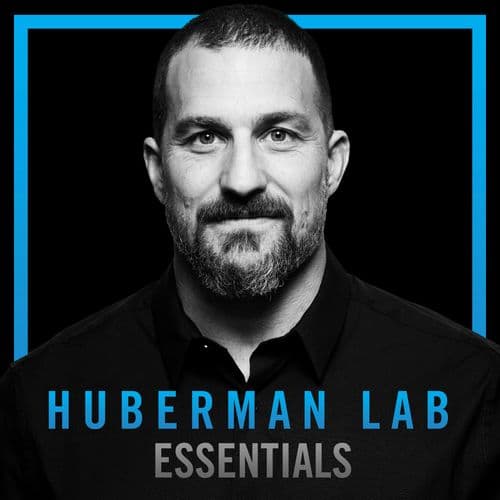
Essentials: Using Light to Optimize Health
Huberman Lab
Hosted by Andrew Huberman
Andrew Huberman explains how UVB light, red light therapy, and nighttime darkness control hormones, immunity, vision, and mood through distinct neural pathways.
In Brief
Huberman maps the distinct neural pathways through which UVB light drives hormones, immunity, and tissue regeneration while nighttime light suppresses dopamine and spikes cortisol. Practical protocols include morning red light for vision, UVB skin exposure for sex hormones, and dim red lighting after 10pm to protect mood.
Key Ideas
UVB exposure increases sex hormones naturally
UVB skin exposure directly raises sex hormones via a documented skin-brain-gonad axis — 20-30 minutes of direct exposure 2-3 times per week with maximum skin uncovered increases testosterone and estrogen, while windows, sunscreen, and clothing block the relevant wavelengths entirely.
Night light exposure suppresses dopamine and mood
Bright light at night suppresses dopamine through a separate neural circuit — melanopsin cells connect to the perihabenular nucleus, and activation between 10pm and 4am truncates dopamine release and spikes cortisol, a neurochemical recipe for depression distinct from melatonin suppression.
Red light therapy restores age-related vision loss
Two minutes of 670nm red light in the morning improved visual acuity by 22% in people over 40 by clearing reactive oxygen species from retinal mitochondria — the exposure must occur within the first 3 hours of waking to produce the effect.
Melatonin pills damage reproductive hormone production
Commercial melatonin suppresses reproductive hormones at supraphysiological doses — it reduces testicle volume, sperm production, testosterone, and egg maturation, making light behavior the correct upstream regulator rather than pills.
UVB exposure primes immune system readiness
UVB light in the eyes primes the immune system by activating a sympathetic nervous system pathway to the spleen, deploying killer T-cells and cytokines into a more ready stance — fewer summer colds reflect better immune readiness, not fewer pathogens.
Summary
Light Controls Far More Than Sleep
Sunlight does far more than warm you up. A cascade of light-activated biological pathways — running from skin to brain to gonads to spleen — controls testosterone, estrogen, immune deployment, pain tolerance, and even the rate at which your retinal neurons age. Most people are blocking these pathways without knowing it: through windows, sunscreen, sunglasses, and bright artificial light after dark.
- UVB hitting your skin directly raises testosterone and estrogen via a documented skin-brain-gonad axis — sunscreen and windows block the relevant wavelengths entirely
- Bright light between 10pm and 4am activates a perihabenular nucleus pathway that suppresses dopamine output and spikes cortisol — a neurochemical recipe for depression
- 2-3 minutes of 670nm red light in the morning produced a 22% improvement in visual acuity in people over 40 by clearing reactive oxygen species from retinal photoreceptors
- Commercial melatonin is supraphysiological and suppresses testosterone, sperm production, and egg maturation — the correct regulator is light behavior, not pills
UVB Skin Exposure and Sex Hormones
UVB light hitting your skin — not your eyes — directly raises testosterone and estrogen. Huberman walks through a Cell Reports study titled "Skin Exposure to UVB Light Induces a Skin-Brain-Gonad Axis and Sexual Behavior" that makes this mechanistically explicit. In both mice and human subjects, sufficient UVB exposure to the skin triggered measurable increases in testosterone and estrogen within brief exposure windows, with the proper sex-specific ratios maintained in both males and females.
In mice, the effects went further: gonadal weight increased past a certain UVB threshold. Female subjects showed enhanced follicle maturation. Human subjects reported increases in passionate feelings and changes in how they perceived others.
The mechanism runs through melanocytes and keratinocytes in the epidermis, which absorb UVB and trigger a neuroendocrine cascade upstream of the gonads. Windows filter out UVB entirely. So does sunscreen on the exposed areas. So do long sleeves.
The protocol Huberman recommends: 20-30 minutes of direct UVB exposure to as much skin surface as feasible, 2-3 times per week minimum. A fully clothed body with only hands and face exposed will produce dramatically different hormonal signaling than arms and legs uncovered.
Nighttime Light and Dopamine Suppression
There's a neural circuit in the eye that bypasses the circadian clock entirely. Melanopsin cells in the retina connect directly to the perihabenular nucleus — a structure dedicated to regulating dopamine, serotonin, and endogenous opioid output. When this pathway fires at the wrong time of day, dopamine goes down. Mood goes down with it.
Activate this pathway between 10pm and 4am — which any sufficiently bright light can do, not just UVB — and you truncate dopamine release. This is distinct from melatonin suppression. It's a separate, faster, mood-specific circuit.
There's a cortisol angle too. Bright artificial light at night pushes cortisol release later into the evening. Cortisol at 9pm or 10pm is well-documented as a marker of depression and mental illness.
The practical fix is positioning and color. Melanopsin cells sit in the lower half of the eye and scan the upper visual field — meaning overhead lights are the worst offenders. Dimming lights and moving them below eye level in the evening reduces perihabenular activation. After 10pm, switching to dim red-only sources protects both melatonin and the dopamine pathway simultaneously.
Red Light Therapy for Vision
Retinal photoreceptors are the most metabolically active cells in the entire body. That metabolic intensity means they accumulate reactive oxygen species faster than almost any other tissue. As ROS rises, ATP production in the mitochondria drops, and cell function degrades. Once retinal neurons die, they do not regenerate.
Dr. Glenn Jeffrey at University College London ran two human studies exposing subjects to 670nm red light at approximately one foot of distance for 2-3 minutes per day. In subjects aged 40-72, the Jeffrey lab measured a 22% improvement in visual acuity using the Tritan exam. Subjects under 40 showed no improvement — their mitochondria weren't yet compromised enough to benefit.
Critical timing detail: the exposure had to occur within the first 3 hours of waking to produce the effect. Later in the day, it didn't work. And a standard red light skin panel is too bright for safe eye exposure — the correct source is a low-intensity 670nm device at a comfortable, non-squinting distance.
Melatonin Supplements Are a Hormonal Intervention
Melatonin is not primarily a sleep hormone. It's a seasonal calendar — a biological signal that encodes day length across the 365-day year and tells every cell in the body where it sits in that cycle.
What isn't normal is the dose in most supplements. Commercial melatonin is supraphysiological — far above what the pineal gland ever naturally produces. High melatonin reduces testicle volume, suppresses sperm production, suppresses testosterone, and inhibits egg maturation in the ovaries. For pregnant women, melatonin is a powerful modulator of placental development.
The right way to manage melatonin is upstream: get UVB light in your eyes during the day to suppress daytime melatonin, and avoid bright light at night to protect the natural nocturnal rise.
UVB Primes Your Immune System
Fewer colds in summer isn't about pathogen seasonality. It's about immune readiness. UVB light arriving in the eyes activates the sympathetic nervous system, which connects directly to the spleen. The spleen then deploys immune cells and molecules — killer T-cells, B cells, cytokines — into a more ready, forward-deployed stance.
Skin exposure adds another layer: UVB hitting the epidermis rapidly increases output of corticotropin hormone and beta-endorphins — endogenous opioids that reduce pain perception. Pain tolerance measurably increases during longer-day conditions.
In winter, a SAD lamp or LED panel positioned at a workstation throughout the day provides compensation through the sympathetic pathway, keeping the spleen primed before cold and flu season hits.
Light Drives Hair, Skin, and Nail Growth
A study published in the Proceedings of the National Academy of Sciences documented that melanopsin ganglion cells in the eye are required to trigger stem cell turnover in skin, hair follicles, and nails. The mechanism is neurally mediated — eye exposure to UVB activates a cascade that reaches the stem cell niches within the dermis.
Blocking UVB from reaching the eyes — through sunglasses, windows, or blue-blocking lenses worn during daylight — interrupts this upstream signal regardless of what else you do for skin and hair topically. For anyone investing in skin quality or hair thickness, daily UVB eye exposure without sunglasses during daylight hours is the foundational intervention.
Red Light at Night Is Safe If Dim Enough
Shift workers, new parents, and anyone who needs to function between 10pm and 4am face a genuine physiological problem. Sufficiently dim red light does not suppress melatonin and does not trigger the late-shifted cortisol release associated with depression.
The protocol is simple: replace any overhead white or blue-spectrum bulbs in spaces where you need light after 10pm with dim red bulbs. Brightness target: as dim as you can while still performing necessary tasks. This is clinical harm reduction for the dopamine system.
Frequently Asked Questions
- How does sunlight affect testosterone and estrogen levels?
- UVB light hitting your skin triggers a skin-brain-gonad axis that directly raises testosterone and estrogen. The mechanism runs through melanocytes and keratinocytes in the epidermis. Windows, sunscreen, and clothing block UVB entirely, so 20-30 minutes of direct skin exposure 2-3 times per week with arms and legs uncovered is the recommended protocol.
- Can red light therapy improve eyesight?
- Yes, for people over 40. Dr. Glenn Jeffrey's studies showed that 2-3 minutes of 670nm red light within the first 3 hours of waking produced a 22% improvement in visual acuity by boosting mitochondrial ATP production and clearing reactive oxygen species in retinal photoreceptors. Standard skin panels are too bright — a dedicated low-intensity source is required.
- Why is melatonin supplementation potentially harmful?
- Commercial melatonin doses are supraphysiological — far above what the pineal gland naturally produces. High melatonin reduces testicle volume, suppresses sperm production and testosterone, inhibits egg maturation, and modulates placental development in pregnant women. The correct approach is managing melatonin through light behavior: UVB during the day, darkness at night.
- How does light at night cause depression?
- Bright light between 10pm and 4am activates melanopsin cells that connect to the perihabenular nucleus, a structure that regulates dopamine, serotonin, and endogenous opioids. This truncates dopamine release and pushes cortisol later into the evening. The fix is dimming lights, positioning them below eye level, and switching to dim red sources after 10pm.
Related Episodes
Best Tools for Gut Health & Weight Loss | Dr. Chris Thompson
Huberman Lab
Sep 21, 2026Essentials: How to Assess & Improve All Aspects of Your Fitness | Dr. Andy Galpin
Huberman Lab
Sep 17, 2026The Art of True Happiness | Dr. Arthur Brooks
Huberman Lab
Sep 14, 2026Read the full summary of Essentials: Using Light to Optimize Health on InShort