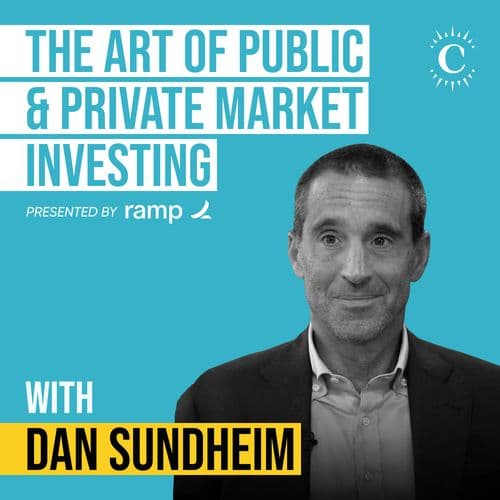
Dan Sundheim - The Art of Public and Private Market Investing
Invest Like the Best
Hosted by Patrick O'Shaughnessy · with Dan Sundheim
Dan Sundheim of D1 Capital explains why he backed Anthropic based on founder writing quality, how LLM moats work like Spotify not Netflix, and why Taiwan semiconductors are the one tail risk that could trigger a depression.
In Brief
Dan Sundheim of D1 Capital reveals that Anthropic's investment thesis was based on Dario Amodei's writing quality rather than model benchmarks, explains why LLM moats depend on Spotify-style personalization rather than having the best model, and warns that Taiwan's semiconductor concentration is the one tail risk that could trigger a global depression.
Key Ideas
Writing excellence signals founder quality reliably
Dario Amodei's writing quality was the entire Anthropic investment thesis — Sundheim recognized the same signal he missed in Bezos's 1997 shareholder letter, concluding that long-form writing is the highest-resolution signal for founder quality, not pitch decks or model benchmarks.
Behavioral data moats beat AI models
LLM moats are Spotify-style personalization, not Netflix-style content differentiation — the winning company will be the one that accumulates the deepest behavioral history on users, making switching costs real even when the underlying intelligence is commoditized.
Growth peaks before hyperscaler insourcing begins
Hyperscalers will post their best growth numbers right before their business model structurally deteriorates — AI is concentrating their customer base into a few LLM companies that will insource compute once cash-flow positive, just as Meta already has.
Taiwan chip concentration risks global stability
Taiwan semiconductors are the one macro risk that could trigger a depression-scale economic event — over 90% of advanced chips come from one island, and there is no scenario where China, Taiwan, and the US are all satisfied with the outcome.
Long-term fundamental investing lacks competition
Markets are less efficient than ever for investors willing to hold a two-year view — capital has rotated to passive vehicles and short-cycle quant strategies, leaving fundamental long-term analysis with a historically thin competitive set, especially in AI-disrupted software.
Summary
Where Edge Actually Comes From
Dan Sundheim runs one of the most unusual books in finance — major stakes in SpaceX, OpenAI, and Anthropic alongside a global public equity portfolio that doesn't cluster in consensus names. What emerges from this conversation isn't a market outlook. It's a coherent theory of where edge actually comes from, why markets are getting less efficient rather than more, and what the AI wave will break before it builds.
- The clearest early signal for Anthropic wasn't the model benchmarks — it was that Dario Amodei writes like Jeff Bezos
- LLM moats won't come from having the best model at any moment; they'll come from knowing you better than you know yourself
- Hyperscalers look great right now — and that's precisely when their structural deterioration begins
- Taiwan semiconductors are the one tail risk that could produce a depression-scale economic event, and there's no scenario where everyone comes out satisfied
Dario Amodei Writes Like Bezos
The S-curve of a model's capabilities meant almost nothing to Sundheim when he backed Anthropic. What mattered was a sentence pattern.
"The only telltale sign" for Amazon, he says looking back, was Bezos' 1997 shareholder letter — the precision of thought, the clear architecture of value creation. Sundheim missed it at the time. He wasn't going to miss the same signal twice. When he encountered Dario Amodei's essays, the recognition was immediate.
What he was looking for wasn't product differentiation — it was cognitive architecture made legible. Amodei, he concluded, "did that better than almost any CEO I've seen since Bezos." The implication: investors who wait for model benchmarks to diverge are looking at the wrong dashboard. Early-stage AI bets are founder bets, and the highest-resolution signal is long-form writing — not a pitch deck, not a demo, not a reference call.
The LLM Moat Is Spotify, Not Netflix
Twenty billion in revenue doesn't settle the business model debate. The real question is whether these companies can build a moat that survives the moment when every frontier lab has a roughly equivalent model.
Sundheim's framework: LLMs are Netflix in capital structure — massive upfront spend on training, then sold at high incremental margins. But Netflix's content was differentiated. The models aren't. That's where Spotify enters. The music on Spotify is identical to what Apple Music serves. Yet users would be "incredibly upset" if forced to switch — because Spotify has personalized the commodity into something that feels irreplaceable.
The winning LLM company won't be the one topping the next benchmark release. It will be the one that has accumulated the deepest behavioral history on the most users — making switching costs real even when the underlying intelligence is commoditized.
Hyperscalers Will Peak Before They Break
"I am more confident in the thesis that the hyperscalers are a worse business model going forward," Sundheim says — then immediately flags the trap: growth won't slow and margins won't contract. He thinks you'll see the opposite.
AWS and Azure built their dominance on fragmented customer bases — every corporation in the world, none big enough to negotiate hard or insource. AI is unwinding both. The new customer base is four or five LLM companies growing at enormous pace, currently treating the cloud as a financing mechanism. Once they're cash-flow positive — which Sundheim thinks happens in the next five to ten years — insourcing becomes the obvious call. Meta already insourced all their compute.
So the growth accelerates, the customer base concentrates, and then the largest customers leave. Investors extrapolating three-year revenue trends into a terminal value are pricing the best part of the story as if it's permanent.
Taiwan Is the Only Macro Risk That Matters
"We are on a collision course with China over semiconductors." Sundheim doesn't hedge this.
Taiwan produces over 90% of the world's most advanced semiconductors. "It's almost as if you went back 50 years, if there's only one country that produced oil" — except oil existed on multiple continents and still triggered wars. The semiconductor supply chain is more concentrated, more fragile, and more central to AI than oil was to the industrial economy.
His geopolitical read: Xi treats Taiwan the way Putin treated Soviet reconstitution — publicly, religiously, and with apparent sincerity. AI raises the stakes further because the semiconductor advantage IS the AI advantage. The escape path — the US replicates the supply chain over 10-20 years while negotiating a face-saving path for China — requires coordination across adversaries with misaligned timelines. "There is no scenario I can think of where everybody's happy."
Markets Are Less Efficient Than Ever
Short books have been graveyards for the last five years. Sundheim thinks that's ending — and the opportunity set is larger than it's been in a generation.
The capital base has rotated from fundamental long-short funds toward passive vehicles, retail flow, and short-cycle quant strategies. "Once you go beyond any kind of short term event and you start to think about what is a business worth? What are the long term cash flows? That's when the competitive set gets pretty thin."
The specific opportunity right now is software. AI will force enormous investment costs and margin compression — the same way Walmart absorbed e-commerce. The ones with genuine systems-of-record positions survive. The rest reprice. Short-term moves exaggerate the true change in intrinsic value, which creates the entry point for investors with a two-to-three year horizon.
Focus Beats Breadth in AI
"I rarely have seen any company succeed trying to go after multiple end markets at the same time." Even Amazon spent seven years building its consumer business before touching enterprise.
OpenAI is running the opposite playbook: hardware, robotics, enterprise, consumer, science, simultaneously. Anthropic went the other direction — pure enterprise, deep coding focus — and has "taken a market leading position." The market spent a year treating Anthropic as Lyft to OpenAI's Uber. That sentiment has inverted.
For investors, the implication is practical: discount multi-vertical ambition and reward demonstrated depth in a single market until proven otherwise.
How D1 Survived Its Worst Drawdown
June 2022. The drawdown was at its worst. Sundheim's message to LPs wasn't "we'll recover" — it was a concrete change in operating doctrine. "We're going to hit singles and doubles. It might take us longer to get back to the high watermark because singles and doubles are not fireworks."
What made it land wasn't the performance forecast. It was the specificity of the commitment — a different risk framework, visibly applied, before the results showed up. The turnaround wasn't announced. It was begun.
Intelligence Stops Being a Human Monopoly
Sundheim's most unsettling observation is anthropological. Humans have always been the most intelligent beings on the planet — that's been the foundational assumption of every economic and political system ever built. That assumption is expiring. The frameworks that work for evaluating companies, picking founders, and shorting inflated software all assume human judgment is the scarce resource. The next decade tests whether that assumption can be updated fast enough to stay useful.
Frequently Asked Questions
- Why did Dan Sundheim invest in Anthropic?
- Sundheim recognized in Dario Amodei's long-form writing the same signal he missed in Jeff Bezos's 1997 shareholder letter — precision of thought and clear architecture of value creation. The models weren't differentiated at the time, but Amodei's cognitive architecture made legible through writing was the highest-resolution founder signal Sundheim had seen since Bezos.
- How will LLM companies build lasting moats?
- Not through having the best model at any moment — expertise and innovation disseminate quickly. The real moat is Spotify-style personalization: the more a model knows about your life, health, and preferences, the stickier it becomes. The winning LLM company will accumulate the deepest behavioral history on users, making switching costs real even when the underlying intelligence is commoditized.
- Why does Sundheim think hyperscalers are a worse business going forward?
- AI is concentrating their customer base from millions of companies into four or five LLM companies growing at enormous pace. These companies currently treat the cloud as a financing mechanism, but once cash-flow positive, they'll insource compute — just as Meta already has. The growth accelerates, the customer base concentrates, and then the largest customers leave.
- What is the Taiwan semiconductor risk?
- Taiwan produces over 90% of the world's most advanced semiconductors. If that supply chain were disrupted, Sundheim says it could trigger a depression-scale economic event. Xi treats Taiwan the way Putin treated Soviet reconstitution, and AI raises the stakes because the semiconductor advantage is the AI advantage. There is no scenario where China, Taiwan, and the US are all satisfied.
Related Episodes

Ray Dalio: Our System Is in Jeopardy - Debt, AI & the Cycle That Destroyed Rome
All-In Podcast
Mar 3, 2026
Advice Line with Alexa Hirschfeld of Paperless Post
How I Built This
Feb 26, 2026
This AI agent completes your To-Do list (plus 4 AI tools that’ll blow you away)
My First Million
Feb 13, 2026Read the full summary of Dan Sundheim - The Art of Public and Private Market Investing on InShort