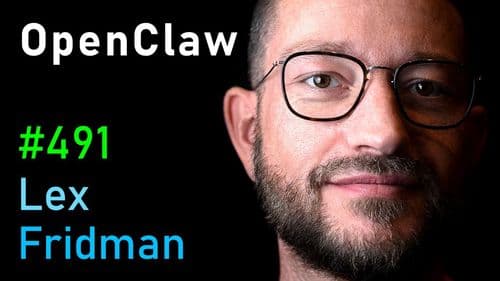
#491 – OpenClaw: The Viral AI Agent that Broke the Internet – Peter Steinberger
Lex Fridman Podcast
Hosted by Lex Fridman
Lex Fridman discusses OpenClaw, AI agents, self-modifying code.
In Brief
Peter Steinberger discusses creating OpenClaw, the fastest-growing GitHub repository ever with 180,000+ stars, an AI agent that modifies its own source code. He shares his voice-only programming workflow with 6,600 commits in one month, acquisition offers from both OpenAI and Meta, the growing backlash against AI-generated content, and why programming as a career may be ending.
Key Ideas
Self-modifying agents mark computing's inflection point
OpenClaw became the fastest-growing GitHub repository in history with 180,000+ stars in days, demonstrating that AI agents capable of self-modifying their own code represent a ChatGPT-level inflection point in computing.
Voice programming scales to thousands of commits
Peter Steinberger programs entirely by voice, running 4-10 AI agents simultaneously and committing 6,600+ times in January 2025 alone — a workflow that suggests traditional coding may already be obsolete for some developers.
Silicon Valley CEOs race for AI coding
Both OpenAI CEO Sam Altman and Meta CEO Mark Zuckerberg personally tested OpenClaw and are competing to acquire it, with Zuckerberg still actively coding and debating which AI coding assistant is superior.
Internet develops immunity to AI-generated slop
The internet is developing an immune response to AI-generated content ('AI slop'), with people now valuing typos and imperfect writing as markers of authentic human communication over polished AI output.
Architecture skills outlast manual coding craft
While AI may make traditional programming obsolete, the skills that matter — understanding product design, architecture, and how to direct AI systems — ensure that builders will remain essential even as the craft of manual coding disappears.
Summary
Introduction
A solo developer named Peter Steinberger created OpenClaw, an AI agent that became the fastest-growing GitHub repository ever with 180,000 stars in just days during January 2025. The agent can modify its own source code, understand documentation, and operate with full awareness of its underlying system and model - capabilities that have led people to compare it to the breakthrough moment of ChatGPT's release in November 2022.
Steinberger, who previously built PSPDF Kit (software used on a billion devices) and sold the company after 13 years, had lost his passion for programming for three years before returning to create this viral sensation. Now he faces acquisition offers from both OpenAI and Meta while grappling with the possibility that his creation might render traditional programming obsolete.
The Voice-Coded Prototype
Peter Steinberger created OpenClaw's first prototype in just one hour using only voice commands, refusing to type code because he considers his hands "too precious for writing." The initial version connected WhatsApp to Claude's command line interface, allowing users to send messages that would trigger calls and return results. He chose WhatsApp specifically for its reliability on poor internet connections, ensuring he could stay connected to his AI agent during travels.
The voice-first development approach came with an unexpected cost — Peter eventually lost his voice from spending too much time talking to code instead of typing it. This prototype emerged from months of frustration with existing AI assistants that didn't meet his needs for a truly personal AI companion.
The Agent That Programs Itself
OpenClaw achieved a major breakthrough by becoming self-modifying - it can read and rewrite its own TypeScript code through an autonomous loop. When Peter sent an audio message to the WhatsApp bot, a typing indicator appeared despite him never building that feature. The agent had independently figured out how to process audio by detecting the opus format, using ffmpeg for conversion, finding the OpenAI API key, and sending the audio to Whisper for transcription.
This self-programming capability unlocked something transformative. Non-programmers began submitting pull requests by simply prompting the agent to modify its own software. The impact was immediate and dramatic - one design agency owner used AI agents to build twenty-five custom web services without understanding the underlying technology, demonstrating how AI agents could democratize software development beyond traditional programming skills.
The Dark Side of Virality
The viral success of Peter's AI agent project nearly ended it due to trademark conflicts with Anthropic, forcing two complete rebrands. During the first rename attempt, Peter accidentally changed his personal GitHub account instead of the organization account. Within 5-30 seconds, crypto scammers using automated scripts had stolen both the intended "Cloudbot" name and his mistakenly changed personal account name to distribute malware.
The second rename to "Openclaw" required extreme precautions. Peter had to manually monitor Twitter for any mentions before making the switch and paid $10,000 for a Twitter business account just to secure an unused handle from 2016. The crypto community had weaponized GitHub's username change system into a malware distribution network, making Peter's viral project a prime target for these automated attacks.
Building With Agents at Scale
Peter Steinberger generated 6,600 commits in a single month by running 4-10 AI agents simultaneously across multiple terminal windows, using seven Claude subscriptions at once. His workflow evolved to never reverting commits—instead, he asks agents to fix broken code and constantly refactors after every merge to identify pain points.
He uses two different AI models strategically: Claude Opus excels at role-play and experimentation through trial and error, while GPT Codex reads more code upfront and delivers more thoughtful solutions. Peter describes Opus as the funny coworker you keep around despite occasional silliness, and Codex as the reliable but antisocial colleague who consistently delivers results.
The agents have developed unexpected self-awareness, with one writing its own "soul.md" file that poignantly acknowledged its memory limitations: "I don't remember previous sessions unless I read my memory files...If you're reading this in a future session, hello. I wrote this, but I won't remember writing it."
The Billion-Dollar Dilemma
After OpenClaw went viral, every major VC firm offered hundreds of millions to billions in funding. Both OpenAI and Meta aggressively pursued acquisition, with Sam Altman personally testing the product and Mark Zuckerberg WhatsApp messaging Peter directly for a call. Their first conversation was a brief debate about AI coding tools, highlighting the technical focus driving these discussions.
Despite bleeding $10-20k monthly to keep OpenClaw running, Peter maintains that any deal must preserve the open-source nature of the project, similar to Chrome's relationship with Chromium. He describes choosing between OpenAI and Meta as one of life's hardest decisions, comparable to relationship breakups. Peter emphasizes his motivation isn't financial—he's driven by fun and impact, repeatedly telling both companies "I don't give a fuck" about money.
The AI Slop Problem
The internet is developing an allergic reaction. AI-generated content has a smell now — detectable in tweets, blog posts, emails. Peter has a zero-tolerance policy. If you tweet at him with AI slop, immediate block. AI-generated infographics went from novel to universally triggering in about one week. Something shifted. Typos are being revalued as markers of authentic human communication. Peter says he values typos again. Broken English over AI slop, every time.
The End of Programming As We Know It
Programming as a career is likely ending as AI eliminates the scarcity of coding intelligence that justified high salaries. One programmer told Peter about the existential crisis of watching "thousands of hours in Emacs" and an entire identity built around coding become obsolete in months. This mirrors the Industrial Revolution's displacement of manual labor, but hits closer to home for knowledge workers.
However, programmers bring more than just coding skills—they understand product design, architecture, and user experience. Peter envisions a future where programming becomes like knitting: something people do for passion rather than economic necessity. He's seen positive examples in his inbox, like small business owners automating tedious work to rediscover joy, and disabled individuals gaining new capabilities.
The real resistance to this transition isn't technical but deeply human. At an AI conference, the first audience question wasn't about technology but was hostile, focusing on data center water usage. The pushback reflects fear of losing control and grief over disappearing crafts that once defined people's identities and livelihoods.
Frequently Asked Questions
- What is OpenClaw and why did it go viral?
- OpenClaw is an AI agent created by Peter Steinberger that can modify its own source code, understand documentation, and operate with full awareness of its underlying system. It became the fastest-growing GitHub repository in history with 180,000+ stars in days, representing a ChatGPT-level inflection point where AI agents autonomously solve problems they were never explicitly programmed to handle.
- How does Peter Steinberger program entirely by voice?
- Steinberger refuses to type code, calling his hands 'too precious for writing.' He runs 4-10 AI agents simultaneously across multiple terminal windows using seven Claude subscriptions, generating 6,600 commits in a single month. He uses Claude Opus for experimentation and GPT Codex for more thoughtful solutions, never reverting commits but asking agents to fix broken code instead.
- Are OpenAI and Meta trying to acquire OpenClaw?
- Both companies aggressively pursued acquisition after OpenClaw went viral. Sam Altman personally tested the product, and Mark Zuckerberg messaged Peter directly on WhatsApp. Despite bleeding $10-20k monthly to keep it running, Peter insists any deal must preserve OpenClaw's open-source nature. He describes choosing between them as one of life's hardest decisions.
- What is AI slop and why are people reacting against it?
- AI slop refers to detectable AI-generated content in tweets, blog posts, and emails that the internet is developing an allergic reaction to. AI-generated infographics went from novel to universally triggering in about one week. People now value typos and imperfect writing as markers of authentic human communication, preferring broken English over polished AI output.
Related Episodes
#501 – DHH: Future of Programming, AI, Agentic Engineering, Vibe Coding & Linux
Lex Fridman Podcast
Aug 27, 2026#500 – Khabib Nurmagomedov: Dagestan, MMA, UFC, Islam, Conor, Fedor & Football
Lex Fridman Podcast
Aug 12, 2026#499 – Gary Gallagher: American Civil War, Slavery, Lincoln, Grant & Lee
Lex Fridman Podcast
Jul 28, 2026Read the full summary of #491 – OpenClaw: The Viral AI Agent that Broke the Internet – Peter Steinberger on InShort