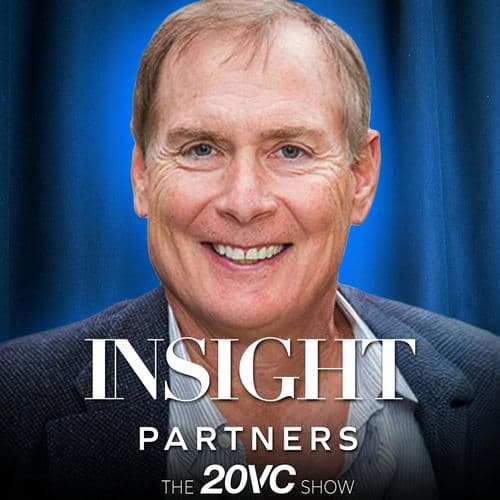
Eight Sleep CEO: How AI Runs the Company | “Our Engineers Stopped Coding a Year Ago”
The Twenty Minute VC
Hosted by Unknown
Eight Sleep's engineers stopped coding a year ago — 160 people now run on AI agents and beat Apple's revenue per employee.
In Brief
Eight Sleep's engineers stopped coding a year ago — 160 people now run on AI agents and beat Apple's revenue per employee.
Key Ideas
AI Agents Replaced Engineering Work
Eight Sleep engineers stopped coding a year ago — AI agents do it all.
Email Revenue Built Without Team
Zero email marketers. Close to $100M in email revenue. Built in 3 days.
CAC Metrics Require Incrementality Testing
Meta's CAC number is at least 20% too low — always run incrementality tests.
Extreme Productivity Beats Apple Output
160 people. Output of 800+. Revenue per employee beats Apple.
AI Makes Human Labor Optional
Kids born now will never work for money — AI makes labor economically optional.
Why does it matter? Eight Sleep is running a company of hundreds inside a headcount of 160
Matteo Franceschetti runs a 160-person company generating more revenue per employee than Apple, operating across 35 countries, with an email team of zero and an engineering team that stopped writing code a year ago. This isn't a roadmap — it's the current operating model.
- Eight Sleep engineers stopped coding a year ago; hundreds of AI agents write the code, primarily using Claude
- A co-founder replaced the entire email marketing function in three days; it now generates close to $100M
- Meta's CAC number is at least 20% lower than the true figure — brands that trust platform dashboards are systematically fooling themselves
- 40% of all revenue still comes from word of mouth, even at multi-hundred-million scale
Eight Sleep's engineers stopped coding a year ago — AI agents do all of it now
Engineers at Eight Sleep haven't written a line of code in twelve months. "What they have is hundreds of AI engineers that code for them," Franceschetti says. The primary tooling: mainly Claude.
This is full displacement of the coding function, not augmentation. Human engineers now manage and direct agents. The output spans 35 countries, each with its own regulatory requirements, run by what Franceschetti calls "a fairly tiny team."
The benchmark he offers: "Our output is 5x what is average in Silicon Valley." Similar companies at Eight Sleep's revenue stage employ thousands of people. Eight Sleep employs 160. "Our revenue per employees is way higher than Apple."
Three-year projection: 250 people making a billion dollars. Not through hiring — through expanding the AI layer while keeping human headcount nearly flat. The job isn't recruiting anymore. It's agent design.
Zero email marketers. Close to $100M in email revenue. The team was replaced in three days.
The entire email marketing function now runs without a single human operator. When the team lead left, co-founder Alexandra spent three days building bots. "Within 3 days she was able to build multiple bots that now run all our email marketing. Now we have a team of zero and email marketing makes close to 100 million."
The system pulls from historical data to determine what to send, when, and to whom — with AI (likely Claude, Franceschetti suggests) generating and scheduling everything in the execution loop.
The distinction matters: this isn't AI changing how people do email marketing. Email marketing is a direct revenue line. It now runs profitably with no one running it.
Any revenue function that is fundamentally workflow-driven and historically repeatable is a full replacement candidate today, not eventually. The audit question shifts from "where can AI help?" to "where can we eliminate the team entirely?"
Meta's CAC number is at least 20% lower than your real CAC — and every platform does this
Platform attribution is structurally inflated. "You cannot trust — there will be an excess of attribution from the same platform. If you look at the CAC on Meta, it's probably 20% lower than what the true CAC is."
Eight Sleep builds its own attribution models and runs geo-based incrementality tests every six months. The method: identify two comparable states, cut spend in one, measure the revenue delta. "If they were both growing 50% year over year and you turn off Meta in one, you can immediately calculate the value of Meta for that state."
The test must repeat continuously. As channels accumulate, each one's incremental contribution shifts. A model accurate six months ago is already stale.
"Oh, 100% — otherwise they just fool themselves."
Growth teams will always want to spend more. Without external attribution discipline, scaling decisions get made from dashboards built by the platform being measured. That's not a data problem — it's a structural conflict of interest.
Eight Sleep counts AI agents as employees — and by that measure it's already 3–4x its official headcount
The real size of Eight Sleep is somewhere between 480 and 640 workers. Only 160 of them are human.
"Probably by now hundreds if not thousands of agents that we use internally at Eight Sleep. Probably the AI employees are — we are probably 3–4x bigger if you start including all our AI employees."
Franceschetti now tracks two headcount figures: human employees and AI employees. Headcount as a proxy for organizational output capacity has broken. The management challenge has shifted from hiring and retaining talent to designing, connecting, and governing agents that function correctly.
Eight Sleep built a dedicated internal AI tools team within the last six months — specifically because the agents need precise access to the data pipeline to operate reliably. This isn't a feature of the engineering org. It's a separate function, and it didn't exist until recently.
China has no e-commerce — Chinese consumers buy through super apps only, making Western DTC playbooks entirely useless
You cannot sell on your website in China. "Chinese don't buy on websites. There is no e-commerce as we know it. They only buy on their super apps — WeChat, Rednote and equivalent."
Franceschetti's analogy: buying everything through WhatsApp. Websites are browsing surfaces. Transactions and credit cards live inside the super apps. Eight Sleep's entire go-to-market had to be rebuilt from scratch — no checkout funnel, no CRM as designed for Western markets, no landing-page-to-purchase flow.
Timing mattered. The launch worked because Eight Sleep already carried global recognition and high-profile athlete associations. Without that brand foundation, a knockoff at $500 less would have won on price. Chinese consumers, Franceschetti learned from local founders, prefer products already validated in the West — enter too early and you're just another option in a commodity price war.
The entry cost to China isn't a marketing budget. It's a platform rebuild and a brand prerequisite.
40% of Eight Sleep's revenue at multi-hundred-million scale still comes from word of mouth — and the share keeps growing
"Word of mouth keeps compounding. We are around 40% of our revenue — even at our size, which is starting to be really big — is 40%."
The marketing budget runs into the hundreds of millions. Meta, Google, TikTok — all of it. And still, almost half of all revenue arrives without spending a dollar on acquisition.
The churn data explains the mechanism: low single-digit yearly churn. The upfront hardware cost locks in commitment. Daily sleep data builds habit. The subscription extends the relationship for years. Customers who own the product stay, and they talk.
Paid CAC starts the flywheel; the product sustains it. If you can't project word of mouth compounding as you scale, paid spend will never become efficient — because the product quality and retention that earns organic growth aren't there. Brand awareness is the bottleneck Franceschetti would fix if economics weren't a constraint. The product already does the rest.
Children born today will never work for money — AI makes human labor economically unnecessary within 20 years
"Kids that are being born now will never work. At least for money."
Franceschetti's timeline: by the time a child born today turns 20, AI will have made human labor economically optional. "I think AI will be at a point where humans don't work. They will do activities, social activities, even to help other humans. But what will we do then? This is what we need to discover."
His framework for what fills the gap: health at the base, relationship above it, purpose at the top. Work has historically delivered all three. If it stops being economically necessary, the design brief for institutions, education, and consumer products changes entirely — not in the future, but for products and infrastructure being built right now.
Treating an Anthropic offer and an Eight Sleep offer as comparable options is a disqualifier — not a yellow flag
Comparing a frontier AI lab to a hardware startup isn't a negotiation tactic. It's a confession.
"Sometimes people say, 'Oh, I'm at the final stage with Anthropic and Eight Sleep.' To me, that is a really bad red flag. Not even for the salary — it means you're confused. There is no way that these two jobs are any way similar. Man, get your shit together."
The issue isn't comp. It's identity. Startup work and large-company work demand different psychology — different tolerance for chaos, different relationships with ambiguity, different definitions of a good day. A candidate who sees them as interchangeable hasn't figured out which type they are. That confusion doesn't resolve once they're hired. It surfaces as misaligned expectations, low output under pressure, and eventual churn.
The efficiency gap between AI-as-infrastructure and AI-as-feature is already compounding
The operating model described in this conversation — agents replacing engineers, zero-headcount revenue functions, attribution built in-house rather than read from a dashboard — isn't a pilot program. It's running at scale across 35 countries, generating hundreds of millions, managed by 160 people.
What the episode reveals about where things are heading: companies that deploy AI as organizational infrastructure are already operating in a different productivity category from those treating it as a productivity add-on. That gap compounds with each quarter. The companies on the wrong side of it are still hiring people into roles that no longer need to exist. Most of them don't know it yet.
Topics: AI agents, engineering, email marketing, attribution, CAC, word of mouth, China market, hardware startup, future of work, headcount efficiency, Eight Sleep, subscription business, hiring, growth channels
Frequently Asked Questions
- How did Eight Sleep eliminate manual coding with AI agents?
- Eight Sleep engineers stopped coding a year ago — AI agents do it all. The 160-person team produces output equivalent to 800+ employees by automating engineering tasks through artificial intelligence. Rather than engineers writing code manually, AI agents generate, test, and maintain the entire codebase. This AI-first approach fundamentally transforms software development, enabling the company to scale without proportional increases in headcount. This dramatic shift demonstrates how AI agents can replace entire categories of routine technical work while maintaining or improving code quality and development speed.
- What is Eight Sleep's revenue per employee compared to Apple's?
- Eight Sleep's 160 people produce output equivalent to 800+, and their revenue per employee beats Apple's. This exceptional productivity metric showcases the impact of AI-driven operations on business performance. By deploying AI agents across the entire organization—not just in engineering—Eight Sleep maximizes efficiency and revenue generation per person. The company's ability to compete with industry giants on this crucial financial metric, despite its smaller scale, illustrates how AI fundamentally changes business economics and enables smaller teams to achieve outsized results comparable to much larger enterprises.
- How did Eight Sleep generate $100M in email revenue without email marketers?
- Zero email marketers. Close to $100M in email revenue. Built in 3 days. Eight Sleep achieved this extraordinary result by automating their entire email marketing operation through AI. Rather than hiring specialized email marketing teams, the company deployed AI systems to design, test, and execute campaigns that generated substantial revenue in just three days. This demonstrates how AI can completely eliminate entire functional roles while maintaining or exceeding revenue output. It challenges conventional assumptions about necessary headcount and shows AI's potential to consolidate multiple specialized functions into automated workflows.
- What does the future of work look like according to Eight Sleep's CEO?
- Kids born now will never work for money — AI makes labor economically optional. This prediction suggests a fundamental transformation in human economic activity, where AI automation reduces the economic necessity of traditional employment. As AI agents become increasingly capable of performing complex work across all domains, the traditional employment model may become obsolete. This perspective reflects an emerging trend where AI doesn't merely augment human workers but potentially replaces the economic rationale for human labor entirely, fundamentally reshaping society's relationship with work and compensation.
Related Episodes
How to Build Your Own Data Center & Why Every Startup Should Do It
The Twenty Minute VC
Sep 5, 2026ClickHouse CEO: AI Margins Need to Improve | Revenue Concentration Should be a Concern
The Twenty Minute VC
Aug 31, 2026Should American Enterprises Work With Open-Source Chinese Models? | Only 10% of Neo-labs survive
The Twenty Minute VC
Aug 29, 2026Read the full summary of Eight Sleep CEO: How AI Runs the Company | “Our Engineers Stopped Coding a Year Ago” on InShort