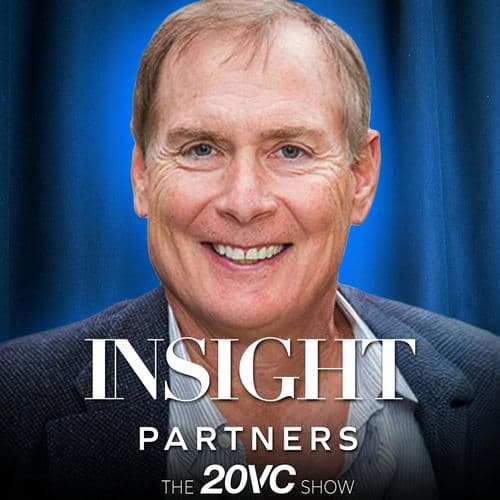
How Hims & Hers Reached a $4.3BN Market Cap on $2.3BN of Revenue | Andrew Dudum
The Twenty Minute VC
Hosted by Unknown
GLP-1 prices crashed 80% in 18 months — and Hims & Hers CEO Andrew Dudum believes his company forced Big Pharma's hand by bypassing it entirely.
In Brief
GLP-1 prices crashed 80% in 18 months — and Hims & Hers CEO Andrew Dudum believes his company forced Big Pharma's hand by bypassing it entirely.
Key Ideas
Hims Crashes GLP-1 Drug Prices
GLP-1 prices dropped 80% in 18 months — Hims claims credit for forcing that change.
Free Blood Tests Enable Health Data Dominance
Hims plans to give away blood panel diagnostics free to build the world's largest preventative health dataset.
Hire Crisis Veterans, Not Pedigreed Strategists
Don't hire pedigreed strategists as you scale — hire builders who've survived company-threatening crises.
Repetition Until Nausea Builds Brands
Brand marketing requires saying the same thing 10 different ways until you're sick of it — then keep going.
Physical Infrastructure Moat Against Tech Rivals
Physical infrastructure plus licensed clinical operations is Hims' moat against OpenAI entering healthcare.
Why does it matter? Because Hims forced the drug of the century 80% cheaper — and that's just the opening move.
GLP-1s went from $2,000 to $149 in 18 months. Hims & Hers claims credit for helping force that collapse by routing patients directly around PBMs and insurers — and Andrew Dudum says the same playbook is coming for every major drug category. This episode reveals a company that most analysts are still mislabeling, built on operating logic most founders never consider:
• The entire US pharmaceutical distribution system is structurally threatened by consumer-direct platforms that cut out the middlemen entirely • Hims plans to hand out comprehensive blood panels — including genetic predisposition markers — for free, betting data is worth more than margin • It's not a weight-loss company: weight loss is "nowhere near the majority" of a dozen independent clinical businesses • Public markets aren't a burden — Dudum thinks they're a better forcing function than staying private, and the biggest companies in history proved it
Hims isn't a telehealth company — it's dismantling the pharmaceutical distribution system
The S&P 500 list price for a GLP-1 drug was $2,000. It's now $149 on Hims. That's not a discount — that's a structural rupture.
Dudum is explicit: "In 18 months, the distribution model has completely changed in pharmaceuticals in the US. Instead of going through PBMs and insurance, they're going straight to customers through platforms like ours at prices everyday people can afford." He frames the 80% price drop on the blockbuster drug of the century as a deliberate campaign — regulatory pressure, consumer pressure, hundreds of thousands of patient voices mobilized to force Novo Nordisk's hand.
The deeper claim is that Hims isn't a DTC brand at all. "I don't think HIMS is a DTOC company. I think HIMS is disrupting how healthcare is delivered in a consumer-focused fashion." The moat isn't brand — it's being the largest global distributor of medicines by volume, with the scale to apply pricing pressure that no individual patient or insurer can. Every other industry — food delivery, banking, retail — runs on on-demand access, price transparency, and consumer choice. Healthcare doesn't. Hims is betting that it will, and that it'll be the platform that captures the shift.
For anyone still modeling Hims as a telehealth play: that framework has already expired.
Free blood panels and genetic risk scores are Hims' Amazon Prime — the loss leader that locks in a lifetime relationship
Hims acquired a home blood collection device last year. Thirty micro-needles, smaller than an eyelash, extract a blood sample painlessly. It costs a couple of dollars to manufacture. The lab panel it enables — 50 biomarkers including genetic predisposition markers — runs Quest or LabCorp between $1,000 and $2,000 cash pay. Hims currently offers it essentially at cost.
That's the setup. Here's the vision: "My goal, my vision is very quickly I want to give that away as a part of the Hims and Hers membership for free."
Dudum tells a story that sharpens the why. A friend in his mid-30s — healthy, running regularly, cholesterol "a bit off" — had never been tested for lipoprotein(a). His number came back at 450. The threshold for serious cardiovascular risk is under 70. Both his father and grandfather died of heart attacks before 60. His cardiologist had run a standard panel and missed it entirely.
That's the case for free diagnostics as a platform strategy: most people have never had the tests that actually matter, and giving them away creates a patient relationship no competitor can easily replicate. "That is the vision, a preventative front door that is near cost or free. And that requires us to spend hundreds of millions of dollars, which we're doing right now to totally verticalize this stuff."
Lab testing will always be priced at cost, deliberately. The margin play is everything downstream.
Hims has a dozen businesses inside it — and the market keeps mistaking whichever one is loudest for the whole company
36 months after launch, Hims was the ED company. Then it was the hair loss company. Then HERS would never work. Then it became a weight-loss company. Dudum has watched this cycle repeat with every category launch and finds it almost amusing.
"Under the hood is that you have a dozen completely different clinical categories, completely different businesses, each scaling with very solid robust growth." Weight loss is "nowhere near the majority of this business" — and Dudum says it never will be, because Hims keeps expanding into new categories while the existing ones compound.
The internal management model mirrors a venture portfolio. Some bets get starved, some get funded, some get ring-fenced for a year or two of exploration. The analogy Dudum draws is to Revolut running 26 product experiments simultaneously — allocate based on performance, not attachment. His background running Atomic Ventures trained him for exactly this: Hims is "a public shell for innovation in bringing great healthcare to consumers."
The valuation risk running in both directions here is real. Investors who see a GLP-1 play get surprised when compounding revenue appears elsewhere. Investors who miss the weight-loss tailwind entirely undercount the category's contribution during its peak. Neither frame is accurate — and Dudum's portfolio structure is specifically designed to outlast any single headline.
Going public in year three wasn't reckless — the 90-day accountability cycle is a feature, not a punishment
Virtually every public company CEO Harry Stebbings speaks to is miserable in the role. Dudum is the exception, and his reasoning is counterintuitive enough to be worth sitting with.
"I think I might be the only person that believes this, but I think running the company in the public markets is more fun than being private. When you're private, it's so easy to get cozy. The worst case scenario is some VCs that call you and they're stressed out. But in the public markets — it's boot camp. You have to deliver."
Hims went public 36 months after launch. By conventional founder wisdom, that's dangerously early. Dudum's reframe: Google, Facebook, Apple, and Amazon all went public within their first few years. The public market didn't constrain them — it forced discipline that accelerated execution. The 90-day earnings cycle isn't a leash; it's a forcing function for building a genuinely high-performance team.
The two preconditions he'd require before advising other founders to do the same: business predictability and a genuine decade-long orientation. This isn't a liquidity event. It's the beginning. But for founders who meet those criteria, Dudum's argument is that waiting longer is a form of comfortable avoidance — and comfort is the thing that kills category-defining companies.
Pedigreed strategists are the wrong hire at scale — look for people who have survived something existential
The CFO at Hims ran Uber's financials during COVID, when the entire rideshare business disappeared overnight. The chief product officer was at Robinhood during the GameStop short squeeze — genuine, company-threatening chaos with no playbook.
"I seek out grit. I seek out a lot of grit. When you're disrupting an industry, you have to have a team that is used to being uncomfortable and used to getting through it."
Dudum is pointed about the failure mode he's seen in other scaling companies: founders who reach a certain size and decide it's time to "uplevel the talent" by hiring polished, credentialed strategists from big firms. He's made that mistake himself. "I think that is a huge, huge mistake." The DoorDash comparison is instructive — a company at multi-billion dollar scale still operating with startup speed, because Tony Xu never stopped hiring builders.
The discipline required: replace yourself in every function every 12 months with someone equal or better, then move to the next highest-leverage problem. Founders who can't hire people smarter than themselves, Dudum says flatly, will fail. The insecurity that makes young managers avoid that — what's my job if I hired someone better than me? — is precisely the trap that caps company growth.
Brand marketing only works if you're willing to say the same thing until you're sick of it — then keep going
One-off campaigns are a great way to feel good and lose money. Hims has done plenty of subway takeovers in New York — fun, photogenic, and nearly impossible to attribute to actual growth.
The lesson Dudum drew: "Consistency is required." His chief comms officer put the failure mode exactly: early companies get bored of their own message and change it. A founder who said something on a podcast three months ago wants to say something new today. That instinct, compounded across hundreds of touchpoints, destroys brand equity before it can accumulate.
The mechanism Dudum describes is a 10-hit model: you need to reach the same person 10 different times in 10 different ways before the cultural association clicks. Not a campaign — an engine. "Great brands are great because everybody knows why they exist, who their customer is, what value they deliver. And it's because they say the same damn thing in 20 different ways every single week."
The discipline this demands is genuinely uncomfortable — it feels less creative, less dynamic, less exciting than launching something new. That's the point. Brand compound interest accrues to companies willing to be boring about their message for years.
AI's real ROI at Hims is 3-4x creative output and clinical decision support — not the broad transformation story boards keep hearing
Hims deploys roughly $1 billion in marketing spend annually across the brand. Photo shoots, TV commercials, Facebook ads, Google ads — thousands of variations. AI has transformed the creative function not by cutting headcount but by multiplying output: "You have the same team but you're probably delivering three to four times the amount."
The second area with measurable impact is clinical. Hims treats over 10,000 patients per day — Dudum claims it's probably the largest healthcare system in the US by patient volume, and the largest digital health platform globally. At that scale, AI feeding clinical guidance to thousands of doctors making decisions every minute isn't just an efficiency play. "It's also a meaningful improvement in quality because you have essentially an intelligent brain helping standardize care across thousands of doctors."
Everywhere else? Dudum is skeptical. "I think we overexaggerate elsewhere where it has impact." This from a CEO running a company at $2.3B revenue with 2,000 employees who's actively pushing AI into every function. The honest read: creative and clinical workflows are where output multiplication is real and measurable. The rest is mostly board-meeting theater.
The platform nobody can easily copy is made of concrete and licensed pharmacists — not software
What happens when OpenAI decides healthcare is the next frontier? Dudum has thought about it. His answer points to where Hims is actually defensible: a million square feet of pharmacy fulfillment, hundreds of pharmacists, robotic compounding equipment, and doctors licensed in every US state.
Dario Amodei made a version of this argument publicly — the most defensible businesses in the AI era are ones that do something physical, that require actual infrastructure and specialization. Dudum agrees. ChatGPT expanding health engagement is, in his framing, a top-of-funnel gift: more people asking health questions creates more people who need a platform that can actually connect them with a licensed specialist and ship them medication.
The free diagnostics strategy, the verticalized lab infrastructure, the compounding pharmacy network — none of this is replicable by a software company in 18 months. That physical moat is being built deliberately and expensively, right now. The companies that survive the AI transition in healthcare won't be the ones with the best model — they'll be the ones that already built the pipes.
Topics: healthcare disruption, direct-to-consumer health, GLP-1 weight loss drugs, pharmaceutical pricing, brand marketing, talent hiring, AI in healthcare, public vs private companies, preventative health, consumer health platforms
Frequently Asked Questions
- What does the Hims & Hers case study focus on?
- This case study examines how Hims & Hers achieved a $4.3 billion market valuation on $2.3 billion in revenue, primarily through disrupting the GLP-1 market. CEO Andrew Dudum argues that his company forced Big Pharma's hand by bypassing the traditional pharmaceutical distribution system entirely. The presentation highlights how GLP-1 prices dropped 80% in 18 months, with Hims crediting itself for catalyzing this market transformation. The company's strategy combines aggressive pricing disruption with long-term health data infrastructure to build sustainable competitive advantages.
- What is Hims' strategy for building a competitive moat?
- Hims plans to establish its moat through physical infrastructure combined with licensed clinical operations—barriers that protect against tech companies like OpenAI entering healthcare. Beyond this, Hims intends to offer free blood panel diagnostics to build what it believes will become the world's largest preventative health dataset. By distributing diagnostics at no cost, the company aims to accumulate massive amounts of health data while creating customer stickiness and deepening its clinical capabilities, ultimately making it difficult for competitors to replicate both the data asset and operational infrastructure.
- How does Hims' hiring strategy differ as the company scales?
- Don't hire pedigreed strategists as you scale—hire builders who have survived company-threatening crises instead. This approach prioritizes practical experience over prestigious credentials, reflecting the belief that crisis-tested executives bring valuable problem-solving capabilities and organizational resilience. The philosophy suggests that proven crisis management experience provides better preparation for scaling challenges than traditional strategic consulting backgrounds, emphasizing execution capability and adaptability over formal credentials or elite institutional backgrounds.
- What role does brand marketing play in Hims' growth?
- Brand marketing requires saying the same thing 10 different ways until you're sick of it — then keep going. This principle reflects the reality that consistent message repetition, even to the point of internal fatigue, is necessary for brand penetration and market awareness. The strategy acknowledges that what feels repetitive and exhausting to the brand's leadership team is still novel and necessary for external audiences, emphasizing persistence in communication as a critical growth driver for Hims' market expansion.
Related Episodes
Daniel Dines on Why Work Processes Not Models Will Be The Most Valuable Asset in AI
The Twenty Minute VC
Sep 21, 2026How Many Will Actually Get Built & Is Energy AI's BIGGEST Bottleneck? | Positron AI Co-founder
The Twenty Minute VC
Sep 19, 2026Eight Sleep CEO: How AI Runs the Company | “Our Engineers Stopped Coding a Year Ago”
The Twenty Minute VC
Sep 12, 2026Read the full summary of How Hims & Hers Reached a $4.3BN Market Cap on $2.3BN of Revenue | Andrew Dudum on InShort