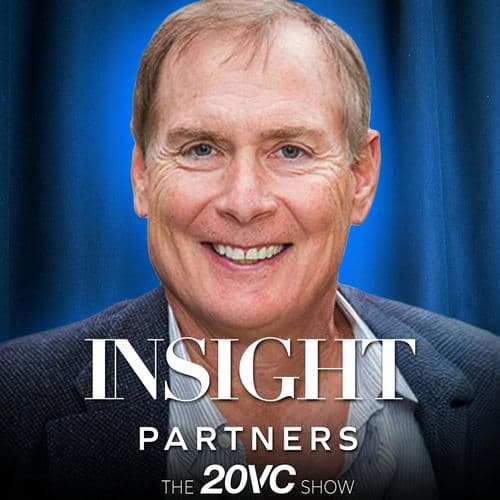
The Most Intense Workplace Culture in America| Corgi Insurance
The Twenty Minute VC
Hosted by Unknown
Sleeping in his office and demanding 7-day workweeks, a $2.5B CEO turns extreme sacrifice into a counterintuitive talent magnet.
In Brief
Sleeping in his office and demanding 7-day workweeks, a $2.5B CEO turns extreme sacrifice into a counterintuitive talent magnet.
Key Ideas
Extreme work culture attracts ambitious talent
7-day workweeks filter for ambition — extreme culture is a recruiting feature, not a bug.
Close deals fast, not expensively
Never take the highest valuation; close in days, not months.
Distribution and sales beat product moats
AI killed the product moat — distribution and sales are now the only edge.
Physical presence builds leadership credibility
Living in the office isn't performance art; symbols build legitimacy from the front.
Retiring workers hold institutional knowledge goldmine
Retiring workers hold trillions in institutional knowledge — the next AI gold rush.
Why does it matter? Because Corgi's extreme culture is a system, not a symptom
Nico runs a $2.5B insurance company from a mattress in his SF office, sleeps 3-4 hours a night, and fields death threats in his DMs without much concern. The extreme isn't the story. The counterintuitive part is why it works: the intensity is a deliberately engineered system — for recruiting, for legitimacy, and for building a team that doesn't need to be managed.
- Demanding 7-day workweeks filters the hiring pool intentionally, toward exactly who you want and away from everyone else
- Sleeping at the office is symbolic leadership — the only thing that gives an extreme culture structural legitimacy
- Business isn't baseball: a home run produces infinite upside, so swinging for the fences is always the optimal call
- Borrowed legitimacy — investor brand names, university credentials — is more transparent than it looks, and the real kind takes longer but compounds harder
The 7-day workweek is a talent filter, not a policy
Most companies soften their culture to broaden the hiring funnel. Corgi deliberately narrows it — and Nico treats the narrowing as the point.
"If your days off happen to be Saturday and Sunday every week, then you will not have a place at Corgi." He says this without apology — a statement about fit, not punishment. The people who recoil were never going to thrive there. The ones who lean in are "particularly young people who want to dream big, who want to do something important with their lives." That's exactly who he's building for.
The filter runs through hiring mechanics too. Corgi uses work trials, often on weekends. Candidates show up, see the office full on Saturday, and immediately understand this isn't theater. Soft skills reveal themselves fast — Nico doesn't care what role you applied for. If you're genuinely all in on doing the hardest, most ambitious thing with your life, he'll find a place for you. The reverse is equally true: checking in and checking out is a tell he spots in an afternoon.
The backlash is constant — death threats, DMs, public mockery. He doesn't care. His read: the critics are the wrong type of person, and they're self-selecting out in real time. The culture doesn't need to convince them. It needs to repel them.
The mattress in the office isn't a quirk — it's load-bearing
The mattress is load-bearing.
"Symbols often really matter. There's a reason why governments and religions and all of the really important things tend to care a lot about symbols." For a company demanding 7-day weeks, the founder's visible sacrifice is what makes the entire ask structurally legitimate. Ask for extreme effort while operating differently, and the legitimacy gap erodes everything underneath.
His personal cost is real. Psoriasis, heart palpitations from the workload, 3-4 hours of sleep a night. He showers at an Equinox one street over — except Friday nights, when they close at 8pm, which he describes as "unpleasant." The SF office has no shower.
Harry asks the hard version: would you rather Corgi be a trillion-dollar company and you die at 50, or it fails and you live to 80? "I think the answer to that is pretty easy," Nico says. He measures life in victories, not years. That's not a rhetorical position — it's operating policy. And it's what makes the intensity land differently from his mouth than it would from almost anyone else's.
In business, a home run can score infinite runs — which is why swinging for the fences is always correct
Fear of losing turns you into a creature afraid of doing anything. Nico doesn't hedge on this.
The framing comes from Bezos: in baseball, swinging for the fences often backfires because the maximum payoff from a home run is four runs while strike-out probability is high. Business inverts the math completely. "A home run might result in actually infinite upside. It might result in something like AWS popping out of nowhere." Uncapped upside with capped downside is the entire structural logic of the game.
Napoleon didn't win every battle. He won more than any general in history because he swung hard each time and his batting average beat the field. The lesson isn't a perfect record — it's the aggregate of max-effort attempts.
The motivational corollary is direct: if fear of losing drives your decisions, you'll optimize for not losing. Defensive choices, protected downside, local maxima wearing the costume of prudence. "The fear of losing can't really motivate you because otherwise you just become this creature afraid of doing anything." The thrill of winning — specifically winning big — is the only durable engine.
Never take the highest valuation — and close in days, not months
A prolonged fundraise isn't a negotiating position. It's a bad sign. Corgi closes rounds in "a couple days at most."
The rule came from Brian Chesky: never take the highest price. Nico took it so seriously that Corgi always goes with the second or third offer, and he's confident they could raise higher valuations in every round. The logic isn't generosity — it's that speed is the actual asset. "You start to optimize for selling equity instead of selling your goods and services." Long processes rewire how founders think, and the damage often outlasts the raise itself.
The compounding cost of a prolonged fundraise — focus redirected from customers to investors, culture drift, the mental renegotiation of what your job actually is — far exceeds whatever dilution you save by maximizing headline valuation. Price cheap, close fast, and you never have to find out which kind of investor you're getting.
AI killed the product moat — sales and marketing are now the only edge left
AI doesn't make engineering more valuable. It makes it less.
"In the past, if you had a really rock-solid, super hardcore engineering and product team, you could come out with something that would just blow everyone away." That era is over. "Now you can make something faster and better — and if you don't have people to sell it or market it or tell people that it exists, it's not really worth a whole lot." The organic network effects around B2B product launches don't exist the way they used to.
Founders still front-loading hiring budgets toward engineering are building for a world that no longer exists. Nico respects traditional B2B sales and has zero patience for traditional B2B marketing — conferences, sponsorships, "sweaty people in a room." Consumer companies cracked marketing decades ago. B2B companies need to close that gap urgently, because product parity is arriving faster than anyone expected.
A $100K accidental cafe became Corgi's most powerful brand signal
The Corgi Cafe started as an annoyance. To secure building signage rights in SF, Corgi was forced to take over an empty barbershop in their retail space. San Francisco's financial district closes by 7pm — no food, nowhere to work past dark. The empty space was costing money. Corgi opened a 24/7 cafe, spent under $100,000, and didn't expect much.
"It caught on a lot more than we thought it would. Now it's always full. There's people signing term sheets and getting deals done." Over 20 founders have told Nico they submitted their YC application from the Corgi Cafe. The investors were calling and texting their objections before it opened. It's now probably slightly profitable via drink sponsors.
The bet is replicable in principle: cheap, authentic community infrastructure that aligns with your actual values sends brand signal that no marketing budget can replicate — because it isn't marketing. It's just who you are.
Startups face a legitimacy crisis — and borrowed credentials are the weakest fix
There's no hereditary loyalty in a startup. No blood ties, no inherited structure — like Rome's non-hereditary emperors, the CEO can simply be replaced. So everyone scrambles for signals: tier-one investors, YC affiliation, university credentials.
Nico is skeptical. "I don't think the credential of a university actually conveys the legitimacy it ought to. It's a bit too naked." Investor brand names work the same way — funds loan their credibility to early companies until the company grows large enough to loan it back. Andreessen Horowitz was once two guys in a room pointing at other funds and wondering when they'd be taken seriously.
Real legitimacy — revenue, growth, the market actually choosing you — is slower to earn and impossible to fake. Nico admits Corgi isn't fully there yet despite being a $2.5B regulated financial institution. There's always a more legitimate version to become. Stop solving for optics.
There are trillions in knowledge walking out the door — and AI is how you stop the bleed
"I just considered old people using fax machines moving at 2 mph to be something uniformly bad — but now I see there's value in their knowledge."
The shift came from watching retiring workers leave with irreplaceable domain expertise that never gets written down. "There's an extraordinary amount of knowledge that lives in the older generations, especially the retiring ones. There's trillions of dollars to make getting that knowledge out and putting it inside of computers that can think and talk." The nuances and edge cases that take decades to accumulate just walk out the door.
This is a significant reframe for a founder actively disrupting the legacy institutions these people built. The AI opportunity he's pointing to isn't replacement — it's capture. Institutional knowledge retiring out of insurance, banking, law, and medicine over the next two decades may be one of the largest untapped AI datasets in existence.
In an AI-commoditized world, the last defensible moat is identity
Nico's operating philosophy — extreme culture, visible sacrifice, fast capital, distribution over engineering — converges on a single underlying bet: as AI levels the product playing field, the companies that win will be the ones who know exactly what they are. Not approximately. Exactly. Corgi is building an identity-first company in a sector that has never had one. Most startups are scaling while the question of identity goes unanswered, optimizing for metrics while AI quietly removes every other advantage. Culture is the moat.
Topics: startup culture, work ethic, insurtech, fundraising, AI, sales and marketing, legitimacy, leadership, company building, San Francisco, talent acquisition
Frequently Asked Questions
- How does extreme workplace culture attract talent at Corgi Insurance?
- The Corgi Insurance CEO creates an extreme workplace culture centered on 7-day workweeks and personal sacrifice, including sleeping in his office. According to the work, "7-day workweeks filter for ambition — extreme culture is a recruiting feature, not a bug." This intense environment serves as a filtering mechanism that attracts ambitious talent. The CEO demonstrates commitment through action, as "living in the office isn't performance art; symbols build legitimacy from the front." This counterintuitive approach transforms what many would consider burnout-inducing practices into a talent magnet that appeals to highly driven individuals seeking ambitious working environments.
- How has AI changed the competitive advantage in business?
- The work argues that AI has eliminated traditional product moats as a source of competitive advantage. Specifically, "AI killed the product moat — distribution and sales are now the only edge." This means companies can no longer rely solely on proprietary technology or unique products to succeed. Instead, businesses must focus on building superior distribution networks and sales capabilities to differentiate themselves. This shift emphasizes that go-to-market strategy and customer acquisition are now the primary drivers of competitive success, rather than pure product innovation.
- Why should companies prioritize speed when closing deals?
- The CEO rejects conventional deal-making wisdom by prioritizing speed over maximum valuation. The principle is to "never take the highest valuation; close in days, not months." This counterintuitive approach reflects the belief that rapid deal closure provides strategic advantages that outweigh higher financial terms. Speed enables companies to move quickly to execution, reduce negotiation risk, and capitalize on market opportunities before they shift. Rather than engaging in prolonged negotiations to squeeze out additional valuation points, the CEO emphasizes decisive action and momentum as competitive advantages that create greater long-term value.
- Why are retiring workers the next AI gold rush opportunity?
- The work identifies a significant overlooked opportunity in retiring workers' institutional knowledge. According to the work, "retiring workers hold trillions in institutional knowledge — the next AI gold rush." As experienced employees retire, companies risk losing critical knowledge about operations, processes, client relationships, and industry insights that cannot be easily documented or replicated. The work positions capturing and leveraging this knowledge before workers retire as the next major competitive frontier. Organizations that systematically extract and preserve this institutional knowledge will gain significant advantages in the emerging AI economy.
Related Episodes
Daniel Dines on Why Work Processes Not Models Will Be The Most Valuable Asset in AI
The Twenty Minute VC
Sep 21, 2026How Many Will Actually Get Built & Is Energy AI's BIGGEST Bottleneck? | Positron AI Co-founder
The Twenty Minute VC
Sep 19, 2026Eight Sleep CEO: How AI Runs the Company | “Our Engineers Stopped Coding a Year Ago”
The Twenty Minute VC
Sep 12, 2026Read the full summary of The Most Intense Workplace Culture in America| Corgi Insurance on InShort