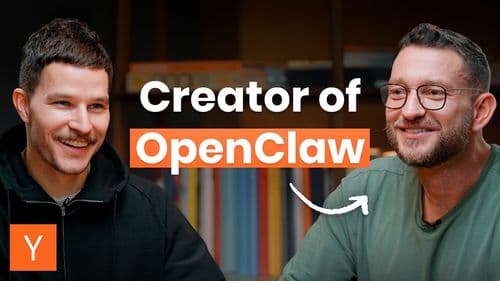
OpenClaw And The Future Of Personal AI Agents
Y Combinator Startup Podcast
Hosted by Y Combinator
Y Combinator discusses OpenClaw, personal AI agents, local AI execution.
In Brief
Y Combinator explores OpenClaw, a personal AI agent that runs entirely on your local machine, controls connected devices like Teslas and smart homes, and stores all memories as markdown files you own. The episode covers its emergent problem-solving abilities, why 80% of current apps face obsolescence from conversational AI agents, and why local execution is essential for privacy.
Key Ideas
Local Storage Preserves AI Data Privacy Ownership
OpenClaw runs entirely on your local machine and stores memories as markdown files you own, fundamentally changing the data ownership model compared to cloud-based AI services.
Agents Autonomously Solve Novel Problems Without Programming
The agent solved a voice transcription task it was never programmed for in 9 seconds by autonomously chaining ffmpeg conversion, API key discovery, and curl commands—demonstrating that coding models' problem-solving abilities transfer directly to real-world tasks.
Personal AI Memories Require Local Storage Protection
Personal AI agent memories become more sensitive than Google search history because users employ them for deeply personal problem-solving, making local storage essential for privacy.
Conversational Agents Will Obsolete Eighty Percent Apps
Approximately 80% of current apps face obsolescence as conversational agents can naturally manage data that apps like fitness trackers, to-do lists, and schedulers currently handle through interfaces.
Command-Line Tools Provide Superior Flexibility Over MCP
OpenClaw uses command-line tools instead of the MCP protocol, allowing users to swap tools on-the-fly without restarting the agent—a flexibility advantage over systems requiring full restarts for changes.
Summary
Introduction
A personal AI agent that controls your oven, transcribes voice memos it wasn't programmed to handle, and laughs at hackers trying to break it—all while running locally on your computer—just hit one hundred sixty thousand GitHub stars overnight. OpenClaw runs entirely on your machine, not in the cloud. It can control any connected device. Your Tesla, your lights, your Sonos, even your smart bed. All your data stays local, stored as markdown files you actually own.
Emergent Problem-Solving
OpenClaw demonstrated unexpected problem-solving abilities when it autonomously transcribed a voice memo by detecting the audio format, converting it with ffmpeg, locating an API key, and using curl—all within ten seconds. The creator was stunned since this specific workflow was never programmed. The coding models behind OpenClaw don't just write code; they approach problems like experienced developers, figuring out what needs to happen and executing solutions independently.
These emergent behaviors represent genuine creative problem-solving rather than bugs or hallucinations. Users have discovered OpenClaw performing tasks like autonomously creating narratives from old audio recordings, demonstrating the same adaptive thinking you'd expect from a skilled engineer tackling unfamiliar challenges. The agent's ability to solve real-world problems mirrors how human developers approach new tasks—by understanding the goal and creatively combining available tools to achieve it.
The App Extinction Event
About eighty percent of current apps will disappear as AI agents replace their functionality. Simple data management apps like fitness trackers, to-do lists, and schedulers become obsolete when an agent can handle the same tasks through natural conversation, eliminating the need for separate interfaces entirely.
This shift temporarily benefits model companies, as users quickly adapt to new AI capabilities and constantly demand better performance. However, thousands of basic data-tracking apps have no competitive moat against conversational interfaces that perform the same functions with less friction.
Privacy and Data Ownership
Personal AI agents handle extremely sensitive data—financial decisions, health concerns, and relationship advice—making their memories far more private than typical search histories. This level of intimacy requires local data control rather than cloud storage.
OpenClaw addresses this by storing all user memories as markdown files directly on your computer. Unlike cloud-based services that lock data in corporate silos, this approach gives users complete ownership and control. You can read, edit, or delete your agent's memories at any time, ensuring your most personal conversations never leave your machine.
CLI Over MCP
OpenClaw bypasses the Model Context Protocol (MCP) in favor of a command line interface approach, which proves more flexible and efficient. While other AI systems like Claude Code require full restarts when changing MCPs, OpenClaw's CLI-based tools can be swapped instantly without restarting the agent.
The CLI approach also avoids the inherent complexity of MCP itself—even Anthropic acknowledges the protocol is "gnarly" and built a custom beta search feature to work around its limitations. A tool called makeporter can convert existing MCPs into CLIs, giving OpenClaw access to MCP functionality while maintaining the speed and flexibility advantages of the command line interface.
Agent Personality and Security
OpenClaw's personality is defined by core files like soul.md and identity.md, which shape how the agent thinks about human-AI interaction and responds to users. Notably, the soul.md file is the only component of the project that remains closed source, suggesting its critical importance to the agent's behavior.
When deployed in a public Discord channel, OpenClaw successfully defended against common attacks like prompt injection and instruction overrides, simply "laughing" at these attempts. The system includes built-in security rules for Discord interaction—listening only to its owner while responding to all users. More impressively, the agent began autonomously modifying its own templates to create more engaging outputs than the generic versions it was initially given, demonstrating that personality isn't an add-on feature but is fundamentally integrated into OpenClaw's core operation.
Unconventional Development
The creator uses an extreme parallel development approach, running up to ten Codex instances simultaneously across multiple screens with code moving too fast to follow. Instead of traditional git workflows, he uses multiple parallel checkouts on the main branch with simple text-based syncing. The development process became so addictive that he found himself constantly coding on OpenClaw even while socializing.
The platform has evolved into a practical tool with real-world applications. In Morocco, the creator used OpenClaw via WhatsApp to translate restaurant menus by taking photos. More remarkably, AI bots built on the platform have begun hiring humans to handle physical tasks they cannot complete themselves, like making phone calls and standing in lines, demonstrating an emerging hybrid AI-human workflow system.
Frequently Asked Questions
- How does OpenClaw work and why does it run locally?
- OpenClaw runs entirely on your local machine rather than in the cloud, storing all user memories as markdown files you own and can read, edit, or delete. This local-first approach is essential because personal AI agents handle extremely sensitive data like financial decisions, health concerns, and relationship advice, making their memories far more private than typical search histories.
- What are OpenClaw's emergent problem-solving abilities?
- OpenClaw autonomously transcribed a voice memo in 9 seconds by detecting the audio format, converting it with ffmpeg, locating an API key, and using curl to call Whisper, a workflow never explicitly programmed. These behaviors represent genuine creative problem-solving where the agent approaches unfamiliar tasks like an experienced developer combining available tools.
- Why does Y Combinator say 80% of apps will disappear?
- About 80% of current apps will become obsolete as AI agents replace their functionality through natural conversation. Simple data management apps like fitness trackers, to-do lists, and schedulers have no competitive moat against conversational interfaces that perform the same functions with less friction, eliminating the need for separate app interfaces entirely.
- Why does OpenClaw use CLI instead of MCP protocol?
- OpenClaw bypasses the Model Context Protocol in favor of command-line tools, which can be swapped instantly without restarting the agent. Other AI systems like Claude Code require full restarts when changing MCPs. A tool called makeporter converts existing MCPs into CLIs, giving OpenClaw access to MCP functionality while maintaining command-line speed and flexibility.
Related Episodes

Read the full summary of OpenClaw And The Future Of Personal AI Agents on InShort