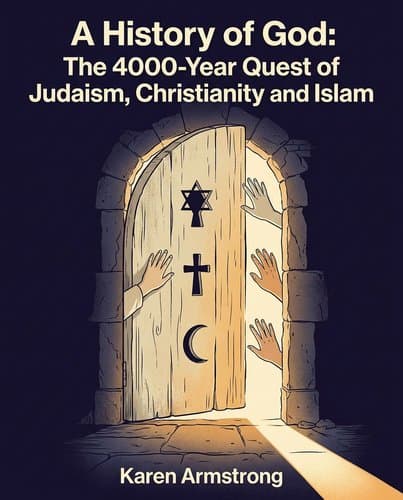
3873_a-history-of-god
by Karen Armstrong
Every argument about God's existence is probably arguing about different Gods—the patriarchs', the philosophers', and the mystics' are mutually exclusive…
In Brief
Every argument about God's existence is probably arguing about different Gods—the patriarchs', the philosophers', and the mystics' are mutually exclusive concepts. Armstrong's 4,000-year investigation reveals that the traditions wise enough to declare God undefinable produced the most enduring and honest theology.
Key Ideas
"God" requires clarification across traditions
When you use the word 'God,' specify which version: the tribal deity of the patriarchs, the moral judge of the prophets, the philosopher's Unmoved Mover, or the mystics' Ground of Being. These are genuinely different — sometimes mutually exclusive — concepts. Most arguments about God's existence talk past each other because neither side identifies the target.
Monotheism emerged from exilic crisis
Full monotheism (one God, no others exist) emerged only in the Babylonian exile of the 6th century BCE, as a crisis response to the Temple's destruction. The Ten Commandments themselves assume other gods exist. The 'original' faith was pagan and then monolatrous — not monotheistic.
Trinity transcends rational understanding
The Cappadocians who formulated the Trinity explicitly classified it as dogma (mystical, experiential, beyond words) not kerygma (public, rational, doctrinal). They said it deliberately confounds reason and must be 'lived, not thought.' Treating it as a logical proposition — to defend or attack — misunderstands the category it belongs to.
Logic cannot establish God fully
Al-Ghazzali's conclusion after his breakdown and decade with the Sufis: God's existence can neither be proved nor disproved by logic or sense perception. Every rational 'proof' of God produces a being-among-beings that can subsequently be declared unnecessary. The traditions that grasped this produced more durable theology than those that tried to meet science on its own terms.
God as Nothing exceeds being
The mystics across all three traditions — Sufi, Kabbalist, Christian apophatic — consistently called God 'Nothing,' meaning not an absence but a reality that exceeds the category of objects. Meister Eckhart's 'God is Nothing' and al-Ghazzali's 'there is no being in the world other than God' are the same claim from different cultural addresses. This was their most intellectually honest position, not a concession to doubt.
Fundamentalism and atheism share origins
Armstrong's structural warning: modern religious fundamentalism is not a recovery of ancient faith but a specifically modern reaction — born in the same 19th-century crisis that produced atheism, responding to the same failed literalism. Fundamentalism and New Atheism are siblings who inherited the same broken idea of God, not ancient faith meeting modern reason.
Who Should Read This
History readers interested in Christianity and Spirituality who want a deeper understanding of how we got here.
A History of God: The 4000-Year Quest of Judaism, Christianity and Islam
By Karen Armstrong
10 min read
Why does it matter? Because the God being argued about — by believers and atheists alike — was never what the most serious thinkers in any of the three traditions actually meant.
Pick a side in the God debate and you already know your lines. Believers defend a being who created the universe and cares about your life; atheists dismiss that being as wishful thinking in logical clothing. Both assume they're arguing about the same thing. Then Karen Armstrong spent years interviewing eminent rabbis, Christian priests, and Sufi mystics (the people most committed to God's existence) and kept hearing something that dismantled the whole argument: the God they'd devoted their lives to wasn't a factual claim to be proved or refuted. Some told her it didn't "really" exist at all. And yet, they insisted, it was the most important reality in the world. That paradox isn't a contradiction to resolve — it's the book's entire subject. What follows is a 4,000-year record of human beings doing something stranger and more honest than either side of the modern debate usually admits.
The God Most People Argue About Was Considered Naive Theology by Those Who Invented It
Karen Armstrong was eight years old when she had to memorize the answer to "What is God?": "God is the Supreme Spirit, Who alone exists of Himself and is infinite in all perfections." She repeated it on command. It meant nothing to her then, and she would later conclude it was not merely arid but incorrect.
She spent the next decades trying to find whatever that definition was pointing at. Seven years in a religious order (scripture, theology, prayer, apologetics), and God, she discovered, barely featured in any of it. The raptures described by the saints made her feel like a failure; whatever religious feeling she manufactured came from working on her own emotions, not from any source beyond herself. When she left religious life, belief didn't shatter. It dissolved quietly, the way a presence you were never sure of simply stops being assumed.
Years later, researching this book, she expected confirmation: God had been a projection all along, a mirror for whatever a given society feared or wanted. She was partly right. But she wasn't prepared for what eminent rabbis, Christian priests, and Sufi mystics told her when she described those years of failed effort. They said she'd been doing it wrong: not morally, but conceptually. Waiting for God to arrive as an objective fact, discoverable through rational inquiry, was a category error. Several said she should have built that sense of God herself — deliberately, the way you'd build a skill, not waited for it to arrive. And then, quietly, a few went further: the God most people argue about isn't really there, and yet represents the most important reality in existence.
This wasn't fringe mysticism — it was the considered position of serious theologians in all three traditions for most of their history. Every generation constructed the God that answered its particular questions. When a version stopped working, it was replaced. This was the whole mechanism.
Moses Was Almost Certainly Not a Monotheist — and That Changes the Entire Argument
The Exodus, Sinai, the covenant — standard reading treats these as the founding of monotheism. They weren't. They were the founding of monolatry: the promise to worship one god while others remained on the field.
Abraham almost certainly worshipped El, the senior deity of the Canaanite pantheon. The evidence is in plain sight: "Isra-El," "Ishma-El," the name God uses for himself when he first appears to Abraham, "El Shaddai" (El of the Mountain). In Genesis, El appears in human form, shares a meal, makes conversation — a pagan epiphany indistinguishable from the gods of Homer. Jacob wrestles a stranger at the ford of Jabbok all night; dawn comes; he realizes his opponent was divine and names the place Peniel: "I have seen El face to face." This is not the beginning of monotheism. It is paganism with one family's loyalty attached.
The Commandments at Sinai spell this out. "There shall be no strange gods before my face" is a prohibition, not an assertion. Other gods are presupposed. The Israelites had no doubt Baal and Asherah existed; what they swore at Sinai was that Yahweh had earned exclusive loyalty by delivering the Exodus. He competed and won. Throughout the biblical period, most Israelites continued to hedge their bets: Baal for rain and harvest, Asherah for household protection, Yahweh for warfare.
Genuine monotheism, the claim that no other gods exist, arrives in the 6th century BCE, when Babylonian armies had leveled Jerusalem and carried the population into exile. An anonymous poet, whom Armstrong calls Second Isaiah, writes: "No god was formed before me, nor will be after me." Not at Sinai. Not with Moses. Six centuries later, in a foreign country, with the Temple in rubble.
But to understand how Second Isaiah arrived there, and how monotheism hardened into that kind of absolutism, you have to go back two centuries, to a period of chaos and competing cults that first forced the question.
Full Monotheism Was a Crisis Response, Not a Revelation — Hammered Out When the Temple Was in Ruins
Hosea, a prophet in the chaotic northern kingdom around 750 BCE, had a bad marriage. His wife Gomer drifted into the fertility cult of Baal, possibly becoming one of its sacred personnel. The law said he should divorce her. Instead he went after her, paid to buy her back, and took her home. Looking back, he concluded it had been divine instruction. Yahweh, he decided, had staged the whole humiliation to reveal something: a god still pursuing a people who had abandoned him for other cults, still tender despite the betrayal.
This is the engine of the entire transformation. Isaiah, who had a seat in the royal court, encountered Yahweh as a great king enthroned above the Jerusalem Temple, attended by supernatural beings chanting his transcendence. Each prophet was, Armstrong argues, sculpting God out of his own experience and projecting it onto the absolute. This is not a debunking. It's the explanation for why the whole project succeeded: an impersonal absolute cannot inspire a spiritual quest. A God who feels what you feel, who burns with your particular moral outrage, who aches with your specific kind of grief — that God pulls people forward across centuries.
But the same mechanism generated the danger. In 622 BCE, reformers in Josiah's court "discovered" a text Armstrong suspects they had largely composed themselves (the core of Deuteronomy) and used it to launch a campaign of destruction. Shrines were burned, Asherah effigies smashed to dust, priests killed on their own altars. Armstrong reads the ferocity as revealing: the wholesale loathing of other gods reflected not theological confidence but something closer to buried panic. The reformers may have sensed, without quite naming it, that they were doing exactly what they accused pagans of — fashioning a deity in human hands. Projecting your specific moral vision onto the absolute and then defending it with sacred violence is a move available to any tradition at any moment of political insecurity.
The God being smashed by Josiah's men was a human construction. So was the God giving the orders.
The Church Fathers Designed the Trinity to Be Incomprehensible — That Was the Entire Point
Around 320 CE in Alexandria, a money-changer, when asked for an exchange rate, prefaced his reply with a lecture on the difference between created and uncreated being. A baker informed customers that the Father was greater than the Son. Both came from Arius, a charismatic Alexandrian presbyter who had set his theology to popular music and watched ordinary people argue about the nature of Christ with the passion usually reserved for sport.
The question: was Jesus genuinely divine, of the same nature as God the Father, or a supremely exalted creature? At Nicaea in 325, Constantine pressured the bishops into declaring Christ "of one substance" with the Father. Arius was condemned. But sixty years of argument followed, because Nicaea had said what Jesus was without explaining how a divine Trinity could be anything other than three gods. Basil of Caesarea, his brother Gregory of Nyssa, and their friend Gregory of Nazianzus finally produced a settlement the Eastern church accepted. Their answer was peculiar.
The Cappadocians drew a sharp line between two kinds of Christian truth. Kerygma was public teaching: scripture, clear doctrine, things demonstrable by reason. Dogma was different. Basil called it truth "preserved in silence," reachable only through contemplative experience and expressible only through symbol. The Trinity belonged to dogma, a structure designed to exceed rational comprehension and push the mind toward what lay beyond it.
Gregory of Nazianzus was explicit: contemplate the Trinity and you find yourself lurching between two incompatible experiences. Think of the One and the Three blazes into view. Distinguish the Three and you're pulled back into the One. The sensation, he said, overwhelmed thought entirely. Not a riddle with a solution but a collision engineered to stop you treating God as something your mind could circle and confirm.
Both sides of today's Trinity argument — defenders wanting it coherent, critics condemning it for failing to be — are making the same mistake: treating a symbol as a factual claim. The Cappadocians said plainly that God was not a being among beings but the ground beneath being itself, and that any formula precise enough to argue about was already a misrepresentation. The Trinity was their way of embedding that warning inside the doctrine itself.
Proving God's Existence Scientifically Was the Worst Thing Believers Ever Did to God
Isaac Newton was the apex of this project. Contemplating his new physics, he noticed something the gravitational equations couldn't account for: why hadn't all the stars collapsed into one another? Gravity alone predicted disaster. The only satisfying answer, Newton decided, was an intelligent divine Overseer who had distributed the celestial bodies at precise distances to prevent catastrophe. God wasn't theology anymore. He was the load-bearing structure of astrophysics, the part of the calculation that held the rest together.
One century later, Pierre-Simon Laplace presented Napoleon with a model of the solar system's stability. Napoleon asked where God fit into the account. Laplace replied that he had no need of that hypothesis. Not hostile; just accurate. The mathematics worked without a divine engineer. Newton's proof hadn't survived a single century of scientific refinement.
Armstrong doesn't read Laplace as a villain. She reads Newton as the one who set the trap. Once you locate God inside the scientific order (as its first cause, its designer, its maintenance crew), you've staked the divine on the current limits of human knowledge. Every gap your God fills becomes a liability: when the gap closes, so does the proof, and down comes the God attached to it. The theologians and scientists who built these arguments in the 17th and 18th centuries thought they were shoring up religion. They were actually building a structure that could only hold until a better equation arrived.
The alternative was always available. Al-Ghazzali, an 11th-century Islamic scholar, drove his rational investigations until they broke him — he lost the ability to eat, to speak, to lecture — and spent a decade recovering among the Sufis. What he found there was not a proof but an experience. It led him to a conclusion his Western counterparts never reached: the reality people call God lies outside the reach of sense perception and logical argument entirely. Science could neither prove nor disprove it. This wasn't surrender. It was a different grammar. You cannot refute a position that never claimed to be a scientific hypothesis, and the mystical traditions (Sufi Islam, apophatic Christianity, later Jewish Kabbalah) produced conceptions of God that Laplace's remark simply couldn't touch.
The God who needs a gap to live in is always one discovery from extinction.
When Mystics Said 'God Is Nothing,' They Meant It as Their Most Precise Statement
Baghdad, 922 CE. A Sufi mystic named Husain ibn Mansur — known as al-Hallaj, the Wool-Carder — stood at his cross awaiting death by crucifixion. The charge was blasphemy. Years earlier, deep in contemplative prayer, he had cried aloud: "Ana al-Haqq" ("I am the Truth"). Al-Haqq was one of the names of God. The religious authorities heard a man claiming to be divine, which in Islam meant claiming to be something other than God's creature. They sentenced him accordingly.
Al-Hallaj's final prayer was for his executioners. He asked God to forgive them, not despite what they were doing but because they were acting in sincere religious zeal, and because they did not know what he knew. God had revealed to him what was hidden from them.
That prayer is the clearest signal of what the mystics were actually doing, and why it was harder to think than systematic theology, not easier. The Islamic establishment read "I am the Truth" as an identity claim: a man putting himself in the place of God. Al-Hallaj meant something more precise: when the ego is progressively stripped away through the disciplines of Sufi practice, what remains is not a self relating to God at a distance but the divine ground itself. His Sufi predecessor al-Bistami had reported his own version of the same collapse: in deep prayer, the distance between self and God dissolved entirely until, as he described it, God addressed him in the first person. These weren't grandiose boasts. They were reports from a controlled interior experiment whose results kept reproducing across traditions. Sufis, Christian contemplatives, Jewish Kabbalists, working in complete isolation from each other, kept arriving at the same paradoxical formulations: not coincidence, but evidence of a consistent interior territory.
A few centuries later in Germany, the Dominican friar Meister Eckhart arrived at the same position and put it in language that still sounds more daring than most atheism: "God is Nothing." He wasn't announcing an illusion. He was making a precise epistemological claim: that God belongs to a category of existence so much fuller than ordinary being that the word "something," with all its objective, graspable connotations, would be a demotion. The formula that got him charged with heresy, as al-Hallaj had been before him: "Man's last and highest parting is when, for God's sake, he takes leave of God." It means: any concept of God specific enough to hold in your mind and argue about is not God. The point of the mystical disciplines, in every tradition, was to exhaust the mind's ability to turn the divine into an object. Not fog. Method.
Modern Atheism and Fundamentalism Are Not Opposites — They're the Same Mistake, Mirrored
What if the most famous atheist and the most rigid fundamentalist are locked in the same argument — just from opposite sides of a door that opens onto nothing?
Nietzsche's 1882 parable of the madman is usually read as triumph. A figure runs through the marketplace proclaiming that God is dead while bystanders laugh. Armstrong reads it differently. The madman isn't crowing; he's in anguish, listing everything that has collapsed: no horizon, no above or below, adrift in infinite nothingness. A diagnosis of catastrophe, not a victory lap. And then, at the end of Nietzsche's sane life (after the Superman, after Zarathustra, after the hymns to will and power), a poem surfaces. Zarathustra pleads: "Oh come back / My unknown God! My pain! my last — happiness." He did not abandon God joyfully. He destroyed something that still had its hooks in him.
The fundamentalist makes the mirror-image error. The God being defended at the 2005 Dover trial — where a Pennsylvania school board pressed to have "intelligent design" taught alongside evolution, and lost in federal court — is a being who assembled the biosphere personally and expects the science classroom to say so. He's not the God of Meister Eckhart or Ibn Arabi; he's the omnipotent lawgiver of Western literalism, a construction the Cappadocians, the Sufis, and the Kabbalists would not have recognized as their territory. Armstrong's point is that Nietzsche and that school board are arguing about the same God. They just reach opposite conclusions.
The 20th-century Protestant theologian Paul Tillich named the problem precisely: a God who tinkers with the universe is just another being among beings, an omnipotent tyrant distinguishable from earthly dictators mainly by scale. Tillich's alternative is God as the Ground of Being — not a supreme being above the clouds but the condition that makes any being possible, the pull you feel at the edge of any genuine experience of meaning or dread. He called this "ultimate concern": not a distinct religious feeling, not something reserved for Sunday mornings, but what's already operating when you feel courage or despair or that something genuinely matters. No separate compartment required. What it does require is harder: the long, deliberate practice the mystics described, a sense of the sacred that doesn't arrive prepackaged.
That path is still there. Whether we still have the patience for it is the question Armstrong leaves open.
After Finding God Guilty, the Rabbi Said It Was Time to Pray
Somewhere in Auschwitz, a group of prisoners put God on trial. The evidence was entered. The verdict came back: guilty. Then, without comment, the evening prayer began.
Armstrong tells this story and refuses to interpret it. She doesn't say the prayer was defiance, or habit, or hope refusing to die. She lets both acts stand — conviction and worship — without resolving the tension between them.
That refusal is the book's most honest moment. You can decide God is guilty and still reach toward whatever the prayer was reaching toward. You can inherit the whole wreckage — failed proofs, broken literalism, fundamentalism and New Atheism facing opposite corners of the same room — and still feel pulled by what the mystics were training themselves to notice: something beyond the edge of any argument you could win.
They convicted God and then they prayed. Whatever that was, it wasn't the God either side of the debate has been arguing about.
Notable Quotes
“I mean to tell you. We have killed him, - you and I! We are all his murderers!”
Frequently Asked Questions
- What is A History of God by Karen Armstrong about?
- A History of God is a 4,000-year survey of how the concept of God has been continuously remade across Judaism, Christianity, and Islam. Armstrong demonstrates that God has never been a single stable concept, but has been shaped by catastrophe, philosophy, and mystical experience rather than fixed revelation. The book explains why theological arguments often fail because participants unwittingly reference different versions of God—from tribal deity to philosopher's abstract principle to mystic's transcendent reality. Understanding these distinct conceptions explains why debates about God's existence frequently talk past each other.
- What does Armstrong argue about when monotheism emerged?
- Armstrong argues that full monotheism emerged only in 'the Babylonian exile of the 6th century BCE' as a crisis response to the Temple's destruction. She notes that the Ten Commandments themselves assume other gods exist, indicating early Judaism was pagan and then monolatrous—worshipping one god while accepting others—but not truly monotheistic. This contradicts the common belief that monotheism was always central to Judaism. Armstrong demonstrates how catastrophic historical events, not immutable revelation, shaped theological evolution. The concept of a single exclusive God developed much later than religious traditions claimed.
- Why do arguments about God's existence talk past each other according to Armstrong?
- According to Armstrong, most arguments about God's existence fail because neither side identifies the same target. When people discuss God, they may reference entirely different concepts—from the tribal deity of early Judaism to the philosopher's abstract Unmoved Mover to the mystics' Ground of Being. These versions are sometimes mutually exclusive, making meaningful debate impossible when participants operate from different definitions. Understanding that God has never been a single stable entity explains why theological discussions frequently misalign. Clarifying which version of God one is discussing becomes essential for productive conversation.
- How does Armstrong explain the Trinity in her book?
- Armstrong explains that Cappadocian theologians classified the Trinity as dogma—mystical, experiential truth—rather than kerygma, or public rational doctrine. They deliberately formulated it to confound reason and it must be "lived, not thought." Armstrong argues that treating the Trinity as a logical proposition to defend or attack fundamentally misunderstands its category. This reveals how certain theological truths were meant to be experienced and embodied rather than rationally proven. Modern fundamentalism's attempts to defend the Trinity logically contradict how medieval theologians originally understood and formulated it as transcendent mystery.
Related Book Summaries



Read the full summary of 3873_a-history-of-god on InShort