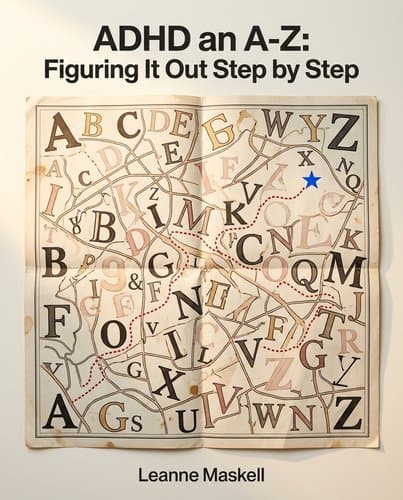
228774853_adhd-an-a-z
by Leanne Maskell
Your ADHD isn't a character flaw—it's a nervous system running different hardware in a world built for another operating system. Leanne Maskell delivers…
In Brief
ADHD an A-Z: Figuring It Out Step by Step (2022) guides readers through understanding ADHD as a neurological difference rather than a personal failing.
Key Ideas
Wait one week before major decisions
When you feel the urge to quit something — a job, a relationship, a commitment — give it exactly one week before telling anyone. ADHD impulsivity and RSD can manufacture a crisis that dissolves overnight; the one-week rule creates the pause your prefrontal cortex can't generate automatically.
Three-item whiteboard replaces endless to-do lists
Replace infinite to-do lists with a three-item whiteboard divided into 'urgent and important,' 'important but not urgent,' and a catch-all slot for intrusive thoughts. Fewer items mean fewer decisions, and decisions are expensive for ADHD brains.
Virtual shop notebook delays purchase impulses
Use a 'virtual shop notebook' for purchase impulses: write the item down instead of buying it. The dopamine hit of the hunt is real; the desire usually isn't. Check the list 24 hours later.
Automatic holding reply creates commitment buffer
For any social or professional request, install an automatic holding reply: 'Can I let you know later? I need to check my schedule.' This single phrase creates the gap between impulse and commitment that executive dysfunction otherwise eliminates.
Track ADHD symptoms with hormonal cycles
Track ADHD symptoms against hormonal cycles if you menstruate — oestrogen fluctuations significantly alter symptom intensity, and patterns become actionable information rather than mysterious crashes.
UK Access to Work funds coaching
If you're in the UK and employed, research 'Access to Work' — the government scheme can fund 100% of ADHD coaching costs and support workers. Most people with ADHD don't know it exists.
Self-care as maintenance, not reward
Treat self-care (sleep, food, water, movement) as the primary management tool, not a reward for productivity. You cannot regulate a neurodevelopmental condition from an empty cup — the neuroscience of executive function confirms that self-care is maintenance, not indulgence.
Lawyer-client test separates facts from feelings
When RSD hits and you feel the tidal wave coming, run the lawyer-client test: separate facts from feelings in writing. 'My friends had breakfast without me' is a fact. 'They hate me' is a story. Look for counter-evidence before acting on the story.
Who Should Read This
Readers interested in Mental Health and Self-Improvement, looking for practical insights they can apply to their own lives.
ADHD an A-Z: Figuring It Out Step by Step
By Leanne Maskell
13 min read
Why does it matter? Because the failures you've been blaming on your character are actually your neurology.
You spent years collecting evidence against yourself. Every forgotten appointment, every unfinished project, every conversation where your mouth moved faster than your judgment — filed away as proof that something was fundamentally wrong with you. Not your circumstances. Not your situation. You. The lazy one. The dramatic one. The one who could somehow ace an exam after one sleepless night but couldn't return a single phone call for three weeks. Here's what nobody told you: that contradiction isn't a character defect. It's a diagnostic fingerprint. Your brain isn't running broken software — it's different hardware, and the world only ever wrote the manual for one kind. This book is that manual. The other one.
The Adult in Your Brain Went on Holiday — and Nobody Told You
Imagine handing the keys of a Ferrari to someone who has only ever driven a bicycle. The engine can do extraordinary things — it just has no brakes proportionate to the speed. That tension, between raw capacity and the inability to slow down and steer, is what Leanne Maskell uses to describe the ADHD brain. Once you understand the specific piece of machinery that's misfiring, the entire catalogue of bewildering failures — the missed appointments, the emotional explosions, the paralysis in front of a simple tax form — stops looking like a character problem and starts looking like a predictable engineering outcome.
The component in question is the prefrontal cortex, the part of the brain that acts as the internal adult in the room. It stops you eating ice cream for every meal, makes you sit down to pay a bill even when you'd rather do anything else, slows your mouth down before you say something you'll regret. In a brain without ADHD, this region quietly governs decisions, manages time, and regulates emotion. In an ADHD brain, it is chronically underregulated. The adult has gone on holiday, and in its place is a committee of toddlers pushing random buttons — installed at birth, not assembled through bad choices. The genetic contribution runs at roughly 75 percent.
The consequences radiate outward from that single neurological fact. Time feels binary — now, or not now — because the prefrontal cortex is what lets you mentally project yourself into the future and feel its weight in the present. Without it, a deadline three weeks away doesn't register as real until it's tomorrow. Emotions arrive without the usual buffering, hitting like a wave rather than a tide. A task like calling a government office can trigger genuine shutdown, not laziness: the stress of imagining the task outweighs the brain's ability to initiate it.
Here is the detail that reframes everything: in 1990, only 40 children across the entire United Kingdom were receiving medical treatment for ADHD. An entire generation grew up with an unrecognised neurological difference and a ready explanation for it — they were lazy, unfocused, difficult, dramatic. Maskell's point is that getting a diagnosis isn't just paperwork.
The Doctor Who Said She Was Fine Because She Had a Law Degree
She was pacing around a park, trying to stop herself from booking a spontaneous flight to Mexico, when she finally decided she could not keep living this way. This was Leanne Maskell at 25, moments before seeing the psychiatrist who would change everything. When she sat down and listed her symptoms — the chaos, the toxic relationships, the alcohol dependency, the inability to hold a job or a postcode — he stopped her and asked a few pointed questions about concentration and impulsivity. His conclusion was unambiguous: ADHD, and a severe case of it. Her response was to burst out laughing. 'ADHD is fine,' she told him. 'That's not a real problem.'
The laugh makes complete sense once you understand what the years before that appointment looked like. Maskell had a law degree. Doctors had told her she was clearly 'self-aware and intelligent' — one explicitly noted she was 'not about to rob a bank' — and sent her away. Another suggested a massage. These weren't fringe practitioners missing obvious signs; they were filtering for the version of ADHD they recognised: a disruptive boy in a classroom who couldn't sit still. What they saw instead was a high-functioning young woman who, on paper, had always managed. What they didn't see was how the managing worked.
Female ADHD has a particular camouflage. Girls learn early to copy the behaviours of peers, to perform composure, to pour unsustainable effort into appearing normal. Maskell crammed entire university subjects in the week before exams and graduated with a 2:1 — proof, in any doctor's eyes, that she was fine. But the cramming was the symptom, not the cure. Education had been providing the external scaffolding her brain couldn't generate internally. The moment she graduated, that scaffolding disappeared. What followed was the collapse doctors should have anticipated but didn't: impulsive breakups, job losses, relocation to another continent, and drinking to manage anxiety that had nowhere else to go.
The numbers confirm it: girls are diagnosed at roughly one-fifth the rate of boys in childhood, yet adult diagnosis rates are nearly equal between the sexes — the gap isn't biological, it's a detection failure. And the consequences are severe. Women with ADHD are more than seven times as likely to have attempted suicide as those without it. Yet the diagnostic criteria used in the UK have not historically included emotional symptoms, despite overwhelming evidence that emotional dysregulation is central to how many women experience the condition. The patients who most need to be found are the ones the system was never designed to find.
She wasn't too weak to cope. She was navigating without the map, and the people whose job it was to hand her one told her she didn't need it.
You Can't Have a Character Flaw That Was Installed at Age 12
By age 12, the average child with ADHD has absorbed roughly 20,000 more negative messages from parents, teachers, and other adults than their neurotypical peers. Not 20,000 over a lifetime — by age 12. That number isn't a statistic to glance past; it's the architecture of a self. Every 'why can't you just focus,' every 'you're so lazy,' every teacher who asked the whole class whether you'd cheated to earn your straight As — those stack. They become the foundation on which you build your understanding of who you are.
Maskell's argument is that what most adults with ADHD experience as a character flaw — the low self-esteem, the imposter syndrome, the emotional explosions — is the predictable downstream effect of that accumulation, compounded by a brain with no internal emotional brakes. She describes a phenomenon called Rejection Sensitive Dysphoria: a neurological response, specific to ADHD, in which perceived rejection triggers an emotional wave so intense it functions like a panic attack. About half the people court-mandated for anger management turn out to have unrecognized ADHD — the rage was never a personality problem. Then there's what Maskell lived: feeling suicidal one night and waking up completely fine the next morning, which left her questioning her own sanity, wondering if she was manufacturing crises from nothing. She wasn't. She was experiencing something real and physiological, and the 20,000 messages had already written the story that told her otherwise.
Self-compassion, then, stops being a soft indulgence and becomes the most practical tool available. Maskell uses the oxygen mask analogy deliberately: the instruction to put your own mask on before helping others isn't about selfishness, it's about physics. A system running on empty cannot regulate itself. Every practical ADHD management strategy — the structure, the routines, the consistent sleep — requires a baseline of self-regard to sustain. Without it, the strategies collapse back into evidence that you can't follow through, which feeds the same story the 20,000 messages already wrote.
Reframing the past means recognizing that the story was written under false pretenses. The kid who couldn't pay attention in class wasn't undisciplined — she was navigating a neurodevelopmental condition in a system that had no category for her. That doesn't undo the years, but it does something more useful than comfort: it relocates the cause. Once you know where the problem actually lives, you can stop trying to fix your personality and start working with the brain you actually have.
The Same Trait That Writes a Book in a Week Will Also Burn You to the Ground
Maskell describes hyper-focus the way someone might describe a drug: intoxicating, useful, and capable of wrecking everything if you don't watch it. One research participant she cites called it 'brain caviar' — the sensation of taking all that scattered, chaotic ADHD energy and compressing it into a single, searingly focused beam. The ADHD brain, which spends most of its time refusing to cooperate, suddenly finds a task it was almost designed for. The result can look miraculous from the outside. Maskell once absorbed an entire year of university law material in a single month before exams, then graduated with a respectable degree. Proof, to anyone watching, that she was fine.
But here's what the outside view misses. The same neurological wiring that produces that month of total immersion also makes it nearly impossible to stop, redirect, or moderate. Hyper-focus isn't a gear you can choose — it's one you get locked into. Maskell describes working from six in the morning until midnight without eating, without moving, barely registering that a body was attached to the brain doing all that brilliant work. The dopamine the ADHD brain is chronically short of arrives in a flood during these episodes, and the brain, recognising that rare feeling of reward, treats this unsustainable peak as its new normal. When the interest passes — and it always passes — the crash isn't just tiredness. It's a collapse back to baseline that the brain now experiences as failure.
This is why, when Maskell attended a Workaholics Anonymous meeting, she found that over half the people in the room had ADHD. Not the distracted, impulsive stereotype — people who had pushed themselves to such extremes that they needed a twelve-step programme to stop. The 'lazy' diagnosis that follows ADHD-ers from childhood obscures the opposite reality: many are running at an effort level roughly five times what the average person sustains, then treating the inevitable collapse as proof they were never good enough to begin with.
Managing this doesn't mean learning to lean into hyper-focus more skillfully. It means building in hard stops — alarms, accountability partners, external structure — precisely because the brain won't generate any on its own. The same engine that writes a book in a week will, without external brakes, simply keep going until there's nothing left to burn.
ADHD Is a 24-Hour Condition — It Lives in Your Wallet, Your Bed, and Your Relationships Too
ADHD doesn't clock out. Once you understand that, the isolated patches — the productivity app, the new planner, the motivational speech you give yourself Sunday night — stop being strategies and reveal themselves as what they are: attempts to fix one output of a whole-system problem.
Consider what happens to money. Research puts the annual cost of having ADHD at roughly £1,600 per person — not in treatment, but in the friction of ordinary financial life: late fees, impulsive purchases, interest on debt that felt manageable until it wasn't. The mechanism is the same prefrontal gap that makes deadlines feel unreal. The future consequence of a purchase — the empty account, the debt spiral — simply doesn't land with the same emotional weight as the purchase itself. Maskell describes waking up each morning with a mental shopping list already compiled, ordering everything on it before she was fully conscious, then coming home to packages she'd forgotten she'd ordered. The dopamine hit of the hunt was real; the financial damage was also real. Her fix wasn't willpower. It was a notebook. When the urge to buy something surfaced, she wrote it down — which satisfied the part of her brain that needed to act on the impulse — and deferred any actual purchase to a designated slot later in the week. More often than not, she didn't want the thing by then. The notebook gave the impulse somewhere to go without giving it access to her bank account.
The same hardware runs at night. Up to four in five adults with ADHD have a clinical sleep disorder — not because they're bad at relaxing, but because the racing mind has been kept occupied all day by external noise, and the moment that noise disappears, the backlog pours in. That isn't insomnia in the conventional sense. It's the ADHD nervous system doing what it does when the distractions stop.
Relationships follow the same pattern. The hyper-focus that locks onto a new project locks onto new people too — early romantic intensity that feels enormous, then fades not because the person became less interesting but because novelty is what drives the signal. Partners read the fade as withdrawal. The ADHD-er reads their confusion as rejection, and Rejection Sensitive Dysphoria (that panic-level rejection response) does the rest: black-or-white thinking, catastrophizing, the urge to preemptively exit before being abandoned. The loneliness this produces isn't a social failure. It's a structural outcome of a brain that was never designed for the slow, unremarkable consistency that intimacy requires.
One condition, three domains, the same engine underneath. Patching the sleep won't fix the spending. Fixing the spending won't repair the relationship damage.
The Medication Moment: Seeing Dust for the First Time
The first morning Leanne Maskell took her medication, she noticed something she had never seen before: dust. Actual dust, covering the surfaces of her flat. The 500 competing thoughts that normally occupied every corner of her mind had simply gone quiet, and in that silence she could perceive something as ordinary as a dirty shelf. Her astonishment wasn't about tidiness — it was about what other people's baseline actually felt like. She had assumed everyone was managing a constant radio blasting fifteen simultaneous channels. They weren't. That was just her.
Before the prescription, she had been self-medicating the only way her brain knew how: ten coffees a day, alcohol in quantities that alarmed her in retrospect, cigarettes. These weren't moral failures — they were a brain recruiting whatever stimulants it could find to patch the gap it couldn't fill on its own. The medication replaced that improvised chemistry with something that worked, and the improvised chemistry quietly stopped being necessary.
Most people land in one of two wrong places. The first is that medication is a crutch — a surrender, a sign that your will isn't sufficient. Maskell addresses this with a deliberately boring comparison: if you broke your arm and a doctor offered you a sling, refusing it out of pride would not make the bone mend faster. Nobody suggests it. Nobody finds it virtuous. But with invisible conditions, this is precisely what gets demanded — the expectation that willpower can do what physiology cannot.
The second wrong place is assuming medication is the destination. Maskell describes finally being able to see the mess in her flat, then realising she had no idea how to clean it. She could see the holes in the jumper. She had never learned to sew. That's what coaching, therapy, sleep, and exercise are for — not as extras, but as the part of the system that the medication makes accessible. The medication clears the noise. What you do in the quiet is still entirely up to you.
The Hacks Are Lateral Because the Brain Is Lateral
Maskell's most counterintuitive example is the £3.50 shipping fee. The instinct is to find the cheapest route to any purchase — free next-day delivery feels like a sensible economy. But she deliberately avoids those accounts, because the moment a small shipping cost appears on screen, a question surfaces that wouldn't otherwise exist: do I actually need this? That question is the whole game. The prefrontal cortex, which in a neurotypical brain quietly inserts a pause between impulse and action, simply doesn't fire on cue in an ADHD brain. So the £3.50 isn't waste. It's a rented pause. The friction that costs a few pounds per order saves considerably more in items that would otherwise arrive, be kept out of post-office-return avoidance, and quietly drain the account. You're not fighting the impulse — you're installing a speed bump before it converts into a purchase.
The same principle runs through her approach to social commitments. Because an ADHD brain responds to requests at speed, the 'yes' is often already leaving your mouth before any evaluation has occurred. Maskell's fix is a stock phrase she treats as literal policy: 'Can I let you know later? I need to check my schedule.' It works like a personal out-of-office reply — not a refusal, just a gap. In that gap, she can actually assess whether she has the energy, money, or willingness for the thing being asked. The phrase doesn't require her to perform the real-time cost-benefit analysis her executive functioning can't reliably produce under social pressure. It outsources the regulation to time itself.
The pattern underneath all of it is the same: none of these fixes demand that the brain override itself through willpower. Each one rebuilds the environment to do the regulatory work instead. The brain can stop fighting its own architecture and just move through a day that was designed with it in mind.
Your Weaknesses Are Mislabeled Survival Traits
The traits you've been apologizing for your entire life were never flaws. They were adaptations — built by a brain running a different operating system in a world designed for another one entirely.
The ADHD brain doesn't refuse to engage out of laziness. It refuses to engage with things it doesn't genuinely care about. For neurotypical people, that friction is negotiable — boredom is uncomfortable but manageable. For an ADHD brain, the friction is neurological. You cannot manufacture sustained attention for tasks that fail to interest you the same way you cannot choose to be taller. But the same mechanism that makes a spreadsheet feel physically impossible is the one that, when genuine interest arrives, produces something researchers call hyper-focus — a state of immersion so complete that adults with ADHD outperform neurotypical peers on real-time creative achievement. The disorder and the superpower are not opposites. They are the same wiring, measured in different contexts.
Richard Branson dropped out of school at 15. The system logged that as failure. What followed was a magazine, then a record label, then an airline, then a space programme. The instruments used to measure intelligence were never calibrated for the kind of thinking Branson was doing. When the test can't detect the signal, the problem is the test.
Self-compassion, here, isn't softness. It's accurate diagnosis. Every trait you've experienced as evidence of being broken — the restlessness, the half-finished projects, the impulsive pivots — points back to a specific neurology operating under specific conditions. Name the condition correctly, and the failure narrative loses its footing. You weren't falling short. You were surviving a world that hadn't yet built the right door for you.
The Map Arrived Late — Not Never
The diagnosis — or even just the framework, if the diagnosis is still somewhere on a waiting list — is the letter that finally explains why the school you were sent to never quite fit. Not Hogwarts specifically, but the version of it Maskell wanted at eleven: something that arrives and says, this is why. It doesn't undo the years of being handed the wrong map and blamed for getting lost. But everything you build from here can be built around the brain you actually have, not the one the system assumed you did. That's not a small thing. And the foundation that makes any of it possible isn't the medication, or the three-item whiteboard, or the notebook full of unpurchased things. It's the decision to stop treating yourself as a project that failed and start treating yourself as an engine that was never given the right fuel. The map arrived late. But you're reading it now. And the engine — it was never the problem.
Frequently Asked Questions
- What is ADHD an A-Z: Figuring It Out Step by Step about?
- ADHD an A-Z guides readers through understanding ADHD as a neurological difference rather than a personal failing. Published in 2022 by Leanne Maskell, the book draws on lived experience and practical research to deliver concrete strategies for managing impulsivity, emotional dysregulation, work challenges, and relationships. It equips readers with systems designed to work with their ADHD brain rather than against it. The guide offers actionable tools: whiteboard task management, impulse-purchase tracking, automatic holding replies for requests, and hormonal cycle monitoring. Maskell emphasizes treating self-care—sleep, food, water, movement—as the primary management tool, positioning these basics as maintenance rather than reward.
- What are the key ADHD management strategies in this book?
- The book provides eight core strategies designed for ADHD brains. These include the 'one-week rule'—give the urge to quit anything a week before telling anyone, as 'ADHD impulsivity and RSD can manufacture a crisis that dissolves overnight.' A three-item whiteboard system replaces infinite to-do lists with urgent/important priorities. The 'virtual shop notebook' captures purchase impulses to tap the dopamine hit without spending. An automatic holding reply—'Can I let you know later? I need to check my schedule'—builds executive function gaps. Additional strategies involve tracking symptoms against hormonal cycles, using the 'lawyer-client test' to separate RSD facts from stories, researching Access to Work funding, and prioritizing self-care as neurological maintenance.
- How does Leanne Maskell recommend handling impulsive decisions?
- Maskell provides two crucial strategies for managing ADHD impulsivity. First is the 'one-week rule': when you feel the urge to quit something—a job, a relationship, a commitment—'give it exactly one week before telling anyone.' The reasoning is that 'ADHD impulsivity and RSD can manufacture a crisis that dissolves overnight; the one-week rule creates the pause your prefrontal cortex can't generate automatically.' Second, install an automatic holding reply to requests: 'Can I let you know later? I need to check my schedule.' This single phrase 'creates the gap between impulse and commitment that executive dysfunction otherwise eliminates.' Together, these strategies leverage the delay needed for better decision-making.
- Is ADHD an A-Z worth reading for ADHD management?
- Yes, this book is valuable for anyone with ADHD seeking practical management tools. Maskell's approach treats ADHD as a neurological difference requiring accommodation rather than willpower, and she provides immediately actionable strategies based on lived experience and research. The book addresses common ADHD challenges—emotional dysregulation, task management, social interaction, impulsive spending—with concrete solutions. A particularly valuable insight: treat self-care as 'the primary management tool, not a reward for productivity,' since 'you cannot regulate a neurodevelopmental condition from an empty cup.' For UK readers, it highlights Access to Work funding for coaching. The strategies span executive function, emotional regulation, and systemic support, making it comprehensive.
Related Book Summaries


Read the full summary of 228774853_adhd-an-a-z on InShort