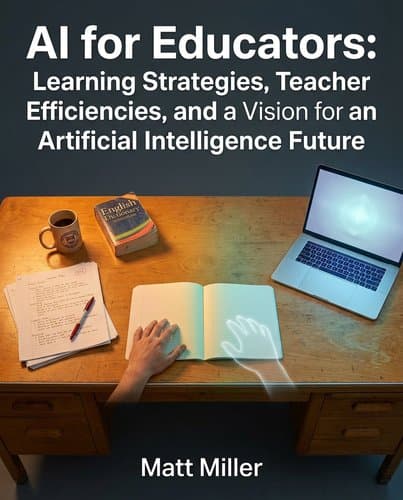
123266072_ai-for-educators
by Matt Miller
AI isn't making teachers obsolete—it's forcing them to decide whether they're preparing students for tomorrow or yesterday. Packed with classroom-ready…
In Brief
AI isn't making teachers obsolete—it's forcing them to decide whether they're preparing students for tomorrow or yesterday. Packed with classroom-ready strategies like 'Think, Pair, ChatGPT' and 'Grating the AI,' this guide shows educators how to reclaim time, redesign assignments, and turn the AI revolution into their greatest teaching advantage.
Key Ideas
Redesign Assignments to Measure Understanding
Audit your assignments through the 'what does this actually measure?' lens — if AI can produce an acceptable answer, ask whether the assignment was measuring understanding or just text production, and redesign accordingly
Structure AI as Learning Interlocutor
Use 'Think, Pair, ChatGPT, Pair, Share' to make AI a structured classroom interlocutor rather than a homework shortcut — the human debrief at the end is where the learning actually happens
Grade AI-Written Essays for Evaluation Practice
Try 'Grating the AI' this week: give students a rubric and an AI-written essay and ask them to grade it — they'll practice critical evaluation without the defensiveness that comes from critiquing their own work
Demonstrate Learning Beyond AI Detection
Replace the question 'did they use AI?' with 'how do I know what they've learned?' — verbal discussion, collaborative projects, and retrieval brain dumps answer the second question in ways that are also more authentic to professional life
Reinvest AI Time into Human Connection
Treat your AI time savings as a deliberate resource: calculate the minutes recovered from planning and feedback tasks and consciously reinvest them — in a creative lesson, in a student conversation, or simply in rest
Teach Prompt Engineering as Core Literacy
Teach prompt engineering as a literacy skill alongside reading and writing — the ability to query a system precisely, evaluate its output critically, and iterate is already appearing as a job requirement
Meet Colleagues at Their Adoption Stage
Apply the Gartner educator cycle to your own school: identify which stage your colleagues are in ('Conflict and Panic,' 'Struggle,' or 'Progress at Scale') and meet them there rather than assuming everyone shares your starting point
Who Should Read This
Readers interested in Teaching and Learning, looking for practical insights they can apply to their own lives.
AI for Educators: Learning Strategies, Teacher Efficiencies, and a Vision for an Artificial Intelligence Future
By Matt Miller
13 min read
Why does it matter? Because the question you're asking about AI in your classroom is the wrong one.
The first instinct made sense: block it, detect it, stamp it out before it spreads. But then a quieter question crept in — if a chatbot can write the essay, what exactly were you measuring with the essay? That question doesn't have a comfortable answer, and Matt Miller doesn't pretend it does. What he offers instead is a more useful reframe: the panic teachers felt in late 2022 wasn't really about cheating. It was about suddenly having to decide, urgently and without a manual, whether their assignments were preparing students for a future that was arriving faster than anyone expected. That's the teacher this book is written for — neither naively enthusiastic nor quietly terrified, but convinced that getting this right matters, and wanting to think it through with someone who has actually stood at the front of a classroom.
The Day the Barrier Disappeared (And Why Panic Was the Wrong Response)
On a cold Friday evening in December 2022, Matt Miller dropped his kids off at a church youth group and got ambushed by middle schoolers holding up a phone. They'd found something called ChatGPT, and they wanted to show him a story it had written — a dinosaur and Harry Styles teaming up to stop a zombie apocalypse. Miller laughed, pulled out his own phone, and became a user that same night. He assumed he was an early adopter. He was not. ChatGPT had already passed one million users by the time he signed up. Five days. That same milestone took Instagram two months and Spotify five. Within two months of launch, ChatGPT had 100 million monthly active users.
The speed of that curve explains everything that happened next in schools. Teachers weren't panicking about a strange new threat. They were doing what every generation of teachers has done when a new tool scrambled the rules: they looked for a way to block it, and when that failed, they looked for a way to detect it. Search for AI detectors. Can we filter the site at the router level? The instinct is understandable and, Miller argues, exactly wrong.
AI researcher Kai-Fu Lee — who spent years at Apple and Google before founding a China-focused AI fund — puts the problem precisely: humans reliably overestimate what a technology will do in five years and underestimate what it will do in twenty. The middle schoolers with the zombie story weren't showing Miller a cheating machine. They were showing him a rough early prototype of something that will be woven into every tool a student touches by the time they enter a workforce twelve years from now. Treating that moment as a discipline problem is like a teacher in 2004 confiscating a student's calculator and saying, "You won't always have one in your pocket." The calculator turned out to be in everyone's pocket within a decade.
Every Technology Panic Follows the Same Script — and Always Ends the Same Way
Every technology panic in education follows the same five-stage arc, and teachers who recognize it can skip the worst of it. Stage one: a new tool arrives and the instinct is to block it. Stage two: blocking fails, so detection becomes the obsession. Stage three: quiet accommodation — a few teachers figure out how to use the thing and stop worrying. Stage four: the tool becomes invisible infrastructure. Stage five: a new tool arrives, and the cycle resets.
The calculator ran this entire loop in under two decades. When pocket calculators became affordable in the 1970s, math teachers raised exactly the same alarm now aimed at AI: students will stop thinking, will stop learning the underlying skills, will become dependent on a crutch. Some districts banned them. Then curricula shifted. Then the SAT allowed them. Today a teacher who warns a student 'you won't always have a calculator in your pocket' is delivering an accidental comedy — everyone has a calculator in their pocket, and has for years. The threat became the furniture.
Search engines, Wikipedia, and Photomath each triggered identical alarms and reached identical endings. The specific anxiety shifted — plagiarism, unreliable sourcing, instant equation-solving — but the underlying fear was always the same: the shortcut will hollow out the thinking. In each case, the skill teachers feared losing turned out to be less central than assumed, while a new skill — evaluating sources, synthesizing across results, checking machine output for errors — quietly became essential.
Recognizing the arc doesn't invalidate today's anxiety — it just tells you where you are in it, and which question to ask next. That question, it turns out, is exactly what the next section is about.
If AI Can Write the Essay, the Essay Was Measuring the Wrong Thing
What if the students using AI to write their essays aren't the problem — what if the essay is?
Miller draws a spectrum. At one end: work generated entirely by AI, with no student thinking involved. At the other: work produced entirely by a human, without any technological assistance. The instinct is to treat the far human end as the gold standard. But Miller points out that this is also a failure mode. An assignment that demands zero AI engagement isn't rigorous — it's anachronistic. A student who graduates having never practiced working alongside AI tools is like one who graduated before the internet and was told that was a feature, not a bug. Neither extreme is actually the goal.
Ken Shelton offers the sharpest reframe of the whole debate. He looks at that spectrum and asks: what if you replaced the word "AI" with "classmate" or "friend"? Suddenly the entire cheating conversation shifts. We've always allowed students to talk through ideas with peers, to read drafts to a roommate, to get a teacher's feedback before submitting. Nobody calls that academic dishonesty — we call it learning. The question has never been whether students get help. It's always been whether the thinking that matters is actually happening.
That question is what identifies the real problem. If an essay prompt can be fulfilled completely — and indistinguishably — by a language model in thirty seconds, the prompt was never really asking for thinking in the first place. It was asking for performance of a task. The right response to that discovery isn't better detection. OpenAI's Sam Altman — OpenAI built ChatGPT — has said plainly that any determined person will find a way around AI detectors. If the engineer responsible for the tool tells you detection is a losing strategy, building your classroom policy around it is like investing in a better fax machine.
The reframe Miller is pushing for lands here: the anxiety about AI and cheating is real, but it's pointing at the wrong target. The assignment worth doing is the one where the student's specific thinking — their experience, their analysis, their voice — is the whole point. AI can draft. It cannot care about the thing you're writing about. If an assignment doesn't require the student to bring something that can't be borrowed — a memory, a stake, a genuine position — it was already in trouble before November 2022.
The Techniques That AI Cannot Fake (and Teachers Can Use Monday)
Going back to paper and pencil doesn't AI-proof your classroom. It inconveniences the students who would have learned the most from your feedback tools — and leaves motivated cheaters one bathroom break away from a phone. The more useful move is designing work where AI completing it would actually miss the point.
Victoria Thompson left teaching to become an education executive at Microsoft. When Miller asked how often her employer checks whether her work was done independently, her answer was flat: never, not once. Her performance reviews ask what resources she used, how she supported colleagues, and who she helped. The skills she gets evaluated on — collaboration, resourcefulness, helping others think through problems — are precisely the skills a student sitting alone, racing a deadline, with a chatbot open in another tab, is not practicing. If that's where work is heading, the classroom that most faithfully prepares students for it looks more like a Microsoft team meeting than a quiet exam hall.
That reframe unlocks a specific toolkit. Verbal discussion is the clearest example: a student defending their interpretation in real time, with follow-up questions coming from a classmate or teacher, has to draw from their own memory on the spot. No chatbot is sitting in the chair with them. Creative demonstrations push the same logic further — when a student turns what they've studied into a news-anchor video or a hand-annotated infographic, the choices they make (what to foreground, what metaphor to reach for, what tone to strike) are the evidence of learning. Those choices can't be outsourced without outsourcing the point. Teachers looking for a writing scaffold have found something similar in a technique called Frankenbot: generate five AI versions of the same prompt, then cut and reassemble the best parts. It reframes the tool from answer machine to drafting scaffold and gives reluctant writers a concrete place to start.
For writing specifically, Toronto educator Jen Giffen found a psychologically astute entry point. Her students grade an AI-written essay using the same rubric they'd eventually apply to their own work. The insight is small but precise: when students critique their own writing, defensiveness kicks in and the feedback slides off. When they're grading a bot, there are no feelings to protect. They engage with the criteria honestly, internalize what a strong argument looks like, and arrive at their own drafting with that standard already in their heads. The AI does no learning in this exercise. The student does all of it.
Think-Pair-ChatGPT: AI as Interlocutor, Not Oracle
Think of the AI assistant like a guest speaker who shows up to class with strong opinions and a willingness to be challenged. You don't hand students the microphone and leave the room. You use the guest to start a real argument.
That's the logic behind a routine proposed by education entrepreneur Sarah Dillard: Think, Pair, ChatGPT, Pair, Share. The familiar think-pair-share structure already works because it layers thinking — solo first, then social. Dillard's version inserts an AI query between the two pairing stages. Students retrieve what they know, discuss it with a classmate, then interrogate an AI assistant on the same question. After that, they pair again — this time to compare what the bot said against what they'd already worked out together. Only then do they share with the class.
Students have already committed their own thinking to a conversation before they touch the AI. When they read the bot's response, they're not receiving information passively — they're measuring it against conclusions they've already reached. Agreement feels confirming. Disagreement feels like a provocation worth chasing. The AI becomes a sparring partner. The final share, human to human, is richer because it has two rounds of thinking behind it instead of one.
The same inversion works in a simpler format. Before querying an AI, students in Miller's 'Be the Bot' exercise write out what they predict the AI will say about a topic they've been studying. They commit to a version of the summary, then compare it to what the model actually produces. The gap between the two is where the learning lives: why did they miss that detail, why did the AI lead with something different, what does that reveal about how they've organized the material? The AI output is a mirror, not a shortcut. The thinking happens in the prediction, and the prediction is entirely, unavoidably the student's own.
The Algorithm Has a Face — and It Matters Whose It Is
Imagine you hired a contractor to renovate your kitchen. The blueprints look great, the materials are solid — but the contractor has only ever seen kitchens in one kind of house, in one neighborhood, built for one kind of family. The blind spots in their experience become the blind spots in your renovation, whether you notice them or not. That's closer to how AI works than the neutral-tool model most of us carry around.
Every algorithm is built by someone. That someone decides which data counts, which patterns matter, and — crucially — what the word "intelligence" means in the first place. Ken Shelton, an educator who focuses on equity, presses this question hard: who gets to define intelligence, and who does that definition benefit? If the people writing the code share similar backgrounds and similar answers to that question, those assumptions get baked into every output the system produces. The model isn't neutral. It's a mirror of whoever built the mirror.
The useful habit is Dorothy's: pull back the curtain and ask who trained this, on what data, toward what end.
These aren't philosophy-seminar questions. They're what a journalist, a researcher, or a careful professional asks before trusting any source — and they now belong on the same list as checking citations or evaluating a website's credibility. Media literacy and critical questioning aren't soft skills you layer on top of AI use. They're the competency that makes AI use responsible at all. A student who can prompt fluently but never asks whose priorities shaped the answer isn't AI-literate. They're just faster at being misled.
Dorothy Vaughan Didn't Fight the IBM Computer. She Learned Fortran.
In 1961, Dorothy Vaughan walked into the room where NASA had installed its new IBM computer — the machine that was, by most readings, about to eliminate her job and everyone on her team. She had spent years as a supervisor of the Black women mathematicians who ran complex calculations by hand, the work that made the space program possible. The IBM could do those calculations faster and without errors. The threat was real. What Vaughan did next is the thing worth sitting with: without access to training programs or formal instruction, she got her hands on a Fortran manual, taught herself the basics, and then brought her entire team along with her. The people who had been human computers became the people who ran the computers. The technology didn't eliminate them — it promoted them, because Vaughan understood that the machine was taking the routine, not the work that mattered.
Miller uses that story to reframe the question teachers keep asking about AI. The choice isn't between using AI and protecting what's human. It's about which layer of the work you want to be doing. IBM didn't end NASA; it made NASA more agile. The same logic applies to a classroom where AI handles the mechanical drafting, the practice question generation, the first-pass feedback — and the teacher is freed up to do the things that require a person to actually be present.
That distinction sharpens considerably when you look at Sherry Turkle's research on robotic companions in nursing homes — specifically her reaction to seeing robotic companions genuinely comfort isolated patients. Turkle's response wasn't relief. It was something she described as wrenching, because what the scene revealed was a world that had decided it was fine to substitute a machine for the harder work of showing up for another person. Her diagnosis: we've started expecting more from technology and less from each other.
That's the line the value chain argument has to hold. Let AI take the routine — the thirty minutes of lesson planning that can become eighteen, the grading pass that frees up an evening. But Turkle's wrenching moment is the warning about what happens when delegation stops being strategic and becomes habitual. Some things don't just work better with a human. They only work with a human. Vaughan figured that out in 1961, which is exactly why Miller's three kids — ages 13, 15, and 17, in school right now — need teachers who treat her as the model: learn the tool, then move up.
Imperfect Answers Are the Only Answers That Arrive in Time
What would it take for you to feel ready enough to try? If the answer involves waiting until someone hands you a complete, proven, settled framework for teaching in an AI-saturated world, here's the uncomfortable truth: that framework doesn't exist yet, and the teachers who wait for it will arrive with answers to a question their students stopped asking years ago.
Miller's argument for moving anyway rests on something almost disarmingly simple. He has planned roughly 12,000 lessons across a decade in the classroom — around 500,000 minutes of instruction. He knows what planning costs. And when he runs the arithmetic on AI assistance, the result isn't impressive in the way a sales pitch wants it to be. If a task that used to take thirty minutes now takes eighteen, you've recovered twelve minutes. That's not revolutionary. But twelve minutes, compounded across a week, is the difference between leaving at contract time and staying late again. It's the margin between having energy for the lesson you've always wanted to design and grinding out another version of the one you already have. Miller calls that recovered time a burnout-prevention tool: the point isn't the technology, it's what you do with the hours it gives back. Those hours belong to you.
One teacher in Miller's research put the whole situation plainly: the technology is unavoidable regardless of how you personally feel about it. That's not a threat — it's a navigation prompt. The question is whether you engage on your own terms, curious and experimental, or scramble to catch up later under pressure. Teachers who took Vaughan's approach — learning the tool, bringing others along, stepping into a bigger role — didn't do it because they had certainty. They did it because they understood that staying still was its own kind of choice, and not the safer one. Your students don't need a teacher with a finished map. They need one willing to explore the territory with them.
The One Thing AI Cannot Generate
That nursing-home seal from the Turkle research is the image Miller wants to stay with you — not as a dystopian warning, but as a mirror. The seal works. That's the unsettling part. It meets a real need efficiently, and nobody in the room is lying about it. What's missing is the thing that can't be automated: someone deciding that this particular person is worth the harder, slower, messier work of actually showing up.
That's where the book finally lands. Not on a policy, not on the right ratio of AI to human input. It lands on a bet — that as machines get better at the mechanical layer of teaching, what you bring that they cannot is worth more, not less. The question worth carrying out of this book isn't how to survive what's coming. It's whether you're spending enough time in the parts of your work that only a person can do.
Notable Quotes
“a graphical depiction of a common pattern that arises with each new technology or other innovation”
“What is this new AI stuff? I don’t like it. It feels like cheating.”
“Oh wow, these AI tools can do some cool stuff. It’s a neat trick, but it’s probably just a fad. I’m still not ready to use it.”
Frequently Asked Questions
- How should teachers redesign assignments for the AI era?
- Teachers should audit assignments by asking 'what does this actually measure?' If AI can produce an acceptable answer, the assignment may be measuring text production rather than understanding. Miller recommends redesigning these assignments to develop genuine comprehension through discussion, collaboration, or alternative formats. He suggests replacing the question 'did they use AI?' with 'how do I know what they've learned?' By reconsidering what each assignment measures, teachers create more authentic assessments aligned with professional expectations that build critical thinking rather than just rewarding text generation.
- What is the 'Think, Pair, ChatGPT, Pair, Share' teaching strategy?
- 'Think, Pair, ChatGPT, Pair, Share' transforms AI into a structured classroom tool rather than a homework shortcut. Students first think individually, pair to discuss, query ChatGPT, pair again to compare AI output with their thinking, and finally share findings with the class. Miller emphasizes that 'the human debrief at the end is where the learning actually happens.' This approach prevents AI from replacing student thinking while building AI literacy and critical evaluation skills, ensuring students engage deeply with AI output rather than accepting it passively.
- Why should prompt engineering be taught as core curriculum?
- Prompt engineering is already a job requirement in AI-fluent workplaces, making it essential curriculum. Miller recommends teaching it 'as a literacy skill alongside reading and writing.' The ability to query systems precisely, evaluate output critically, and iterate when needed prepares students for professional contexts where these skills are increasingly expected. Students who develop prompt engineering competency gain competitive advantages in fields integrating AI tools, ensuring they can leverage AI effectively and responsibly in their professional futures.
- How can teachers strategically use time saved by AI tools?
- Teachers should 'treat your AI time savings as a deliberate resource' by calculating minutes recovered from planning and feedback tasks, then consciously reinvesting them. Miller suggests allocating recovered time toward creative lessons, meaningful student conversations, or rest and teacher wellbeing. Rather than letting automation simply compress workloads, educators should recognize reclaimed time as an opportunity to enhance educational impact and sustainability. This strategic reinvestment ensures AI genuinely improves teaching practice rather than shifting demands, creating space for meaningful work.
Related Book Summaries
Read the full summary of 123266072_ai-for-educators on InShort