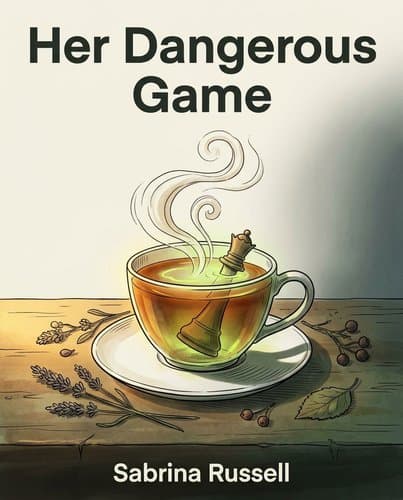
48632491_her-dangerous-game
by Sabrina Russell
When a woman suspects a love potion, the real question isn't whether the magic is real—it's whether she deserves to be chosen at all.
In Brief
When a woman suspects a love potion, the real question isn't whether the magic is real—it's whether she deserves to be chosen at all. Maeve must dismantle a lifetime of inherited smallness before she can accept a man who drinks bitter antidotes and sacrifices his own senses just to prove he means it.
Key Ideas
Self-doubt proves stronger than magic
The love potion mystery is a narrative decoy. Maeve doesn't actually doubt the potion — she doubts whether she deserves to be chosen. No antidote addresses that, which is why the question keeps resurfacing even after Saul drinks three of them.
Costly action proves sincere devotion
Saul's most convincing proof of sincerity is practical and costly: he drinks three doses of bitter antidote and chews a bezoar at a public festival, sacrificing his ability to taste his own baking for a month, specifically so Maeve cannot attribute his feelings to magic. Grand speeches are cheap. This has a price.
Inherited trauma blinds to competence
Maeve's actual competence — quietly producing the shop's most valuable healing salves, identifying a rare shifter-specific poison that stumps a credentialed healer — is visible to everyone who pays attention. Her self-perception isn't humility; it's the inherited conclusion of a child whose father lost interest in her mother when her herbal knowledge stopped being useful.
Antagonist weaponizes her own beliefs
The black moment lands not because the antagonist invents Maeve's weaknesses but because she names the ones Maeve already believes about herself — which is why Maeve's exit feels like her decision and not something being done to her. 'I know who I am' is the saddest line in the book precisely because she's right about knowing.
Competence victories precede romantic resolution
The book's happy ending is earned before the romantic reunion: Maeve pins a sneering healer against a wall, saves a bear cub from poison berries with a potion brewed from her own greenhouse, and receives public vindication from the man who said she wasn't good enough — all before she and Saul exchange a word. The romance ratifies what competence already proved.
Who Should Read This
Readers interested in Urban Fantasy and Novels, looking for practical insights they can apply to their own lives.
Her Dangerous Game
By Sabrina Russell
10 min read
Why does it matter? Because 'is this feeling real?' is always a decoy for a harder question.
The setup reads like a paranormal gag: witches spike the town potion contest, a grumpy bear-shifter baker kisses the wrong woman in front of the whole town, nobody can trust their feelings. Fun. Frothy.
Except the antidote doesn't touch what's broken. Maeve Whisper has spent her whole life inside someone else's verdict — a father who married her mother for magical knowledge and lost interest when Maeve failed to inherit it, a town that sells her healing salves under someone else's name. She is too small, too scared, too limited. When a bear the size of a small building decides she's the other half of his soul, calling it a potion is the least frightening explanation. It doesn't require her to believe she deserves him.
She finds out she does by pinning a contemptuous healer against a wall to save a dying child. The question was never about magic.
The Original Sin Is Played as Farce — And That's What Makes It Work
Down in the basement of a potions shop, three sisters are covered in exploded love potion — chartreuse, viscous, deeply unappetizing — and arguing about who has to drink it. The cauldron belongs to their great-great-aunt Hermia, dug out of a buried basement room with a grimoire months ago. The regional BrewFest is coming up, and the Duprees need a winning entry after four straight losses to the Rathbone warlocks. The potion needs testing. Someone has to volunteer.
Tempest, the eldest, refuses. She doesn't have time for anyone tripping over their feet fancying themselves in love with her. Fleur, the youngest, also refuses. Everyone is already in love with her, she points out, so the data would be skewed. That leaves Phoebe, the middle sister, the one who always ends up doing the dirty work. Except this time she has an alternative.
Their assistant Maeve is upstairs, a timid witch who hides behind the counter when the bear shifter from the bakery comes in to yell at them, which is often. She would never volunteer for something like this. But she's about to make tea.
"That would be terrible and unethical," Phoebe says, when Fleur floats the idea.
Then Tempest turns the challenge back on her. And in roughly the time it takes to fill a flask, Phoebe decides maybe it wouldn't be so bad. Maeve sees few people anyway, and couldn't a little confidence do her good? She heads upstairs, hands Maeve a cup with a warm smile, and accepts thanks she hasn't earned. Tempest calls after her from the basement: tell us if she can taste anything or smell it.
The employee is now a test subject. The ethical line was crossed calmly, in broad daylight, in the same sentence that named it wrong. That gap is the book's engine. The potion reaches Maeve, the BrewFest chaos follows, and a bear shifter named Saul Grimsbane gets pulled into consequences he never volunteered for either. The whole thing runs on farce. But farce only works when the original transgression is real — and Phoebe's is, precisely because she said the right thing out loud before deciding it didn't apply to her.
The Bear Who Drank Three Antidotes to Prove He Didn't Need Them
The most convincing romantic gesture in this book costs Saul Grimsbane approximately one month of his professional life.
After Mayor Elwyn douses the festival's most chaotic judges' table with a wall of ice water (interrupting a kiss that had escalated to Maeve wrapped around Saul like a climbing vine), Saul does not chase her. He demands antidote. All of it. Three full doses, plus a chalky mineral pellet called a bezoar as insurance, choking them down in front of the assembled BrewFest crowd while officials argue about how much antidote a grizzly actually needs. Nobody knows. He doesn't care. He wants zero ambiguity in anyone's mind, especially Maeve's, that what just happened was the potion talking.
Here is what makes this absurd instead of merely heroic: Saul runs a bakery. His ability to taste things is his livelihood, his craft, the thing he presumably cares about more than most of the people in Grimm Mawr. The antidote is described as bitter oatmeal. The bezoar is chalky. He'll be eating his own baked goods for the next month and tasting nothing. He accepts this without hesitation. His sister Sacha, watching all of this unfold, gives him a small bow and waves him toward the parking lot: have at it, brother, go get your mate.
The book treats the whole sequence as comedy — the crowd jumping when he bellows for antidote, the glass shattering when he slams it down, his sister standing between him and the exit like she's blocking a linebacker. But underneath the staging, the math is unambiguous. He voluntarily destroyed his sense of taste for a month, in public, specifically so the woman he kissed could not dismiss what happened as a side effect. That's not genre machinery. That's someone with skin in the game.
When he finally reaches Maeve in her greenhouse (he tracked her by scent to her late mother's sanctuary, a place almost no one else enters), she's still mixing antidote for him. Still trying to undo it. He tells her he probably won't be able to taste his baking for a month, and she blinks at him, recalibrating. He points out that she herself said love potions don't create love, only attraction — so what exactly is she trying to neutralize?
The reader exits this sequence believing him, and that's the setup's small achievement: sincerity proven not by declaration but by sacrifice, and by sacrifice made ridiculous enough that he clearly wasn't performing it for anyone else's benefit. That's also where the problem starts. Because Maeve didn't get to make any of these calculations. She drank something she didn't know she was drinking, felt something she can't be sure is hers, and is now being asked to sort out what's real by the man whose certainty about her seems to have arrived fully formed, before she's had a chance to form any of her own. And that's not a question antidote can answer.
Maeve Has Been Running the Shop's Best Potions All Along — Under Someone Else's Name
When a character keeps deflecting credit with "you're thinking of my mother," the genre convention says that's false modesty, evidence of low self-esteem that the story will resolve. But Maeve Whisper's self-perception isn't modesty. It's the conclusion of a child who watched her father lose interest in her family the moment it stopped being useful to him.
The burn salve Saul's bakery keeps on hand (the reason he has no scars despite years of forgetting his oven mitts) is made by Maeve. It's sold through the Duprees' shop under their name. She was rejected by Botanica Magica, the regional guild, so her work gets distributed through other people's credentials while she stands behind someone else's counter. She mentions this the way you'd mention a parking ticket. The injustice is structural, and she has categorized it as normal.
The moment that makes this visible happens at Cornelius Digby's private botanical garden, a place so sealed off that even Maeve's mother only visited once, decades ago, as a student. Saul arranged access through a standing favor he'd held back for years: a long-running arrangement supplying Digby with baked goods made from the honey badger's extraordinary bees, with a never-deployed batch of baklava as the final payment. When Maeve learns a favor that specific was spent on her, she asks with genuine bewilderment: "You used a favor on me?" Saul's response — "Well, who better to use it on?" — is a simple question because to him it is. To Maeve, it's a category error.
Inside the garden, she immediately identifies Devil's Thimbleberry, a rare Hungarian species almost no one can cultivate, a key ingredient in an all-purpose antidote mentioned in her mother's notebooks, difficult enough to grow that even her mother never managed it. She knows its medicinal uses, its soil requirements, what it protects against. Digby, a reclusive former academy professor who taught her mother and remembers her as one of his few tolerable students, steps out from behind a tree and tells her she knows more about it than most potions masters.
Her response: "You're thinking of my mother."
Her mother is dead. The woman standing in front of Cornelius Digby, naming his rarest plant on sight, is her daughter. Her father's failure was of the quietly surgical kind — the life-extension research that brought him to her mother stalled when Maeve didn't inherit the gift he'd been counting on, and he didn't need to say so. The lesson arrived not through cruelty but through indifference; he still barely registers her presence across a breakfast table. Indifference is harder to argue with because it doesn't give you anything to push against.
What Cornelius's recognition exposes is a gap: not a woman who knows her worth and needs someone to see it, but one who is genuinely skilled with no framework for placing herself in that sentence. The salves work. The plant knowledge is real. None of it appears next to her name.
Felicia Didn't Slam the Door, and That's Exactly Why the Wound Didn't Close
Felicia Borges walks into the Dupree shop without her green boils (recently cured, recently irritated about it) and gets immediately to the point. Saul needs a strong female bear to lead his clan. Maeve is weak, limited, a liability. Any children between them would likely be unable to shift. Felicia advises her to step aside, turns, and leaves. The door closes with a quiet snick.
The book flags this directly: it would have been easier if she'd slammed it. A slammed door is theater — it gives you something to be indignant about, a flash of heat you can argue against. The soft click is something else. It's the sound of someone who didn't need to work very hard. Felicia delivered a verdict and went about her day.
What made it land so cleanly is that Felicia didn't introduce a new argument. She returned an old one. "Little mouse" (Felicia's phrase, or close enough to the one she'd been hearing most of her life) had been running as background noise long before today. Tempest Dupree, just hours earlier in the same shop, had offered the same assessment more gently: Maeve doesn't have the strength an alpha's mate requires. Two women with no reason to coordinate, both arriving at the same conclusion she'd already been given at home, just stated aloud this time. When two people who've never spoken arrive at the same word for you, your brain finds that very convincing.
That evening, Saul finds her in the greenhouse beside her newly planted Devil's Thimbleberry, honey badger curled in her lap, shoulders stiff when she hears his voice. She lays out her case: the potion made it unreal, she'll damage his position, she cares for him too much. He counters everything. She leaves anyway. His last shot: You're being a coward. Why won't you fight for us? She doesn't answer. What she says instead: I know who I am.
She's not wrong about knowing. She's wrong about what she knows. The black moment is Maeve recognizing her own conclusions, stated back to her with better vocabulary and a quietly closing door.
The Moment the Book Is Actually About Involves a Wall, a Healer, and a Poison Berry
The romantic reunion happens in a moonlit meadow: Saul confessing love, Maeve admitting she'd been hiding, both of them finally saying what the book has been building toward. It's earned. It's also not the turning point. The turning point is Maeve in a sickroom, hand wrapped around a credentialed healer's throat, three bears growling at her back.
Saul's nephew Brady — a bear cub impish enough to have previously asked Maeve to please not mate his uncle — has eaten something by the creek that looked like blueberries but wasn't. He's pale, sweating, breathing shallow. The clan healer, long white robes signaling his status, has tried everything he knows and stalled. When Saul brings Maeve in, the healer's assessment is immediate: she's a potion-shop clerk who couldn't get hired at a real establishment, and she could kill the cub if she tries anything.
Maeve crosses the room and pins him to the wall by his throat. She needs his treatment list. Three bears growl, and the healer recites the herbs. None of them produced the sweet-under-decay smell she's been tracking since she walked in — not illness, something the cub ingested. She asks Brady if he ate berries near the creek that tasted different from blueberries. He did. She turns to Saul: Klosinth berries, visually identical to blueberries, sweet enough to attract shifters specifically, and lethal to them. The healer has never heard of the plant.
The antidote is in her greenhouse. Devil's Thimbleberry, a rare plant she'd identified at a reclusive botanist's private garden whose uses she knew from her dead mother's notebooks, goes into hot water, steeped faster than ideal because Brady can't wait. She mashes the berries, strains out the seeds that would make him vomit, spoons the liquid into an unconscious child's mouth, and waits. A few hours later, Brady asks for his mother.
Saul's father pulls her aside before she reaches the door. This is the man who told his son, explicitly, that Maeve wasn't fit to be alpha mate. His reversal is brief and direct: she took charge, she knew what to do, she kept the room calm. The clan owes her. She says "You're welcome, Mr. Grimsbane" and walks outside into the cold.
The romantic confession comes after this. The mating ceremony comes after this. Both are warmer for it. Not because Maeve found confidence she didn't have before, but because the evidence was already in the room. The burn salve in Saul's bakery, the plant knowledge that outpaced a former academy professor, the antidote brewed from memory under pressure. All of it was real.
The expected beat here is a character who breaks open and surrenders. What this book does instead is build toward a moment where Maeve doesn't need to surrender anything. She's already in the room. She's already right. The clan's most skeptical member told her so to her face.
The Bond That Can't Be Broken Still Required Her to Choose It
The mating ceremony has a gap where Maeve's father was supposed to stand. The book doesn't dramatize his absence. It notes it, moves on.
What fills the space is Brady — the cub she saved with a potion brewed from memory and a healer briefly pinned to a wall — arriving in a tiny suit, tongue pressed to his lips in full concentration, to cut in on her dance. The same kid who once asked her, very seriously, to please not mate his uncle.
The mate-bond is described in the language of permanence — souls fused, irreversible by design. It sounds like it forecloses choice. But the novel stops, mid-ceremony, to ask whether Maeve is choosing it anyway. She is. That's the whole argument, and it lands right there: not fate rescuing her, but a woman who already proved herself deciding, of her own considerable accord, that she wants this too.
Notable Quotes
“Maeve? Maeve, are you here? We need you.”
“I need your help. Please. Come with me. It's Brady.”
“I need your help. Something is wrong with Brady. He's throwing up, has the chills. We don't know what's wrong. The healer isn't sure what's going on. Please?”
Frequently Asked Questions
- What is the central conflict in Her Dangerous Game?
- Her Dangerous Game centers on Maeve, a skilled herbalist who doubts whether she deserves genuine affection, not whether a love potion explains her suitor's feelings. This inherited self-doubt masks the novel's true conflict: a person's inability to accept that they are worthy of being chosen, even when evidence contradicts their negative self-perception. The love potion mystery serves as a narrative decoy. No antidote can address Maeve's core uncertainty because the problem isn't external—it's her internalized belief that competence isn't enough to make her worthy of love. This question resurfaces even after multiple attempts to prove the potion's absence.
- How does Saul prove his love is genuine in Her Dangerous Game?
- Saul proves his love is genuine through a costly, practical sacrifice rather than words or grand gestures. He drinks three doses of bitter antidote and chews a bezoar at a public festival, sacrificing his ability to taste his own baking for a month. This ensures Maeve cannot attribute his feelings to magic. Grand speeches are cheap; Saul's proof has a price. By willingly enduring physical discomfort and surrendering something central to his identity as a baker, he provides evidence that his feelings survive external verification. The sacrifice itself becomes more persuasive than any declaration of love could be.
- What are Maeve's actual strengths in Her Dangerous Game?
- Maeve possesses genuine, observable competence that others recognize even if she cannot see it herself. She quietly produces the shop's most valuable healing salves and identifies a rare shifter-specific poison that confounds a credentialed healer. Her self-doubt is not humility—it's an inherited conclusion rooted in her childhood, when her father lost interest in her mother once her herbal knowledge stopped being useful. Maeve learned that competence alone cannot guarantee someone will value you, and this belief colors how she interprets her worth. Her abilities are real and demonstrable, but she cannot access their value until she believes in herself.
- Does Her Dangerous Game have a satisfying ending?
- The ending is deeply satisfying because it's earned before the romantic reunion. Maeve's happy ending begins when she pins a sneering healer against a wall, saves a bear cub from poison berries using a potion from her greenhouse, and receives public vindication from someone who once said she wasn't good enough. Only after proving her competence does she and Saul exchange meaningful words. The black moment doesn't invent Maeve's weaknesses—it names ones she already believes about herself, making her exit feel like her choice. The romance ratifies what competence has already proven true.
Read the full summary of 48632491_her-dangerous-game on InShort