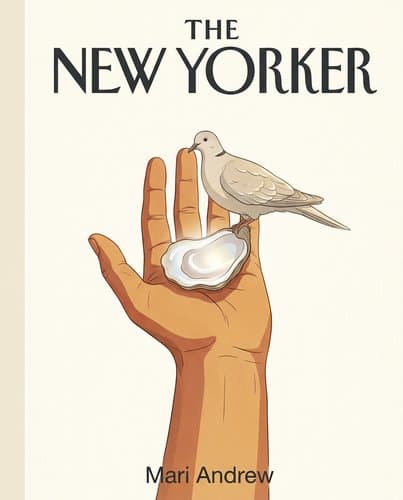
221754289_how-to-be-a-living-thing
by Mari Andrew
We've been taught to transcend our animal nature, but Mari Andrew argues that our suffering lives precisely in that denial—and that learning to be a living…
In Brief
We've been taught to transcend our animal nature, but Mari Andrew argues that our suffering lives precisely in that denial—and that learning to be a living thing among living things, as gloriously needy and inconsistent as any oyster or dove, is the path back to wholeness.
Key Ideas
Reframe shame as human nature
When you feel ashamed of your neediness, grief, or inconsistency, name it as 'human-ing' — the natural behavior of your species — rather than a personal moral failure.
Convenience creates anxiety not relief
Notice when convenience is producing orca-level anxiety rather than relief. Friction, striving, and difficulty are not problems to be eliminated; they are the conditions your nervous system was built for.
Mirror emotions instead of fixing
In the next conversation with someone in pain, try mirroring instead of fixing. 'This seems really scary' or 'It makes no sense' will reach them where advice cannot.
Attention is your finite currency
Treat attention as a finite biological reserve. Ask what is worth the internal storm before you give your full focus to a screen, a feed, or an outrage cycle.
Commitment solves loneliness not feelings
Commit to at least one person, place, or community you cannot simply opt out of when it gets hard. Loneliness is not a feeling problem — it is a commitment problem.
Face discomfort to reclaim wholeness
Practice looking directly at what makes you uncomfortable — a disabled person, a rat, a pigeon, a grieving stranger — as a discipline for reintegrating the parts of yourself you have tucked away out of fear.
New life grows from endings
When your world ends — relationship, identity, home, era — look for what the crocodile looks for: not evidence that everything is fine, but the first sign of new life in the charred landscape.
Who Should Read This
People working on personal growth in Mindfulness and Self-Improvement, especially those tired of generic motivational advice.
How to Be a Living Thing: Meditations on Intuitive Oysters, Hopeful Doves, and Being Human in the World
By Mari Andrew
13 min read
Why does it matter? Because the shame you feel about your neediness, grief, and inconsistency is borrowed from a worldview that got biology exactly backwards.
You have probably spent real time convinced that the problem is you — too needy, too distracted, too grief-prone, too inconsistent to be taken seriously as a functioning adult. The cats and gorillas and oysters of this world have no such opinion. They are busy being exactly what they are, without apology or self-improvement plan, and it turns out that watching them closely enough will quietly dismantle the story you've been telling about your own failures. Mari Andrew's How to Be a Living Thing argues, through biology and personal confession, that the qualities you've been most embarrassed by aren't defects in your human character — they're evidence of it. The animals already knew. This book catches you up.
The Myth That Being Human Means Transcending the Animal
There's a particular flavor of shame that arrives around 2 a.m., the kind where you replay a conversation and decide you were too much — too needy, too reactive, too visibly affected by something that a more evolved person would have shrugged off. The feeling is familiar because most of us carry some version of it: a quiet suspicion that other people have their emotional lives better organized, and that the gap between them and us is a personal failing we should have fixed by now.
Mari Andrew has a cat named Sunny who was pulled from a shelter euthanasia list and has spent years thanking no one for it. Sunny won't cuddle. She ignores her name. She hisses. She is, by any conventional measure, a difficult pet — needy enough to fall apart when left alone, yet avoidant enough to refuse the comfort she clearly wants. Andrew loves her without qualification anyway, and she doesn't frame Sunny's contradictions as character flaws. When Sunny knocks something off a shelf, Andrew doesn't think: bad cat. She thinks: cat-ing. The behavior belongs to the species. It carries no moral weight.
The book's central argument is that the same courtesy almost never gets extended to humans. We have inherited a definition of humanity built on distance from the animal world — the idea that what makes us human is precisely what sets us apart from our instincts, our bodies, our messiness. The trouble is that this framework quietly classifies anything raw or inconsistent or anything that shows need as less-than.
Flailing, contradicting yourself, needing more than feels reasonable — these are not evidence of a character you failed to improve. They are the natural range of a species. You're human-ing. Sunny would understand.
Ease Is Not What You Were Built For
Imagine spending a year at a spa — all meals delivered, no obligations, nothing required of you ever. Sounds restorative for a week, maybe two. Extend it indefinitely and something starts to corrode. That intuition is exactly what Andrew found confirmed in the biology of orcas.
During the COVID lockdowns, she came across research by Lori Marino, a scientist who studies whales held in marine parks. The picture Marino painted wasn't what SeaWorld's marketing suggested. Orcas in captivity — fed on schedule, protected from predators, asked only to perform a few choreographed leaps per day — developed catastrophic psychological symptoms. Some banged their heads against tank walls. Some tried to hurl themselves out of the water entirely. Not because their lives were difficult. Because they weren't difficult enough. Evolution had spent millions of years designing these animals for an ocean full of complexity: hunting prey across miles of open water, navigating social hierarchies within the pod, contending with parasites and rivals and shifting currents. A swimming pool with fish delivered on schedule wasn't rest from all that. It was the removal of everything the animal was built to do, and the result was a kind of existential agony.
Andrew read this while sitting in the same chair where she'd spent weeks attending baby showers on a screen, tracking gnocchi deliveries, and signing up for virtual museum tours. The frictionless convenience she'd assembled around herself — designed to soothe the difficulty of being trapped at home — had produced its own particular nausea. She hadn't named it until the orcas named it for her: the stressfulness, she writes, of so-called ease. The need for difficulty isn't a personal weakness or a failure to optimize. For any animal shaped by a complex world, struggle is part of what a good life is made of.
A Howl Is the Only Language All Living Things Share
Penny Patterson spent years teaching sign language to a gorilla named Koko, then one day handed her a small kitten to keep as a companion. Koko named her All Ball, carried her everywhere, and was gentle in the way you wouldn't expect from a 280-pound animal. Then All Ball wandered out and was struck by a car. When Penny signed the news to Koko, the gorilla signed back: 'Bad, sad, bad.' Critics said it was mimicry — Koko was just reflecting the expression on her trainer's face. Maybe. Words are slippery even between humans who share a mother tongue. That night, though, Koko made a sound no vocabulary could dismiss. A hooting cry, audible from across the zoo, that her keepers recognized as something she hadn't produced since infancy — the cry of 'someone's leaving me.' She pounded the walls until morning.
Grief lives in that sound, not in the words we build around it. A father who lost his daughter to a truck while she was biking home from work wrote five pages of memories about her — funny stories, small details, the full record of a life — and then arrived at the end and wrote two words: 'I ache, I howl.' You understand it with your body before your mind has finished reading it.
The sound is the thing. A hooting gorilla, a father at the bottom of five pages, elephants circling a dead herd member and producing a low sobbing that sounds nothing like their usual calls — all of it the same frequency, recognized across every species that has ever had something to lose. You've made that sound, or something close to it. So has Koko. That's not a metaphor.
And it doesn't stay in the mind, either. It moves through the body — which is why Plato's insistence on separating the two costs us something important when it comes to understanding what grief actually is.
You Are a Body, and Plato Has a Lot to Answer For
The idea that your mind is the real you, and your body a kind of embarrassing luggage, feels less like a choice you made and more like the air you breathe. You manage your body, discipline it, apologize for it. You override its signals with enough coffee and willpower to function. You've probably never stopped to ask where this arrangement came from — but it came from somewhere specific, and the consequences have been catastrophic.
It came from Plato. Ancient Greece was brutal — constant war, rampant slavery, bodies routinely broken or stolen by others. Plato's philosophical escape hatch was elegant: the mind is the true self; the body is just the crude vehicle hauling it around. While bodies could be humiliated and owned, the mind remained pure and untouchable. You can see why it was appealing. What's harder to see is the trap it sprung. Once you've established that a person's essence lives somewhere other than their body, it becomes possible — even logical — to treat the body as an object. Slavery follows. Eugenics follows. The standard office schedule, designed not around human circadian rhythms but around the needs of manufacturing companies, follows.
Andrew's own body made this undeniable after a month-long hospital stay. She emerged with graying skin and dwindling muscles — the signature of someone who had spent weeks overriding every physical signal in favor of managing, enduring, getting through. Bears, by contrast, spend months dormant and emerge with healthy, gleaming coats, their bodies having regulated themselves with flawless precision the whole time — because no philosopher ever taught them their instincts were suspect. That gap isn't a coincidence.
The rule Andrew offers her writing students — 'you are a body' — comes out of watching people struggle to write honestly about physical experience, as though their own sensations needed a permission slip. It sounds simple. It isn't. It's a repudiation of centuries of inherited contempt for the one home you've ever actually lived in.
The Most Radical Thing You Can Say to Someone in Pain Is Nothing Useful
Mari Andrew walked into her hospital chaplaincy internship carrying, by her own admission, the spiritual confidence of someone who had read several meditation books and was ready to deploy them. Then she met Theo — curled into himself on a stained bed, condensed to the smallest possible human shape — and he responded to her scripted offer of emotional support with a sob that seemed to drag every loss he'd ever experienced into the room at once. Every prepared phrase dissolved on contact. She stood there, useless in the most clarifying way.
What she learned over the weeks that followed is something most of us have to unlearn our entire social training to understand: the most healing thing you can offer someone in pain is not perspective, not hope, not a reframe. It's confirmation that the pain is real. A woman in her ward recited the evidence of her own goodness — a hard life, decency maintained throughout, and still this — and asked the unanswerable question: why? Andrew felt the pull to answer, to find the loose thread of meaning that would tie it up. Instead she said: it's unfair, it makes no sense. The woman softened. She laughed, a little. Not because the pain had been fixed, but because someone had finally stopped trying to fix it.
The formula Andrew developed sounds almost embarrassingly simple: mirror the patient's language back to them. 'I'm scared' becomes 'this seems really scary.' The effect was disproportionate to the effort, which tells you something about how rarely it happens. We've been trained — by productivity culture, by a medical system that measures recoverable bodies, by the inherited suspicion that suffering is a problem to be solved — to treat witnessing as a waypoint on the way to fixing. The radical act is making it the destination.
Loneliness Is Not a Feeling Problem — It's a Commitment Problem
What if loneliness isn't about having the wrong people in your life, but about how few obligations you have to any of them?
Gibbons — small, acrobatic apes living across the forests of Asia — mate for life. What makes this more than a biological footnote is what they do with that commitment: over time, two gibbons weave their individual calls into a single shared song, a duet that belongs to no one else. It becomes the sound of their particular bond — what calls each of them home. Andrew recognized the same impulse in a small compromise at her own wedding, where she and her fiancé landed on Blink-182's 'All the Small Things' as the song to walk down the aisle to. It was neither person's first choice and exactly both of theirs. A private code. The beginning of a shared language that would belong only to them.
That's what commitment actually produces — not safety from conflict, but a song that outlasts it. Andrew's friend Amanda, a peace education scholar, put the alternative plainly: when you have infinite options, infinite mobility, infinite access to new people who already agree with you, there's no rational case for staying. The math of unlimited options quietly dissolves the argument for working anything out.
Andrew noticed something driving through the tiny towns of Wyoming — places with populations of 50, 88, 46 — and suspected that whatever they had figured out was connected. In a town of 46, you cannot opt out of your neighbors. Survival, historically, required getting along with people you found difficult. You stayed not because you'd found the right people, but because leaving wasn't an option. The commitment wasn't chosen — it was structural. And it worked.
Her own solution was a church two blocks from her apartment where she has shown up, week after week, among people she knows very little about, with whom she has almost nothing on paper in common. The loneliness didn't lift because she found her people. It lifted because she obligated herself to some people, and let them obligate themselves to her. Commitment isn't the reward you get after loneliness ends. It's how loneliness ends.
Disgust Is a Map of What You're Afraid to Admit About Yourself
Disgust is a social technology, not a natural reaction. The feeling arrives dressed as instinct — the flinch, the recoil, the 'ugh' — but it was built for a purpose: to draw a bright line between you and whatever reminds you of what you fear most about yourself.
When Mari Andrew received a wheelchair after months of paralysis and finally got to leave her apartment, she felt something close to triumph. Then she noticed what the wheelchair did to people around her. Café patrons looked away. Waiters acknowledged her with the kind of careful distance that says 'I want to be kind, but I don't want to be associated.' She recognized the behavior immediately — she'd performed it herself, before she became the person being looked away from. Later, she mentioned to her hairdresser that lower Manhattan had almost no wheelchair-accessible restaurants. Her hairdresser, whose teenage daughter will never walk or talk, didn't express outrage. She just said: no one wants to see disabled people. It's too confronting.
That blunt diagnosis is the whole map. Disgust doesn't arise from genuine threat — disabled people, rats, pigeons, the 'weird' kid sitting alone at lunch. It arises from proximity to mortality, failure, and dependence. The people we recoil from hold up a mirror to the losses we work hardest not to think about. A wheelchair says: your body could betray you. A person asking for change outside the grocery store says: stability is not guaranteed. The very elderly say: this is where all of it goes. So we look away, fund eradication programs, cross the street, and tell ourselves we're just responding naturally.
The lie is in the word 'naturally.' Disgust is trained, and it is directed. The creatures and people we collectively agree to revile reveal far less about them than about which fears a given society most urgently needs to quarantine. Recognizing that doesn't make the flinch disappear. But it changes what you do next — whether you let the flinch be the end of the story, or the beginning of a better question.
Your Attention Is a Finite Reserve You Keep Giving Away for Free
Think of a big cat — not the drowsy version stretched across a rock, but the version that has spotted something worth hunting. Everything changes at once: the body drops low, the eyes lock on, the world outside that single point of focus ceases to exist. A panther in that mode isn't choosing to be consumed by its prey. Evolution chose it. The intensity is the point — because the sprint that follows will cost everything the animal has, and it cannot afford to summon that storm for the wrong target.
Andrew noticed this same mechanism in her cat Sunny, who can sleep through earthquakes yet will transform mid-nap into something predatory when a sock slides across the floor. The whole feline family, from apartment tabby to South Asian panther, shares the same design: conserve, attend carefully, spend only when the target is worth it. Attention is a limited reserve, not a tap left running.
Humans were built the same way. Then smartphones handed us something our nervous systems cannot distinguish from an ancient threat. The email from a boss requesting a private meeting triggers the same quickened pulse as a rustle in the undergrowth. A comment from a stranger online focuses every cell in the body with the same urgency our ancestors reserved for stalking prey. The screen becomes the hunt — and unlike the panther, we never get to decide whether the target is worth the storm we summon. The decision gets made for us, hundreds of times a day, until the reserve runs dry.
When Andrew quit social media, she had to cook her own perspective instead of being handed one. She found she could hold a nuanced view of a cousin whose politics differed sharply from hers — because she also knew this person had clawed back from addiction through sheer will. That kind of relational complexity requires slow attention. Reaction is immediate and cheap; response is something you build. Protecting the reserve long enough to actually respond to what matters isn't a self-optimization tip. It's how you get back to a life where the things you spend yourself on can actually pay you back.
The Broken World Has Always Been the Beginning, Not the End
She was a physician. Then she lost her two daughters and their father in a single plane crash, and the career she had spent a lifetime building became unreachable — not because she couldn't practice medicine, but because the person who had chosen medicine no longer existed. Years passed. Something small stirred. A childhood memory of decorative tiles. She followed it, cautiously, until she was making mosaics — and then teaching other grieving people to make them, guiding hands that needed to do something with all that broken material. The form is the argument: you take the shattered pieces, and you arrange them into a new image. Not the original. Something else entirely.
This is what the Cretaceous-Paleogene extinction makes literal. The asteroid hit with the force of ten billion nuclear bombs and turned a Technicolor world to ash in an afternoon. The dinosaurs had run the planet for 165 million years. Then they were gone. In that scorched silence, the small warm-blooded creatures who had been hiding in the undergrowth came forward. We are here because that ending was total. The catastrophe was not the interruption of life — it was its precondition.
Crocodiles survived that aftermath by changing constantly: reshaping their bodies, adjusting to whatever food a charred world still offered. A crocodile in the weeks after the impact would have walked the ash-covered ground with its head low, nosing at debris, eating anything that moved — insects, rotting fish, whatever the die-off left behind. Scanning ruin for signs of life and finding them. That is not optimism as a mood. It is what a body does when staying alive is still possible.
What the mourning doves understand, and the ceramicist understands, and the crocodile understands, is something the rest of us keep trying to argue our way out of: the world ends, and then something begins. Always. The physician did not rebuild by deciding to be resilient. She followed the smallest available thread — tiles, color, her own hands — and let the new life assemble itself around that. The doves returned to the same balcony where their eggs had failed and wove a new nest from plastic straws and cigarette butts. Not a metaphor for hope. Just the next thing a living creature does.
You are not naive for rebuilding. You are not in denial for believing something comes after. You are doing the most biologically consistent thing available to a species shaped by loss. The question is only whether you can stay present long enough — in your body, in your commitments, in the specific grief in front of you — to notice what is still there.
Julian of Norwich Knew That Claiming Your Animal Nature Is a Revolutionary Act
In 1349, a seven-year-old girl in Norwich built tiny houses beneath the blackthorn trees — little shelters for fairies, the way children do when the world still feels hospitable to magic. Within two years, half the people she knew were dead. The Black Plague had arrived, and with it came the particular theological cruelty of her era: the disease was punishment. Humans had sinned. God was furious. The body itself was suspect, a site of corruption.
That girl grew up to be Julian of Norwich, and by the time she was thirty, living through wave after wave of plague, she had a series of visions that led her to the most dangerous conclusion available in medieval Europe: human nature is inherently good. Not redeemable if you suffer enough. Not tolerable if you transcend your base instincts. Good. Now. As it is.
This was a direct assault on what Mari Andrew calls Empire thinking — the Roman inheritance that sorted the world into dominators and dominated: men over women, mind over body, civilization over nature. That hierarchy needed a story about the human animal as something shameful to be overcome. Julian dismantled the story at the foundation. She described the union of body and soul as a 'glorious union,' not a problem to be managed. She insisted no human sin caused the plague — a claim that mattered beyond theology, because her contemporaries were blaming the Jews for it, burning them in the streets.
She arrived at this not despite her grief but through it. Andrew describes her as someone who fell back in love with the world the way you might fall back in love with a long-term companion: by attending to its small sweetness rather than demanding it be something else. The conclusion she reached after decades of loss was four words that contain the entire book you've just read: 'All shall be well.'
Not a denial of suffering. A refusal to let suffering be the final word about what we are. To claim your grief, your body, your need for others, your animal nature — this, Julian understood, was the most radical act available. The animals have always known it. Now you do too.
What the Animals Already Know
Somewhere in Brooklyn, Mari Andrew's cat is napping — not because she earned it, not because she optimized her schedule around it, but because she is an animal and this is what animals do. Outside, a raccoon with a bad leg is crossing the street at exactly the pace its body allows. Neither of them is working on themselves. Both of them are, without question, alive.
Julian of Norwich survived three waves of plague and arrived at all shall be well — not because the math added up, but because she finally stopped auditing herself against some inhuman standard and came back to what she actually was: a creature of grief and wonder and body, living on an earth that kept going regardless. That's what all of it is asking. Not self-improvement. Not transcendence. Just the long, undramatic return — to your body, your grief, your need for others — and the discovery that there was never, not once, anything wrong with any of it.
Notable Quotes
“this beautiful human nature out of which we all arise.”
“All shall be well, and all manner of things shall be well.”
“You know the guy who thinks oysters get signals from the sky?”
Frequently Asked Questions
- What is the main argument of 'How to Be a Living Thing'?
- The book argues that human suffering stems from rejecting our animal nature rather than embracing it. Mari Andrew draws on animal kingdom examples to help readers reframe feelings like neediness, grief, and inconsistency—encouraging them to see these as natural "human-ing" rather than personal failures. By learning to live with our biology instead of fighting it, readers can find freedom from shame. The book positions our animal nature not as something to overcome, but as the foundation for living authentically and peacefully within the conditions our nervous systems were built for.
- What are the key takeaways from Mari Andrew's 'How to Be a Living Thing'?
- Mari Andrew offers seven transformative reframes. When ashamed of neediness, call it "human-ing"—natural species behavior. Notice when convenience produces "orca-level anxiety"; friction and difficulty are conditions your nervous system was built for. Practice mirroring in conversations: say "This seems really scary" or "It makes no sense" rather than offering advice. Treat attention as a finite biological reserve. Recognize that "Loneliness is not a feeling problem — it is a commitment problem." Practice observing discomfort directly. Finally, when your world ends, "look for what the crocodile looks for: not evidence that everything is fine, but the first sign of new life in the charred landscape."
- How can I apply Mari Andrew's teachings about embracing my animal nature?
- Start by naming difficult feelings as natural species behavior. When you feel neediness or grief, recognize it as "human-ing." Assess whether your routines create relief or the "orca-level anxiety" that convenience paradoxically produces. In conversations, try mirroring: "This seems really scary" reaches people where advice cannot. Before scrolling or engaging outrage cycles, ask whether your limited attention is worth the internal storm. Commit to at least one person or community you cannot opt out of—recognizing that commitment, not mere feeling, heals loneliness. Practice tolerating discomfort by observing what unsettles you, reintegrating the parts of yourself you've tucked away.
- Is 'How to Be a Living Thing' worth reading?
- This book is valuable if you struggle with shame around normal human needs or feel anxious despite modern conveniences. Andrew's framework reframes neediness, grief, and commitment as natural rather than pathological. Her practical advice is immediately applicable: mirror before fixing, question your attention's worthiness, embrace friction. The prose is warm yet biologically grounded. You'll benefit if you want to understand suffering not as personal failure but as misalignment with your animal nature, and you want concrete tools for integrating the full spectrum of human experience. Best for readers ready to stop fighting their biology.
Related Book Summaries
Read the full summary of 221754289_how-to-be-a-living-thing on InShort