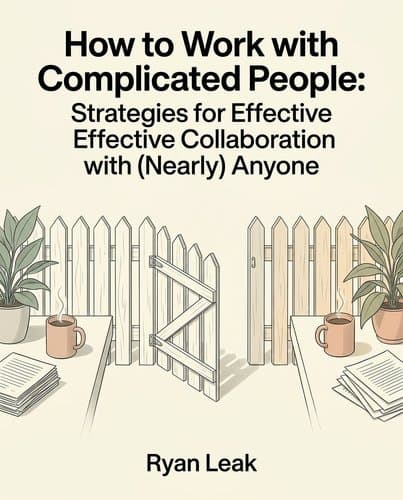
215008809_how-to-work-with-complicated-people
by Ryan Leak
Most workplace conflicts begin not with a difficult coworker but with a mirror you haven't looked into yet. Ryan Leak reveals how self-awareness, strategic…
In Brief
Most workplace conflicts begin not with a difficult coworker but with a mirror you haven't looked into yet. Ryan Leak reveals how self-awareness, strategic empathy, and one powerful question—'What story am I telling myself?'—can transform nearly any frustrating relationship into effective collaboration.
Key Ideas
Apply 74% test to your own behavior
Run the 74% test on yourself before your next difficult conversation: assume you are also someone's complicated colleague, and ask what quirks of yours might be contributing to the friction
Decode leader values through 3 Cs framework
Use the 3 Cs (Celebrate, Champion, Complain) to decode what your leader actually values — read their emails and meeting patterns for clues before trying to influence them
Question your narrative about difficult colleagues
Replace the instinct to label a colleague 'difficult' with the question 'What story am I telling myself about this person, and what information am I missing?'
Seek understanding before defending in conflicts
When a conflict escalates, try 'Help me understand what's going on' before defending the policy — the presenting problem is almost never the actual problem
Distinguish complicated from toxic relationships
Distinguish between complicated and toxic: apply curiosity to the former and a picket-fence boundary to the latter — healthy limits allow for connection while marking where your autonomy begins
Value dissenting voices as organizational assets
Treat the dissenting voice in any meeting as a potential asset, not a disruption — BlackBerry lost $70 billion by silencing exactly that person
Set expiration dates on grudges
Set an expiration date on bitterness: holding a grudge costs you the mental energy you need for the future, regardless of whether the person who wronged you deserves your forgiveness
Who Should Read This
Business operators, founders, and managers interested in Organizational Behavior and Team Building who want frameworks they can apply this week.
How to Work with Complicated People: Strategies for Effective Collaboration with (Nearly) Anyone
By Ryan Leak
10 min read
Why does it matter? Because the person you're most frustrated with might be you.
Right now, you're picturing someone specific. Maybe it's the colleague who replies to your emails with a single word, or the manager who treats every meeting like a tribunal. You're certain the workplace would run smoother if they'd just get their act together. Here's the problem with that certainty: 74% of people believe they're less complicated than average — which is statistically impossible, and quietly hilarious. Somebody is that complicated person in someone else's story, and statistically, sometimes that person is you. Ryan Leak's book doesn't let you off that hook, but it doesn't leave you dangling on it either. It hands you a framework for understanding why difficult people behave the way they do — and why their friction, once you know what to look for, might be exactly what you and your team need.
74% of People Think They're Easier Than Average — and That's Impossible
Nearly three-quarters of Americans believe they are less complicated to work with than the average person. That's a mathematical impossibility. If 74% of people are convinced they're easier than average, a whole lot of them are wrong — and statistically, you're probably one of them.
Leak doesn't exempt himself: he's the guy who vacuums in front of dinner guests and once refused to enter a friend's home because of a dog phobia, until a terminally ill friend forced the issue. He isn't confessing to minor quirks. He's establishing that the author of a book about difficult people is, without question, someone else's difficult person — and that no one is a reliable narrator of their own reasonableness.
The story that proves this most cleanly involves a woman named Lucy. For eight years, her colleagues labeled her rude because she never responded when people greeted her in the hallway. Eight years of resentment, quiet avoidance, and settled verdict — until a video call finally revealed she was deaf in one ear and simply couldn't hear the greetings at all. The story isn't really about Lucy. It's about how fast we convert a gap in our information into a conclusion about someone's character.
That's the book's real starting point: before you develop any strategy for handling a difficult colleague, you have to reckon with the likelihood that somewhere, someone is developing a strategy for handling you.
The Irritating Colleague Is Probably Standing Between You and Disaster
Think of your immune system. The sneezing, the fever, the inflammation — none of it feels like help. It feels like the problem. But remove it entirely and a minor infection kills you. The friction is the protection.
That reframe is what happened to BlackBerry. In 2012, after Apple and Google had already begun dismantling the smartphone empire BlackBerry's parent company built from scratch, an analysis of the board revealed that all eight outside directors shared nearly identical professional backgrounds — accountants, economists, and finance people, every one of them. Same training, same instincts, same blind spots. When the iPhone arrived in 2007, they categorized it as a consumer toy and kept their eyes on the business market they believed they owned. Nobody in the room had the mental architecture to argue otherwise. Or if they did, the room had long since stopped being safe for that kind of argument. The result wasn't just a missed product cycle — it was $70 billion in lost market value and the slow death of a company that had invented the market it eventually abandoned.
The point isn't that BlackBerry needed more conflict for its own sake. It's that the person asking uncomfortable questions — the one who makes meetings run long, who won't let the consensus settle, who insists on playing devil's advocate one more time — is performing exactly the function the immune system performs. They're the cognitive diversity the group needs to avoid talking itself into disaster. Strip them out in the name of efficiency and you get a room full of people confidently agreeing their way off a cliff.
Most of us have spent years treating that person as a tax. The energy drain. The reason the 45-minute meeting became 90. But the uncomfortable colleague and the catastrophic blind spot tend to cancel each other out. One usually prevents the other. Which means the irritation you feel in the moment is frequently the price of the mistake you won't make later — and that changes the calculation entirely.
'Complicated' Is Usually Just a Label for 'Different From What I Expected'
A year after dismissing a player named Michael as one of the most frustrating people he'd ever dealt with, an NBA coach told Ryan Leak something that stopped him mid-interview: 'I'm all the way in love with him now.' Same player. Same habits. Same relentless, exhausting drive to do more, go harder, move faster. What had changed was the coach's willingness to actually look.
He'd inherited a narrative. Scouts, former coaches, front office gossip — all of it had arrived before Michael did, pre-loading the coach's brain with a verdict before a single practice. When he finally set that down and got curious, what he found under all the friction was almost disarming: Michael's intensity came from a genuinely pure place. The coach put it plainly — asking an ex-boyfriend for a reference before a first date is a terrible way to start a relationship. You've already handed your perception to someone with an agenda.
Leak argues this is how most 'complicated' labels get built. We inherit a reputation, or we bump into someone whose pace or priorities differ from ours, and the brain does what brains do: it fills the gaps with a story. Usually that story casts us as the reasonable one and them as the problem. Leak calls this being an unreliable narrator in your own life — technically accurate from where you're standing, but missing most of the evidence.
Leak's prescription is to lead with generosity — not as something the other person earns, but as your opening position. The person who seems combative might simply be direct in a way that unsettles you. The one who reads as disorganized might be the most creative thinker on the floor. Neither reframe is naïve — you're not pretending the friction doesn't exist. You're asking whether the story you've told yourself about where it comes from might be missing a chapter.
What makes the coach's turnaround worth sitting with is that Michael didn't change. The coach updated his file. He stopped treating a year-old stigma as a fact and started treating a person as someone still in the process of becoming. Which is, of course, what all of us are — and what we quietly hope the people around us remember about us too.
You Can't Read the Room If You Don't Know the Language
What separates someone who can work with almost anyone from someone who keeps hitting the same walls? Not patience. Not emotional control. It's fluency — and most of us are trying to influence people in a language we've never learned.
Before Leak took the stage at a hair and makeup convention — 800 industry professionals, zero overlap with his background — he spent an hour learning enough of their vocabulary to signal he'd done the work of giving a damn. Their trust shifted. Not because he'd changed what he was saying, but because he'd crossed into their frame of reference before asking them to cross into his. That instinct scales.
For working with people above you in an org chart, where miscommunication costs the most and feedback arrives the slowest, Leak offers a three-signal framework for decoding what a leader actually values — since most of them won't tell you directly. Watch what they celebrate: the behaviors they praise out loud, whether that's speed, creativity, or decisiveness. Watch what they champion: where the budget goes, which metrics they pull up first. And watch what they complain about: the friction points they return to, the things that visibly drain them.
When Mark Cuban bought the Dallas Mavericks in 2000, he sat with fans, argued with referees, and personally answered complaint emails. A fan mentioned not being able to see the shot clock; new three-sided clocks appeared on the court within weeks. You didn't need his mission statement to understand what Cuban valued — you just had to watch where his attention went. Within three years, revenue had more than doubled.
Curiosity Is the Only Move That Actually Works on the Genuinely Difficult
A man is making a scene at the front desk of a fitness club. He pays $300 a month, he's explaining — loudly — and that should entitle him to bring whoever he wants, whenever he wants. The manager watches him talk over her, tries to explain the guest pass policy, watches him get louder. So she does something counterintuitive: she brings him into her office, sits him down, and asks four words. Help me understand what's going on.
What comes out has nothing to do with guest passes. His sister-in-law is visiting from overseas for two months. His wife is battling breast cancer and hasn't set foot in the gym in months. He's watching money leave his account for a membership a sick woman can't use, and he's been too overwhelmed to figure out what to do about it. The policy argument was the surface. The actual conflict was grief, financial pressure, and the specific helplessness of watching someone you love get sicker.
The manager didn't win the argument. She dissolved it. She refunded the wife's membership and set the sister-in-law up with her own. The man left with money back in his account, a solution he hadn't known to ask for, and — this is the part that doesn't show up in the policy manual — the feeling that someone had actually seen him.
Leak's argument is that curiosity is the only move that consistently works on people who seem genuinely unreasonable. The presenting conflict is almost never the actual conflict. Someone arguing aggressively about a rule is usually telling you, in the only language available to them in that moment, that something else is wrong. Trying to win the surface argument is like treating a fever with a cold cloth — you're addressing the symptom while the infection runs.
'Help me understand what's going on' works because it doesn't require the other person to be reasonable first. It meets them where the real pressure is. The gym scene is a clean illustration of this, but it's worth knowing the pattern holds at scale: Leak's survey of 1,000 working Americans found that effective collaboration with difficult people correlates with a 44% increase in job satisfaction. That's not a reward for being nice. It's what happens when you stop fighting a conversation that was never really about what it appeared to be about.
Which raises the obvious question: does this work on everyone? The honest answer is no — and that's where things get more complicated.
Some People Aren't Complicated — They're Just Toxic, and That Requires a Different Move
Not every difficult person is waiting to be understood — some are simply toxic, and applying curiosity there doesn't dissolve anything. It just exhausts you. This is the distinction Leak names late in the book, and it reframes everything that came before: the strategies around generosity and listening are designed for complicated people, the vast majority. A small minority are something else — think of the colleague who has made an identity out of making everyone around them pay for their own misery. You can't listen your way out of that. The move is a boundary.
But the mental image most of us carry for "boundary" is wrong. We picture a castle wall — drawbridge up, moat filled, archers at the ready. That kind of boundary is defensive, hostile, and ultimately isolating. It says: you're a threat, and I'm fortifying against you. Leak offers a different image: a picket fence. A picket fence marks where your property ends and theirs begins without cutting off the relationship. You can still talk across it. You can still lend tools or pass cookies over the top. What you can't do is let them wander into your yard and rearrange your furniture.
The practical difference matters, especially when manipulative colleagues use existing goodwill to erode the line over time — what Leak calls boundary creep. The mechanism sounds like: "You've never let me down before." That sentence doesn't ask for anything. It recruits your own reliability as leverage, making refusal feel like a betrayal of your own character. Naming it as a tactic is half the defense.
The other half is holding the line without burning the relationship. Instead of telling a boundary-crossing boss they don't compensate you for after-hours availability, Leak suggests: "My kids are young — I generally don't check email after I leave work." Same boundary. Entirely different relational temperature. The picket fence stays up, but the gate doesn't slam.
Forgiveness Isn't Absolution — It's the Only Way to Get Your Energy Back
Imagine scuba diving with an anchor chained to your wrist. The coral reef is right there — color, movement, everything you came to see. But you're pinned to the seabed, burning through air just staying in place. That's resentment. Holding on isn't noble. It's expensive.
Leak's survey found that 59% of working Americans reported feeling anger or bitterness toward a colleague in the past year. That's not a personality crisis — it's a resource crisis. Every hour of mental bandwidth devoted to replaying an offense is an hour not available for the actual work, which is why Leak frames forgiveness as an operational decision rather than a moral one. You're not pardoning someone. You're repossessing your own energy.
The CPO story is where this argument gets tested against something real. A chief people officer was a finalist for a C-suite role at another company — the kind of opportunity that doesn't come twice. Late in the process, the hiring company called his current boss for a reference. The boss said he wasn't ready. They gave the job to someone else. When the CPO confronted him, the boss didn't even pretend: he needed to keep a good manager in place. A career-defining opportunity, sabotaged out of sheer selfishness.
Leak doesn't minimize it. He calls it almost unforgivable. But the CPO eventually found a better role, and the betrayal moved into the rearview mirror — for him, anyway. The boss has presumably never thought about it since. That asymmetry is the whole point. When you stay furious at someone who has moved on, you haven't punished them. You've handed them ongoing influence over your life at no cost to them whatsoever.
Forgiveness, then, is the act of taking that back — not as a gift to the person who wronged you, but as a refusal to let them keep collecting rent inside your head.
The Colleague You Almost Wrote Off
Tomorrow you walk back into whatever friction you left on Friday. The same colleague who talks over everyone. The same manager sending mixed signals. The same team that moves too slow or too fast or in the wrong direction entirely. None of that will have changed over the weekend. But here's what Leak is really betting on: you don't need it to. The NBA coach didn't get a new player — he got new eyes. That's the whole move. Because the person currently irritating you most might be the only one in the room willing to say the thing that saves you from your next expensive mistake. BlackBerry had the warning signs. They just didn't have anyone left who felt safe delivering them. When you approach a difficult colleague with curiosity instead of a verdict, you're protecting the quality of every decision made in rooms where that person sits.
Notable Quotes
“constantly needs to be saved from the drama and complications they create.”
“how to be less complicated”
“The truth is, none of us are easy to be with.”
Frequently Asked Questions
- What is the main premise of "How to Work with Complicated People"?
- The book argues that navigating difficult colleagues starts with recognizing your own role in workplace friction. Ryan Leak emphasizes that before labeling someone "complicated," you should run the 74% test on yourself and assume you are also someone's complicated colleague. The core approach is replacing snap judgments with curiosity and asking what information you might be missing about the situation. By understanding what leaders actually value through the 3 Cs framework (Celebrate, Champion, Complain), readers can decode behavior patterns and collaborate more effectively. The book provides practical strategies for setting healthy boundaries while remaining open to connection with almost anyone in the workplace.
- What are the key takeaways from "How to Work with Complicated People"?
- The book provides seven key strategies. First, run the 74% test on yourself before difficult conversations: "assume you are also someone's complicated colleague, and ask what quirks of yours might be contributing to the friction." Second, use the 3 Cs (Celebrate, Champion, Complain) to decode what your leader values. Third, replace judgment with curiosity: ask "What story am I telling myself about this person, and what information am I missing?" When conflicts escalate, try "Help me understand what's going on" before defending policies. Distinguish between complicated (apply curiosity) and toxic (set firm boundaries). Treat dissenting voices as assets, and set expiration dates on grudges for your own mental energy.
- How does Ryan Leak recommend setting boundaries with difficult colleagues?
- Leak distinguishes between complicated and toxic colleagues, requiring different approaches. For complicated colleagues, apply curiosity to understand their perspective and what story you're telling yourself about them. For toxic behavior, set what Leak calls a "picket-fence boundary" — healthy limits that allow for connection while clearly marking where your autonomy begins. When conflicts escalate, lead with "Help me understand what's going on" rather than defending policies, since "the presenting problem is almost never the actual problem." Leak emphasizes that curiosity opens dialogue while boundaries protect your wellbeing. This dual approach prevents you from either enabling toxicity or closing yourself off to growth-oriented collaboration.
- What is the 74% test and how should you use it?
- The 74% test is a self-awareness exercise designed to shift your perspective before difficult conversations. Leak asks readers to assume you are also someone's complicated colleague and identify what quirks or behaviors of yours might be contributing to the friction. Rather than viewing a colleague as entirely difficult, this test redirects your focus inward first, recognizing your shared humanity and mutual role in workplace dynamics. By running this test before engaging in conflict resolution, you interrupt the judgment-cycle and approach the conversation with humility. This foundational step enables curiosity instead of defensiveness, making subsequent strategies like asking "What story am I telling myself?" more effective and genuine.
Related Book Summaries



Read the full summary of 215008809_how-to-work-with-complicated-people on InShort