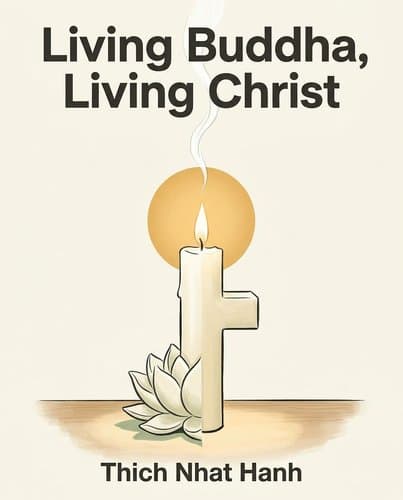
73184_living-buddha-living-christ
by Thich Nhat Hanh
Buddha and Christ pointed to the same quality of attention—mindfulness itself—available to anyone right now. Thich Nhat Hanh reveals how stillness, deep…
In Brief
Living Buddha, Living Christ (1997) draws direct parallels between Buddhist and Christian contemplative practice, arguing that both traditions point toward the same quality of mindful presence.
Key Ideas
Depth Over Tradition-Switching
When spiritual practice feels mechanical or dry, the solution is not switching traditions — it is going deeper into practice until it touches the living reality the tradition points toward, not just its outer forms. This applies equally to Buddhism and Christianity.
Recurring Sounds for Mindfulness
Use a recurring sound — a church bell, a timer, a phone notification — as a bell of mindfulness. When you hear it, stop completely, breathe in and out once with full attention, and return. This is not a Buddhist practice or a Christian practice. It is simply attention, which both traditions require.
Christian Prayer Mirrors Buddhist Meditation
Psalm 46:10 ('Be still and know that I am God') maps onto Buddhist practice with precision: 'be still' is samatha (stopping, calming), 'know' is vipassana (looking deeply). The two traditions share a single contemplative technology described in different vocabularies.
Understanding Naturally Produces Love
The enemy koan: 'To love our enemy is impossible, because the moment we love him, he is no longer our enemy.' Deep understanding does not prepare us to love — it produces love as a natural fruit. Forcing forgiveness fails; looking deeply at the causes of someone's harmful act transforms anger automatically.
Inner Harmony Precedes Outer Peace
Interfaith dialogue must begin within yourself first. TNH keeps images of Buddha and Jesus on the same altar. If two traditions cannot coexist in one practitioner, they cannot coexist in the world. Your own tradition is made of non-self elements from every other tradition it has encountered.
Kingdom of God Is Now
The Kingdom of God is not a future destination — it is the present moment, already available. 'If the wave does not have to die to become water, then we do not have to die to enter the Kingdom of God.' The only thing required is genuine presence.
Who Should Read This
Thoughtful readers interested in Buddhism and Christianity willing to slow down and wrestle with ideas.
Living Buddha, Living Christ
By Thich Nhat Hanh
9 min read
Why does it matter? Because the gap between Buddhism and Christianity is not doctrinal — it is attentional.
On the evening of April 4, 1968, Thich Nhat Hanh shared the Eucharist with a Catholic priest, chanted the Heart Sutra as a sacred reading, and then sat in a lecture hall as news broke that Martin Luther King Jr. had been shot. Three traditions, one room, the same night. The book's real question isn't whether Buddhism and Christianity can coexist — that had already happened. It's what the convergence reveals: the two traditions look different from the outside and are the same from the inside, and the gap between them is not doctrinal but attentional. Closing it doesn't require a new theology. It requires a different quality of awareness.
The Beauty of Jesus Was Hidden from Thich Nhat Hanh by History — Until He Met People Who Embodied It
In the seventeenth century, a French Jesuit missionary named Alexandre de Rhodes wrote a catechism for Vietnamese converts. His reasoning was direct: once Buddhism was uprooted, the "sinister and deceitful" tree felled, its branches would fall with it. He was not describing dialogue. He was describing demolition.
This is how Christianity arrived in Vietnam: not as an invitation but as an eradication campaign. The wound did not close quickly. In 1963, President Ngo Dinh Diem issued a decree banning Wesak — the central Buddhist national holiday — triggering mass demonstrations and eventually a coup. Christianity and colonial authority had been fused together in Vietnamese memory for three centuries before Thich Nhat Hanh began traveling the world to speak for peace.
No amount of reading the Sermon on the Mount could dissolve that.
What dissolved it was a human body.
The moment Thich Nhat Hanh met Martin Luther King Jr., he recognized something he had no theological framework to expect: this man was holy — not because of his arguments or his track record, but because of something that came off him directly, the way heat comes off stone. When King spoke, he did not perform. He was simply present, his attention complete, and that quality was exactly what Thich Nhat Hanh had spent decades watching in Buddhist monks: the posture, the silence, the particular way of listening that says I am not elsewhere. He had not expected to find it in a Baptist preacher in Chicago. Here was someone so completely shaped by his tradition that it showed in how he occupied a room. What showed was the same thing Thich Nhat Hanh had spent his whole life learning to cultivate.
The book's foundational claim: access to another tradition runs through people who embody it, not through texts that explain it. You cannot touch a teaching by reading about it. You touch it through someone who carries it in their body, their attention, their choices.
For Thich Nhat Hanh, that door had been sealed for a very long time. The humans who finally opened it were what made everything that follows possible.
Mindfulness and the Holy Spirit Are Not Two Different Things — They Are the Same Energy with Two Names
Mindfulness and the Holy Spirit are the same energy. They arrive through different traditions, but they produce the same thing: understanding arises, compassion follows, the desire to help comes with it.
A Catholic priest in Florence gave Thich Nhat Hanh the formulation he'd been looking for. Asked about the Holy Spirit, the priest said: it is the energy sent by God. Not a theological argument — a description. Energy, living and present, something you can be in the presence of or cut off from. Thich Nhat Hanh had felt the equivalence before he could state it. The priest's answer made it statable.
The Buddhist account is starker. When asked what he and his monks practiced, the Buddha said: we sit, we walk, and we eat. Everyone does that, the questioner pressed. His reply: when we sit, we know we are sitting. That is the whole definition. Ordinary activity, inhabited fully. When that quality of attention is present, understanding arises, compassion follows, the desire to help comes naturally. The same fruits that appear when the Holy Spirit is at work.
A North American priest had lived the practice at Thich Nhat Hanh's community in France: walking in silence, meals eaten with attention, the bell that rang through the day and called everyone to stop and breathe. He felt the peace of it. His worry was the crossing back: can any of this survive inside a parish with a schedule and a congregation?
Thich Nhat Hanh asked him one question: does your church have a bell? It does. Do you ring it? Yes. Then use it that way — as an invitation to return, not just to gather. In Vietnamese village temples, when the bell rang, the whole village stopped. Not in performance. Just a breath, a moment of being exactly where you were, before continuing. He went back and tried it. The first Sunday, he rang the bell and let it settle. A few people closed their eyes without being told to. That's the fruit: not the explanation, but the stillness that moves through a room when someone in it is genuinely present. The pause works inside a church as cleanly as inside a temple because the energy it calls up has no address. When mindfulness is alive in you, it shows through your whole being, not through what you say about it.
The Buddha was called the King of Healers. When people touched Christ, they were healed. Both traditions point to the same source: understanding and love, fully present.
Jesus Called It the Last Supper, But Every Mindful Meal Is Actually the First
Think about a meal you've eaten distracted — at your desk, phone in hand. You moved food from plate to mouth. That and eating are not the same thing. Every serious spiritual tradition arrives at the same diagnosis: the problem at the table is not what you consume but whether anyone is present when it arrives.
Buddhist monasteries have a formal answer. Meals happen in silence. Before eating, monks recite five contemplations that trace the food back through soil, rain, and labor. They chew each bite thirty or more times, not for digestion but for contact.
The Eucharist, Thich Nhat Hanh argues, is the Christian answer to the same problem.
His reading of the Last Supper is stark. Jesus's disciples had followed him for years. They had been in the room with him, and still they had not made real contact with what he was. When he broke the bread and said this is my body, when he poured the wine and said this is my blood, that was not a doctrinal statement. It was a drastic shock, an attempt to jolt people out of the ordinary fog in which you are physically present but mentally rehearsing your anxieties, your plans, anything but here.
The fog hasn't lifted. Modern congregants have heard those words so many times that they no longer land. They receive communion while thinking of something else, which means they are not receiving anything. The ritual has outlasted the alertness it was designed to produce.
The solution is not a better ritual. It is the quality of attention that makes any ritual work. Thich Nhat Hanh asked Cardinal Jean Daniélou, a senior Catholic theologian, whether the Eucharist could be understood as touching "the body of ultimate reality, the ground of all existence." Daniélou said yes. And Thich Nhat Hanh draws the sharpest conclusion: bread and wine are not symbols pointing toward something absent. They contain the reality directly, the living presence both traditions reach toward, the same way we do.
Which is why he renames the meal. Not the Last Supper — the First. A last supper is historical, receding. A first supper is now, entirely new, because when you are genuinely present, nothing is stale. The Buddha and the Holy Spirit don't need to be summoned. They arrive the moment you do.
A Wave That Realizes It Is Water Has Already Solved the Problem of Death
Imagine a wave in the middle of the ocean. It rises, crests, falls — afraid of the trough ahead, of the moment it flattens back into the surface and disappears. Now imagine the wave realizes it is made of water. Not that it contains water. That it is water, the same water the entire ocean is. Fear dissolves instantly, because nothing is being lost. The wave was never in danger of becoming nothing.
Thich Nhat Hanh uses this image to describe what enlightenment actually is: not a destination reached after death, but a recognition available in any moment. The wave does not have to stop being a wave. It only has to recognize what it is made of. When that happens, fear of death ends, because death was only ever the story the wave told itself about disappearing.
Buddhism and Christianity, he argues, are not pointing at different things. They are pointing at the same thing from different starting positions. Protestant theologian Paul Tillich described God as the ground of being: not a person in the sky but the substrate from which all persons arise.
If the wave does not have to die to become water, then we do not have to die to enter the Kingdom of God. The Kingdom is not a posthumous reward. It is the water — already present, already what everything is made of. The barrier is only the wave's failure to notice.
He found proof of this in his garden. Walking toward a dry leaf on the ground, he stopped. He saw it not as dead matter but as something in mid-transition — breaking down into soil, preparing to reappear the following spring as part of a new branch. "You are pretending," he said to it. Not dying. Not born. Cycling through forms the way water cycles through wave, rain, river, cloud. Birth and death described one surface. The underlying reality was continuous.
Nirvana and the Kingdom of God, in this reading, are both names for the water. Thich Nhat Hanh finds the same recognition in Tillich, in the desert fathers, in the contemplatives who stopped theorizing about the ultimate and started living in it. Both traditions are reaching toward the same thing. The practices differ because the cultures differ. The water is one.
Both Buddhism and Christianity Have Largely Abandoned Their Own Most Important Teaching
What if the deepest divide in this conversation isn't between Buddhism and Christianity — but between both traditions and their own most essential teaching?
Thich Nhat Hanh tells a story about a woman named Mrs. Ly. For ten years, she invoked the name of the Buddha hundreds of times every day — bell, chant, bell, chant. One afternoon, her neighbor repeatedly called her name while she was mid-practice. She became furious, threw down her bell, stormed to the door. The neighbor said: "I only called your name twelve times and you're already this angry. How must the Buddha feel — you've been calling his name for ten years."
Ten years of form, zero transformation. The name was being pronounced; the reality the name points to was never touched. Christians, Thich Nhat Hanh says flatly, do the same: recite prayers without presence, take communion while thinking about something else, perform the Eucharist as memorial rather than encounter.
The critique isn't aimed at individual practitioners. Thich Nhat Hanh turns it on the institutions. The Buddha accepted untouchables into his community. Are Sanghas today reaching the poor and the oppressed? The Buddha accepted women as teachers. Are women being ordained? The Buddha owned three robes and one bowl. Are religious institutions practicing voluntary poverty, or accumulating property and aligning with power? An American officer explained the destruction of the Vietnamese city of Ben Tre to a reporter: "We had to destroy Ben Tre in order to save it." Thich Nhat Hanh asks, without raising his voice, whether a servant of the church stood there and blessed those troops.
Not evil — just drift. Communities organize ceremonies, do charity, and through all of it never deepen. The prayers that worked once become automatic. The images that once pointed toward something living become decorations. The Trappist monk Thomas Merton called this the abyss of doubt: the moment when suffering and fear arrive in full force and the practice that once worked goes hollow, the words falling into silence and reaching nothing. Stronger belief in the same images won't fix this. Continuous practice keeps contact with what the images point toward.
The living Buddha and the living Christ survive only in practitioners who keep the teaching in their bodies, their choices, their refusals — the way the teaching was actually lived.
The Miracle Is Not Walking on Water — It Is Walking on the Green Earth Right Now
That critique needs a witness. On a beach in Sri Lanka, six barefoot children ran toward Thich Nhat Hanh across the sand. They shared no language. He put his arms around all six of them, and they stood together. Then, wondering whether sound might cross where words couldn't, he began chanting in Pali, the ancient liturgical language of the tradition: Buddham saranam gacchami — I take refuge in the Buddha. Four children placed their palms together and joined the chant. The other two smiled, placed their palms together, and chanted in the same rising cadence: I take refuge in Mother Mary.
That is the book's entire interfaith thesis, without a word of doctrine. The same need — for a place safe enough to return to — took the same musical shape across two traditions. The children didn't negotiate it. They recognized it.
What prevents most adults from this is not wrong belief but postponement. Thich Nhat Hanh names the pattern precisely: once I finish the degree, then I'll really be alive. Then the degree arrives and it's: once I have the job. Then the car. Then the house. His conclusion is blunt: it is possible to never be truly alive in an entire life. Not because the right moment never arrived. Because we kept placing it in the future.
Both traditions refuse that deferral. Jesus doesn't say the Kingdom arrives after sufficient preparation. He says become like a child — like the six on that beach, who didn't negotiate the miracle; they simply met it. Thich Nhat Hanh draws the parallel: the miracle is not walking on water. It is walking on the green earth right now. A bell rings, and if you stop and breathe, you have touched it. Bread eaten with full attention becomes communion. A single breath, taken in awareness — that is the door.
You are already standing where healing happens. Come alive to it — now.
Start Blooming
TNH keeps a small altar in his hermitage with a Buddha and a Christ figure side by side, not as a statement about tolerance but as a report about what is actually true. Both are ancestors. Both are alive. Neither diminishes the other. That is what Angelus Silesius, the seventeenth-century German mystic, demanded in a different register: start blooming, frozen Buddhist; start blooming, frozen anyone. The spring is not coming. It is already here, in the breath, in the bell, in the next meal you eat with full attention. Both traditions have always insisted on this: not which image to stand before, but whether you are actually standing there — awake, present, breathing. Neither asks you to be ready first. They ask you to stop, once, completely, and notice that what you were waiting for has never been anywhere else. That is the only practice. Begin.
Notable Quotes
“Everything is pretending to be born and pretending to die, including that leaf. The Buddha said,”
“Things are empty of a separate, independent self. If you look for the self of a flower, you will see that it is empty.”
“It is worse if you get caught in the non-self of a flower than if you believe in the self of a flower.”
Frequently Asked Questions
- What is Living Buddha, Living Christ about?
- Living Buddha, Living Christ argues that Buddhist and Christian contemplative practices point toward the same reality of mindful presence. Published in 1997, Thich Nhat Hanh draws direct parallels between the two traditions, showing that the living Buddha and living Christ are not separate figures to compare but a single reality accessible through practice. Rather than treating Buddhism and Christianity as competing systems, the book provides readers a framework for deepening their own tradition while genuinely engaging another. It demonstrates that both religions share a contemplative foundation beneath their different vocabularies and cultural expressions.
- What practical teachings are in Living Buddha, Living Christ?
- The book offers concrete practices accessible to both Buddhist and Christian practitioners. Thich Nhat Hanh recommends using a recurring sound—a church bell, a timer, a phone notification—as a bell of mindfulness: when you hear it, stop completely, breathe in and out once with full attention, and return. He also maps Psalm 46:10 ('Be still and know that I am God') precisely onto Buddhist practice: 'be still' is samatha (stopping, calming), while 'know' is vipassana (looking deeply). These teachings show that fundamental contemplative technology transcends tradition. Both Buddhism and Christianity require the same quality of attention, simply expressed in different language.
- How does Living Buddha, Living Christ approach interfaith dialogue?
- Interfaith dialogue must begin within yourself first, according to Thich Nhat Hanh. He keeps images of Buddha and Jesus on the same altar, demonstrating that two traditions can coexist in one practitioner. The book argues that if different faiths cannot coexist within an individual, they cannot coexist peacefully in the world. Thich Nhat Hanh suggests that your own tradition is made of non-self elements from every other tradition it has encountered throughout history. This challenges readers to recognize the interdependence of religions rather than view them as separate systems. Authentic dialogue happens when practitioners deepen understanding of both traditions within themselves.
- What does Living Buddha, Living Christ teach about love and transformation?
- Thich Nhat Hanh presents the enemy koan: 'To love our enemy is impossible, because the moment we love him, he is no longer our enemy.' This reveals that deep understanding does not prepare us to love—it produces love as a natural fruit. Forcing forgiveness fails because it operates at the surface level of intention. Looking deeply at the causes of someone's harmful act transforms anger automatically, without requiring willpower or emotional effort. This teaching applies equally to Christian and Buddhist approaches to reconciliation. Both traditions recognize that genuine transformation comes not from moral effort but from seeing clearly how suffering arises and flows through all beings.
Related Book Summaries



Read the full summary of 73184_living-buddha-living-christ on InShort