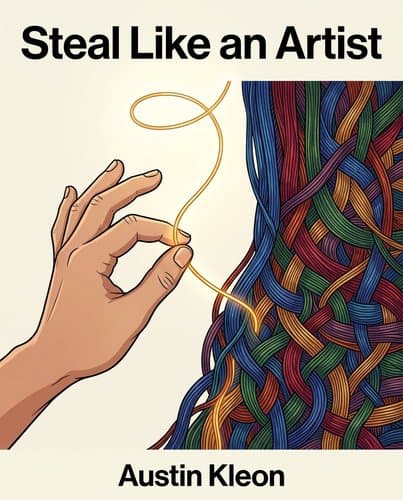
13099738_steal-like-an-artist
by Austin Kleon
Every artist steals—the difference is knowing how to do it with intention. Kleon shows you how to trace the genealogy of ideas, copy heroes until your failures…
In Brief
Every artist steals—the difference is knowing how to do it with intention. Kleon shows you how to trace the genealogy of ideas, copy heroes until your failures become your style, and turn deliberate theft into a genuinely original creative voice.
Key Ideas
Climb mentorship trees don't scan fields
Build a genealogy of ideas: find one thinker you love, find the three people they loved, and climb that tree — don't try to absorb a whole field at once
Collect worth stealing inspiration constantly
Keep a swipe file — analog or digital — where you collect things worth stealing. Your creative output is only as good as what you've let in
Copy thinking to find voice
Start copying your heroes deliberately: not the surface style, but the thinking behind the style. Your failure to copy them perfectly is where your voice lives
Separate analog creation digital refinement
Set up two workstations: an analog desk (no electronics) for generating ideas and a digital desk for editing and publishing. Never let the delete key near a half-formed thought
Side passions create original work
Don't discard your side passions to focus on one thing. Keep them, let them talk to each other — the cross-pollination is where original work happens
Don't break the consistency chain
Use the Seinfeld chain: put a wall calendar up and mark an X every day you do the work. Your only job is not to break the chain
Constraints force creative ingenuity
Embrace constraints actively: give yourself arbitrary limits — one color, one lunch break, 50 words — to force ingenuity instead of waiting for inspiration
Share process build lasting audience
Share your process openly, not just finished work. People who give their secrets away build audiences; people who guard them build nothing
Use anonymity for fearless experimentation
Treat obscurity as a finite resource to be used, not a problem to be solved. You will never again be as free to experiment as when no one is watching
Who Should Read This
People working on personal growth in Creative Thinking and Self-Improvement, especially those tired of generic motivational advice.
Steal Like an Artist
By Austin Kleon
10 min read
Why does it matter? Because originality was always a lie — and that's the best news you'll ever get as a creator.
Here's a quiet confession most creators carry: the sneaking suspicion that their best ideas are just borrowed, their taste assembled from other people's work, their voice a patchwork of everyone they've ever admired. That suspicion feels like a flaw to hide. Austin Kleon says it's actually the mechanism. Every artist you've ever loved was doing exactly what you're doing — collecting, remixing, rearranging influences with one hand while insisting the other hand worked alone. The myth of pure originality isn't just wrong; it's been keeping you stuck, waiting for some bolt of genius that was never coming. What this book offers instead is something stranger and more useful: a complete way of working, from how you gather ideas to how you build the physical habit of making them real to how you put them into the world before you feel ready.
Originality Is a Myth Invented by People Who Didn't Want You to Compete
Every artist you admire was shaped by someone who came before them. That's not a bug in the creative process — it's the whole mechanism. The myth of the solitary genius, the person who conjures something wholly new from the void, is a useful fiction that gatekeepers invented to make creativity feel scarce. It isn't. Originality, as Jonathan Lethem observed, is mostly just plagiarism that hasn't been detected yet.
Here's the more honest picture: nothing comes from nowhere. Every idea is a remix of influences absorbed, combined, and filtered through one particular human nervous system. The question was never whether you'd steal — you will, you already do — but whether you'd steal selectively enough to make something worth stealing.
Kleon turns this into a practical method. Find one thinker you genuinely love. Then find the three people that thinker loved, and study them. Climb one branch further. You're not surveying a field; you're tracing a lineage. You're building a family tree of ideas you actually care about — so you'll live inside them instead of skimming past. The result isn't plagiarism. It's research with a purpose.
The relief in this is real. You don't need to arrive with an original voice fully formed. Nobody does. You start by collecting the work of people who move you, understanding how they thought, and then — through the imperfect process of trying to imitate them — you discover where your own instincts live. The goal was never to copy the surface. It was to see the world the way they saw it, until you start seeing it your own way.
Copying Your Heroes Is Not a Shortcut — It's the Only Map to Your Own Voice
A young Kobe Bryant used to sit alone watching hours of game tape, studying the footwork of players he idolized — the pivots, the fakes, the angles they used to get open. Then he'd go to the gym and try to replicate the moves exactly. And he couldn't. His body was built differently, his balance point was off, his arms were a different length. So he had to adapt each move to fit the body he actually had. Those adaptations, those places where the copy broke down and he had to improvise — that's what people eventually called his style.
Copying isn't about producing a replica. You copy to understand how something works from the inside. The goal is to learn the logic the original builder encoded — once you have that, you can build something that never existed before.
The mistake most people make is treating copying as the destination when it's actually the starting point. The Beatles were, for years, a cover band — playing Buddy Holly and Elvis note for note in Liverpool clubs. They only started writing originals because rival bands kept stealing their setlist. That external pressure pushed them past imitation into something else entirely. But they couldn't have gotten to Lennon-McCartney without first putting in years of copying people they loved.
What you aim to copy matters. Replicating someone's surface — the visual style, the chord choices, the sentence rhythm — without understanding the thinking underneath produces knockoffs. What you actually want is to see the way your heroes see. What problem were they trying to solve? What did they value? What were they refusing to do? When you absorb that, the style becomes a byproduct rather than a costume.
And then the beautiful, reliable thing happens: you fail to copy them perfectly. Your failure isn't a flaw in the method — it's the method working. The gap between what your hero made and what you produce when you try to imitate them is exactly where your own instincts live. You weren't trying to be original. Originality arrived anyway.
The Void You Feel as a Fan Is the Assignment
The day after seeing Jurassic Park, ten-year-old Austin Kleon sat down at the family computer and typed a sequel. His version had the game warden's son and the park founder's granddaughter — one wanting to destroy the island, one wanting to save it, love blooming somewhere in between. He wasn't trying to launch a career. He was trying to get more of something he loved, because what existed wasn't enough.
That hunger is the whole assignment. Kleon reframes it this way: the desire for more of something you love is the creative work, not a precondition for it. Every novel, album, and business that becomes something new started as someone wanting something that didn't exist yet. Brian Eno said he made music specifically to hear sounds that hadn't happened yet — which means he didn't wait to feel inspired. He manufactured the craving into an output.
You don't need an original idea. You need an honest craving. Ask yourself what's missing — what your favorite makers didn't get to, what they fumbled, what a collaboration between all of them might have produced if you were running the room. That question is a creative brief. The people who seem to generate ideas out of nowhere are usually just people who got comfortable acting on their cravings rather than waiting for permission to have them.
Kleon's childhood Jurassic Park treatment was fan fiction, which sounds like a lesser category until you realize all fiction is fan fiction — every story written in love of stories that came before it. Bradford Cox used to record fake versions of albums he was desperate to hear before their release dates; a lot of those songs became actual Deerhunter records. The sequel in your head is always better than the one Hollywood makes. The void you feel as a fan is not a passive experience. It's telling you exactly what to build.
Put Down the Laptop. Your Best Ideas Need Your Hands.
Your laptop is lying to you about what creativity feels like. The moment you open it, something shifts — the cursor blinks, the font looks clean, the paragraph you just typed already resembles a finished thing. That resemblance is the trap. When work looks done, you stop playing with it. The delete key is always one reflex away, and the computer, with its tidy interfaces and infinite undo, trains you into editing before you've actually thought.
Cartoonist Tom Gauld figured this out by noticing what happened when he let the computer in too early. His sketchbook felt alive — ten directions a strip could go, dead ends that led somewhere else, happy accidents. The moment he moved to the screen, that openness collapsed. The ideas suddenly felt locked in, heading somewhere specific whether he wanted them to or not. Not because the computer changed the ideas, but because it changed his relationship to them. Finished-looking work triggers the critic. Rough work keeps the generator running.
Kleon built his whole studio around this distinction. Two desks, two different jobs. The analog desk holds nothing electronic — just markers, paper, index cards, whatever you can tear or tape or scribble on. This is where ideas get born. The digital desk is for the next phase: editing, refining, sending things into the world. The physical separation isn't symbolic; it's functional. When you sit at the analog desk, the perfectionist doesn't have a keyboard to reach for. You're forced into the messier, more productive mode of thinking with your hands.
The practical infrastructure matters because the philosophy alone won't change anything. Sitting at the same screen you always use and willing yourself into a looser headspace lasts about four minutes — the interface pulls you back before you've even started. But set up a corner of your space with nothing but cheap paper and a few pens — ten dollars at any drugstore — and you've built an environment that enforces the right state of mind before you even sit down. The room does the work the willpower can't.
Boredom and Side Projects Are Not Distractions — They Are the Work
What if the thing pulling you away from your serious work is actually the source of it?
Kleon spent five years doing exactly what focused people are supposed to do: he quit playing music and committed entirely to writing. No distractions, no side projects, no divided attention. Pure discipline. The result was a kind of phantom limb pain — not creative breakthrough, but a low-grade ache, a missing input he hadn't anticipated needing. So he started showing up on Sunday mornings to play with a band, no ambitions attached, just the pleasure of making noise with other people.
Something unexpected followed. The music didn't compete with his writing. It fed it. The two practices occupied completely different rooms in his mind, and moving between them kept both rooms aired out. What looked like procrastination from the outside was, from the inside, the engine staying warm.
Kleon's distinction is this: a hobby gives but doesn't take. No paycheck riding on it, no audience expecting consistency, no career implications if Sunday's session goes nowhere. That absence of pressure isn't a lesser version of real work — it's the specific kind of regeneration that serious work requires. The hobby is where you get weird without consequences, where happy accidents survive long enough to teach you something.
The practical move is to keep multiple projects alive at once. When one stalls — and it will stall — you move to another instead of grinding against the stuck place until both you and the project are exhausted. The momentum carries over. You come back to the stalled work rested, and sometimes what unstuck it was something you made on a Tuesday afternoon for no reason at all.
Obscurity Is a Gift. Stop Trying to Escape It Too Soon.
Think about the moment right before a restaurant opens — before the first customer walks in, before there are real stakes. The kitchen can experiment, adjust the sauce, throw out the batch that didn't work. Nobody saw it fail. Now imagine trying to run that same creative chaos with a full dining room watching every move. The stakes changed, which means the freedom changed.
That's the structure of early creative life, and most people spend it trying to escape as fast as possible. Get discovered, get attention, get known. But Kleon flips this: obscurity is not a problem to solve. It's a resource with an expiration date.
Here's what actually lives inside anonymity. No public image to protect. No agent sending panicked emails. No audience that paid for consistency. When the world isn't watching, you can fail in private, which means you can try things you'd never attempt with a reputation on the line. That window closes the moment people start paying attention — and it closes permanently once they start paying money. You only get one shot at being unknown.
The formula Kleon offers is almost insultingly simple: do good work, then share it with people. Step two is easy now — the internet turned it into a few clicks. Step one is where most people actually live, quietly hoping that step two is the problem. It isn't. And here's the thing about sharing: it's not just how you find an audience. It's how you find out what you're actually making.
Bob Ross is the unlikely illustration. The painter with the quiet voice and the cloud of hair built one of the most loyal audiences in television history not by protecting his methods, but by teaching them out loud, week after week. He gave the secrets away. The audience didn't leave once they knew how. They came back because watching someone share a process openly is magnetic in a way that finished, polished results never quite are.
You don't have to wait until you have something finished to put yourself into the world. The sharing itself is how you find what you're making.
Routine Isn't the Enemy of Creativity — It's the Only Thing That Protects It
Picture a professional fighter two days before a major bout. Training camp is over, the diet is locked, the sleep schedule is non-negotiable. The routine is so rigid it would bore most people to tears. That's precisely the point — by making everything else automatic, the fighter has one job left: be explosive when it counts. Creativity works the same way.
Flaubert had a line about this: keep your life regular and orderly so you can be violent and original in your work. The romantic image of the tortured genius — chaotic schedule, dramatic lifestyle, waiting for inspiration to strike — is just a story people tell about other people. In practice, chaos burns the exact fuel creativity needs. Every hour you spend on financial stress, social drama, or decision fatigue is an hour the work doesn't get.
Jerry Seinfeld's calendar system is the concrete version of this. He writes jokes every single day. At the end of each session, regardless of whether anything was good, he marks a large X on that day's box of a wall calendar. A few Xs become a chain. The chain grows. The only goal — the only metric — is not breaking it. Notice what this does: it removes quality from the daily equation entirely. You're not trying to write something great today. You're trying to fill the box. Great work shows up as a byproduct of showing up, not as a condition for it. The chain manages the perfectionist so the generator can run.
The day job fits this same logic. Kleon spent years treating employment as a tax on creative time, which is the wrong frame. A steady paycheck means you never create out of desperation, which is when artists make compromising decisions. A fixed schedule forces you to actually schedule creative work rather than assume it'll happen in some imagined block of free time that never arrives. And being around other people all day gives you material you can't get alone — the customer who launches into a ten-minute complaint about a coupon that expired yesterday, and somehow reveals everything about how people relate to fairness.
Stability isn't the opposite of creative wildness. Think of the fighter again, finally in the ring, moving without thinking — every wild instinct made possible by the months of boring, locked-in routine that came before.
The Best Work Comes From What You Choose to Leave Out
What if the thing stopping you from making your best work isn't a shortage of resources — but the surplus of them?
Here's the Dr. Seuss story that reframes everything. His editor challenged him to write a children's book using no more than 236 different words. The Cat in the Hat was the result. Then the editor pushed further: do it with 50 words. Impossible, obviously. Except Seuss went away and came back with Green Eggs and Ham, which went on to become one of the bestselling children's books ever printed. The constraint didn't diminish the work. It detonated it.
Jack White, the guitarist and producer, made the same observation from a different angle: tell yourself you have unlimited time, unlimited money, the full palette of options — and creativity dies on the spot. This sounds perverse until you feel it yourself. The blank document with infinite space is somehow harder to fill than the notepad you grabbed because it was nearby. Limitless possibility doesn't liberate you. It paralyzes you, because when nothing is ruled out, nothing is decided, and undecided work stays undone.
The practical conclusion is almost aggressive in its simplicity. You don't need more time, better tools, or a roomier studio. Write the song on your lunch break. Work with the one color you have. The constraints you're quietly resenting are the very pressure the work needs to become something. Start now, with what's in front of you — ideal conditions are just a reason to wait.
The Work Was Never Waiting for You to Be Ready
The notebook, the analog desk, the Sunday sessions — none of it requires a credential or an original idea or the right moment arriving at last. It only requires that you sit down today. Your heroes were all mid-stride when they made the work you love. Confused, borrowing freely, figuring it out as they went. The finished masterpiece erases the mess that produced it, which is how the myth of the prepared, arrived, fully-formed artist survives. Every one of them started before they were ready, with whatever was nearby.
The you who was waiting to feel ready wasn't being careful. That version of you was the obstacle.
You don't become an artist and then do the work. You do the work, and somewhere in the doing, you stop asking whether you're allowed to call yourself one.
Notable Quotes
“I don’t believe in art. I believe in artists.”
“Start copying what you love. Copy copy copy copy. At the end of the copy you will find your self.”
“I emulated Buddy Holly, Little Richard, Jerry Lee Lewis, Elvis. We all did.”
Frequently Asked Questions
- What is Steal Like an Artist about?
- Steal Like an Artist argues that all creativity is built on borrowing from others — and that embracing this honestly is the foundation of developing a genuine voice. The book provides practical strategies for collecting influences, building daily habits, and sharing work openly. Rather than viewing copying as unethical, Kleon frames it as necessary for creative development. By understanding how great artists learned from their influences, readers gain insight into building their own practice. The toolkit helps creators move from passive consumption to active, original making.
- How do you develop your creative voice according to Steal Like an Artist?
- Your voice emerges through deliberate copying of heroes and embracing limitations. Kleon advises: "Start copying your heroes deliberately: not the surface style, but the thinking behind the style. Your failure to copy them perfectly is where your voice lives." The book emphasizes building a genealogy of ideas by finding one thinker you love, then three people they loved, climbing that tree rather than absorbing an entire field. This structured approach to learning influences creates the foundation for authentic expression. Originality comes not from creating in a vacuum but from thoughtfully absorbing and transforming what you study.
- What practical daily habits does Steal Like an Artist recommend for creative output?
- Steal Like an Artist provides concrete daily practices for sustainable creative work. Key strategies include maintaining two workstations: "an analog desk (no electronics) for generating ideas and a digital desk for editing and publishing." This separation protects half-formed ideas from premature deletion. Kleon introduces the Seinfeld chain method—marking an X on a calendar daily to avoid breaking the chain of consistent work. The book also emphasizes keeping a swipe file where you collect things worth stealing. These tools transform creative work from sporadic inspiration to disciplined practice, with your output only as good as what you let in.
- Is Steal Like an Artist worth reading?
- Steal Like an Artist is worth reading if you struggle with perfectionism, creative block, or feel your ideas aren't original. The book dismantles myths about genius and inspiration, showing how creative work builds systematically on what came before. Kleon's practical advice applies across mediums—writing, design, music, and beyond. A key insight reframes constraints as tools for ingenuity and "obscurity as a finite resource to be used, not a problem to be solved." For anyone seeking permission to create imperfectly while building skills, this book offers both philosophical foundation and actionable tactics grounded in how artists actually work.
Related Book Summaries

Read the full summary of 13099738_steal-like-an-artist on InShort