2199_team-of-rivals
by Doris Kearns Goodwin
Lincoln didn't just tolerate his political rivals—he appointed them to his cabinet, then outmaneuvered them all by wielding empathy and patience as precision…
In Brief
Team of Rivals: The Political Genius of Abraham Lincoln (2005) examines how Lincoln built his wartime cabinet by appointing his fiercest political rivals, then managed them through empathy, strategic patience, and precise timing.
Key Ideas
Embed rivals to prevent external opposition
Surround yourself with your strongest critics rather than your most loyal supporters — not out of magnanimity, but because rivals inside your coalition can't lead opposition from outside it, and their expertise becomes yours
Perfect timing beats perfect reasoning
Timing matters more than being right: Lincoln held the Emancipation Proclamation for months after deciding on it, waiting for a military victory so the act wouldn't read as desperation — the lesson is that a correct decision issued at the wrong moment can fail as badly as a wrong decision
Sacrifice personal dignity for priorities
Absorbing humiliation without retaliation isn't weakness if you're simultaneously working the problem — Lincoln held McClellan's snubs privately while publicly protecting his command, not from passivity but from a clear-eyed calculation that dignity was less valuable than a functioning army
Let supporters feel outcome ownership
The most durable political tool is letting other people feel instrumental to outcomes you've already decided — Lincoln's cabinet members often believed they'd shaped his major decisions when he'd merely allowed them to feel that way, which secured their loyalty without compromising his judgment
Speak in your audience's terms
Translate your arguments into the language of your audience's daily life, not your own expertise — Lincoln's snake-in-the-bed metaphor worked where Seward's Trojan horse failed because it required no classical education, only a parent's protective instinct
Ignore insults that threaten mission
Know which fights aren't worth winning: Lincoln repeatedly accepted personal slights — from McClellan, Stanton, Chase — that would have driven most leaders to retaliate, because he'd identified the actual goal (winning the war) and refused to be distracted by the proximate insult
Who Should Read This
History readers interested in Political Figures and Leadership who want a deeper understanding of how we got here.
Team of Rivals: The Political Genius of Abraham Lincoln
By Doris Kearns Goodwin
14 min read
Why does it matter? Because the qualities we call 'decency' turn out to be the most powerful leadership tools ever deployed.
Here's the part nobody expected: Abraham Lincoln was the laughingstock candidate. When the results came in from Chicago in May 1860, sophisticated Republicans across the East winced. Not him. The man had no formal education to speak of, no national reputation worth measuring, and no powerful machinery behind him. His opponents were giants — the most celebrated Republican in the country, a former governor with decades of party loyalty banked, an elder statesman with a resume that dwarfed Lincoln's entirely. They didn't just expect to beat him. They expected to barely notice him.
What this book reveals is that Lincoln had already beaten them before the balloting started — and that the instrument he used wasn't strategy in the conventional sense. It was something the political class had never thought to weaponize: the capacity to absorb contempt without becoming contemptible, to keep rivals close without losing himself, and to turn his rivals' ambitions into fuel for his own purpose. That story is stranger and more useful than the myth.
The Man Nobody Took Seriously Had Already Outthought Everyone
On the morning of May 18, 1860, William Seward's supporters marched to the convention hall in Chicago a thousand strong, accompanied by a uniformed brass band with epaulets gleaming in the sun. Seward was the clear front-runner — senator from New York, so certain of the nomination that he'd already written his Senate resignation speech. The procession was meant to announce the inevitable. When they arrived at the Wigwam, the enormous temporary structure built for the convention, hundreds of them couldn't get in. Lincoln's people had printed counterfeit tickets the night before and filled every seat at dawn.
That detail is the whole story in miniature. While Seward was staging a victory parade, Lincoln's team was running a different kind of operation.
Three weeks earlier, Lincoln had been in Springfield telling a friend he expected to go back to his law practice. He wasn't being falsely modest — by any conventional measure, he was outmatched. Seward had decades of national stature. Salmon Chase, the governor of Ohio, had spent his career as the intellectual architect of the antislavery movement. Edward Bates of Missouri was the elder statesman whom conservative Republicans saw as the candidate who could hold the country together. Lincoln had served one unremarkable term in Congress and lost two Senate races.
What shifted the outcome wasn't geography or luck. Lincoln's managers, led by the relentless Judge David Davis, worked the convention floor with a precision that Seward's camp, coasting on inevitability and champagne, never matched. Davis secured the Pennsylvania delegation by hinting at a cabinet appointment for its favorite son — directly defying Lincoln's written instruction to 'make no contracts that will bind me.' Lincoln won on the third ballot. In Auburn, New York, where Seward had been waiting in confidence, grown men wept.
Lincoln's instruction to Davis — don't make promises — tells you what kind of politician he already was. He understood that a reputation for clean dealing was itself a strategic asset. He'd spent the convention not campaigning but waiting, letting Davis work, while Seward's people celebrated too early and too loudly. The man nobody took seriously had been thinking several moves ahead the whole time.
His Rivals Were Genuinely Formidable — Which Is What Made His Choice So Audacious
Seward, Chase, and Bates were not also-rans who happened to be standing near Lincoln when history happened. They were the formidable men, each with a genuine claim to the presidency that Lincoln's team had to dismantle piece by piece.
Chase is the clearest case. By 1860 he had spent nearly three decades building the intellectual and legal architecture of the antislavery movement — the kind of singular commitment that reshapes a party around itself. He had lost three wives and several children to early deaths, and his response to grief was not retreat but a ferocious doubling down: more work, more correspondence, more certainty that his suffering had earned him something. He genuinely believed the country owed him the White House. Not as vanity, exactly, but as moral accounting: he had paid a price, and the presidency was the receipt. His daughter Kate had organized her entire adult life around making him president, turning their Columbus mansion into a political operation and herself into the most formidable woman in Ohio Republican circles. When a Seward supporter visited the Chase household and admitted, after several hours of conversation, that Seward would likely be nominated ahead of Chase, Chase received the news 'as if he had heard something unexpected' — a man so insulated by his own conviction that honest assessment landed like an insult.
Lincoln put this man in his cabinet. Not a manageable second-tier figure, but someone who believed the nomination had been stolen from its rightful owner and would spend the next four years looking for an opportunity to reclaim it. Lincoln knew this. He appointed Chase anyway, as Treasury Secretary, handing him control of the Union's wartime finances. The audacity of that choice only registers once you feel the full weight of what Chase was — not a rival Lincoln had dispatched, but a rival who never quite accepted that he'd lost. Which raises the obvious question: why would anyone do that? The answer is the part nobody expected.
Lincoln's Real Advantage Was Built in the Dark, Years Before Anyone Was Watching
What actually made Lincoln precise in that convention hall wasn't charm or luck — it was a set of mental habits built through years of obscurity, including one winter where those habits were built from the bottom of a breakdown.
In January 1841, Lincoln's friends quietly removed the razors from his room. He had stopped attending the legislature. He'd lost his closest friend to a move back to Kentucky, watched his internal improvements program collapse under the weight of a recession he'd championed, and broken an engagement in a way that left him convinced he'd destroyed a woman he'd also failed to love properly. He told Joshua Speed, with apparent sincerity, that he was willing to die — but couldn't, because he hadn't yet done anything that would make any human being remember he had lived. That last part is the key. It wasn't a death wish so much as a diagnosis: his ambition had a specific shape, and he hadn't yet grown into it.
The recovery from that winter produced something. Lincoln returned to the legal circuit — eight weeks each spring and fall, riding from county seat to county seat across Illinois — and he used the long evenings differently than his colleagues. Where other lawyers played cards, Lincoln read Euclid. He worked through the geometry proofs until he could demonstrate them from scratch, training himself to distinguish what he actually understood from what he merely believed. The Euclid habit is less interesting as biography than as explanation for what happens later: the Peoria speech of 1854, Lincoln's first great antislavery address, doesn't exhort or denounce. It builds a case, step by step, daring the listener to find the flaw.
The circuit also gave him something harder to name — a decade spent reading rooms, watching how ordinary people in dozens of small Illinois towns received arguments, what metaphors they reached for, when their attention sharpened. Seward, making his case against slavery's spread in 1860, reached for the Trojan horse — a classical reference that required a particular kind of schooling to fully land. Lincoln, in the same period, described slavery as a snake discovered in bed with one's children: you might not kill it immediately if the risk of waking the children was too great, but you wouldn't carry it to a neighbor's bed. Every parent in the room understood the problem exactly. The circuit was where Lincoln learned to speak that way — not as a concession to his audience but as precision, the right tool for the measurement at hand.
He Invited His Enemies Into His Cabinet — And That Was the Confident Move
Inviting your three main rivals into the cabinet wasn't idealism. It was containment.
Seward, Chase, and Bates each commanded loyal factions of the Republican Party. Left outside the administration, any one of them could organize opposition, cultivate the press, and position himself as the competent alternative to the rail-splitter who'd somehow won the nomination. Lincoln's solution was to pull them inside, where their energy would be spent governing rather than conspiring.
Watch how he did it, because the method is specific. When Lincoln offered Seward the State Department, he sent two letters simultaneously. The first was the formal offer. The second, marked private and confidential, was engineered around what Lincoln understood about Seward's psychology: the man feared the appointment was a courtesy gesture, a public compliment he was expected to decline gracefully. So Lincoln's second letter told Seward directly that from the day of the nomination, he had intended this post for him — that Seward's position, integrity, and experience made the appointment 'pre-eminently fit to be made.' Not a consolation prize. A necessity. Seward trembled reading it.
Then Seward tested him. Before the cabinet was even sworn in, he sent Lincoln a resignation letter, trying to force the removal of Chase from Treasury. Lincoln's response was to note, calmly, that if Seward was unavailable, he supposed he could offer the State Department to William Dayton instead. The resignation was quietly withdrawn.
His stated reasoning for the cabinet as a whole was that the country couldn't be deprived of its strongest men during a rebellion — even men who had every personal reason to undermine him. That sounds generous. It was also accurate. The strongest men, managed correctly, were an asset. The same men, resentful and outside the administration, were a threat. Lincoln wasn't confident he could charm them into loyalty. He was confident he could manage them — and the Dayton counteroffer, delivered without drama and accepted without protest, showed exactly what that confidence looked like in practice.
Lincoln Waited in McClellan's Parlor for an Hour, Was Snubbed, and Said Nothing
The evening of November 13, 1861 started as a courtesy call. Lincoln, Seward, and the president's young aide John Hay arrived at McClellan's house and were told the general was still at a wedding. They waited in the parlor. When McClellan finally came home, the porter told him the president was there. McClellan walked past the parlor and climbed the stairs. Half an hour later, a servant came down to report that the general had gone to bed.
Hay was so furious he recorded it in his diary as a 'portent of evil' — the first symptom of military authority consuming civilian oversight. Lincoln's response was to tell him, without visible irritation, that he would hold McClellan's horse if it brought a victory.
That's not resignation. That's a man who had decided, with full clarity, that his personal dignity was worth less than a functioning army, and who refused to let wounded pride turn into a command decision he'd regret. The contrast with McClellan makes the principle sharp: McClellan was a general who couldn't move without certainty, who padded enemy troop estimates to justify inaction, who needed victories to justify himself before he was willing to risk them. Lincoln was a president who could absorb humiliation in a parlor and wake up the next morning still trying to find a way to make the man useful.
This was also the period that was costing him everything else. Willie died in the White House in February 1862. He was eleven. Mary's grief became a collapse, and Lincoln was left to manage his own in whatever margins he could find.
The cabinet was fracturing at the same time. Chase was quietly cultivating radical Republicans against the administration. Cameron's War Department was hemorrhaging money through corrupt contracts. Frémont's freelance emancipation proclamation in Missouri had nearly handed Kentucky to the Confederacy, forcing Lincoln to publicly overrule his own general. The Northern press was printing editorials about the administration's incompetence, and the army hadn't moved.
To absorb all of that and still not make McClellan's snub into a crisis wasn't weakness. Lincoln was holding the cost steady while he waited to see if McClellan could spend it productively. When it became clear he couldn't, Lincoln removed him — but the patience was never the mistake. The patience was the point.
The Emancipation Proclamation Was Lincoln's Alone — But He Let Everyone Else Think They'd Influenced It
Lincoln had already made up his mind. The preliminary draft of the Emancipation Proclamation was sitting in his desk when he called his cabinet together on July 22, 1862, and the first thing he told them — before reading a single word — was that he hadn't summoned them for advice. He had resolved upon this step. He wanted their suggestions after the fact, not before it.
What followed was one of the stranger demonstrations of political craft in American history. Lincoln read the draft aloud, and the cabinet reacted in ways that told him exactly where each man stood — information he filed carefully. Bates, the most conservative voice at the table, endorsed it immediately. Chase, the radical who had spent thirty years making the antislavery cause his life's work, pulled back from the plan — perhaps unwilling to let Lincoln claim the moment Chase believed history had been saving for him. And Seward, the pragmatist, offered the one suggestion Lincoln immediately recognized as right: don't issue it now, after a string of defeats. Wait for a military victory, or the proclamation will read like a desperate government's final gasp.
Lincoln adopted Seward's advice on the spot. Seward appears never to have fully understood that he'd influenced the timing but not the decision — the decision had been made before anyone sat down. What Seward gave Lincoln was a frame. Lincoln took it, and filed the draft away to wait for Antietam.
Meanwhile, in August, the newspaper editor Horace Greeley published a furious open letter demanding to know why Lincoln wasn't moving against slavery. Lincoln's famous reply — 'My paramount object in this struggle is to save the Union, and is not either to save or to destroy slavery' — was read as a moderate rebuke of the abolitionists, a careful hedging of bets. The proclamation draft was in his desk when he wrote it. The reply was a public position calibrated to prepare opinion for something already decided, not a confession of uncertainty.
This is Lincoln's actual operating method, made visible: he gives his rivals the experience of influence while holding the lever himself. The cabinet meeting on July 22 wasn't consultation — it was intelligence-gathering and co-optation, conducted simultaneously, in the same room, with the same speech.
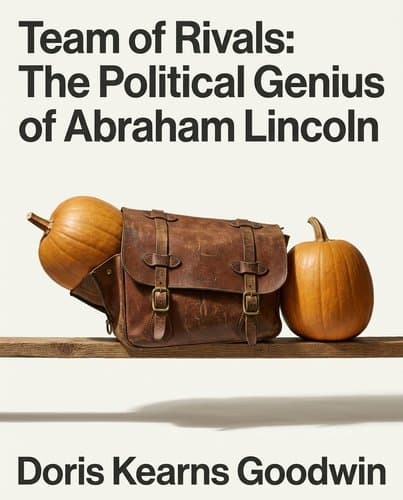
The Pumpkin in Each End of the Bag: How Lincoln Defused a Cabinet Coup Without Anyone Knowing He'd Done It
For months, Chase had been doing something that would later embarrass him: quietly briefing Senate Republicans against his own colleague Seward, feeding them a story about cabinet dysfunction Lincoln supposedly couldn't see. It's December 19, 1862, and Salmon Chase is trapped. He's sitting across the table from the Senate committee whose members he's been secretly briefing against Secretary of State Seward — feeding them stories of cabinet dysfunction, encouraging their conviction that Seward was a malign influence Lincoln needed to shed. Now Lincoln has arranged for that same committee to sit face to face with the full cabinet. Chase has two options: confirm the senators' complaints, which would mean openly attacking a colleague in front of the president who appointed him, or endorse the cabinet's unity, which would mean repudiating everything he'd been whispering for months. Watching the room, Lincoln said nothing. He didn't need to.
Chase chose his dignity over his strategy. He told the senators, with visible discomfort, that while he wished certain matters had been more fully discussed, the cabinet had generally worked in accord. He grudgingly admitted that no member had ever blocked a decision after it had been made. The senators left unconvinced by the complaints they'd arrived to confirm. Chase left humiliated. The next morning he showed up at the White House clutching a letter of resignation.
Here's where the method becomes unmistakable. Lincoln had already accepted Seward's resignation, submitted the previous day when Seward heard the Senate was moving against him. Now Lincoln had both letters. When Chase produced his, Lincoln's eyes lit up. He leaned forward and snatched the paper before Chase could reconsider: 'This cuts the Gordian knot.' Then he refused them both and sent everyone back to work.
His description of the outcome afterward is the clearest window into how Lincoln thought about power: 'I can ride on now, I've got a pumpkin in each end of my bag.' The image is deliberately unglamorous — a farmer's trick for balancing a load. That was the point. Lincoln had not outcharmed his rivals or morally persuaded them. He had engineered a situation in which each man's own choices — Chase's decision to keep feeding the senators, then his decision to resign when cornered — produced the leverage Lincoln needed, without Lincoln ever having to reveal that he'd seen any of it coming. Chase went to his grave believing Lincoln never fully understood what he'd been doing. Lincoln never corrected the impression.
'That Speech Won't Scour': The Man Who Couldn't See His Own Greatness
Ward Lamon was standing close enough to hear Lincoln murmur it the moment the applause began at Gettysburg: 'Lamon, that speech won't scour. It is a flat failure and the people are disappointed.' He had read 272 words in roughly two minutes, and he was already certain he'd embarrassed himself.
What had actually happened was that the audience stood motionless before the applause came — and Lincoln read the stillness as disapproval. The silence was awe. He couldn't tell the difference, because for Lincoln the gap between what he'd intended and what he'd achieved always seemed wider than it was. Edward Everett, who had delivered a two-hour oration that morning in the formal classical style, wrote Lincoln the following day that he wished he had come as close to the central idea of the occasion in two hours as Lincoln had in two minutes.
The speech was the product of the same compulsion he'd been building since childhood, when he'd stay up late reworking his father's stories until any boy in the room could follow them — worrying at language until it did exactly what he needed it to do. At Gettysburg that compulsion produced something Everett's ornate performance hadn't touched: a redefinition of what the war was for. Most people in that crowd understood the war as a fight to restore the Union as it had been. Lincoln redefined it as a test of the Declaration's claim that all men are created equal — quietly moving the nation's founding document from the Constitution, which had accommodated slavery, to the Declaration, which hadn't. He fit the whole argument inside two minutes, in sentences any farmer could carry home.
He was genuinely surprised when it worked. That surprise is the point — the craft was real precisely because he never trusted it.
Decency Wasn't Lincoln's Character — It Was His Method
When Chase submitted his fourth resignation letter in 1864, Lincoln accepted it with what observers described as undisguised relief — and then, in the same conversation, said that there was no man in the country who would make a better Chief Justice of the Supreme Court. Not as consolation, not as face-saving diplomacy, but as a sincere assessment he'd apparently been holding alongside four years of Chase's scheming, his covert presidential campaigns, his circular letters calling Lincoln's reelection 'practically impossible.' He nominated Chase months later. One observer, struggling to explain how Lincoln could function this way, concluded that he 'must move upon a higher plane and be influenced by loftier motives than any man' he had ever known.
That framing is understandable but slightly wrong, because it makes Lincoln sound remote, operating from moral altitude. What actually seems to have happened is simpler and stranger: Lincoln genuinely separated how a person had behaved toward him from whether that person was useful to the country. Chase had been disloyal and was the best available Chief Justice. Both things were true at the same time, and Lincoln experienced no apparent contradiction between them. The vindictiveness that Chase's behavior fully warranted just didn't accumulate in him the way it does in most people.
You could argue this was calculated: keep Chase close, neutralize the threat, use the talent. That reading is available, and it fits the pattern.
But then there's the trembling hand at the Emancipation Proclamation signing — Lincoln pausing until his arm steadied, not wanting anyone who read the document to think he had doubted it. And the Good Friday carriage ride with Mary, hours before Ford's Theatre, saying they must both be more cheerful, that between the war and losing Willie they had both been very miserable. These are not the moments of a man performing decency for strategic effect. They are the moments of someone who processed the world through a specific, consistent emotional register — one that happened, again and again, to produce exactly the right political outcome.
The question of whether that distinction matters is worth sitting with. If the behavior is identical — if Lincoln's genuine inability to carry a grudge produces the same decisions as a calculated choice to suppress one — does it change anything to know it came naturally? Maybe not for history. But it changes what we understand about the kind of person who can hold a team of rivals together through a civil war without flinching. The mechanism wasn't genius applied to decency. The decency was the mechanism.
What the Wreckage Tells Us
What's striking about the aftermath is how quickly everything collapsed. The rivals lived on, but without Lincoln as the organizing force, their ambitions had nowhere useful to go — Chase still angling for a presidency that kept receding, Stanton burning out at fifty-five, Mary Lincoln eventually alone in Springfield in the house where it had all started. They weren't lesser people after he died. They were the same people, minus the one man who had understood exactly what they were capable of and arranged conditions where that capability served something larger than itself. The epilogue quietly insists on this: Lincoln's political genius wasn't a technique you could extract and apply. It required the actual belief underneath it — the genuine conviction that even a scheming, resentful rival contained something worth using, something worth protecting. Take away the belief and the tactics are just manipulation. The belief was what made them work.
Notable Quotes
“magnificent band, which was brilliantly uniformed—epaulets shining on their shoulders,”
“their march a little too far.”
“it was part of the Seward plan to carry the Convention”
Frequently Asked Questions
- What is Team of Rivals about?
- Team of Rivals examines how Lincoln built his wartime cabinet by appointing his fiercest political rivals and then managed them through empathy, strategic patience, and precise timing. Drawing on diaries and letters from Lincoln and his cabinet, Doris Kearns Goodwin demonstrates how emotional intelligence and a clear focus on ultimate goals are more effective leadership tools than ego protection or loyalty-seeking. The 2005 book shows that Lincoln's genius lay not in surrounding himself with loyalists, but in strategically incorporating opposing voices into his administration, transforming potential threats into allies who believed they shaped outcomes he had already determined.
- Why did Lincoln appoint his political rivals to his cabinet?
- Lincoln appointed his strongest critics to his cabinet not from magnanimity, but because rivals inside your coalition can't lead opposition from outside it, and their expertise becomes yours. This wasn't a gesture of grace; it was strategic calculation. By bringing competitors into his administration, Lincoln neutralized potential threats, concentrated diverse expertise under his control, and created a structure where rivals had a vested interest in his success. The most durable political tool is letting other people feel instrumental to outcomes you've already decided. This approach secured loyalty without compromising Lincoln's judgment and allowed him to navigate the Civil War with unprecedented flexibility and effectiveness.
- What is the most important leadership lesson in Team of Rivals?
- Timing matters more than being right—Lincoln held the Emancipation Proclamation for months after deciding on it, waiting for a military victory so the act wouldn't read as desperation. A correct decision issued at the wrong moment can fail as badly as a wrong decision. Beyond timing, Goodwin emphasizes that absorbing humiliation without retaliation isn't weakness if you're simultaneously working the problem. Lincoln held McClellan's snubs privately while publicly protecting his command, not from passivity but from a clear-eyed calculation that dignity was less valuable than a functioning army. These principles reveal that strategic clarity and patience often accomplish more than immediate action.
- How did Lincoln handle conflict and disagreement within his cabinet?
- Lincoln repeatedly accepted personal slights — from McClellan, Stanton, Chase — that would have driven most leaders to retaliate, because he'd identified the actual goal (winning the war) and refused to be distracted by the proximate insult. Rather than seeking loyalty or protecting his ego, he held these conflicts privately while maintaining public support for his commanders. This emotional intelligence enabled him to compartmentalize personal disagreements from strategic decision-making. Lincoln's approach demonstrates that effectiveness requires knowing which fights aren't worth winning. By subordinating pride to purpose and refusing to be drawn into ego-driven conflicts, he maintained cabinet cohesion while preserving his authority for decisions that mattered.
Related Book Summaries
Read the full summary of 2199_team-of-rivals on InShort