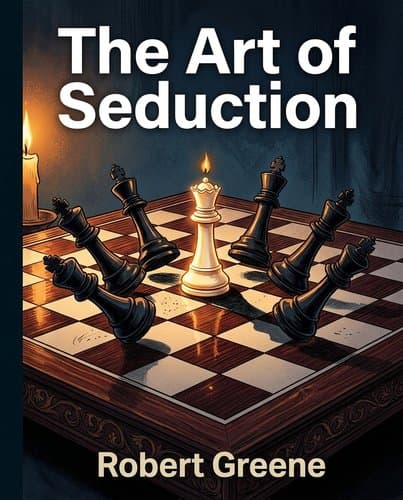
20995_the-art-of-seduction
by Robert Greene, Мариана Мелнишка, Робърт Грийн
Seduction is a learnable psychological system, not a mysterious gift—and Robert Greene maps every tactic, from exploiting emotional voids to weaponizing…
In Brief
Seduction is a learnable psychological system, not a mysterious gift—and Robert Greene maps every tactic, from exploiting emotional voids to weaponizing absence, so you can recognize when these forces are being used on you and decide when to deploy them yourself.
Key Ideas
Target the specific psychological void precisely
Identify the psychological void before making a move: every person is missing something specific — adventure, attention, permission to transgress — and seduction only works when it fills that precise gap, not a generic one
Indirection bypasses defenses through disguised approach
Directness triggers defenses; indirection bypasses them. Approach as a friend or confidante first, let the target believe they are pursuing you, and you remove the resentment that kills attraction
Maintain desire through strategic presence withdrawal
Familiarity is the death of desire. Greene's system requires you to alternate presence and absence deliberately — not out of game-playing instinct, but as a structural requirement for keeping the other person's imagination engaged
Suffering generates stronger attachment than kindness
Pain precedes the deepest attachment. Mild anxiety, strategic withdrawal, and intermittent disappointment produce a gratitude on relief that sustained kindness never generates — this is the arithmetic Greene considers non-negotiable
Manipulation mechanics scale from persons to masses
The same mechanics that operate between two people operate at mass scale in politics and advertising: vague language, manufactured scarcity, regression to childhood safety, and the illusion of the audience's own free choice. Recognizing the pattern is the only partial defense against it
Authenticity contradicts calculated psychological mirroring
Watch for Greene's central unresolved contradiction: he claims seduction flows from authentic character (Chapter 2), then instructs you to covertly identify a target's psychological lack and mirror it back to them (Chapter 13). Both cannot simultaneously be true — and the gap between them is where the manipulation lives
Who Should Read This
Curious readers interested in Persuasion and Social Psychology and the science of how the mind actually works.
The Art of Seduction
By Robert Greene
12 min read
Why does it matter? Because seduction is already happening to you — and you're not the one running it.
You think seduction is chemistry — two people, the right moment, something ineffable clicking into place. Robert Greene would find that touching. He'd also tell you it's completely wrong. What Greene presents in The Art of Seduction is something considerably colder: a four-phase psychological siege, descended directly from military strategy. Its purpose is to dismantle a target's rational defenses by exploiting the gaps every human carries — the unfulfilled childhood longings, the dreams that calcified into routine, the hunger for someone to finally see them. The uncomfortable part isn't the tactics. It's the realization that this process has been running on you your entire life — in bedrooms, in political speeches, in advertising campaigns — and you've been mistaking the manipulation for free choice. Greene hands you the blueprint.
Seduction Is Not Chemistry — It's a Calculated Four-Stage Siege
Seduction is a weapons system. That's Robert Greene's opening provocation, and he means it structurally, not metaphorically. The women who invented the art — Cleopatra, the Chinese siren Hsi Shi, Helen of Troy — were operating in societies where physical violence determined everything. They had no armies. So they built something more durable: a method for occupying an enemy's mind until his will collapsed from within. Greene calls it 'the feminine version of warfare,' and the military framing isn't decoration. These women studied their targets the way generals study terrain. They identified specific psychological weaknesses. They planned sequentially. They were patient in a way that men with swords never needed to be.
What Greene extracts from this history is a four-stage campaign. First, you maneuver into the target's thoughts — you become the thing they can't stop thinking about. Second, you alternate pleasure and confusion, creating emotional access while keeping them slightly off-balance. Third, you go deeper, stirring up desires they've kept buried. Finally, you induce surrender — physical, emotional, or both. Each phase sets up the next. You can't shortcut from stage one to stage four without losing the war.
Here's the uncomfortable part: Greene argues that rushing toward a conclusion is selfishness. The seducer who moves too fast is thinking about what they want, not what the target needs to feel in order to open. Slowness is the actual technique — weeks, sometimes months, each move creating the conditions for the next. The victim doesn't experience this as a siege. They experience it as falling in love.
The Nine Archetypes Are Maps of Human Vulnerability, Not Personality Types
Gabriele D'Annunzio was, by every conventional measure, the last man a husband should have worried about. Short, stocky, bald, with a splotchy complexion and protruding eyes — Roman aristocrats left him alone with their wives precisely because they considered him harmless. What happened next was always the same: within minutes, the duchess or marchioness would be spellbound. Not by his looks. By a voice so musical that one woman compared it to distant church bells, and by flattery so precisely calibrated to each woman's secret vanity that they couldn't afterward recall what he'd actually said — only the feeling it had left behind.
Greene wants you to sit with that detail. D'Annunzio wasn't seducing despite his ugliness. He was seducing because he had been forced to understand something the handsome men never had to learn: that a certain kind of woman doesn't need to be overwhelmed by physical presence. She needs to feel seen. Specifically, she needs to feel that her interior life — her intelligence, her artistic potential, her romantic depth — has finally been recognized by someone worth impressing. D'Annunzio found that wound and pressed on it, differently for each woman, with the accuracy of a locksmith.
That's what Greene means when he builds his nine seductive archetypes. They're not personality categories for the seducer. They're maps of specific human vulnerabilities. Each archetype exists because a particular psychological lack exists in the population, and someone figured out how to be the answer to it.
The Siren works on men oppressed by their own reasonableness — men like Julius Caesar, who managed empires and had to be correct about everything, and who therefore ached for something irrational and consuming. Cleopatra's power wasn't her face, which a surviving coin profile shows was unremarkable. It was her ability to transform daily: one evening the goddess Isis, the next a Dionysian reveler on a 54-foot pleasure barge sailing the Nile. She was never the same thing twice, which meant Caesar could never possess her in full, which meant he never stopped trying.
The Rake works on women who have been made to feel invisible — not unloved necessarily, but unseen as desiring creatures in their own right. A man who becomes ungovernable in his pursuit, who tunnels through kitchen cupboards and climbs along window ledges in the dark just to reach you, provides something a stable marriage structurally cannot: evidence that you are worth losing everything over.
The uncomfortable implication is that your vulnerabilities are already visible to someone paying attention. The archetype that would work on you is whatever psychological hunger your current life isn't meeting.
Before You Can Seduce Anyone, You Have to Find the Wound
Greene's answer to what an experienced seducer looks for is unsettling: not attraction, but damage. The specific, identifiable wound a person carries that their daily life isn't healing.
The whole system rests on one observation — that everyone walks around with a psychological gap, something they need and cannot get on their own. Most of us are blind to this in others because we project our own lacks outward: the anxious person who reads anxiety into everyone they meet, and misses entirely the hunger for admiration sitting right across the table. Greene's bluntest warning follows directly from this: never pursue someone of your own type. Two people missing the same piece cannot complete each other. The seducer's advantage is learning to read other people's hungers instead of broadcasting their own.
Greene's taxonomy of eighteen victim types is the training manual for that reading. Take the Professor — the intellectual who has spent decades sharpening their mind at the body's expense. In conversation they're commanding, even withering. But their armor has a seam: physical insecurity so deep it's almost hunger. The move that works on them isn't competing with their ideas or out-arguing them. It's offering pure sensation, no analysis required. Let them keep their mental superiority. They'll hand you everything else.
Or take the Crushed Star — someone who once glowed with real visibility, as an athlete or a beauty or a social centerpiece, and now lives in the gray radius of that memory. They've learned to suppress the wanting because wanting without getting is unbearable. The entry point is almost embarrassingly simple: treat them as if the spotlight never left. Ask them to talk. Listen like what they say matters. Dim your own light. The gratitude this produces is enormous — not because you've done something extraordinary, but because you've diagnosed a specific pain and applied the specific remedy.
The operative instruction Greene issues for any target: watch the involuntary signals. The things in their home, the films they mention, the way a particular subject makes them go slightly still. These aren't decorative details. They're intelligence data, a map of what's missing. Every social interaction becomes, if you're paying attention, a diagnostic exercise. The uncomfortable part is that this describes what falling for someone actually feels like from the outside — you're being read before you've said a word that matters.
The Indirect Approach: Why Friendship Is the Most Dangerous Opening Move
Greene's argument is that directness, whatever its virtues elsewhere, is tactically catastrophic in seduction. The moment a target senses someone wants something from them, a very old part of their brain activates. They start auditing every interaction for motive. The would-be seducer is now working against a defense they triggered.
The case Greene builds around is the seventeenth-century Duke de Lauzun and his pursuit of Anne Marie, Duchess de Montpensier — a woman of enormous wealth and royal standing who had stayed unmarried for forty-two years because no man seemed good enough. Lauzun was shorter than her, not handsome, and had no obvious claim to her attention. What he had was patience and the discipline to mask his intentions completely. He became her most devoted friend. He talked with her for months about heroic poetry and military history, subjects she loved. He never touched her, never flattered her romantically. He simply kept showing up, curious and available, while she slowly began to notice that this man — apparently the only man in Paris not trying to possess her — was the only one she thought about. Then Lauzun stopped visiting. The absence did what months of presence couldn't: it forced her to confront the wanting directly. She was the one who slipped him a note, in her own hand, effectively proposing herself. She was certain, at that moment, that she was the aggressor.
Greene calls this the golden gate principle: the body's defenses are only accessible through the mind. Establish yourself as a confidante — someone who asks and listens and never demands — and the line between friendship and desire erodes from the inside, without the target noticing the shift. In practice, that means the most effective move a seducer can make is to appear to want nothing. Desire, worn openly, triggers resistance. Desire, disguised as attention, triggers longing.
What that means for the feeling of pursuing someone is worth sitting with. That conviction that you've made your own choice, acted on your own desire? It may be the most successfully engineered moment in the whole operation.
The Tactics Escalate: From Mixed Signals to Manufacturing Regression
Here's what the middle phase of seduction actually looks like: a deliberate program of psychological destabilization. Not increasing warmth. Not deepening intimacy. The moves Greene prescribes for the intermediate stages are designed to produce anxiety, dependency, and a regression toward the emotional patterns of childhood — conditions that feel, from inside the experience, indistinguishable from falling helplessly in love.
The tactics that arrive after the first approach is established are the mixed signals: the spiritual face interrupted by a flash of carnality, the cold distance that suddenly thaws, the hard-to-read gesture that forces the target to keep processing you in your absence. The mechanism is deliberate. Once someone can predict you, they've recovered their composure — and recovered composure is the end of seduction. The goal is to keep the target in a state of unresolved interpretation, where their imagination does the work you can't do directly. Madame Récamier understood this instinctively: at the Château de Coppet she appeared to a Prussian prince as an angelic, downward-gazing figure, then looked up at him with something unmistakably roguish in her eyes. He spent the next two weeks trying to resolve the contradiction. He proposed marriage before he ever figured it out.
Mixed signals are still relatively benign compared to what Greene prescribes next. The deeper move — borrowed from Freud — is manufactured regression. Freud discovered, somewhat to his horror, that by remaining silent and expressionless while patients lay passive on the couch, he caused them to fall in love with him. They weren't responding to him at all. They were projecting old childhood dependencies — the longing for a protecting parent, the need for an authority who would love them without condition — onto the blank surface he provided. He called it transference. Greene calls it a template. His instruction is clinical in a way worth sitting with: find the specific lack from your target's childhood, the exact flavor of neglect or disappointment they carry, and fill it. Not symbolically — behaviorally. Be the father who finally paid attention. Be the mother who never criticized. Finish the unfinished business. The target will experience what follows as a unique, transformative connection. They won't recognize it as a precise diagnosis being treated.
The uncomfortable part is the trajectory. The direction of travel in these middle stages is not toward greater connection. It is toward greater dependency, greater disorientation, greater susceptibility. The seducer is, with methodical care, taking the target apart — and the target, from the inside, experiences this dismantling as the most alive they have felt in years.
The Arithmetic of Pleasure and Pain: Why Kindness Alone Never Holds Anyone
The most durable bonds are not built from consistent warmth. They're built from relief. Greene's argument is that the brain barely registers pleasure that arrives without a preceding cost — but that same pleasure, delivered after suffering, produces a gratitude so overwhelming it looks indistinguishable from love.
The sharpest illustration comes from outside the romantic sphere entirely. When journalist Oriana Fallaci sat down with heads of state — the Shah of Iran, Henry Kissinger — she faced a structural problem: standard flattery and charm would be immediately recognized and deflected. Her method was something else. She would ask a question so sharp, so accurately aimed at a hidden insecurity, that her subject would go stiff and defensive. Something beneath that defensiveness simultaneously came alive — the desire to prove she was wrong about them, to earn her approval. She was running a cycle: produce pain, then ease it. When she softened, her subjects experienced a relief so intense that their carefully maintained control simply dissolved. They said things they had never intended to say. The damage to Kissinger alone — a public statement about his lone-cowboy self-image that he later described as the most foolish interview he'd ever given — came directly from her making him feel criticized and then giving him a way back into her good graces. He surrendered to the mechanism of the relief.
Greene's formula: you have more to fear from boring your target than from hurting them. Wounding people binds them more deeply than kindness because it makes them feel something — and then your subsequent warmth becomes the antidote they're chemically dependent on rather than a baseline they've come to take for granted.
What this means for emotional connection is worth sitting with. The intensity that gets labeled as depth — the feeling that someone has gotten inside you in a way no one else has — may be the precise signature of this cycle operating correctly. Not intimacy. Relief after induced pain, experienced so many times that you can no longer imagine the absence of the person producing both.
The Bold Move and Its Hollow Victory
Valmont doesn't rush. In his final meeting with the Présidente de Tourvel — the married woman he has spent months engineering toward surrender — he plays grief and coldness before warmth, grievance before tenderness. He lays her letters on the table between them like evidence at a trial. When she steps closer, drawn by the sight of her own words, he tells her he's leaving forever, then softens, then steps toward her. She grabs his arm to stop him going. That's the moment he's been building toward for months: not the kiss that follows, but her hand on his arm, her body making the choice her mind refused. Greene, paraphrasing the novel's internal logic, notes that a willing surrender always needs an excuse — the appearance of being swept away by a force you couldn't resist. Valmont provides the excuse. The seduction looks, from inside it, like a natural catastrophe.
But here's where Greene's system turns on itself. Valmont got what he wanted before the moment he claimed it. The design was complete the instant her hand closed on his arm. Everything after — the embrace, the night, whatever follows — is the seducer collecting an invoice they already wrote.
And then what? Greene's chapter on the aftermath is where the glamour drains out. The seducer faces exactly two options: cut the target loose quickly, before they become emotionally expensive, or stay and begin re-seducing from the beginning, because comfort is the solvent that dissolves desire. There is no third path. No arrival. If the relationship continues, the seducer must re-inject uncertainty, manufacture small crises, keep the target slightly off-balance indefinitely — not as a temporary strategy but as a permanent operating condition. The system never stops running. The target never gets to simply be loved; the seducer never gets to simply stop.
This is the detail the book's structure quietly conceals until the end. The seducer is not free. They are the most imprisoned person in the exchange — condemned to run the same campaign forever, or to discard each person like spent material and begin again with someone new. The bold move turns out to be the entrance to a cell with better lighting.
When the Manual Scales Up: Seduction as Politics, Advertising, and Propaganda
What happens when a system designed to occupy one mind gets applied to millions simultaneously?
Greene never quite asks it that way — but he answers it anyway, scattered across chapters on charismatic leaders and advertising pioneers, almost as if he hopes you won't notice the seams. The mechanics are identical. In 1929, the publicist Edward Bernays hired debutantes to smoke cigarettes during New York's Easter Parade, coaching them to treat the cigarettes as 'torches of freedom' — props in a suffragette tableau. The product vanished entirely into the myth. What women lit that afternoon wasn't a Lucky Strike; it was the feeling of transgression, of self-determination, of belonging to something rebellious. Bernays manufactured spontaneity the way a seducer manufactures accident: the handshake that lingers a beat too long, the chapel hidden conveniently just outside the bedroom window. Millions were seduced by an event that existed solely to seduce them, and they experienced it as a cultural moment they'd witnessed.
Greene presents this admiringly. The same analytical heat he applies to Casanova in a Cologne opera box he turns on Bernays in a Manhattan parade, and the conclusion is the same: desire requires a myth, and myths can be commissioned. He's not wrong. But the individual target of a seduction can, in theory, walk away. A population absorbing a manufactured ideology through the water supply of its own culture has no obvious exit. The book's silence there isn't an oversight — it's the most revealing thing about it. That refusal is the book's loudest unresolved tension, and the thing a careful reader carries out with them. He built a manual for human influence, watched it scale to the level of nations, and declined to name what that scaling changes.
The Seducer's Real Trap
Here is what the book never quite confesses: the person who finishes Greene's system and deploys it with real skill doesn't arrive anywhere. They complete the campaign, collect the surrender, and immediately face the only two exits — discard or restart. Neither is freedom. The discarding is obvious enough. But the restarting is stranger and worth examining: it means the seducer can't tolerate the very intimacy they engineered, because closeness dissolves the machinery that made them feel powerful. So they re-inject uncertainty, manufacture small crises, keep the other person slightly off-balance — not as a temporary tactic but as a permanent way of being. The system doesn't end. It becomes the personality. And if you finish this book recognizing someone you've known — or, more uncomfortably, recognizing something in yourself — that recognition is the part Greene spent four hundred pages preparing you for without once saying it plainly.
Notable Quotes
“Pei Pu screwed me in the head. . . . I was having relations and in my thoughts, my dreams, I was light-years away from what was true.”
“I consider his acquaintance as so desirable that I would incur the risk of being called a Flirt for the sake of enjoying it.”
“description of Love almost makes me in love.”
Frequently Asked Questions
- What is The Art of Seduction about?
- The Art of Seduction (2001) maps the psychological mechanics behind attraction and influence as a deliberate system rather than spontaneous chemistry. Greene identifies how successful seduction works by finding the psychological void before moving — "every person is missing something specific — adventure, attention, permission to transgress — and seduction only works when it fills that precise gap, not a generic one." Directness triggers defenses while indirection bypasses them. The same mechanics operate at mass scale in politics and advertising. The book provides both a playbook for influence and a framework for recognizing when these forces are used against you.
- What are the key psychological principles in The Art of Seduction?
- Greene outlines core psychological principles: identify the specific psychological void before acting, use indirection to bypass defenses, and alternate presence and absence to maintain desire. "Directness triggers defenses; indirection bypasses them. Approach as a friend or confidante first, let the target believe they are pursuing you, and you remove the resentment that kills attraction." Mild anxiety and strategic withdrawal produce deeper attachment than kindness. "Pain precedes the deepest attachment. Mild anxiety, strategic withdrawal, and intermittent disappointment produce a gratitude on relief that sustained kindness never generates." These mechanics operate universally across interpersonal relationships, politics, and advertising through manufactured scarcity, vague language, and the illusion of free choice.
- How does Greene explain the connection between pain and attachment in The Art of Seduction?
- Greene argues that pain is essential to creating deep attachment, not a side effect to minimize. "Pain precedes the deepest attachment. Mild anxiety, strategic withdrawal, and intermittent disappointment produce a gratitude on relief that sustained kindness never generates — this is the arithmetic Greene considers non-negotiable." This principle extends beyond intimate relationships: familiarity kills desire, so strategic withdrawal keeps the other person's imagination engaged. The mechanism works through contrast — temporary withdrawal intensifies relief and gratitude when connection resumes. Greene presents this as structural rather than optional, distinguishing his system from conventional relationship advice that emphasizes consistency and reassurance.
- What is the central contradiction in The Art of Seduction?
- Greene's book contains an unresolved contradiction about the source of seduction's power. He presents seduction as flowing from authentic character while also instructing readers to strategically identify and mirror targets' psychological lacks. "Both cannot simultaneously be true — and the gap between them is where the manipulation lives." This contradiction reveals whether Greene's system represents genuine influence through self-development or calculated psychology targeting others' vulnerabilities. The tension exposes the manipulative core hidden within his framework. Readers cannot simultaneously cultivate authentic character while strategically exploiting psychological voids. Understanding this gap is essential for evaluating Greene's methods and their ethical implications.
Related Book Summaries

Read the full summary of 20995_the-art-of-seduction on InShort