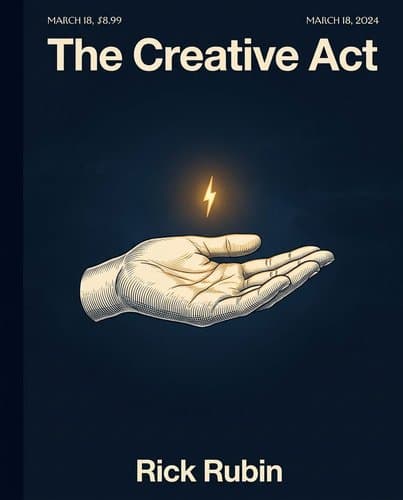
60965426_the-creative-act
by Rick Rubin
Creativity isn't something you generate—it's a signal you learn to receive. Rick Rubin reveals how to silence the interference of ego, judgment, and habit so…
In Brief
The Creative Act (Janu) reframes creativity as an act of reception rather than production — the artist's job is not to generate ideas but to remove the interference that blocks them. Drawing on decades of producing music across every genre, Rick Rubin offers practical tools for quieting the inner critic, developing taste, and sustaining creative output across a lifetime.
Key Ideas
Reception Problems, Not Personal Defects
When you hit a creative block, diagnose it as a signal problem — ask 'what's creating interference?' rather than 'what's wrong with me?' The source is always broadcasting; something is blocking reception.
Name The Noise, Not Fight It
When the inner critic activates, try naming the noise rather than arguing with it. Rubin's artist started calling his doubts 'papancha' and moving forward. The label reduces the voice's authority without requiring you to defeat it.
Accumulate A Hundred Seeds First
Before committing to a creative direction, collect seeds for weeks without evaluating them. The right seed announces itself only once you have enough material for comparison — a hundred seeds make number fifty-four obvious in a way it couldn't be on its own.
Invisible Conventions Hide Innovation
The next time you study an art form you love, look for what the practitioners never question — the rectangular canvas, the three-to-five-minute song, the three-act structure. That invisible convention is where the most interesting experiments live.
Separate Creation From Critical Judgment
Separate the work of making from the work of judging. The child in you makes; the adult reviews what the child made. Let them take turns rather than running simultaneously — the inner editor kills work that isn't finished yet.
Diary Entry, Not Forever Monument
Release each project as a diary entry, not a monument. The work is only a snapshot of who you were at that moment. Holding it back doesn't preserve it — it makes it a photograph of someone you're no longer.
Who Should Read This
People working on personal growth in Creative Thinking and Artistic Expression, especially those tired of generic motivational advice.
The Creative Act
By Rick Rubin
10 min read
Why does it matter? Because the block isn't in your talent — it's in your signal.
Most people treat creative work as an output problem. Not enough ideas. Not enough nerve to finish. Not enough talent to justify the attempt. Forty years producing some of the most celebrated records ever made quietly corrected Rick Rubin's assumptions about this. The artists he worked with weren't failing to generate — they were failing to receive. The signal was already moving through them, the way it moves through everyone. What blocked it wasn't deficiency. It was interference: the noise of self-doubt, the noise of imagined audiences. The Creative Act is a guide to clearing that interference. Not a method for making more. A practice for letting through what's already there.
Creativity Isn't Something You Do — It's What Perception Already Is
Every person reading this sentence is already an artist. Not aspirationally — literally, right now, in the act of reading.
Rubin's argument begins with a fact most people accept intellectually but haven't followed to its conclusions: your brain never passively receives the world. It constructs it. Every experience of warmth, color, sound, texture — your brain is building that right now. The forest you see isn't the forest that exists; it's the one your brain makes. Same with cold air, the weight of a book in your hands, the sound of someone's voice. You are not an audience to reality. You are its author, frame by frame, every waking moment.
Rubin's point isn't a metaphor. Having an experience of the world and making something are the same act. You have been creating continuously since birth without knowing it.
The category of "artist," then, isn't a special rank. It's a description of how humans work. A hummingbird builds its nest because that's what hummingbirds do. Human beings make things — conversations, interpretations, entire internally generated worlds — because that's what humans do.
The question isn't whether you are creative. You are. The question is whether you're doing it consciously.
Your Best Ideas Don't Come From You — They Come Through You
Radio waves are passing through you right now. Every frequency being broadcast, moving through the room, through your body, without your knowledge. You can't hear them. Not because they aren't there, but because you don't have the receiver.
Rubin's central claim about creativity works the same way. Ideas don't originate inside the artist. They're already out there, circulating in the culture, ripening on a timetable the artist doesn't set. The artist's only job is to be a good enough receiver to catch them when they arrive.
The claim isn't a metaphor for modesty. Rubin means it literally. He describes a kind of energetic material traveling on frequencies above ordinary sensory input — not something you analyze into existence or will yourself toward. You create the conditions for it by emptying out. The signal reaches you through a cleared space, not through effort.
The implications are strange. If two songwriters arrive at similar melodies in the same month without knowing each other, neither stole the idea. Both were tuned to the same signal at the same time. The idea found two open receivers. Rubin calls this the cosmic timetable: history is full of simultaneous discoveries, parallel innovations, movements of art that erupt at once across people who've never met. That's not coincidence. It's the signal finding anyone who can hear it.
Which raises the question: what makes one receiver better than another?
Here is where Rubin takes the argument somewhere unexpected. The most sensitive antennae, he writes, weren't developed through artistic training. They were developed through pain. Think of someone who couldn't make it through a party (too much noise, too many undercurrents), or who kept a journal as the only way to survive a loud house. That sensitivity wasn't built for art. It was built to survive. When everything hurts more, you pay more attention. You learn to read rooms, moods, undertones. That capacity, built for self-protection, turns out to be exactly the equipment creativity demands.
So the artist's work isn't manufacturing ideas. It's maintenance — keeping the receiver clear, tuned, open. Not chasing inspiration, but becoming the kind of person it can reach.
The harder question is what gets in the way.
The Voice Telling You You're Not Good Enough Isn't Yours
An artist sat frozen in session with Rick Rubin, unable to begin. He described the condition the way most people describe self-doubt: a wall inside himself, structural, permanent. Rubin asked if he knew the Buddhist concept of papancha: the mind's compulsion to multiply a single moment into cascading commentary before anything has actually happened. Recognition crossed the artist's face. He knew exactly what that was. It was him.
That moment of recognition was the beginning of the work. Not because naming a problem solves it, but because naming it changes what it is. What had felt like a private interior failing suddenly had a genus: a documented human phenomenon with a tradition behind it. When the torrent arrived again, they called it papancha, noticed it, and moved forward. The wall was still there. But it wasn't locked.
Rubin goes further. That voice in your head repeating you're not talented enough, your idea isn't good enough — it is, in most cases, not your voice at all. It arrived from outside and was absorbed so early, so completely, that it now sounds like thought rather than transmission. A critical parent. A dismissive teacher. You have been arguing with someone else's judgment for years, believing you were arguing with yourself.
The distinction has practical teeth. You cannot defeat a voice that feels structurally woven into you. But you can return a borrowed one — notice it, name it, recognize it as interference rather than signal. The artist's job is to distinguish the noise from the work. Commercial success, reception, legacy, fear of judgment: none of it belongs inside the process. These are static from outside the frequency. The mountain doesn't argue with clouds. It simply remains while they pass. The critic is the loudest cloud — but beneath it, quieter and harder to notice, are the absorbed conventions: assumptions about form, about genre, about what the work is supposed to look like. External all the same.
The Machine That Beat the World's Best by Not Knowing the Rules
Lee Sedol stood up from the board and walked out of the room. It was move 37 of a 2016 tournament match, and the reigning Go grandmaster had just watched his opponent make a move no human had chosen in three thousand years of play. Commentators called it a mistake. Sedol returned visibly shaken. What unnerved him afterward, he said, wasn't being beaten by something superior — it was that the move felt alien, as though it came from somewhere outside Go's entire human history. He lost four of the five matches and retired from professional competition the following year.
His opponent was AlphaGo, a DeepMind AI. Rubin comes back to this story in The Creative Act because AlphaGo's advantage had nothing to do with processing power. It won by learning Go from the rules alone, with no human coach and no immersion in how the game is properly played. Three thousand years of convention simply hadn't reached it. The full range of the board stayed open.
What three thousand years of mastery had actually refined was, it turns out, a narrower question than Go allows: not what the game permits, but what a skilled human player would do. The cultural weight of that tradition had quietly become the ceiling. AlphaGo, free of that weight, could see above it.
Rules work the same way. Every convention you absorb settles into place before you make a single actual decision: the three-act structure, the expected song length, the genre's unwritten dress code. You don't choose the constraint. It arrives with the label. Say "I'm writing a horror film" and you've already imported a bundle of invisible obligations. The work begins inside that enclosure.
Rubin doesn't argue against expertise. He argues that rules absorbed without examination become static — interference you didn't choose and may not even recognize as interference. The question worth sitting with: which of the walls in your process did you build, and which arrived already standing?
The Ramones thought they were making bubblegum pop, aiming to be the next Bay City Rollers, a mainstream teen pop act of the moment. Unaware they were near a boundary, they crossed it. What they accidentally invented was punk rock. Ignorance of a limit is sometimes the only way through it.
The Old Man Who Refused a Pulley
Once you've lifted the ceiling on what's possible, the question turns inward: what are you actually carrying in?
The old man carried a clay pot to the well every morning, lowering it by hand and raising it back up with total concentration, careful not to let it knock the sides. A traveler offered him a solution: a simple pulley that would let the pot drop and fill automatically, no collision risk, much less effort.
The old man said no. Not because he distrusted pulleys. Because the care he put into carrying the water was in the water itself. Take away the attention, he reasoned, and the taste would change.
Rick Rubin opens his chapter on intention with this parable, a story that inverts the usual logic of caring for your work.
We assume caring means wanting: wanting the project to succeed, to find an audience, to hold up over time. That's the pulley logic: optimize the path from making to result, because the result is the point.
The old man's position reverses the causality. The water doesn't carry the intention. The act of carrying the water does. Every conscious movement transfers something from the maker into the thing being made. A pulley would fill the pot just as full. But the pot would hold different water.
Rubin calls it intention, and it's harder to manufacture than it sounds. Not a goal you set, not a strategy. What you consciously want to make, what you actually believe you deserve to make, and how you spend the hour before you sit down need to point the same direction. You can't will it the way you set a deadline. You either bring yourself fully to the making, or you don't.
The liberating part is what this removes. The audience, the career calculus, whether the work reflects well on you — these are the pulley. They're efficient routes from making to result, and the moment you start planning the taste while filling the pot, the water changes. Rubin puts it directly: of everything that goes into a work, intention is primary. The object itself is only evidence — it points backward at the quality of attention that produced it.
Stop needing the work to be about you. Not as discipline. A shift in what you're actually doing. The maker building a reputation is making something different from the maker who is only making the thing. Both pots fill. The water is different.
You Can't Command the Lightning — But You Can Be There When It Arrives
What's the alternative when inspiration doesn't arrive — wait, or work through it anyway?
Rubin's answer is that the question is already wrong. Both options (waiting and grinding) assume the artist is trying to produce the transmission. There's a third position: stop trying to produce it, and start managing the space around it instead.
The image he uses is a lightning bolt. You can't summon one. But lightning doesn't strike randomly. It requires preconditions. The right atmospheric charge, the right height, the right exposure. Focus on building those conditions before, and on capturing what the strike delivers after. The bolt itself remains outside your control. The surrounding space is entirely yours.
In practice, this looks unremarkable. Carpenters show up each morning and do carpentry. Sculptors knead clay and sweep the floor and lock up at night. None of this is inspired. It's just the work. But showing up is itself the precondition. You can't be struck by something if you're not standing in the field.
Most people miss the second half. When the bolt does arrive, everything else gets set aside. John Lennon's rule: if you start a song, finish it in that sitting. The vitality in the initial spark can carry the whole piece — but leave it unattended and it loses charge fast. Step away from the fire and you may return to find only ash. A rough, complete version produced in that first heat is almost always more useful than a technically better fragment started later from a colder state.
You can't command the lightning. But you can keep standing in the field, and when it comes, you can refuse to leave until it's done.
The Greatest Work May Be Sitting in a Drawer Somewhere
Perfectionism feels like a high standard. It operates like one too — endless revision, higher bars, the refusal to settle. What it actually is: fear wearing quality's clothing.
The evidence is the work the world never received. Rubin makes a claim that should haunt anyone who has sat on a finished thing: the greatest artists we know may not be the greatest artists who lived — just the ones who could release what they made. The ones who couldn't let go left nothing. Not in museums, not in memory. Perfectionism doesn't produce better work. It produces no work.
The mechanics of the trap are familiar. Near the end of a project, faith drops out. Flaws appear that weren't there before. Small changes multiply. The sense that somewhere ahead, a better version is waiting. Rubin names it for what it is: the mind sheltering in incompleteness, keeping the clay soft so nothing has to be final. Release means losing control.
The frame shifts. An album isn't a monument; it's a diary entry, a record of who you were when you made it. Hold it another two years and you won't produce something better; you'll produce something different, made by a different person. The work may already be an old photograph before you consider it done.
The deeper inversion is this: once you stop needing the work to define you (to vindicate or redeem you), the grip loosens on its own. Each piece is just a page. Release it, and your hands are free for the next one.
The Frame Is Always Too Small
Rubin ends his book with the quietest possible move — less than a sentence where you'd expect a summary. After three hundred pages, the book simply goes quiet. That restraint is part of the argument.
Every frame you build around your creative identity is smaller than what it contains: what kind of artist you are, what work you make, why any of it matters. The book isn't asking you to find the right frame. It's asking you to notice when the current one has gotten tight, and to loosen it.
Which leaves you with this: the work was never about you. Your reputation, your legacy, your proof of worth — all static. Stop needing it to be yours, and something clears. The best work moves through an open hand.
Notable Quotes
“This will allow the pot to go straight down quickly,”
“then fill with water and come back up, without hitting the sides. It's much easier and the pot will be just as full with much less work.”
“Not a single human player would choose move 37,”
Frequently Asked Questions
- What is The Creative Act about?
- The Creative Act reframes creativity as an act of reception rather than production—the artist's job is not to generate ideas but to remove interference blocking them. Rick Rubin draws on decades of producing music across every genre to offer practical tools for quieting the inner critic, developing taste, and sustaining creative output across a lifetime. The book challenges conventional productivity thinking by suggesting creativity flows from openness and receptivity rather than constant effort. This philosophical reframing has practical applications for all creative professionals.
- What are the main concepts in The Creative Act?
- Key concepts include diagnosing creative blocks as signal problems rather than personal failures, naming the inner critic's noise to reduce its authority, and collecting creative seeds before evaluating them. Rubin emphasizes separating creation from judgment—letting them take turns rather than simultaneously running. He also advises releasing work as a diary entry rather than a monument, viewing each project as a snapshot of who you were at that moment. Additionally, practitioners should examine invisible conventions in their art form to discover opportunities for innovation and experimentation.
- How does Rick Rubin suggest handling creative blocks?
- When you hit a creative block, diagnose it as a signal problem rather than personal failure. The central question shifts from "what's wrong with me?" to "what's creating interference?" This reframes the problem as a reception issue—the source is always broadcasting something; the challenge is identifying what blocks the signal. Rubin suggests quieting interference through practices like meditation, nature time, or reducing overstimulation. By approaching blocks as technical problems to solve rather than personal deficits, artists can focus problem-solving energy on specific obstacles instead of self-doubt, transforming creative paralysis into actionable troubleshooting.
- What is Rick Rubin's approach to the inner critic?
- When the inner critic activates, Rubin recommends naming the noise rather than arguing with it. One artist began calling his doubts "papancha" and moving forward; this label reduced the voice's authority without requiring defeat. Rather than engaging in internal struggle, acknowledge the critic and continue creating. This transforms the inner critic from an enemy to background noise. By externalizing and naming the voice, artists create psychological distance that frees creative energy for productive work, enabling peaceful coexistence with the critical mind rather than exhausting conquest attempts.
Related Book Summaries



Read the full summary of 60965426_the-creative-act on InShort