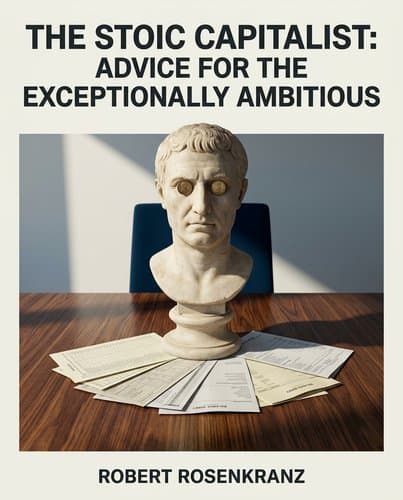
217593479_the-stoic-capitalist
by Robert Rosenkranz
Extreme ambition and Stoic discipline aren't opposites—they're the exact combination that builds lasting wealth. Rosenkranz shows how to pick the right…
In Brief
The Stoic Capitalist: Advice for the Exceptionally Ambitious (2025) argues that Stoic philosophy is the ideal mental framework for extreme wealth-building — not its opposite. Drawing on expected value thinking, structural industry analysis, and Marcus Aurelius, it gives ambitious readers a disciplined system for making high-stakes bets, evaluating opportunities efficiently, and building a life worth the fortune they accumulate.
Key Ideas
Build expected value models explicitly
Before entering any high-stakes negotiation or career bet, build the expected value model explicitly — including the realistic downside scenario. Most people skip the math and act on instinct; the Stoic move is to do the arithmetic and then act on it, even when instinct says run
Pick the playing field first
Identify which industry you're in before you optimize how you perform in it. The Forbes 400 analysis suggests that structural tailwinds (tax advantages, leverage, float) account for more of extreme wealth creation than individual skill — pick the playing field before you start training
One hard-to-fake data point suffices
When evaluating an implausible but high-upside opportunity, find the single low-cost, hard-to-fake data point — the 'picture' — before committing to full due diligence. Fifteen minutes of targeted research often tells you more than months of elaborate analysis
Judge by process not outcome
Judge your decisions by the quality of your process and information at the time, not by the outcome. The Ivy Hill disaster was a sound decision that met an unpredictable technology shock — what matters is whether you built in a margin of safety that made bad luck affordable rather than fatal
Process reveals character in partners
In any relationship that matters long-term — a marriage, a partnership, a key hire — the negotiating process is a window into the other person's character. If the process makes your stomach churn, the relationship will likely be worse. Walk away before the contract makes it expensive
Schedule yellow pad audit days
The 'yellow pad day': take an occasional full day in an unfamiliar place with your phone off and a yellow pad. Audit your relationships, your habits, your macro risks, and your errors of omission. Being busy is the enemy of being thoughtful — Aurelius: 'do less, but do what's essential with greater concentration'
Omission costs exceed commission costs
Errors of omission are often more expensive than errors of commission for people who are already good at avoiding bad decisions. Ask for the GP stake. Ask for the partnership. The cost of asking is nearly zero; the cost of not asking can be a $17 billion missed opportunity
Who Should Read This
Business operators, founders, and managers interested in Stoicism and Wealth Building who want frameworks they can apply this week.
The Stoic Capitalist: Advice for the Exceptionally Ambitious
By Robert Rosenkranz
12 min read
Why does it matter? Because the gap between Stoic philosophy and ruthless ambition is smaller than you think — and Rosenkranz spent fifty years proving it
Most people read the Stoics as a philosophy of endurance — bear the loss, accept the outcome, don't let Fortune make you its fool, as the Stoics warned. Robert Rosenkranz read them as a philosophy of leverage. At thirty-five, he walked into a meeting at the Pierre Hotel and proposed putting his entire liquid net worth on the line — not as a gamble, but as the most rational move available to him. The math was clear, the downside was survivable, and the fear was just noise to be processed and set aside. That's the argument this book makes and keeps making across sixty years of deals, disasters — a manufacturing bet wiped out by the Walkman, a partnership dissolved by cancer — and accumulated thought: that Stoicism isn't about wanting less — it's about wanting precisely the right things, with a clarity most people never achieve. Ancient wisdom didn't slow Rosenkranz down. It told him exactly when to go all in.
Putting Everything on the Line Is Sometimes the Rational Move
Spring 1978, a Saturday afternoon. Robert Rosenkranz, thirty-five years old and restless despite a partnership at Oppenheimer & Co., rides the elevator up to Joe Mailman's apartment at the Pierre Hotel in Manhattan. Mailman — a self-made industrialist who had parlayed a pawnbroker's shop in upstate New York into a major stake in Hess Oil — had already made money alongside Rosenkranz on a leveraged buyout of a supermarket chain. Now he wanted to back a dedicated buyout firm. The terms were the sticking point.
Mailman balked at the standard Wall Street arrangement, where the fund manager pockets twenty percent of the profits while absorbing none of the losses. He called it what it was: heads I win, tails you lose. Rosenkranz agreed — and then proposed something that stopped Mailman cold. He would put his entire liquid net worth, $400,000, into the fund. He would take fifty percent of the profits and absorb fifty percent of the losses. A loss of just twenty percent across the fund's capital would leave Rosenkranz with nothing.
That looks reckless until you run the numbers Rosenkranz had already run in his head. Based on returns he had watched Oppenheimer generate on similar deals — some returning twenty to fifty times capital, one returning a hundred times — he put the odds of the new firm generating $100 million in profit at roughly one in three. The standard carry on that outcome was worth about $6.7 million in expected value. His proposed fifty-percent share was worth $16.7 million. The extra risk he was taking — a one-in-three chance of losing $400,000 — carried an expected cost of $167,000. He was trading $167,000 in expected downside for $10 million in expected upside.
Daniel Kahneman documented why almost no one makes this trade even when the math is this clean: our brains weight losses far more heavily than equivalent gains. Stoicism, properly understood, is not the philosophy of acceptance and restraint you may have encountered in popular self-help. It is the philosophy of acting on reason even when instinct is screaming otherwise. Rosenkranz didn't override his fear by suppressing it. He examined what failure would actually look like — he still held illiquid stakes in other deals, he had marketable skills, he would not be destitute — and found that the catastrophe his nervous system was conjuring simply wasn't there. The rational move and the courageous move turned out to be the same move. He took the deal.
The Wealthy Aren't Smarter — They Picked the Right Playing Field
Most people who study the Forbes 400 are looking for inspiration. Rosenkranz looked for structure. When he set out in the late 1960s to understand how extreme wealth actually gets built in America, he didn't read biographies or chase the story of the decade's most celebrated entrepreneur. He pulled twenty-five years of Forbes data, sorted it into five-year blocks to smooth out the noise, and asked a simple statistical question: where do new fortunes actually come from?
The answer was surprisingly concentrated. Each five-year window produced roughly 100 to 150 new names — confirming that American capitalism remained genuinely open — but the vast majority of those new entries clustered inside four industries: real estate, oil and gas, insurance, and shipping. Not technology. Not finance. Not manufacturing. The same four fields, decade after decade.
The reason, once you saw it, had nothing to do with the genius of the people involved. It was purely structural — each of those industries carried a tax advantage that allowed wealth to compound with far less friction than everywhere else. A real estate developer could mortgage a property he'd built up, pulling out large sums of cash the IRS couldn't touch, because borrowing money isn't a taxable event. An oil and gas operator could deduct drilling costs immediately, funnel a hundred percent of profits back into new wells, and pay essentially nothing along the way. An insurer could park reserves two or three times the size of its actual capital into tax-exempt municipal bonds, effectively tripling the yield available to ordinary investors. Shipping companies registered offshore and largely sidestepped the tax system entirely.
The structural tailwind mattered more than the operator. Which means that someone doing the statistical work Rosenkranz did — before most people were thinking this way — could identify the right playing field and step onto it, rather than waiting to be brilliant enough to win on a harder one. When he walked Leon Levy, the senior partner at Oppenheimer, through this analysis during what was essentially a job interview, Levy was struck less by the conclusions than by the method. Here was a young man who had done the homework to understand where the game was being played before asking how to win it. That was enough: Levy hired him on the spot, firm rule against inexperienced hires be damned.
The Real Skill Isn't Picking Stocks — It's Picking Your Spot in the Capital Structure
The clearest illustration is a trade Rosenkranz engineered in 1970–71 that most people in his position would never have noticed. Studying metals exchange prices, he found that you could buy silver and simultaneously lock in a sale for delivery one year later at a gain of roughly ten percent — two percentage points better than what banks were charging to finance the purchase. That spread was real money, but it wasn't the point. The point was what the IRS was about to do to the profits.
Under tax rules of the era, silver held for more than six months produced long-term capital gains, taxed at twenty percent. But the interest expense on the loan used to buy it was deductible against ordinary income — and Oppenheimer's partners were paying seventy cents on every dollar they earned. Rosenkranz saw that the same dollar, routed through this trade, could be transformed: what would have left a partner with thirty cents after income tax would instead leave him with eighty cents after capital gains tax. The interest-rate spread was almost incidental. The real engine was the tax-rate gap. Think of the tax code as a terrain map rather than a rulebook — two people making identical economic decisions arrive at radically different destinations depending solely on which path they walked.
He bought thirty million ounces, roughly $50 million worth, enough that it took the silver market an entire month to deliver the warehouse receipts. That delay, irritating in any other context, was itself a gift: eleven months of interest charges where twelve had been budgeted. When the dust settled, the trade had earned the firm around a million dollars in pretax profit and lifted its after-tax earnings by forty-five percent. In one transaction.
The mechanism matters more than the magnitude. Rosenkranz hadn't found a better company to invest in or negotiated a sharper price. He had identified a seam in the tax code where two rates, applied to the same underlying transaction, created a gap wide enough to walk through. The IRS was an involuntary co-investor in every dollar of gain. That's the template: the structurally savvy investor doesn't need to be smarter than other investors about what the world will do next. He needs to be smarter about how value is being distributed before it reaches anyone's pocket.
The Stoics Were Right That Most of Your Competitors Are Running on Emotion
What separates the investor who acts on mathematics from the one who acts on reflex? Rosenkranz's answer is Stoic training — not philosophical background, but a specific cognitive discipline with measurable consequences when real money is at stake.
The principles Rosenkranz distills from Marcus Aurelius and Epictetus run through his thinking on markets at every level. The most practically useful is the dichotomy of control: some things are within your power, and some are not. Marcus put it bluntly — wanting what is impossible is a form of madness. Epictetus built his entire philosophy on the same hinge. CBT inherited this framework almost intact, teaching patients to distinguish the actual event from the story they've constructed around it — same distinction, different vocabulary. What Rosenkranz adds is the competitive implication. Most people in markets conflate the two constantly. They rage at price movements they cannot control, catastrophize outcomes that haven't happened, and read every ambiguous data point as confirmation of whatever they already believed. The emotion is doing real work — just not work that benefits them.
The antidote isn't detachment. It's the 'Man from Mars' stance that commodities trader Charles Stevenson described to Rosenkranz early in his career. Stevenson had built a substantial fortune not by mastering supply-and-demand fundamentals, but by training himself to watch other participants the way an alien observer would — zero emotional investment in their reasoning, watching only for the direction of the stampede. He didn't need to understand why the crowd was moving. He just needed to avoid being trampled.
That discipline — treating your own initial response as data to examine rather than a signal to act on — is what Stoicism actually offers a competitive investor. Anger clouds the calculation. Fear inflates the downside. Seneca called them temporary insanities, and both are recoverable through the same mechanism: stop, ask whether your interpretation is the only one available, and measure your response against your actual interest. The investor who can do that consistently has an edge no proprietary data source can replicate, because most of his competitors are too busy reacting to think.
Spotting a Fraud Takes Fifteen Minutes If You Ask the Right Question
A stack of papers six inches high lands on Rosenkranz's desk — three months of trade confirmations from a friend's account at Bernie Madoff's firm. Madoff has offered Delphi $100 million of investment capacity, promising steady returns in the ten-to-fifteen percent range with essentially no losses across years of track record. The offer is worth taking seriously. So Rosenkranz picks six slips at random from the pile. Three purchases, each executed at the exact low price of the trading day. Three sales, each at the exact high. He pulls a few more. Same pattern. Nobody trades that well — not once, not six times in a row. He does the arithmetic: working backward from Madoff's known scale, his friend's account represents roughly one percent of total assets, so the implied trading volume, scaled up, runs several times larger than the entire market's reported activity for those days. The trades weren't skillful. They were invented.
The rest took minutes. Madoff's SEC-mandated audited financials bore the signature of a tiny accounting firm operating out of a suburban shopping center. The balance sheet was more damning: a legitimate market-making business, and nothing else. No customer securities. No receivables or payables tied to a money-management operation. The business Madoff was selling to investors didn't appear anywhere in the documents he was legally required to file. The fraud was visible on the face of the filing.
Rosenkranz walked two friends through this — one had an account with Madoff, the other had invested personally. Neither withdrew. They had already decided they'd found something rare: high returns, negligible risk, insider access. The evidence didn't dislodge the conclusion because the conclusion wasn't based on evidence to begin with. Confirmation bias isn't a lapse in intelligence. It's what intelligence does when it's already committed.
The lesson isn't that fraud is easy to spot if you're clever enough. The decisive test is almost always simpler than you expect — and the reason most people skip it is that they're hoping not to find anything. The right question, asked early, costs almost nothing. Rosenkranz spent less time unmasking one of history's largest financial frauds than most investors spend reading a pitch deck. The analytical frame, not the volume of effort, was the whole game.
The Same Detachment That Makes Great Deals Can Hollow Out a Life
The same analytical distance that makes a great investor can make a terrible husband. Rosenkranz spent years building a framework for seeing clearly — stripping emotion from decisions, reframing every situation through Stoic cost-benefit logic — and then applied almost none of it to his marriage.
Peggy Hill was a Fordham Law editor who had clerked for the chief judge of New York's highest court. When she walked away from a legal career at the exact moment law firms were desperate to promote women, Rosenkranz told her directly that she was making the wrong choice. He sided with her colleagues who wondered aloud when she was going to 'do something.' The marriage turned cold. What he had failed to calculate — the man who ran expected-value tables in his head before meetings — was that Peggy's domestic choices were the hidden infrastructure of every financial move he made. Their entire lifestyle ran on a single discipline: she never pushed him to spend money he wasn't comfortable spending. While his peers at law firms were consuming salaries, the Rosenkranzes saved roughly half of his investment banking income. By the time he rode the elevator to Joe Mailman's apartment at the Pierre, the $400,000 in liquid capital he put on the table — his entire bet, the founding stake of Rosenkranz & Co. — existed because of her indifference to consumption. He had the capital to risk everything because she had never asked him to spend it.
He knew this, eventually. What's striking is how completely the 'angry wife' frame had blocked the view. CBT calls it a cognitive distortion: once you've assigned someone a label, ambiguous evidence gets filed under the label, and contradictory evidence disappears. The man who could identify a Madoff fraud from six trade confirmations couldn't see that the person financing his ambitions was the person he came home to.
The same blind spot showed up differently a decade later. His first real business partner, Bob Posnak, died of cancer in 1994. Posnak's command of insurance accounting had been the operational engine of Delphi's early growth. Losing him sent Rosenkranz back to working alone, and he stayed there for over a decade — substituting capable employees for a genuine partner, and paying for it in the institutional scale he never fully recovered.
The Appaloosa Lesson: Your Best Investment Decisions Are Also Your Best Errors of Omission
It is 1992, and David Tepper — passed over twice for a Goldman Sachs partnership despite managing the firm's own distressed-debt capital — walks into an interview and proceeds to answer every question correctly. His strategy checked almost every box on Rosenkranz's mental list: bonds trading at pennies on the dollar, a built-in date with destiny when companies emerged from bankruptcy, institutional sellers forced to dump positions by rating agencies regardless of price, and almost no qualified buyers willing to do the complex legal and structural work required. Rosenkranz committed $25 million — half of what Tepper needed to launch Appaloosa — and stayed in for more than twenty-five years. The ride included a year where Tepper lost seventy percent of his capital, followed by a recovery of ninety percent the next year. His partners marked the comeback by presenting him a pair of brass balls. Annual returns averaged better than twenty-five percent. Total profits for Rosenkranz ran into the hundreds of millions.
Then comes the sentence you almost miss: as the founding investor, Rosenkranz could almost certainly have asked for a general partnership stake in what eventually became a $17 billion operation. He never raised the question.
(A bad bet on Ivy Hill, wiped out by the Walkman, had cost $100,000 — a small, clean loss the structure was built to absorb.)
The Appaloosa omission is harder, because nothing went wrong. The analysis was right. The execution was right. The relationship held for decades. The only thing missing was one question — the kind of question that people who are already good at avoiding bad decisions sometimes forget to ask, because they're focused on not losing rather than on the full scope of what winning could mean. You can build a rigorous framework for evaluating downside and still leave the most consequential upside unexamined, and never ask what else the deal made possible.
Philanthropy Is Not Giving Back — It's Applying Investment Discipline to a Different Problem
Rosenkranz eventually concluded that the same discipline that built a fortune — finding structural obstacles, identifying the low-cost intervention that clears them, measuring the actual delta — was also the right framework for spending one. The Yale curriculum story is the clearest proof.
Sit on enough charity boards and a pattern emerges: institutions want two things — applause for management and an ambassador to recruit more donors. Suggest that their plans have hidden tradeoffs and you'll get polite silence. The Stoic move, Rosenkranz decided, is to accept this without resentment and reroute. Don't push your own priorities onto an organization. Find an initiative already moving inside it, identify what's blocking it, and apply capital precisely there.
At Yale in the early 2000s, the institution had a genuinely ambitious curriculum proposal: replace knowledge-based requirements with competency-based ones, built around five skills every undergraduate should leave with — among them quantitative reasoning and scientific method. The logic was airtight. The execution was stalled. Faculty wouldn't design the new courses because Yale grants tenure for research output, not classroom innovation. Spending a summer building a rigorous science course for non-majors produces nothing that moves a career forward; spending the same summer on a journal article does. The incentive structure wasn't broken — it was working exactly as designed, just toward the wrong end.
Rosenkranz identified the mechanism, then priced the intervention. Working with the dean overseeing the project, he determined that if course design paid the same as research, some faculty would do it — and if talented pedagogues were brought in to help, the courses could clear the bar for non-majors who needed to be engaged, not just informed. The Rosenkranz Foundation covered both costs. Over two summers, thirty courses were built. Student evaluations came back with language you don't usually see in institutional assessment: 'I took this because I had to. It changed the way I think. I changed my major.'
That's what Rosenkranz calls the selfish philanthropist's template. Not guilt, not legacy-polishing — find where the delta is large, where structural friction is holding back something already worth doing, and price the fix. The building named after him he calls 'rich man's graffiti.' The curriculum work, which carried no public recognition, was the real return.
The Stoic Paradox: The Man Who Controlled the Most Was Most Convinced Only Internal Conditions Are Really Yours
Rosenkranz built the whole apparatus — the tax-structure analysis, the asymmetric carry arrangement with Mailman, the systematic elimination of meetings without clear purpose — in service of a single interior condition: the capacity to reason without distortion. Ask what all that control was actually for, and the answer isn't domination. It's freedom from anxiety about the board, so the mind can think clearly.
Marcus Aurelius captured the target precisely. He was the most powerful man in the world, commanding armies and deciding criminal appeals, and he spent his private hours writing a diary no one was meant to read — talking himself back, again and again, to the one thing he actually controlled: his own perception. Not events. Not other people's behavior. The quality of his own thinking. Rosenkranz finds this not just admirable but practically useful, because it names what the whole enterprise is protecting.
Epictetus, who began life as a slave and ended it as the most sought-after teacher in Rome, arrived at the same place from the opposite direction. When you own nothing, you discover fast what can't be taken. His answer: only your judgment. Everything outside it — other people's opinions, institutional barriers, the market's mood on a given morning — belongs to a category you can influence at most and must ultimately release.
The ten-year-old Rosenkranz who rejected his mother's fatalism — her insistence that their circumstances were fixed, that money and class operated like weather — wasn't making a financial argument. He was making a Stoic one: your circumstances are not your character, and your character is the only asset with a guaranteed title. The yellow pad days (one annual ritual: total isolation in an unfamiliar place, phone off, a structured review of relationships to repair, habits to drop, risks to face) aren't a productivity trick. Neither is the ruthless calendar pruning, or the refusal to become a purchasing agent for his own life. These are how you protect the reasoning faculty that Aurelius called, without exaggeration, the only thing that makes freedom possible. Control the outside so the inside stays clear. That's the whole system.
The Question Worth Carrying Forward
Here is what the book finally leaves you with: all the structures Rosenkranz built — the asymmetric carry, the tax-code arbitrage, the fraud-detection heuristics — were never really about accumulating control. They were about clearing enough external noise that one thing could function without distortion: his own judgment. The Stoics didn't promise winners. They promised that reason, kept honest and kept yours, is the one asset no counterparty can reprice. The art collection, the debate initiative, the longevity research — each a separate chapter, each running the same discipline — weren't covered here, but they belong to the same logic. The hard question the book puts to you isn't whether you're willing to risk everything on a good expected-value bet. It's whether you're honest enough with yourself to know which risks you've actually calculated and which ones you've just declined to look at — because the man who could see a Madoff fraud in six trade confirmations spent a decade replacing a dead partner with employees, and never once did the math on what that was costing him. Which leaves you to wonder what's on your own list of numbers you haven't run.
Notable Quotes
“heads I win, tails he loses”
“Sorry, I didn’t realize the taxi was occupied,”
“After a long and arduous campaign, he defeated Darius III of Persia. His troops were eager to return home, and semi-mutinous as he drove them further east toward India. What the hell was he thinking?”
Frequently Asked Questions
- What is The Stoic Capitalist about?
- The Stoic Capitalist: Advice for the Exceptionally Ambitious argues that Stoic philosophy is the ideal mental framework for extreme wealth-building — not its opposite. Robert Rosenkranz combines Stoic principles with expected value thinking and structural industry analysis to give ambitious readers a disciplined system for making high-stakes bets, evaluating opportunities efficiently, and building a life worth the fortune they accumulate. The book draws on Marcus Aurelius and Forbes 400 analysis to show how Stoicism enables sound decision-making under uncertainty and risk.
- What does The Stoic Capitalist say about entering high-stakes negotiations?
- Before entering any high-stakes negotiation or career bet, The Stoic Capitalist recommends building an explicit expected value model that includes realistic downside scenarios. Most people skip the math and act on instinct, but Rosenkranz argues the Stoic move is to do the arithmetic and then act on it, even when instinct says otherwise. This disciplined approach reflects Stoic philosophy's emphasis on reasoned judgment over emotional impulse. By quantifying risks and rewards, readers can make better decisions in situations with significant financial or career implications.
- What industry selection strategy does The Stoic Capitalist recommend?
- The Stoic Capitalist emphasizes identifying which industry you're in before optimizing how you perform within it. According to Forbes 400 analysis, structural tailwinds—tax advantages, leverage, and float—account for more of extreme wealth creation than individual skill. Rosenkranz advises selecting your playing field before training, since industry economics matter more than personal excellence. This structural approach distinguishes his Stoic framework from conventional advice focusing on skill development. Choosing the right industry with favorable tailwinds provides better returns than perfecting performance in an unfavorable one.
- What does The Stoic Capitalist say about errors of omission?
- Errors of omission are often more expensive than errors of commission for people already good at avoiding bad decisions, according to The Stoic Capitalist. Rosenkranz advises asking for opportunities—whether a GP stake, partnership, or investment—because the cost of asking is nearly zero, while not asking can result in missed billion-dollar opportunities. This principle reflects Stoic acceptance of what you can control (your actions) versus what you cannot (the response). For ambitious people who typically make sound decisions, the risk lies less in acting boldly and more in failing to pursue worthwhile opportunities.
Related Book Summaries
Read the full summary of 217593479_the-stoic-capitalist on InShort