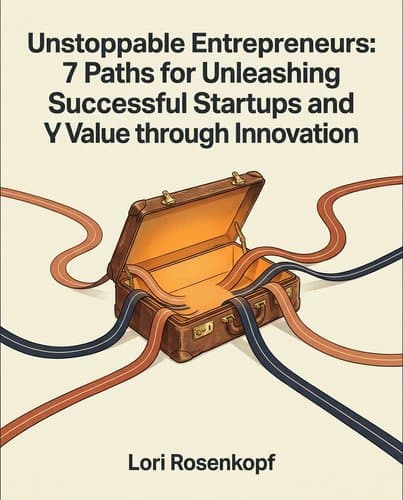
220222969_unstoppable-entrepreneurs
by Lori Rosenkopf
The 'tech bro unicorn' myth keeps capable people from ever starting—Rosenkopf dismantles it by revealing entrepreneurship as seven distinct, learnable paths…
In Brief
Unstoppable Entrepreneurs: 7 Paths for Unleashing Successful Startups and Creating Value through Innovation (2025) dismantles the myth that entrepreneurship belongs only to a narrow archetype and maps seven distinct paths — from bootstrapping to intrapreneurship to acquisition — that match different skills, backgrounds, and goals.
Key Ideas
Six Rs diagnose bottleneck, not checklist
Run your situation through the Six Rs as a diagnostic, not a checklist: identify which R is the actual bottleneck (missing relationships? insufficient reason? no resilience plan?) rather than treating the framework as a sequential to-do list.
Unconventional background creates asymmetric insight
Map your 'Zone of Genius' — the cross-industry experience or unconventional background that gives you an asymmetric insight — before you evaluate any idea. The recombination that feels obvious to you is invisible to people who've only worked in one field.
Reframe risk questions as growth
When fundraising as a woman or founder of color, prepare for 'prevention' questions (about risk and failure modes) and practice giving 'promotional' answers (reframing around growth potential) — because the framing of the question shapes how investors categorize the opportunity.
Acquisition path: skip product-market fit
Before assuming you need to build from scratch, explore the acquisition path: search funds have produced 35.3% average annual returns since 1984 and let you skip the product-market fit stage entirely.
Bootstrapping preserves autonomy and survival
Bootstrapping is a strategic choice, not a fallback — 80% of bootstrapped startups survive five years versus roughly 50% of the broader startup population, and the absence of outside investors preserves the autonomy to make counter-consensus bets like signing retail leases when everyone else is fleeing brick-and-mortar.
Partnership: structural resilience against crisis
Resilience is easier with a partner than alone: the two most extreme crisis moments in the book (Joan Lau's deal resurrection, Jackie Reses's five-year charter fight) were both survived through partnership — Hollingsworth's recovery plan, Reses's board credibility. Treat 'who carries this with me' as a structural question, not an afterthought.
Visible failure: cost of intrapreneurship
Intrapreneurship inside a large organization is a legitimate path — but it requires a specific willingness to absorb public failure over a long horizon. If you're not prepared to have your project killed after five years of visible effort, the intrapreneur path will break you.
Who Should Read This
Readers interested in Startups and Innovation, looking for practical insights they can apply to their own lives.
Unstoppable Entrepreneurs: 7 Paths for Unleashing Successful Startups and Creating Value through Innovation
By Lori Rosenkopf
12 min read
Why does it matter? Because the entrepreneur you picture in your head is keeping you from becoming one.
The average founder of a fastest-growing startup is 45 — not the hoodie-wearing college dropout you've been sold. Lori Rosenkopf, who has spent years at Wharton watching real entrepreneurs up close, argues that the 'tech bro unicorn' narrative isn't just misleading — it's actively keeping capable people on the sidelines, waiting for permission they'll never get. This book is the permission slip, but a rigorous one. It maps seven distinct paths into entrepreneurship and makes a quiet, devastating case that the raw material you need — your career detours, your industry frustrations, your employer's dusty patents — is already in your hands.
The 'Tech Bro' Myth Is Costing You Years
The entrepreneur you picture when you close your eyes is not a template — it's a statistical outlier. Wharton professor Lori Rosenkopf points to a striking number: among the top 0.1% of fastest-growing new ventures, the mean founder age is 45. Not 22. Not a Stanford dropout in a hoodie. Middle-aged. The college-dropout-turned-billionaire story dominates media coverage precisely because it's anomalous — extreme outcomes attract cameras. The vast majority of people who successfully build businesses look nothing like Mark Zuckerberg, and many start considerably later in life, after accumulating exactly the kind of experience and judgment that makes businesses actually work.
Consider what entrepreneurship looks like when you zoom out past Silicon Valley. Aravind Krishnan became preoccupied with declining horseshoe crab populations after a middle school field trip. The crabs' blood is harvested to test for dangerous bacterial contamination in medical devices and drugs — every IV bag, every injectable medication has to pass this test — and the process kills roughly 30% of the crabs harvested. Aravind spent years engineering a plant that glows in the presence of those same bacterial contaminants, offering a substitute test at one-twentieth the cost of the current standard. He co-founded a company before finishing his first year at Penn. No tech credentials. No disrupted app market. Just a specific problem, a biology lab, and the drive to work the problem until it broke.
No pitch deck required. No VC gatekeepers. Just a founder who looked nothing like the archetype — and built something that matters anyway.
Your Strangest Career Detour Is Your Biggest Competitive Advantage
Think of the person who learns to cook in five different countries before opening a restaurant. None of the local chefs can see the connections between all five. That accumulated strangeness is the menu.
Amy Errett spent years as a venture capitalist before founding Madison Reed, and she was miserable at it. The job looked like a pinnacle on paper — dispensing money and advice, carrying no operational responsibility. She hated it. What that stretch gave her, though, was a vantage point no beauty industry insider possessed: she had watched DTC businesses like Dollar Shave Club reshape how men bought razors, and she had the financial pattern-recognition to ask what the equivalent was for women. The answer she landed on — premium hair color, sold by subscription, made without the harsh chemicals that salon brands had spent fifty years normalizing — was invisible to people who had spent their careers inside the industry. They were too close to the existing map to notice it was wrong.
The most cited papers in any field show a consistent ratio: roughly ninety percent of the ideas come from within the established canon, and about ten percent arrive from somewhere else entirely. That foreign ten percent is what makes the work matter. Pure novelty confuses; pure familiarity adds nothing. The cross-industry transplant, the immigrant who built intuitions in one economy and then operated in another, the person who cycled through four departments instead of climbing one ladder — each carries that ten percent that insiders cannot replicate.
Recombination runs through every entrepreneurial path in this book. The disruptor who spotted a market gap nobody inside the industry bothered to map. Jesse Pujji, whose father's immigrant arithmetic gave him a harder-edged definition of profit than any MBA program would have. The form of the venture matters less than the distinctiveness of the lens. Your strangest detour is where that lens was ground.
Disruption Doesn't Require a Blank Slate — It Requires a Moat
Imagine it's March 2020 and you run a hair color company. You have twelve stores, all of them just shuttered by a pandemic. Your Italian factory — the only one willing to formulate a product clean enough to match your standards — is located in the second region on earth hit by the virus. And then, in a single day, demand explodes to one box sold every four seconds. That is where Amy Errett found herself when COVID arrived.
The crisis exposed something most disruption stories skip past: landing in a gap no one owns is the easy part. Surviving long enough to own it is the hard part, and survival depends less on originality than on building walls that incumbents cannot cross without embarrassing themselves.
Errett's walls were already in place before the pandemic hit. Madison Reed had entered the hair color market by occupying the gap between a ten-dollar box of chemicals at the drugstore and a two-hundred-dollar salon appointment — but that positioning alone would have been easy to copy. What made it defensible was a specific trap she'd set for the competition. The moment any established brand tried to match her cleaner formulation, they'd face an awkward question from their own customers: if this new version is safer, what exactly have we been selling you for the past fifty years? The product moat worked not because it was technically impossible to replicate, but because replication required self-incrimination.
Then the pandemic hit anyway, and the walls got tested.
With 150 stylists suddenly out of work and call volume spiking toward eighty thousand daily inquiries, Errett bought every available computer she could find across the Bay Area, ordered headsets online, and trained 137 of those stylists to staff a digital call center — in six days. She could have furloughed them for less money. She didn't, because she understood that her consumer data and brand loyalty were the third wall of her moat, and those things are built one interaction at a time by people who genuinely know the product.
The bet she turned down was equally clarifying. Private equity firms offered her a hundred million dollars on the condition that she never open another physical store. She declined, signed new leases at a third of normal rates while everyone else was predicting the death of retail, and watched what happened: wherever two or more of her Color Bars operated in a region, every sales channel around them performed roughly thirty percent better — including neighboring Ulta locations, which had no direct stake in Madison Reed's success. That's not foot traffic spillover. That's brand halo: proof that the stores were changing how people in the area thought about hair color altogether.
Disruption isn't a single creative act. It's a structure you build so the people who come after you can't arrive without walking through walls you've already raised.
Bootstrapping Isn't a Consolation Prize — It's a Different Game with Better Odds
Jesse Pujji was days away from updating his resume when everything changed. He and his cofounders had left Goldman Sachs and McKinsey to build Ampush, a digital marketing firm, and their business plan rested on a single assumption: their ads would convert at five percent. The first time they ran one, it converted at zero point one. They maxed their credit cards. They stopped sleeping well. They got close enough to quitting that the question became concrete rather than hypothetical. Then, heads down for a couple of months, they cracked the model — figured out what a competitor was doing, made it work, and lived to build a company that would eventually manage over a billion dollars in advertising spend for clients like Uber and Dollar Shave Club.
That crisis is a better advertisement for bootstrapping than any statistic, but the statistics are worth knowing. Only about seventeen percent of entrepreneurs fund their businesses with bank loans or venture capital. The rest figure it out on their own cash and reinvested profits — and they survive at a striking rate. Roughly half of all small businesses fail within five years; for bootstrapped companies, eighty percent are still operating after five. That gap exists for a reason: bootstrapped companies have to be profitable from the start, so they build the discipline into their DNA rather than bolting it on later. The conventional wisdom has the causality backwards. Bootstrapping isn't what you do when no one will fund you. It's a deliberate bet that a business generating its own cash is sturdier, more autonomous, and ultimately worth more to the people who built it.
Pujji had a philosophy behind this choice, inherited from his father — an Indian immigrant who built his own business in St. Louis from scratch. The lesson his father kept repeating was simple: a real business sells something for more than it costs to make. Bootstrappers answer to their customers. Founders who raise money answer to whoever is underwriting the promise of future scale. That distinction, compounded over years, is enormous.
What Pujji calls the 'zombie company' problem captures the downside of the alternative. When founders raise money at valuations they haven't yet earned, they get trapped — too expensive to acquire, too underpowered to grow into their own price tag, stuck in a kind of corporate purgatory. Gateway X, the venture studio Pujji founded after selling Ampush, is already past twenty million in revenue across its portfolio, with no outside capital. The bootstrapped path makes profitability the metric from day one — which is exactly the compounding logic his father taught him over a copy machine in St. Louis.
You Don't Have to Start from Scratch — You Can Buy Your Way In
What if the hardest part of starting a business — whether anyone will actually pay for what you're selling — is a problem you never have to solve? That's the quiet logic behind entrepreneurship through acquisition, a path most people overlook because they assume it requires either a trust fund or a private equity pedigree.
Charbel Zreik had neither. A Lebanese immigrant who once collected aluminum cans on New York street corners for a nickel apiece, he spent years at McKinsey before walking away from a path to partner because he wanted to own a profit-and-loss statement, not advise someone else's. The insight that cleared the way came from an unlikely source: Staples co-founder Thomas Stemberg told a room of Wharton MBA students that building a business around your passion is one of the fastest ways to destroy value. Find a need in the market, Stemberg said, and work backward from there. Charbel had been at risk of doing the opposite — drawn to sectors he found interesting rather than ones with structural demand — and the advice recalibrated him. Rather than founding a startup, he raised capital from search fund investors, people who back aspiring CEOs in finding, buying, and running existing businesses, and spent months analyzing more than ten thousand companies before landing on DCI Design Communications, an $18 million telecom provider serving hotels.
The numbers from that category of investment are striking: search funds have averaged 35.3 percent annual returns since 1984 — against roughly 10 percent for the S&P 500 — with a total return of more than five times invested capital. The model works for a structural reason. You're buying a business with customers, revenue, and operating history already in place. The existential question that kills most startups — will this ever work? — has already been answered.
Charbel's path wasn't frictionless. Two years in, sitting in a Brooklyn coffee shop with bank covenants nearly tripped and an entire department he'd just let go, he gave himself three months to fix everything or resign. The plan he took to his board involved three senior hires. One of the candidates he interviewed for the COO role mentioned, almost in passing, that the division he was currently running was for sale. Charbel hired him and bought the division. The crisis that nearly ended the company became the acquisition that saved it.
In 3.5 years, he doubled revenue, tripled headcount, grew the hotel roster from 850 to 3,500, and sold for more than three times what he paid. The question was never whether to build something from nothing — it was whether to find something already worth owning.
The Most Dangerous Entrepreneurial Move Is the One That Takes Five Years with No Feedback
Jackie Reses spent more than five years trying to get Square a banking charter from the FDIC. The application was sent back and had to be rebuilt from scratch at least three times. No precedent existed to tell her whether the logic of her case was sound — the only companies holding equivalent charters were legacy auto-finance operations and department store credit programs, not technology firms. Regulators weren't rejecting her; they were interrogating a category of question no one had answered before. That ambiguity is a specific kind of torment, different from a product launch that fails and gives you data, or a fundraise that falls apart and at least ends. This never ended. Years passed without resolution. Reses described it later as one of the hardest stretches of her working life, and said bluntly that anyone who wants to push a project like that forward has to be willing to be publicly humiliated and possibly fired over it — and that most executives simply won't accept those terms. When the charter was finally approved in 2020, the board members she called were in tears.
What kept her going wasn't fortitude in the abstract. It was credibility she had earned with the people around her — enough that they were willing to follow her down what she called a path of folly and stay there. That is the operational insight: resilience at this scale is a structure, not a solo act. You sustain action under ambiguity by distributing the psychological weight across people who trust each other enough to hold the thing up when any one of them buckles.
The question isn't whether you can endure the dark period. It's whether you've built the partnerships that make endurance a property of the team rather than a demand you place on yourself.
The Funding Gap Is Real, and So Are the Workarounds
The funding gap for diverse founders is not a perception problem — it is a documented structural one. In 2022, Black founders received one percent of all US venture capital. Latino founders received one and a half percent. Women-founded startups received under two. When those founders do get funded, the terms are measurably worse. Knowing this is dispiriting; knowing what to do about it is something else.
Jarrid Tingle is one founder who decided to fix the arithmetic rather than navigate around it. Harlem Capital's 'Culture Carry' program takes one percent of the fund's carried interest (the partners' share of profits) and distributes it collectively across all portfolio founders. The logic is deliberate: not every company will exit successfully, but the community can win even when individual companies don't. That shared stake creates an incentive for founders to help each other, though Tingle says they largely do it anyway. The internship program compounds the effect further upstream: by running part-time, remote, and year-round, it opens access to people who couldn't survive a summer-only Manhattan program. Harlem Capital estimates it has produced roughly nine percent of all Black and Latino venture capital professionals in the United States. That one number says more about leverage than most diversity initiatives manage in a paragraph.
For founders who can't wait for the ecosystem to fix itself, there's a tactical move available right now. VCs systematically ask men questions about growth — how big can this get? — while asking women and founders of color questions about risk — what happens if it fails? Since investors are hunting for growth, risk-framed answers deflate enthusiasm regardless of the underlying business quality. The counter-move is to refuse the frame: answer briefly that contingencies exist, then pivot immediately to the growth story. Give an opportunity-focused answer to a risk-focused question. The bias is real, but so is the workaround.
The Asset Inventory You Haven't Done Yet
The permission you've been waiting for isn't coming — and this book's quiet argument is that you never needed it. The average top-growth founder is 45. The most cited breakthroughs borrow ninety percent of their material from existing ideas. Jesse Pujji's business philosophy came from watching his father balance a cash register. None of that looks like the origin story you've been sold. The barriers that feel structural often are — the funding bias is documented, not imagined — but the people in these pages didn't wait for the system to repair itself before they moved. They used what they already had: a miserable detour through venture capital, a father's immigrant arithmetic, a crisis that accidentally surfaced their next acquisition. The real question isn't whether you have what it takes — it's which parts of what you've already lived are still sitting unused.
Notable Quotes
“We had 12 stores when Covid hit,”
“I made the call that our online business required a lot of support,”
“There was no way you could have enough supply when a box was being ordered every four seconds,”
Frequently Asked Questions
- What are the seven paths to entrepreneurship described in Unstoppable Entrepreneurs?
- The book maps seven distinct entrepreneurial paths that match different skills, backgrounds, and goals. Rosenkopf dismantles the myth that entrepreneurship belongs only to "a narrow archetype," offering alternatives to the typical venture-backed startup route. The paths include bootstrapping, fundraising, acquisition, and intrapreneurship, each with different characteristics. Bootstrapped startups have 80% five-year survival rates; acquisition lets you skip product-market fit; and intrapreneurship offers organizational resources. The framework acknowledges that there is no single "right" path. Instead, the key is identifying which path aligns with your strengths, background, and available resources to build a sustainable business.
- What is the Zone of Genius concept in Unstoppable Entrepreneurs?
- Your "Zone of Genius" is the cross-industry experience or unconventional background that gives you an asymmetric insight into business problems. Before evaluating any business idea, identify your Zone of Genius—the unique perspective that comes from working across different fields. This recombination that feels obvious to you based on your experience is invisible to people who've only worked in one industry. Your unconventional background becomes your competitive advantage by revealing patterns and opportunities others cannot see. Understanding your Zone of Genius helps match your distinctive background to startup ideas where you genuinely have insight advantages that competitors lack.
- How should women and founders of color prepare for fundraising conversations?
- Women and founders of color should anticipate that investor questions are often framed as "prevention" questions focused on risk and failure modes rather than growth potential. This framing shapes how investors categorize opportunities, sometimes limiting how the business is perceived. The key strategy is preparing "promotional answers" that reframe the venture around growth potential. By recognizing this pattern upfront, founders can strategically shift conversations away from risk-focused framings and redirect investor attention toward the upside of their ventures. This preparation helps level the playing field in fundraising conversations where the question framing itself biases the evaluation.
- What are the benefits of bootstrapping according to Unstoppable Entrepreneurs?
- Bootstrapping is a strategic choice, not a fallback position, with compelling data supporting this approach. The book shows that "80% of bootstrapped startups survive five years versus roughly 50% of the broader startup population." Beyond superior survival rates, bootstrapping provides valuable autonomy—the freedom to make counter-consensus bets like "signing retail leases when everyone else is fleeing brick-and-mortar." This independence allows founders to pursue longer-term strategies without external investor pressure or constraints. For founders who value strategic control and can manage gradual growth, bootstrapping offers significantly better odds of long-term survival and freedom to execute contrarian strategies.
Related Book Summaries
Read the full summary of 220222969_unstoppable-entrepreneurs on InShort