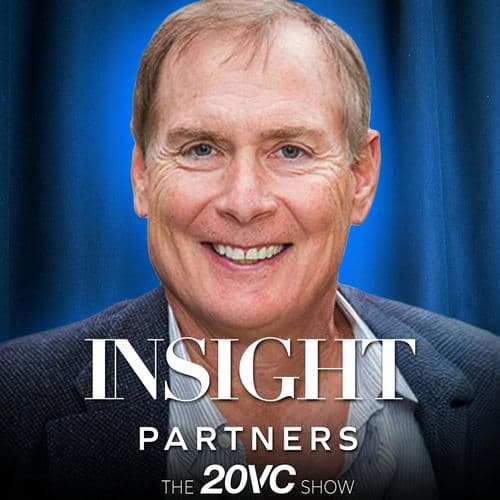
A Masterclass in Seed Investing | The AI Boom Will Create Enormous Roadkill | David Frankel
The Twenty Minute VC
Hosted by Unknown
Seed legend David Frankel calls 95% of AI startups future roadkill — and says the most dangerous investments are exactly the ones everyone is rushing to make.
In Brief
Seed legend David Frankel calls 95% of AI startups future roadkill — and says the most dangerous investments are exactly the ones everyone is rushing to make.
Key Ideas
Inevitable market crash timing remains unknown
A crash is coming. The only question is when, not if.
AI startups fail at Hollywood rates
95% of AI startups will fail — it's Hollywood with worse marketing.
Mid-size seed rounds structurally broken
$50–100M seed funds are structurally broken: too big and too small at once.
Next great theme emerging invisibly cheap
The next great theme is seeding invisibly right now, dirt cheap.
Hiring comprises half of CEO work
Per Bezos: 50% of the CEO job is just putting bums in seats.
Why does it matter? Because the hottest AI rounds are exactly where you should not be.
David Frankel has been the first check in Uber, Suno, and Shield AI — and his clearest signal is that the deals generating the most buzz right now are the ones that should make you most nervous. This isn't reflexive contrarianism. It's 18 years of watching venture euphoria create enormous winners and even larger wreckage.
• A crash is coming — "definitely," not "maybe" — and 95% of today's funded AI companies won't be standing at the end. • Fewer than 100 companies in the last 25 years have been sustainably worth more than $10B. That distribution hasn't changed just because the theme is louder. • The $50–100M seed fund is structurally broken — too big and too small at exactly the wrong moments. • The next fund-returning theme is being seeded right now, cheap and off-radar, by founders nobody is paying attention to yet.
A crash is coming — the only open question is when
"Will there be roadkill from this wave? Oh my god, there's going to be a lot." Frankel doesn't hedge this. He's watched internet, SaaS, and mobile each generate sufficient enthusiasm to obscure the fact that winner concentration in venture is total and always has been.
The raw math: fewer than 100 companies created in the last 25 years are sustainably worth more than $10 billion. Five of them — SpaceX, Tesla, Meta, Nvidia, PaloAlto Networks — account for roughly $5 trillion in market cap. The rest of the top 500 have a median value of $2.6 billion. That is the actual distribution, and the current AI cycle hasn't restructured it.
"Like it's Hollywood, man. 95% are not going to be there." The companies raising enormous AI rounds today are, in Frankel's view, almost uniformly capital inefficient — and the jury is very much out on whether the spend builds durable businesses or just extends the runway to a worse outcome.
"Are we headed for another crash? Definitely. If is not a question. When nobody knows." Investors who treat the timing question as analytically tractable are usually rationalizing their way into momentum exposure. The math of venture concentration hasn't changed. It never does.
The $50–100M seed fund is structurally the worst place in venture right now
At $50–100M, you're too big to be useful and too small to lead anything — and most managers in that range haven't fully processed what that means for the business.
The squeeze runs from both ends. A fund that size can't write the $100–250K collaborative checks that make small-fund seed work — you're no longer the helpful friend writing a check, you're an institution with different expectations. But it also can't credibly lead the $8–10M seed rounds that now set terms in competitive processes. What you end up with is a $500K–$1M position as an "insurance policy" — useful brand, board-adjacent credibility, a relationship buffer for founders who've taken a large check from a multi-stage fund that might move on. Frankel describes this role without embarrassment. It's a value. It's just not a fund model.
Harry pushes back: entrepreneurs want capital with minimal interference, and the multi-stage players offer more of it at a higher price with a junior investor who'll stay out of the way. Frankel doesn't fully disagree — he just notes that 95% of those entrepreneurs won't get follow-on support when they need it, and won't realize it until the moment the champion at the big fund moves on to start their own firm.
"You've got this narrowing out in venture where the bigger you get, it becomes like a pyramid." The top needs the $3 trillion names or you're nearly impossible to sell to major LPs. The collaborative small funds have genuine differentiation. The middle has neither.
The next fund-returning theme is being seeded right now — invisible, cheap, and completely unfashionable
Founder Collective's Fund 2 is, in retrospect, an applied AI fund. Shield AI, Vicarda, Whoop — all investments made in 2016, years before the market had a name for what they were doing. The hardware was commoditized (drones at $50, cameras, wearables), and the thesis was simply: wrap intelligence around cheap, standardized platforms. Nobody called it an AI wave. That was exactly the point.
"Those weren't the expensive ones though. Those were not — they never are."
Fund-returners are always discovered before the category is named, before momentum builds, before valuations decouple from anything rational. "In 10 years time or in 5 years time there will be a new theme. The job will have been to get into that theme ahead." Frankel suspects the label will be something like "physical AI" — but the label is beside the point. The founders building the next cycle right now are working in verticals that look either premature or boring, at prices that reflect neither.
"It's not where the momentum is. It never is." That's the entire contrarian investment thesis compressed into eight words, stated as observation rather than philosophy.
The CEO's only real job is recruiting — Bezos said 50%, Suno's founder lives it at 30–40%
Recruiting is 50% of the CEO job — and the data points on this are unambiguous. Bezos said it at a lunch decades ago when someone asked how he spent his time: "50% of my time is bums on seats." Frankel has carried that line ever since. The week before this conversation, he sat with Mikey Schulman — Suno's founder, now running a $5 billion company. Same question, different phrasing: "I'm 30–40% of my time just recruiting."
The CEO trajectory is a steep, continuous learning curve without a plateau. CTO co-founders often find their ceiling around 50 people; a good one becomes a Swiss army knife deployed flexibly across the organization, a weak one becomes a structural bottleneck. The CEO's path diverges sharply from there: managing larger teams, making harder personnel calls, building human density ahead of the next growth stage. Every founder who doesn't internalize that recruiting is the actual constraint — not product, not fundraising, not strategy — runs out of organizational capacity before they run out of opportunity.
Frankel treats it as a diagnostic. When he asks founders how they spend their time, the answer is a filter. Most investors don't probe it carefully enough before writing the check.
The founders with the sharpest edge grew up inside the vertical they're now disrupting
TJ Parker was in his dad's pharmacy at 14. That's Pillpack. Evan at Rebar watched his uncle's HVAC company get rolled up by private equity, was sent out to find AI for the commercial quoting workflow, discovered none existed, and built the company. "There are folks who have been in these verticals since they were kids... they have more edge than they know what to do with."
Frankel calls these founders "domain nepo babies" — his term, not the trust-fund connotation. What he means: accumulated vertical fluency that no amount of research from the outside fully replicates. These founders already know which buyers hold the real budget, why incumbent software hasn't been replaced, what the compliance texture looks like in practice, and where the friction is genuine versus just entrenched habit.
In AI-disrupted sectors especially, that insider knowledge compounds. It's not only a head start — it's a moat that widens as outsider competitors catch up on the generic infrastructure layer while the domain founder has already moved three layers deeper.
Consumer AI is the biggest whitespace in the most overhyped cycle — and most investors aren't touching it
Despite the trillions flowing into AI, consumer applications have barely moved — and that gap may be the least contested opportunity in the current cycle. Frankel changed his read on this over the past 12 months. He expected far more consumer breakthroughs than materialized.
"I would have expected much more around consumer AI." He can point to Suno. He can point to voice interfaces improving meaningfully — he types less now, speaks more. "There are so many consumer areas that I feel are not yet played out at all."
The vast majority of AI capital has chased enterprise: coding tools, legal automation, data infrastructure, model tooling. The consumer layer — how people learn, create, manage health, communicate, discover — is still wide open in ways B2B workflows already aren't. That asymmetry won't persist. The founders who get there first are building right now in a market that's barely paying attention.
The SaaS apocalypse is overdone — the most embedded platforms are decade bargains hiding in plain sight
"Buy a basket of the top SaaS stocks that have all lost huge market cap. You're going to do okay." Frankel says this plainly, then adds it's not his business — but the logic is real and the market is ignoring it.
The sell-off is indiscriminate. What's being missed is switching cost. A platform running billions of restaurant orders in real time is not the same creature as a productivity tool you can swap out over a weekend. "The more embedded you are, the more difficult you are to dispense because real-time thousands, billions of orders are being run in your system or mission-critical biotech research is being run in your system." The AI replacement thesis holds cleanly for shallow integrations. For deeply embedded infrastructure, that last 5% of AI penetration is precisely where the switching cost lives. The market is pricing both categories as if the distinction doesn't exist.
Seed math still works — 5% of the median top-500 company returns the fund, every time
The median of the top 500 companies created in the last 25 years is $2.6 billion. That number — not a trillion-dollar outcome, not SpaceX adjacency — is how seed funds actually get built. Own 5% of one at exit and you've returned the fund. Do it three or four times and you've built a generational business.
Harry's counterpoint: ownership thresholds matter less than access to the true winners, and the mega platforms are best positioned to secure that access. Frankel's response is precise: that's the momentum business. "I think seed isn't dead. I think seed is crowded and to some degree very commoditized." Crowded doesn't mean broken. What makes it work is pricing discipline at entry, patience through the companies that don't triple in 18 months, and the conviction to hold. Frankel has owned every share of SeatGeek since 2010 without selling a single one. That patience isn't spiritual attachment — it's the model.
The math hasn't changed. The noise level has.
What this conversation reveals is that the structural logic of seed investing is entirely intact — find before the theme names itself, price entry rationally, hold with conviction. What's different now is that the AI wave is so loud, and so much capital is chasing it, that the spread between momentum plays and quietly seeded winners is wider than it's been at any previous point in the cycle. That spread is the opportunity.
A crash is coming. The roadkill will be the funds that mistook the loudest rounds for the best ones.
Topics: seed investing, venture capital, AI investing, fund strategy, founder selection, SaaS, secondary markets, Founder Collective, consumer AI, photonic computing, market cycles, recruiting
Frequently Asked Questions
- What does David Frankel predict will happen to AI startups?
- David Frankel predicts an inevitable crash in AI investments, with timing uncertain but outcome certain. He estimates that 95% of AI startups will fail—characterizing them as "Hollywood with worse marketing." Frankel argues this failure rate stems from structural hype rather than differentiated innovation. Most ventures pursue identical strategies in a crowded market, making failure probabilistic for the vast majority. His most controversial claim is that the most dangerous investments are exactly the ones everyone is rushing toward—meaning peak hype correlates with peak risk, not peak opportunity.
- Why are $50-100M seed funds structurally broken according to David Frankel?
- Seed funds sized at $50–100M are "structurally broken: too big and too small at once," according to Frankel. These funds occupy an untenable middle ground—too large to operate with the flexibility and speed of smaller seed funds, yet too small to command the market influence and deployment capacity of mega-funds. This structural constraint limits their competitive advantage in a bifurcated market. Smaller funds can move quickly on emerging opportunities, while larger funds have capital scale. The $50–100M range captures neither advantage, creating operational friction and reduced returns.
- Where does David Frankel say the next great investing theme is emerging?
- The next great investing theme is "seeding invisibly right now, dirt cheap," according to Frankel. This represents a direct antithesis to the visible, heavily-funded AI startup space attracting mainstream attention. Frankel identifies opportunity in ventures being built quietly with minimal resources and zero media hype—the opposite of today's billion-dollar AI raises. These invisible, dirt-cheap seed investments develop outside the hype cycle, positioning early investors to capture breakthrough returns before others notice. Frankel's core insight is that excessive capital and attention in AI create risk, while scarcity and invisibility in emerging themes create opportunity.
- What is David Frankel's key insight about CEO talent in startups?
- Frankel references Jeff Bezos's observation that "50% of the CEO job is just putting bums in seats"—emphasizing that founder and executive talent matter more than most investors acknowledge. In the context of the AI startup crash, this insight becomes critical: many AI ventures with abundant capital will still fail due to weaker execution teams. Conversely, exceptional founders operating in non-hype themes will succeed despite lower profile and smaller seed rounds. Frankel's broader point is that venture success depends fundamentally on people and execution rather than capital availability or timing.
Related Episodes
Daniel Dines on Why Work Processes Not Models Will Be The Most Valuable Asset in AI
The Twenty Minute VC
Sep 21, 2026How Many Will Actually Get Built & Is Energy AI's BIGGEST Bottleneck? | Positron AI Co-founder
The Twenty Minute VC
Sep 19, 2026Eight Sleep CEO: How AI Runs the Company | “Our Engineers Stopped Coding a Year Ago”
The Twenty Minute VC
Sep 12, 2026Read the full summary of A Masterclass in Seed Investing | The AI Boom Will Create Enormous Roadkill | David Frankel on InShort