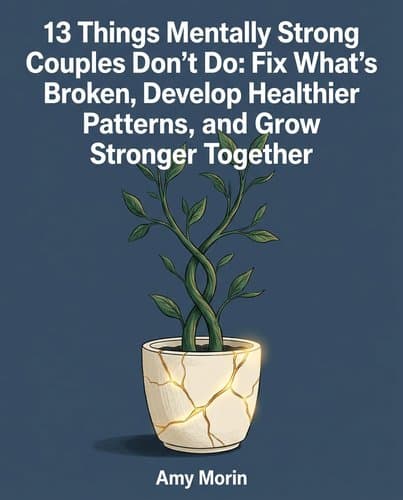
124470174_13-things-mentally-strong-couples-don-t-do
by Amy Morin
Most relationship advice tells you what to add—more date nights, more communication. Amy Morin reveals the 13 toxic mental habits silently eroding your…
In Brief
Most relationship advice tells you what to add—more date nights, more communication. Amy Morin reveals the 13 toxic mental habits silently eroding your partnership, from martyrdom to blame, and shows how eliminating them builds lasting strength more effectively than any romantic gesture ever could.
Key Ideas
Focus energy on solvable problems only
Distinguish solvable problems from unsolvable ones — happy couples focus energy on the former and strategically release the latter rather than relitigating what can't change
Diagnose: problem or emotional processing first?
Ask yourself the diagnostic question before every difficult conversation: 'Do I need to solve the problem, or do I need to solve how I feel about the problem?' These require different responses
Context reveals genuine needs versus manipulation
If a partner's behavior upsets you, check whether you're accommodating a genuine emotional need or an effective manipulation tactic — the test is whether the same person manages fine in other contexts
Respond with warmth, not fixing lectures
Replace the fixer role with influence: warmth when a partner makes healthy choices, calm neutrality (not punishment or confrontation) when they don't — lecturing reinforces the behavior it opposes
Shift from opposition to shared problem
When conflict escalates, move from 'you vs. me' framing to 'us vs. the problem' — a shared external challenge, even a small one, activates cooperation rather than defensiveness
Track positives to overcome negativity bias
To counteract the 50% perception filter in unhappy periods, actively track a partner's positive behaviors for one week — your brain needs deliberate input to override its negativity bias
One behavior change transforms the entire dance
You don't need your partner's participation to begin — changing one behavior in the pattern changes what your partner encounters, which changes the dance whether they intended to join or not
Who Should Read This
People working on personal growth in Relationships and Marriage, especially those tired of generic motivational advice.
13 Things Mentally Strong Couples Don't Do: Fix What’s Broken, Develop Healthier Patterns, and Grow Stronger Together
By Amy Morin
12 min read
Why does it matter? Because your relationship problems are almost certainly not caused by what your partner is doing wrong.
Most couples trying to fix their relationship are solving the wrong problem. They add things — date nights, love languages, weekend getaways — while the actual damage continues quietly underneath, the way a slow leak ruins a foundation long before anyone notices the walls are crooked. Amy Morin, a therapist who has spent years in rooms with couples who arrived as adversaries and left as teammates, argues that the most destructive forces in a relationship aren't absences but presences: specific mental habits already running that no amount of Valentine's Day effort can outrun. The book's premise is almost counterintuitive: the most powerful move isn't to do more. It's to stop doing thirteen very particular things. Change yourself, not your partner. The dynamic shifts anyway. That's the part worth understanding.
The Marriage That Looks Fine From the Outside Is the Most Dangerous Kind
Angela arrived for her therapy appointment a full hour early. She told the receptionist she knew the time — she just wanted to be around people. She wasn't in crisis. Her marriage wasn't violent. Her husband Carl wasn't cheating. For thirty years, they had divided their life like two tidy businesses: he earned, she managed the household and raised their three sons. They rarely fought. By most visible measures, they were doing fine.
Then the kids left. On evenings when Carl came home from work, they ate dinner staring at their phones and retreated to separate rooms. Angela realized she had no idea what her husband actually thought about his life, and he had no idea she'd been quietly lonely for decades. The children hadn't been holding the marriage together so much as obscuring the fact that there wasn't much marriage left to hold.
Amy Morin returns to this pattern again and again in her work with couples: the relationship that looks functional from the outside is often the one in the most danger, precisely because the slow erosion never triggers the alarm systems. Affairs and blowout fights are loud enough to demand attention. Two people filling their years with soccer schedules and separate televisions can go on indefinitely. Nearly half of people Morin surveyed don't raise problems with their partner because they fear making things worse. The silence feels like keeping the peace. What it's actually doing is letting the distance compound.
Angela's eventual move wasn't a confrontation. She bought two tickets to a play, then negotiated Carl's buy-in with dinner at his favorite restaurant beforehand. On a hiking trip she organized a few weeks later, Carl started talking about whether he'd been a good enough father — something he'd apparently never said aloud. The conversation didn't happen because Angela announced there was a problem. It happened because she created conditions where connection was possible, and the distance had somewhere to go.
You're Not Avoiding the Problem — You're Keeping It Alive
Avoidance feels like discipline — choosing not to fight, holding your tongue, being the reasonable one. But what avoidance actually does is let interest compound. The problem you don't raise today doesn't disappear; it earns a higher rate.
A 2019 study in Family Process found that the happiest couples shared a specific habit: they rarely argued about problems that couldn't be resolved. Not because they were conflict-avoidant, but because they were precise. They distinguished between what was changeable — who handles the finances, how often they have sex, the division of chores — and what wasn't: different core values, personality traits, past events that couldn't be undone. They put their energy where it could actually do something.
Morin distills this into a diagnostic question worth sitting with: do I need to solve the problem, or do I need to solve how I feel about the problem? These look similar but point in opposite directions. Trying to convince a partner to share your values isn't addressing a problem — it's fighting a fixed condition. What can change is how you navigate the gap.
The harder implication is that keeping score of what your partner does wrong is often a way of avoiding that question entirely. It's easier to build a case against someone than to ask what you actually need and whether you've communicated it. The unsettling part isn't that your partner has flaws. It's that your frustration might be sitting on top of something solvable — something you haven't named yet because naming it would require you to do something about it.
The Difference Between Privacy and Secrecy Is Whether You're Afraid
When Autumn discovered a string of credit card charges she didn't recognize, she assumed a billing error. Then she looked closer. Her husband David had been paying a monthly subscription to his college girlfriend's explicit content account — for months. When confronted, David's first move wasn't to apologize. It was to argue about definitions: plenty of married men visit strip clubs, he said. This wasn't cheating. That deflection is the tell. The moment someone reaches for a technical defense, they've already revealed that they knew the information would hurt someone. They just hoped to find a category where it wouldn't count.
Morin draws a line that sounds simple but changes how you look at your own behavior: privacy is keeping something to yourself that wouldn't hurt your partner to know; secrecy is hiding something because you're already anticipating the fallout. The distinction isn't size or severity. It's fear and shame. David's subscription wasn't a secret because of what he was watching. It was a secret because some part of him knew, the whole time, that Autumn would be devastated.
That internal awareness costs more than most people account for. Research shows that even what people classify as harmless secrets — a vegetarian quietly ordering the burger, someone buying something they know their partner would find wasteful — makes them more likely to buy gifts for their partner afterward. The relationship looks warmer. The warmth is guilt. And if the secret ever surfaces, the kindness retroactively curdles.
The average adult holds thirteen secrets at any given time. The question isn't whether yours are big enough to matter. It's what you're spending to keep them. Every secret requires maintenance: the avoided topic, the revised story, the split-second calculation before answering a direct question. That cognitive load runs continuously, and it runs at the expense of everything else you could be building.
Setting Boundaries Isn't Controlling Your Partner — It's Respecting Yourself
Jen knew exactly how Ethan felt about her debt — he told everyone else first. At his parents' dinner table, when his dad floated the idea of a cruise, Ethan smiled and said he'd be paying for her college spring break trip until his mid-thirties. At a friend's new house, he joked that her credit score was so bad the bank wouldn't lend them enough for a tent. Jen laughed along each time and said nothing, because she'd decided he had every right to be angry. She thought his feelings were the issue. The actual issue was that she had no boundary protecting her own dignity, and without one named, she couldn't even see that something was being taken from her.
A boundary isn't a rule you impose on someone else. It's a rule you set about how you're willing to be treated. Ethan wasn't obligated to feel differently about the debt. But Jen was allowed to decide that their financial situation wasn't available as social material without her consent. Those are different claims entirely, and only one of them is controlling.
When Jen finally named what she needed, it didn't look like an ultimatum. It looked like a shared script: if anyone asked why they couldn't do something, they'd say they were working toward specific financial goals and leave it there. Vague, honest, united. The frame shifted from Ethan explaining Jen's mistakes to both of them declining to make their private life public. That shift — from internal blame to shared front — only became possible once Jen stopped treating her silence as generosity and started recognizing it as self-erasure.
The absence of stated boundaries doesn't preserve harmony. It just means resentment accumulates without a name.
The Person Using Emotions as a Weapon Often Believes Their Own Performance
People who use their emotions as weapons often believe, at least partly, that they genuinely can't cope. That belief is what makes the pattern so durable — and so hard to name from inside a relationship.
Consider what Jillian's life looked like before therapy. Her husband Marcel claimed severe phone anxiety, so she scheduled his medical appointments. He said conflict destroyed him, so she stopped raising concerns. When guests came over, he might vanish to the bedroom mid-dinner, leaving her at the table making excuses. She read his moods the way you'd monitor a pressure gauge, trying to anticipate the next rupture. She called this being supportive. The therapist had a different read.
The tell was context. At work, Marcel had held the same job for five years without incident. In his family of origin — genuinely chaotic people — he was the steady one, the voice of reason, the person others called when things got loud. The anxiety that paralyzed him at home evaporated the moment he wasn't around someone willing to absorb it. He wasn't faking distress, exactly. But the distress was working, and somewhere beneath conscious awareness, he knew it.
The feeling is real; the expression is a choice. Marcel could feel anxious without outsourcing his doctor's appointments. He could feel sad without sulking for three days when Jillian pushed back. The emotion isn't the problem. What becomes a weapon is the performance around it — the behavior that trains a partner to organize her life around your moods.
Jillian's shift wasn't dramatic. She started going to family events whether Marcel came or not. She stopped canceling his appointments when he didn't feel like attending. The weapons didn't immediately disappear — they briefly intensified. But when they stopped producing results, Marcel started developing actual coping skills. He learned to ask for help instead of manufacturing crises that required it. The accommodation hadn't been kindness. It had been the thing keeping him stuck.
Lecturing Your Partner Into Change Has a 0% Success Rate
Think of a smoke detector that goes off every time someone makes toast. At first, the household pays attention. Within a week, everyone's learned to ignore it. The alarm hasn't made the kitchen safer — it's trained everyone to tune out the warning signal entirely.
This is what consistent lecturing does to a partner with a habit you want them to change. Janice spent months trying to get her husband Ken — a diabetic in his sixties who'd started stopping at a bar most nights after work — to cut back on drinking. She dumped his alcohol, argued at the front door when he came home late, catalogued every health risk. Nothing shifted except their evenings, which reliably ended in separate rooms.
When you tell someone they should give up something, they don't think about whether you're right. They think about why they disagree — every reason they enjoy the habit, every way your concern feels like overreach. The confrontation doesn't introduce doubt; it produces a rehearsed defense. By the time the argument ends, they're more committed to the habit than when it started.
What changed things for Janice was structural, not conversational. On nights Ken arrived home late, she stopped waiting at the door. She said the leftovers were in the fridge and she was going to read, and then she did exactly that. On nights he came home on time, she met him warmly and they had dinner together. No alcohol mentioned. No blood sugar interrogation. Within a few weeks, he started showing up for dinner more often — not because she'd argued him into it, but because she'd changed what the two outcomes felt like.
Her therapist's framing for this is clarifying: your job isn't to fix your partner. It's to manage how you respond to them. Janice came in wanting a better script for the argument. She left having realized the argument itself was the problem. That shift — from fixer to person with their own life to attend to — turned out to be the more effective intervention by a distance she hadn't expected.
Contempt Is Divorce in Slow Motion
Contempt is not just a bad mood that surfaces under stress. It is a signal — one that John Gottman identified as the single strongest predictor of divorce — and it works differently from ordinary conflict because it does not attack what a person did. It attacks what they are. Criticism says your partner made a mistake. Contempt says your partner is beneath you. The eye-roll, the sarcastic impression, the tone that treats someone like a slow child — these do not register in the receiving brain as disagreement. They register as fundamental devaluation. And once a person feels fundamentally devalued by the one they live with, the whole architecture of the relationship is under pressure.
The corrective Morin builds toward is less intuitive than it first sounds. It is not "be nicer" — it is a structural reframe of what the couple is doing in the room. Consider the 231 couples who lived through Hurricane Harvey in Harris County, Texas, in 2017. Their relationship satisfaction actually increased — beginning before the storm arrived and carrying through the aftermath. The explanation is simple: the hurricane gave them a common enemy. They stopped operating against each other and started operating as a unit with a shared problem to solve. Nobody felt beneath consideration when the windows needed boarding.
You do not need a natural disaster to access that frame. You need to stop making your partner the problem and start making the problem the problem. That shift is individual work with relational consequences — one person choosing to redirect their frustration outward, toward the actual obstacle, rather than letting it land on the person sleeping next to them. Contempt thrives in the absence of that choice. The antidote is not warmth performed under pressure. It is the decision, made deliberately, about where the enemy is.
Your Brain Is Filtering Out Half the Good Things Your Partner Does
How accurate is your read on your partner right now? The uncomfortable answer is that it depends almost entirely on how happy you are — because an unhappy brain doesn't observe a relationship neutrally. It edits it.
In the early 1980s, Robinson and Price placed outside observers inside the homes of couples in troubled marriages. The couples were also asked to log the positive things their partners did. When the researchers compared the two sets of notes, the gap was stark: the couples missed roughly half the supportive, kind, or considerate acts that the observers recorded. Unhappy partners weren't misinterpreting the evidence. They were deleting it before it could register.
Shane experienced the other side of this when his wife Katherine left with their kids after twelve years together. He genuinely believed the marriage was fine because they didn't fight. What he hadn't noticed was that Katherine was invisibly managing nearly everything: the parenting, the household, the finances, the emotional labor of keeping it all running. He dismissed her requests for help as overreaction. It took two days alone with their sons — trying to replicate what she did seven days a week while also working — for him to understand what he'd been filtering out for years. The information had been in front of him the whole time. He just hadn't been looking.
The practical implication is more hopeful than it first sounds. If a distorted emotional state is doing the filtering, then changing how you look — deliberately, with effort — can start reversing it. When you make a habit of noticing what your partner actually does rather than what they fail to do, your brain begins searching for that kind of evidence throughout the day. The negative lens doesn't disappear on its own. But it can be trained.
Expecting One Person to Complete You Is a Burden No Relationship Can Carry
Every Saturday, Cara sat in an empty house while her husband Ben drove his late grandfather's car to a show across the county. The anxiety that rolled in was visceral and old — more than boredom, more than loneliness. It took a therapist's question to trace it back: a four-year-old girl at a window, waiting for a father who sometimes just didn't come. Ben had no idea he was re-enacting that absence. He was looking at carburetors. She was reliving a childhood wound.
The structural problem with expecting one person to meet all your emotional needs is that the math never holds. Relationship therapist Willard Harley found that the needs one partner ranks highest tend to land near the bottom of the other's list. That gap isn't a failure of love — it's the default condition of two separate people. When Cara finally talked to Ben without trying to guilt him into staying home, she discovered he'd had no idea any of this was happening. He thought she found car shows boring. He didn't know she was managing a lifelong fear of abandonment on those empty Saturday afternoons.
The resolution isn't proximity. It's independent sources of meaning. Cara rediscovered knitting, something her grandmother had taught her years before. It gave her weekends a shape that didn't require Ben to provide it. She finished scarves and brought them to friends, which solved the loneliness through her own action rather than someone else's sacrifice. The marriage didn't shrink when she stopped needing it to do everything. It had more room to breathe.
Therapist Shane Birkel frames the underlying dynamic cleanly: if your sense of worth depends on your partner's attention, every moment they're unavailable becomes evidence that you don't matter. That's too much weight for any relationship to carry. The move is building a self-sustaining interior life — not to need your partner less, but so that when they show up, they're meeting you rather than rescuing you.
Changing Your Steps Changes the Dance — Even If You're Dancing Alone
Think about what happens when one partner in a slow-moving dance suddenly changes their steps. The other person has two options: stumble, or adjust. There's no third option of continuing unchanged, because the dance has shifted beneath them.
This is the quiet argument running through everything Amy Morin builds in this book. You don't need your partner's agreement to begin. You need to stop waiting for it.
The clearest version of this is how she frames the relationship between personal change and relationship health. She won't promise that changing yourself will change the relationship. What she promises is that it will change the dynamic. Those sound like the same thing, but they're not. A changed dynamic is something your partner has to respond to, whether they intended to or not. When Janice stopped waiting at the door and went back to reading, Ken had to do something with a front porch that no longer held a confrontation. When Jillian attended family events alone, Marcel had to do something with a wife who was no longer organizing her life around his moods. Neither partner asked for participation. Both got it.
The arranged marriage research Morin cites sharpens this. Couples without a romantic high at the start can't coast — they have to build deliberately from day one. That necessity, which looks like a deficit, may be exactly why their satisfaction tends to rise over time while couples who began with intense feeling watch it fade without replacing it with anything structural. The insight isn't that romantic love is a trap. Effort is the mechanism, and effort can begin unilaterally.
Morin's closing instruction is deliberately modest: pick one or two things, start small, let momentum build. Not because the problems are small, but because the reader in front of her has a partner who may not be reading this page. That asymmetry isn't a reason to wait — it's the whole point. Cara doesn't need Ben to suddenly understand the four-year-old at the window before she can stop bracing for abandonment. She just needs to catch herself bracing, and do something different. When she does, Ben isn't rescuing her anymore. He's meeting her.
The Work Is the Point, Especially When You Don't Feel Like It
You don't need your partner to agree with any of this to begin. The most powerful move isn't adding something new — a date night, a grand gesture, a difficult conversation you've been rehearsing. It's stopping one destructive habit. Just one. The dance changes the moment your steps do, whether your partner intended to adjust or not.
Notable Quotes
“I knew the kids would only be home for a short period in our lives so it never occurred to me that Carl and I should go to dinner by ourselves sometimes or go anywhere without them.”
“Deep down, I knew that was a bad sign but I didn’t want to do anything about it.”
“I just discovered my partner, Alex, is having an inappropriate relationship. Alex and I would like to start therapy to see if we can salvage our marriage.”
Frequently Asked Questions
- What are the main toxic habits that damage relationships according to this book?
- The book identifies four primary toxic mental habits that quietly damage relationships: blame, avoidance, martyrdom, and secrecy. These patterns undermine trust and connection over time, creating distance between partners. Amy Morin explains how these habits become entrenched in relationship dynamics and offers psychological insights into why couples fall into these traps. Rather than focusing on external circumstances, the book emphasizes that mental strength—how couples think, respond, and communicate—determines relationship health. By recognizing these destructive patterns early, couples can interrupt them before they cause significant damage to the foundation of their partnership.
- How should couples distinguish between solvable and unsolvable problems in their relationship?
- Happy couples understand that not all problems can be solved, and this distinction is crucial for relationship health. The book advises couples to focus energy on solvable problems while strategically releasing unsolvable ones rather than relitigating what cannot change. This framework prevents couples from exhausting themselves on irresolvable issues tied to fundamental personality differences or circumstances beyond control. By accepting certain limitations and directing effort toward problems with actual solutions, couples reduce frustration and build resilience. The key is making conscious choices about which battles deserve your energy and which ones require acceptance.
- What is the diagnostic question couples should ask before having difficult conversations?
- The diagnostic question to ask before every difficult conversation is: "Do I need to solve the problem, or do I need to solve how I feel about the problem?" This distinction fundamentally changes how to approach the discussion. Some conversations require problem-solving focused on external solutions, while others prioritize emotional regulation and acceptance. Understanding which type of conversation is needed prevents mismatched expectations and frustration. The book explains that this single question, asked consistently, transforms how couples navigate conflict by clarifying their actual objective—whether it's changing circumstances or changing their emotional response to them.
- How can one partner change the relationship dynamic without the other partner's cooperation?
- You don't need your partner's participation to begin changing dynamics. When you change one behavior in an established pattern, it "changes what your partner encounters, which changes the dance whether they intended to join or not." This breaks the myth that both partners must simultaneously commit to change. By shifting your responses—stopping certain reactions, setting boundaries, or responding differently to triggers—you disrupt the relational pattern. The other partner will naturally adjust to the new dynamic, even without explicit agreement, because relationship systems are interdependent. Demonstrating change in one area creates a cascade that transforms how partners interact.
Related Book Summaries

Read the full summary of 124470174_13-things-mentally-strong-couples-don-t-do on InShort