221739800_the-opposite-of-settling
by Case Kenny
Stop outsourcing your happiness to love and start building a life so whole that the right relationship can only amplify it. Case Kenny gives you concrete…
In Brief
Stop outsourcing your happiness to love and start building a life so whole that the right relationship can only amplify it. Case Kenny gives you concrete diagnostics—sacrifice vs. betrayal, standards with reasons, consideration over declarations—to stop settling without losing your spark.
Key Ideas
Love amplifies wholeness, doesn't fill voids
Treat love as an amplifier, not a cornerstone: your life should already be satisfying before someone joins it — the test for any relationship is whether it adds to something whole, not fills something hollow.
Sacrifice versus self-silencing through fear
Use the 'sacrifice vs. betrayal' question as a real-time diagnostic: sacrifice is a practical, reciprocal reshuffling of priorities; betrayal is silencing yourself out of fear. When you can't tell which you're doing, that's the answer.
Standards need reasons to survive pressure
Give yourself a 'because' for every standard you hold — not to justify yourself to others, but because standards without reasons collapse under pressure. 'I need honesty because I am honest' is harder to negotiate away than a vague feeling.
Consistency matters more than grand gestures
Watch for consideration, not declarations: a partner who remembers your coffee order and does the dishes unasked is showing you more than one who plans a surprise weekend trip after two weeks of distance.
You're likely more likable than believed
The liking gap is real — you are almost certainly more likable and less 'too much' than your inner monologue reports. The evidence of smiles, open body language, and returned energy is more reliable than your self-assessment.
Your patterns reveal self-sabotage gaps
Distinguish your type from your pattern: your type is what you desire, your pattern is what you repeatedly tolerate. The gap between those two lists is where the self-sabotage lives.
Boundaries build bridges, not walls
Reframe a boundary as a bridge: the point of knowing your nonnegotiables isn't to keep people out — it's to make you confident enough to let the right ones in.
Who Should Read This
People working on personal growth in Relationships and Dating, especially those tired of generic motivational advice.
The Opposite of Settling: How to Get Everything You Want Out of Love and Life Without Losing Your Spark
By Case Kenny
11 min read
Why does it matter? Because the love you've been told to want is keeping you from the love you actually deserve.
Here's a thought that might sting a little: being heartbroken, ghosted, or alone on a Friday night wondering what's wrong with you — that's not evidence of a defect. That's your standards refusing to quit. The real problem isn't you. Most of us have been operating with a completely backwards definition of what love is supposed to do. We've been treating it like a missing piece — the thing that finally makes life make sense. And when love doesn't arrive, or arrives broken, we conclude the flaw is in us. But the actual flaw isn't in you — it's in the premise everyone handed you. Love isn't a cornerstone. It's an amplifier, which means you can't use it until you've built something worth amplifying. That one reframe changes everything — who you pursue, what you tolerate, and why you keep repeating the same painful loop.
You Were Already Satisfied With the Meal
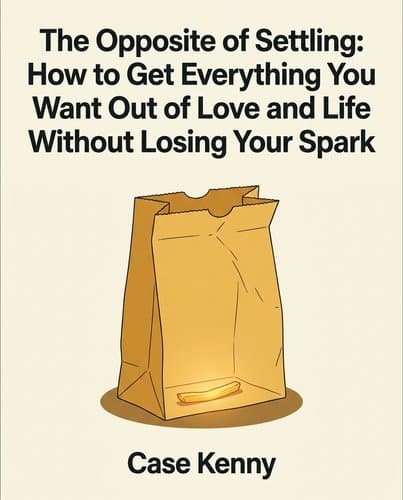
Picture arriving at a fast food counter alone, no one waiting at home, no partner to split fries with — and ordering exactly what you want, eating until you're full, savoring every last bite. Now imagine reaching into the bag when you thought it was empty and finding a bonus fry hiding at the bottom. That surprise doesn't retroactively mean the meal was missing something. It's a gift on top of something already good.
That image is the center of Case Kenny's argument about what love is actually for — and it quietly dismantles the assumption most people drag into every relationship they've ever had.
The dominant story about romance goes like this: life is incomplete until you find someone to build it with. You're spinning your wheels until then, just marking time before the real thing begins. Kenny's problem with this story isn't that it's unromantic — it's that it sets you up to make desperate decisions. When a partner is supposed to be the cornerstone of your existence, the pressure to find one, and then to keep one, becomes enormous. You accept what you shouldn't. You stay longer than you should. You mistake relief from loneliness for actual compatibility.
The reframe Kenny offers is simple and sturdy: instead of building a life with someone, the goal is to do life with someone. The difference is everything. 'Doing' implies you already have a life in motion — with momentum, interests, a self — and the right person falls into stride beside you rather than arriving to construct you from scratch.
That means the stretches of being single, and even the relationships that fell apart, aren't evidence that something has gone wrong with you. They're evidence that you kept eating — that you didn't stop the meal waiting for someone else to show up and give it meaning. Every relationship that ended without you lowering your standards is proof the standards held. That's not failure. That's exactly the point.
Love, on this view, is what you find at the bottom of the bag when you weren't expecting it anymore — a bonus, not a rescue.
The Liking Gap: You're Probably Wrong About How You Come Across
Your self-critical inner monologue after a bad date or another relationship that fizzled is not accurate social feedback. It just feels like it is.
Here's the strange thing researchers at Wharton found when they watched strangers meet for the first time — college roommates getting acquainted, people paired up in public, the usual awkward-first-interaction scenarios. After each conversation, they asked both people the same two questions: how much did you like this person, and how much do you think they liked you? Without exception, people ranked themselves lower than they were actually rated. The other person was smiling. Leaning in. Enjoying themselves. And the first person walked away convinced the whole thing had gone badly. The liking gap, they called it.
What makes this genuinely strange is that it runs against everything we know about human self-assessment. We inflate our abilities in almost every domain — except this one. In social settings, where the feedback is right in front of us and mostly positive, we flip to undercutting ourselves. The reason, as best anyone can tell: when we're busy managing how we come across, we stop seeing what's actually there. Too busy editing our next sentence to notice the other person is smiling.
The practical consequence is this — every time you've walked away from a connection thinking "too much, not enough, hard to be around," that verdict almost certainly came from the same broken instrument. Which means the loneliness, the relationships that didn't work, the stretches of wondering if something is fundamentally off about you — none of that is evidence. Your standards held. The instrument was wrong.
A Soulmate Isn't the One — They're the Catalyst
Imagine Michelangelo standing in front of a solid block of marble, not adding anything to it, just removing what doesn't belong — chip by chip, until David emerges from inside the stone. He didn't create something that wasn't there. He revealed it.
Caryl Rusbult spent years studying what the best romantic partners actually do for each other and landed on the same metaphor. She called it the Michelangelo Phenomenon: the right person sculpts you toward your ideal self, not by rewriting you but by chiseling away distraction, doubt, and the habits that were never really yours to begin with. The marble was already there. They just helped you see it.
That reframes the entire project of dating. If you're searching for 'the One' — that singular, cosmically assigned person who completes your missing half — you're asking the wrong question. The more useful question is: who, when they're around, makes the version of you you actually want to be feel closer and more real? That standard opens the door to something the 'the One' framework closes off entirely: the possibility that different people sculpt different parts of you, that a relationship can be meaningful and finite, that someone can enter your life as a catalyst for a specific phase of growth rather than a permanent fixture.
C.S. Lewis, writing about friendship, noticed that certain facets of a person only come to light through specific other people — that some part of who your friend is exists, and breathes, only in your company. Romantic partners work the same way. The right one for this chapter of your life isn't necessarily the one for the next. What they share is the direction they're pointing you: toward yourself, not away.
So the question walking into any relationship isn't 'could this person complete me?' It's 'does being around them make my own best self feel more accessible?'
Struggle Love Isn't a Rite of Passage — It's a Misdiagnosis
Why do so many people endure obvious one-sidedness — the mixed signals, the emotional hot-and-cold, the relationships where one person is clearly carrying more weight — and call it love?
The answer isn't weakness or bad taste. It's a structural misunderstanding, inherited and reinforced so quietly you probably never noticed it operating. The belief goes like this: real commitment means tolerating difficulty, and difficulty is what proves you care enough to stay. Chaos and drama become evidence of investment. A relationship without those familiar highs and lows can feel suspiciously calm — almost boring. And so the dysfunction stays, dressed up as depth.
Kenny's name for this is 'struggle love,' and his core argument is that it isn't a rite of passage you graduate from once you've suffered enough. It's a misdiagnosis of what love actually requires. Sacrifice is real in any relationship — you make time, you compromise, you prioritize another person consistently. But there's a hard line between that kind of practical sacrifice and something else: silencing your own needs, tolerating dishonesty, accepting a lopsided equation and telling yourself it will eventually balance out. The first is what healthy relationships ask of you. The second is self-betrayal.
Here's the internal tool that makes the distinction concrete. In the 1970s, Ellen Langer ran a simple experiment at a Harvard photocopier. When someone asked to cut in line, about sixty percent of people agreed. When they added 'because I'm in a rush,' compliance jumped to ninety-four percent. The striking part: even a nonsensical reason — 'because I have to make copies' — worked at ninety-three percent. The word 'because' alone triggered cooperation, regardless of the logic behind it. So try it on yourself: 'I deserve honesty because I am honest. I deserve consistency because I show up consistently.' You're not constructing an argument to present to anyone else. You're giving your own nervous system a because — and it turns out that's enough.
The deeper reason struggle love persists is that the chaos is often familiar before it's recognized as harmful. If early relationships were defined by cycles of connection and abandonment, that turbulence becomes the baseline. Safety starts to feel dull. Drama starts to feel like proof that something real is happening. Kenny's reframe is simple: that's not passion. That's a pattern. And unlike a type, a pattern can be changed — the moment you decide your definition of safety is no longer excitement, but consistency.
Consideration, Not Declaration: What Real Attention Actually Looks Like
Think about the last time someone remembered something small about you without being reminded — your usual order, the name of the coworker who's been driving you crazy, the fact that you hate ice in your water. Now think about the last time someone showed up with flowers after a week of barely answering texts. One of those moments felt like love. One of those moments actually was.
Kenny draws a clean line between declarations and consideration. Declarations are the fireworks end of the spectrum — surprise weekend trips, public gestures, the dramatic 'I miss you so much' text that arrives after weeks of near-silence. They're memorable, easy to point to, and genuinely feel like evidence of something real. The problem is they're designed to. A declaration is a reset button, and the pattern is predictable: drift, neglect, frustration, then boom — a big gesture that makes both of you temporarily forget the drift was happening at all. You feel seen for a moment. Then the cycle restarts.
Consideration works differently. It's not designed to be noticed — it just quietly proves that someone is thinking about you when there's no reason to perform. Remembering a coffee order. Doing a chore before you had to ask. Knowing which topic kills your mood and not pushing on it anyway. None of that makes a great story at a dinner party. All of it is what you're actually describing when you say you want to feel known by someone.
Declarations are so effective at substituting for consideration because they're easier. Going big requires effort in a single concentrated moment. Consideration requires something harder: sustained attention, day after day, when no one is watching and there's no credit to collect. It requires, as Kenny puts it, a conquering of the ego — the willingness to keep showing up in small ways even when it goes unremarked.
So when you feel vaguely unsatisfied in a relationship despite someone 'doing so much,' this is likely what you're missing. You're not ungrateful. You're tracking the right signal. Declarations tell you someone knows how to show up when the relationship needs rescuing. Consideration tells you they show up when it doesn't.
You're Not Attracted to the Wrong People — You're Running a Pattern
You don't have a type. You have a pattern — and the difference matters more than you might want to admit.
A type is what you say you want: confident, ambitious, passionate. A pattern is what you keep accepting alongside it: the ego, the jealousy, the controlling streak you tell yourself is just intensity. Kenny's point isn't that your taste is wrong — it's that somewhere along the way, you started treating the harmful attachments as a package deal. Confident men come with control issues, that's just how it goes. You rationalized it so many times it started feeling like wisdom. That's a pattern wearing a type's clothing.
The same sacrifice-versus-betrayal line from earlier applies here, but the qualifying question is what makes it portable: am I sacrificing, or am I betraying myself? One is what relationships ask of everyone. The other is what patterns require you to keep paying.
What keeps patterns invisible is that the chaos inside them often reads as chemistry. If your earliest experiences of love were turbulent — connection followed by withdrawal, closeness followed by distance — your nervous system calibrated to that rhythm. When a consistent, low-drama person shows up, they can feel somehow less real. The adrenaline is gone and you mistake its absence for a missing spark. So you drift back toward familiarity and call it preference.
Willful ignorance as a moral strategy: a meta-analysis of over six thousand people found that roughly forty percent of us will choose not to learn how our actions affect others — specifically so we can maintain a self-image as a decent person while still acting selfishly. Kenny uses this to reframe one of the most painful experiences in dating: being ghosted or blindsided by someone who knew exactly what they were doing. Their vanishing act wasn't a verdict on your worth. It was them choosing not to watch the consequences of a decision they'd already made. That's their pattern, not your verdict.
You break yours by stopping the rationalization — by calling the difficult parts what they are instead of treating them as the price of admission for the good parts. The pattern started with you accepting the package deal. It ends when you stop.
Boundaries Aren't Walls — They're the Reason You Can Open the Door Again
Most people treat a boundary as a fortress — something you build after someone breaks you, designed to keep the next person at a safe distance. Kenny's reframe is blunt: that's the order reversed. A boundary's primary job isn't to protect you. It's to open you up to more life. Protection is a side effect, not the headline.
Here's the distinction that makes it land. When you establish a genuine boundary — not a vague preference, but a specific, nonnegotiable promise to yourself about what you will and won't accept — you stop needing to audit every new person for danger before you let them in. The promise is already made. You know what a violation looks like, and you know you'll act on it. That settled certainty is what frees you to try again with full force instead of half a heart. The boundary isn't the wall. The boundary is the reason you can open the door.
The payoff for doing this shows up in places cynics wouldn't expect. Jamil Zaki spent years tracking this — his research found that self-described cynics earn meaningfully less over a decade than their optimistic counterparts, report lower job satisfaction, and are less likely to reach leadership positions. Cynicism feels like sophistication, like you've seen enough to know better. What the data actually describes is a posture so focused on not getting burned that it stops creating anything. Optimism isn't about ignoring red flags. It's about staying in action — making the next call, extending the next genuine effort — because you've decided the possible upside is worth the exposure. That's not naive. That's strategic.
Kenny calls patience the same kind of active stance. Not waiting passively for something good to arrive, but moving through ordinary days with a quiet internal confidence that what you're building — yourself, your standards, your life — is worth the time it takes. Think of it like parallel play: two people in the same space, each absorbed in their own work, not performing for each other, just building. That's what this looks like in practice. Not two people clutching each other for safety. Two people who have done enough work on themselves that they can share a life without losing it.
So: clean up your relationship with yourself, understand what you actually need, stop rationalizing the price of admission. Do all of that, and the goal isn't a smaller, more defended life. It's a bigger one — lived at full volume, with the door wide open.
The Meal Was Already Good
Here is something worth sitting with before you close this: the extra fry was never the point. The point was that you were already full. Everything in these pages — the sacrifice-versus-betrayal test, the because you owe your own nervous system, the difference between declarations and someone remembering how you take your coffee — none of it was designed to make you harder to love or more defended against disappointment. It was designed to make you someone who shows up to the table hungry for their own life, orders exactly what they want, and eats without waiting for permission. When someone extraordinary does walk in, you'll recognize them — not because you were searching, but because you weren't desperate. That's not settling. That's the opposite of it. And if you made it this far, you've already done something most people won't: you looked directly at the pattern instead of around it. Go be that person first. The rest follows.
Notable Quotes
“I want a partner to DO life with”
“I want a partner to BUILD life with.”
“Loneliness is proof that your innate search for connection is intact.”
Frequently Asked Questions
- What is the main premise of The Opposite of Settling?
- The main premise is that fulfilling relationships begin with a fulfilling life, and that love should amplify what you've already built rather than complete what's missing. The book argues that you should enter relationships from a position of wholeness, treating love as an amplifier for an already-satisfying life rather than as a cornerstone that fills a void. This approach requires raising your standards, recognizing patterns of self-sabotage, and using practical diagnostic tools like the sacrifice-versus-betrayal test. The book provides readers with frameworks to assess whether potential or current relationships genuinely add value to an already complete life.
- What are the key concepts for building healthy relationships according to The Opposite of Settling?
- The book introduces several practical frameworks: the sacrifice-versus-betrayal test, which distinguishes between reasonable compromise and self-silencing; the liking gap, which reveals the gap between how likable you truly are and how likable you perceive yourself to be; and the distinction between your type and your pattern. Another key concept is watching for consideration over declarations — small, consistent actions matter more than grand gestures. Finally, the book frames boundaries as bridges rather than barriers, designed to build confidence in letting the right people in. Each concept helps readers raise standards and recognize self-sabotaging patterns.
- How does Case Kenny define the difference between sacrifice and betrayal in relationships?
- According to the book, sacrifice is a practical, reciprocal reshuffling of priorities, while betrayal is silencing yourself out of fear. The sacrifice-versus-betrayal test serves as a real-time diagnostic: when you can't tell which you're doing, that's the answer. The book emphasizes that this test helps readers recognize when they're compromising in healthy ways versus abandoning their own needs and values. Understanding this distinction is critical because it reveals whether you're in a relationship that respects your wholeness or one that pressures you to diminish yourself for the sake of connection.
- What is the liking gap and why does it matter in relationships?
- The liking gap refers to the gap between how likable you actually are and how likable you perceive yourself to be — you are almost certainly more likable and less 'too much' than your inner monologue reports. The book emphasizes that evidence of smiles, open body language, and returned energy is more reliable than your self-assessment. This concept matters because it directly addresses self-sabotage in relationships: many people underestimate their own value and likeability, leading them to settle for less than they deserve. Understanding the liking gap helps you approach relationships with greater confidence.
Related Book Summaries


Read the full summary of 221739800_the-opposite-of-settling on InShort