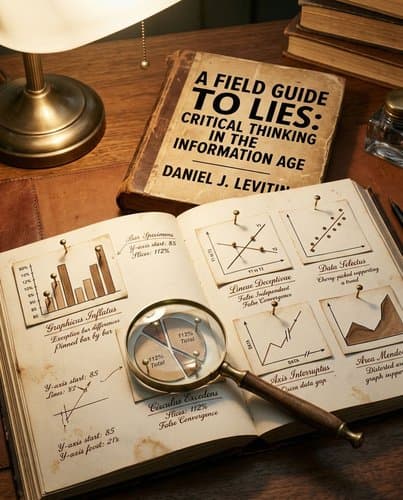
28504537_a-field-guide-to-lies
by Daniel J. Levitin
The lies shaping your beliefs aren't sophisticated—they're elementary tricks of scale, framing, and selection that collapse the moment you ask "compared to…
In Brief
The lies shaping your beliefs aren't sophisticated—they're elementary tricks of scale, framing, and selection that collapse the moment you ask "compared to what?" and run the arithmetic. Master a handful of checks and you'll never be fooled by a truncated graph or a reversed statistic again.
Key Ideas
Verify calculations on rates and percentages
Run the arithmetic before accepting any claim involving rates, percentages, or multiples. Work through the numbers from first principles — if the result requires a physically impossible quantity (17 billion marijuana smokers, anorexia deaths exceeding all female deaths), the claim is false. No expertise required, only the habit of pausing to check.
Examine denominators behind average claims
When you hear 'average,' ask: average of what, and which denominator? The same dataset grouped differently can produce opposite conclusions. The startup owner earning $170,000 and the startup owner earning a 'saintly' 2.3% of company profits are the same person — only the framing changed.
Check axis scaling in graphs
Before trusting a graph, check three things: where does the y-axis start (truncated axes fabricate trends), are there two y-axes with different scales (any correlation can be made to look like zero or one), and are the axes labeled at all. A chart without axes is an argument without evidence.
Identify the proper comparison group
Ask 'compared to what?' for every statistic. Soldiers dying at 2.4 per 1,000 versus civilians at 8.2 per 1,000 sounds miraculous — until you compare populations that are actually comparable. The denominator and comparison group are where most manipulation hides.
Reverse conditional probabilities carefully
Distinguish P(A given B) from P(B given A) — they are not interchangeable and cannot be reversed. '93% of breast cancers occur in high-risk women' does not mean high-risk women have a 93% chance of cancer. Draw a fourfold table before accepting any medical, legal, or diagnostic conclusion that rests on conditional probability.
Expertise doesn't transfer between domains
Treat credentials as domain-specific. A pediatrician's authority on clinical care does not extend to statistical epidemiology. A Nobel Prize in physics does not transfer to genetics or social science. Ask not just 'is this person an expert?' but 'is this person an expert in this specific claim?'
Control groups prove causation not correlation
Before accepting evidence for any pattern, ask: what is the control group? The Mozart Effect collapsed when researchers added one — boredom was depressing IQ, not Mozart elevating it. Without knowing what would have happened anyway, a correlation proves nothing.
Adjust confidence gradually with evidence
Update beliefs in both directions, not all at once. Don't flip from trust to blanket cynicism — assign rough probabilities and revise them as new evidence arrives. The goal isn't knowing everything with certainty; it's knowing what you know with appropriate confidence, and flagging the rest as provisional.
Who Should Read This
Curious readers interested in Cognitive Psychology and Decision Making and the science of how the mind actually works.
A Field Guide to Lies: Critical Thinking in the Information Age
By Daniel J. Levitin
9 min read
Why does it matter? Because the people misleading you are relying on you not doing the arithmetic.
We picture the liars as professionals — data scientists with motives, political operatives with focus groups, PR firms who've read the literature. That's a comforting story. It means we'd need equally professional defenses, and who has time for that?
Here's the embarrassing part: the examples that fill this book are not sophisticated. A graph whose y-axis starts at 34 instead of zero. A percentage that mathematically cannot exceed 100. A death rate comparison between soldiers and civilians that forgets soldiers are young and healthy. These aren't master manipulations — they're the kind of thing a curious twelve-year-old with a skeptical streak would catch. We're not being outfoxed. We're just not looking. This book teaches you to look, and gives you the specific questions — "compared to what?" "which denominator?" "where does the axis start?" — that make invisible choices suddenly, uncomfortably visible.
Most Statistical Lies Are Catchable in 30 Seconds
Most numerical deceptions don't survive thirty seconds of back-of-an-envelope arithmetic. The skill isn't statistics — it's pausing to apply the arithmetic you already have.
Consider a claim that circulated about California: in the thirty-five years since marijuana enforcement relaxed, the number of smokers had doubled every year. Read quickly, that sounds roughly plausible — marijuana use presumably increased. But run the math. Start with just one smoker in 1982, which is absurdly conservative given that half a million people were arrested for marijuana possession nationwide that year. Double it annually. Pause at year twenty-one: you've already crossed a million. Keep going to year thirty-five and you land at seventeen billion — more than twice everyone alive on the planet today. Not just implausible. Mathematically impossible. It collapses the moment anyone multiplies it out.
That's the unsettling part. The deception wasn't clever. Nobody hid the numbers in jargon or buried them in a footnote. The person who wrote it either didn't pause to do the multiplication, or counted on you not pausing either. We extend numbers the same courtesy we extend to people — we assume good faith, and we don't check. The calculation that exposes this is something you learned before you turned ten.
None of this requires expertise. Just the decision to stop and multiply.
Every 'Average' Is an Argument in Disguise
Three founders sit down with the year-end books. Five employees, $630,000 in combined salaries, $210,000 in profits — and two audiences to satisfy at once: employees who want to feel valued, and investors who want to see that the founders aren't looting the company. The numbers are fixed. What's flexible is how you arrange them.
Version one, the honest read: founders averaged $170,000 in total compensation, employees averaged $66,000. True. Probably don't show this one.
Version two: list founder salary at $100,000 and employee average at $66,000, with the $210,000 in profits appearing as a separate line item. Show investors all three lines; show employees only the salaries. Two different documents, neither one false.
Version three, the masterwork: reclassify $150,000 of profit as founder bonuses, fold everyone, founders included, into a single average salary of $97,500, and watch "profits" shrink to $60,000, or 7 percent of total outlay. The founders look practically altruistic. Divided among three people, it's barely 2 percent each.
Same payroll. Same profit. Not a single figure falsified. Only the grouping and denominator moved.
"Average" isn't a number, it's a calculation, and every calculation embeds a choice about what to count and how to group it. The word, on its own, is less a summary than an invitation to ask whose numbers, sorted how, against what denominator.
A Graph Can Make Any Trend Look True
In the fall of 2015, a congressman held up a graph during a congressional hearing and said it proved that Planned Parenthood was abandoning cancer patients to perform more abortions. Two lines appeared on screen. One climbed steeply. The other fell sharply. They crossed in the middle. The visual case was airtight.
The numbers embedded in the chart told a different story. In 2013, Planned Parenthood performed 327,000 abortions. Cancer screening and prevention services that same year: 935,573 — nearly three times as many. The lines couldn't have crossed, not if drawn on the same scale. They crossed because the graph had no axes at all. Each trend line was scaled independently, positioned wherever it needed to be to produce the intended picture. Rep. Jason Chaffetz's proof was a drawing pretending to be a graph.
Chaffetz's version had no cover at all: no axes, no scale, lines placed wherever the argument required. Most readers never check the axis numbers. They see the shape of the lines and draw their conclusions before they've read a single tick mark.
The same move works more subtly when axes are present but scaled deceptively. Forbes once ran a graph comparing per-student school spending with SAT scores using two y-axes. Scaled one way, the two lines ran flat and parallel: spending does nothing. Scaled differently (same data, same years), they rose together: spending drives scores. The actual correlation between spending and scores is .91. The data had an unambiguous story. The axis choice was the only argument.
Every graph embeds choices: where the axis starts, what scale each variable gets, which years appear. Those choices are where the story lives. The picture isn't speaking for itself. Someone built it.
The Manipulation Lives in What You Aren't Shown
During the Iraq and Afghanistan wars, you could argue, using real data, that a soldier in a war zone was more than three times safer than an ordinary American at home. The math: roughly 3,500 active-duty military personnel died in 2010 out of a force of 1.4 million, a rate of about 2.4 deaths per thousand. The U.S. civilian death rate that year was 8.2 per thousand. Not a manipulation of numbers. An accurate comparison that produces a false conclusion.
The comparison is designed to fail. Active-duty soldiers are young — the military doesn't enlist the elderly. They're medically screened. They eat structured diets, get regular exercise, and have access to health care. The civilian population includes everyone: people in their eighties, the chronically ill, people in dangerous occupations, people without reliable access to doctors or food. These two groups were never comparable. Stacking them against each other and handing you the ratio isn't a measurement — it's a trick performed with real numbers.
There's nothing to correct. The figures are accurate. The calculation is right. The fraud is in what the analyst chose not to include: the age distribution, the health screening, the actual composition of the comparison group. All of that was available. It just wasn't shown.
Before you trust a comparison, ask what the comparison group actually contains. The argument lives there — not in the number you're given, but in the denominator you weren't.
The Number You're Given Is Almost Never the Number You Need
Ninety women heard the same statistic from the same surgeon: 93 percent of breast cancers occur in women classified as high-risk. Each of them was in that group. Each agreed to have her healthy breasts removed.
The figure the surgeon cited was accurate. The study was real. What it measured was the probability of being high-risk given you already have cancer — about 93 percent of women who develop breast cancer fall into that category. That's a defensible number. It is not the number his patients needed. They needed the reverse: the probability of developing cancer given that you're high-risk. Those two questions point in opposite directions, and the answers are not interchangeable.
In a population of 1,000 women, roughly 570 are high-risk. The overall breast cancer rate is about 0.8 percent, so 8 women in that sample will develop it. His 93 percent figure tells you that 7 of those 8 will be in the high-risk group. Seven cases divided by 570 high-risk women: 1.2 percent. Not 93. He had reversed the fraction without noticing and overestimated the actual risk by nearly 100 times.
Whenever you encounter a conditional claim — 93 percent of cancer patients are high-risk, most accidents happen near home, the majority of crime victims knew their attacker — ask which direction the probability is running before you trust the number. The statistic you're handed describes one relationship. The decision in front of you almost always requires the reverse. Those are not the same thing, and the distance between them is where the damage happens.
Credentials Travel Further Than Expertise
Dr. Roy Meadow was one of Britain's most celebrated pediatricians when he took the stand in Sally Clark's 1999 murder trial. Clark had lost two infant sons to what appeared to be sudden infant death syndrome. The prosecution needed to show this was murder, not tragedy twice. Meadow supplied the math: the odds of two SIDS deaths in the same family were 1 in 73 million. He got there by squaring 1-in-8,543 — the estimated single-death rate — as if the two events were statistically independent. They weren't. SIDS clusters in families; the deaths share genetic and environmental factors. Squaring independent probabilities is a basic statistical operation; applying it to correlated events is a basic error. Meadow had no training in epidemiology or statistics. He was an expert in childhood medicine, which is adjacent, and the prosecution counted on jurors not noticing the gap.
Clark served three years in prison before her conviction was overturned.
William Shockley co-invented the transistor and shared a Nobel Prize in physics for it. In his later years he testified before Congress and toured campuses arguing that Black Americans were genetically inferior in intelligence, a claim geneticists and population biologists rejected since Shockley had no training in either field. The audiences hearing him didn't always know what his Nobel was actually for. A prize in semiconductor physics is not a credential in human genetics, just as a reputation in childhood medicine is not a credential in biostatistics. The credential that matters is the one that covers the claim being made. Meadow's didn't.
The Antidote Isn't Skepticism — It's a Running Tally
In 1840s Vienna, Ignaz Semmelweis walks between two maternity wards that share a wall and almost nothing else. One kills roughly one in five women within days of childbirth. The other barely kills anyone. Same hospital, same city, same patient population. Nobody knows why.
A board of inquiry had a theory: a priest crossed the first ward ringing a bell whenever he came to deliver last rites, and the psychological distress was killing the mothers. Semmelweis tested it. He had the priest take a detour to avoid passing the beds, and had the nurse stop ringing the bell. The mortality rate didn't budge. Hypothesis ruled out.
Next: overcrowding. He checked — the second ward, the safe one, was in fact more crowded. Ruled out. Temperature, humidity: identical in both wards. Ruled out.
Then a colleague was accidentally cut by a scalpel fresh from an autopsy. The man died with the same symptoms as the women in the first ward. Semmelweis noticed something he'd overlooked: the first ward was staffed by medical students who came directly from dissecting cadavers to deliver babies, without washing their hands. The second ward's midwives had no autopsy duties. He asked doctors to disinfect their hands with a chlorine solution. Mortality in the first division fell from 18 percent to under 2 percent.
None of this is an argument for permanent suspicion. It's an argument for keeping a running tally. You form a hypothesis. You test it against the evidence available. You revise when the evidence doesn't fit. You don't need certainty to act — you need the best probability you can honestly construct from what you know so far.
The priest-and-bell story shows why this matters more than either blind trust or blanket skepticism. If Semmelweis had deferred to the board of inquiry, hundreds more women die. If he'd decided the problem was too murky to reason about, hundreds more women die. What saves them is the willingness to treat each explanation as a testable hypothesis, assign it a rough probability, and update when the results come back.
Not "trust the institution" and not "trust nothing." The tally is always provisional. So was Semmelweis's — but it dropped the death rate from 18 percent to under 2.
The Bargain You Already Made
The surgeon who sent ninety women to mastectomies had data. So did whoever made the chart with the truncated y-axis. The numbers were always there; the choices were in how they got cut and framed. Catching those choices doesn't require much — not most of your time, not most of your skepticism. Just enough to pause before you forward something or act on it: where does that axis start, what's in the denominator, is this the expert you actually need? The questions aren't complicated. Neither is the arithmetic. What's hard is the habit — treating every tidy statistic as a choice someone made, and wondering whether they made it honestly. You won't catch everything. Nobody does. But you'll catch more than you did yesterday, and when something slips past you, you'll know how to revise when better evidence arrives. That's not cynicism. That's just keeping an honest tally.
Notable Quotes
“What is the probability that I have breast cancer given that I had a positive test result?”
“the probability that we would find a match if the defendant were actually innocent.”
“because this happened after that, that must have caused this”
Frequently Asked Questions
- What is A Field Guide to Lies about?
- A Field Guide to Lies teaches readers how to detect statistical tricks, misleading graphs, and faulty reasoning in everyday information. Daniel J. Levitin equips readers with tools to evaluate claims, spot manipulated data, and hold beliefs with calibrated confidence. The book emphasizes checking arithmetic, questioning averages, analyzing graphs critically, and distinguishing conditional probabilities—building practical habits for navigating an information-saturated world.
- What should I look for to spot misleading graphs?
- Before trusting a graph, check three things: where does the y-axis start? Truncated axes fabricate trends by exaggerating minor variations. Are there two y-axes with different scales? Any correlation can be made to look like zero or one depending on scale choices. Are the axes labeled at all? A chart without axes is an argument without evidence. These critical checks help identify visual manipulation and prevent misleading visual representations from distorting your interpretation of data and statistical claims.
- How does A Field Guide to Lies explain statistical manipulation?
- The same dataset grouped differently can produce opposite conclusions. For example, the startup owner earning $170,000 and the startup owner earning a 'saintly' 2.3% of company profits are the same person — only the framing changed. When you hear 'average,' ask: average of what, and which denominator? Ask 'compared to what?' for every statistic you encounter. Soldiers dying at 2.4 per 1,000 versus civilians at 8.2 per 1,000 requires properly comparable populations. The denominator and comparison group are where most manipulation hides.
- How does A Field Guide to Lies explain conditional probability?
- Distinguish P(A given B) from P(B given A) — they are not interchangeable and cannot be reversed. '93% of breast cancers occur in high-risk women' does not mean high-risk women have a 93% chance of cancer. Draw a fourfold table before accepting any medical, legal, or diagnostic conclusion that rests on conditional probability. Mastering this distinction prevents critical misinterpretations of test results, medical diagnoses, and evidence-based claims across healthcare, law, and policy. The error is ubiquitous and consequential.
Related Book Summaries


Read the full summary of 28504537_a-field-guide-to-lies on InShort