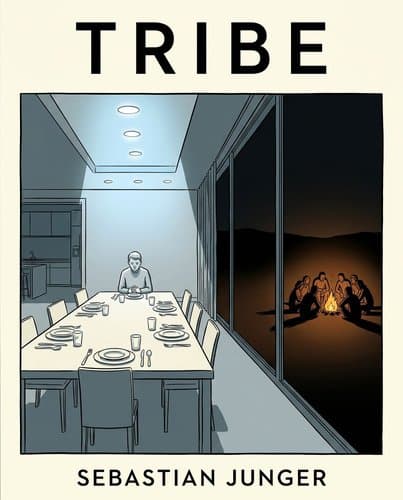
28119237_tribe
by Sebastian Junger
Humans didn't evolve for comfort—they evolved for tribes. Sebastian Junger reveals why war zones and disasters produce better mental health than modern…
In Brief
Humans didn't evolve for comfort—they evolved for tribes. Sebastian Junger reveals why war zones and disasters produce better mental health than modern affluence, and what we've quietly destroyed by optimizing away the one thing we need most: being necessary to each other.
Key Ideas
Social Support Matters More Than Trauma Severity
Social support predicts long-term PTSD more reliably than trauma severity — meaning the real wound is often what's missing at home, not what happened in the field. Improving reintegration matters more than cataloging symptoms.
Isolation Contradicts Our Evolutionary Social Design
Humans evolved for bands of roughly 50 people with enforced sharing, constant companionship, and mutual necessity. Isolation and individualism aren't the natural state — they're the experiment, and the mental health data shows how the experiment is going.
Being Needed Is Essential Psychological Requirement
The experience of being necessary to others is a psychological requirement, not a lifestyle preference. Modern society has systematically optimized this out of daily life, and the consequences show up as depression, suicide rates, and alienation that rise with affluence.
Crises Restore Critical Social Interdependence
Disasters and crises produce measurably better mental health outcomes not despite their danger but because they temporarily restore communal interdependence. Understanding this reframes the question: the goal isn't to eliminate hardship, but to preserve the social structures that hardship makes visible.
Victim Framing Delays Reintegration and Healing
Framing veterans — or any survivor — primarily as victims can foreclose the moral reckoning and active participation that recovery actually requires. Acknowledgment that positions someone outside normal society can delay the reintegration that heals.
Belonging Requires Sacrifice and Mutual Obligation
Tribal belonging is constituted by sacrifice and obligation, not proximity or identity. The question isn't whether it's available in modern life — Martin Bauman and the man in Gillette both answered that — but whether the people around you are willing to pay it.
Who Should Read This
Curious readers interested in Social Psychology and Anthropology and the science of how the mind actually works.
Tribe
By Sebastian Junger
9 min read
Why does it matter? Because you may be one of the most comfortable humans who has ever lived—and that comfort may be what's making you miserable.
Here's the assumption modern life runs on: safety is good, comfort is progress, and the more of both you accumulate, the better off you are. Hard to argue with. And yet veterans in record numbers report that their deployment years — the fear, the deprivation, the constant proximity to death — were the best years of their lives. Survivors of sieges and disasters describe the experience in terms that sound almost like gratitude. Something in these reactions refuses to be explained away, because they're not anomalies. They're evidence. The explanation reaches well past the battlefield, into the social wiring that affluence quietly dismantles: the tribal belonging and shared purpose that humans are built for, and that modern comfort has nearly eliminated. Junger spent years in war zones watching what happens when all of it floods back.
For Three Centuries, White Settlers Defected to Indian Tribes—and Almost None Ever Came Back
For three centuries, people who had a genuine choice between modern civilization and life in a tribal community chose the tribe — and almost never came back.
This is one of American history's strangest documented facts. From the early 1600s through the 1800s, white settlers regularly abandoned colonial life to join Indian tribes, while the reverse almost never happened. Benjamin Franklin noted it with puzzlement in 1753. Virginia tried criminalizing it. A Puritan leader named Increase Mather wrote a formal tract against it, warning that people were ready to abandon Christianity and run back into the woods. None of it slowed the defections.
The moment that makes this most vivid is a forced handover in 1764. A Swiss colonel named Henri Bouquet had defeated a coalition of Indian tribes in the Ohio territory, and among his peace terms was the return of roughly 200 white captives. Many had been taken in raids years earlier; some had lived among the Indians long enough that they'd forgotten their Christian names and had to be entered in army ledgers as Redjacket, Sourplums, and Bighead.
What happened at the handover looked nothing like rescue. Some reunions were joyful. But young women stood reluctantly before families they'd left years earlier. Children screamed as soldiers separated them from the only kin they knew. A Mingo warrior followed the army column for days after departure, bringing food for a woman he wouldn't leave — even knowing her original family would kill him on sight. In the weeks after, several women who'd been handed over slipped away at night and walked back.
The Indians, for their part, were devastated to give anyone up.
What was pulling people so powerfully that Virginia had to make it illegal? The answer is structural. Tribal life ran on enforced interdependence — you shared what you had, others depended on you, your actions had direct consequences for people you knew by name. You were necessary. That's not a romantic description of primitive virtue; it describes the nervous system conditions under which humans were built, the social environment that shaped us for roughly a million years. Modern civilization improved on almost everything material while quietly eliminating the conditions that made people feel they mattered.
If that sense of being necessary was what kept pulling people back into the woods, you'd expect its removal to leave a mark. It does. People in wealthy countries suffer depression at up to eight times the rate of people in poor countries. The most affluent women in a study comparing Nigeria to North America were the most likely to report clinical depression of anyone surveyed. The upgrade is real, but it came at a cost that thousands of people across three centuries understood clearly enough to walk away from it.
People Trapped in a Siege Reported the Happiest Years of Their Lives—and the Data Agrees With Them
Nidžara Ahmetašević was seventeen when Serbian artillery opened up on Sarajevo in 1992. Within weeks, shrapnel from a shell that hit her parents' apartment tore into her leg. At the hospital (floors, hallways, and bathroom stalls packed with wounded), surgeons rebuilt her leg without anesthesia. When she describes the pain now, she's matter-of-fact: "They hold you down and you scream. That helps." Her first night there, an old woman in the next bed died and rolled onto her. Ahmetašević woke to find a corpse on top of her.
Six months later, evacuated to safety in Italy at her parents' insistence, she was miserable. Safe, healing, physically recovering — and unbearably lonely. She grew terrified that the war would kill everyone she knew and leave her alone in the world. So she started trying to get back into Sarajevo, which was bureaucratically harder than getting out. She eventually made it, flying into the sandbagged airport and hitching back into a city under siege.
What she was returning to: five apartment buildings near her home had organized themselves into a single cooperative, sixty families sharing ovens, food, and shelter, growing vegetables in the courtyard. On her eighteenth birthday, a neighbor gave her one egg. She couldn't think how to divide it among her friends, so she turned it into pancakes and split those. The neighborhood teenagers had colonized the basement of one building, sleeping on mattresses, falling in and out of love, joking about the war. Boys left for ten-day rotations at the front lines and came back to play music. Her answer, when Junger asked if people had been happier during the war: "We were the happiest. And we laughed more."
You could dismiss this as trauma-bonding, as nostalgia softening a brutal past. But the empirical record makes that hard. During the London Blitz, when German bombers hit the city for fifty-seven consecutive nights, British authorities predicted psychiatric collapse on a massive scale. Public shelters, they worried, would breed Communism. What actually happened: psychiatric admissions across London fell. Long-standing patients saw symptoms subside. Epileptics reported fewer seizures. The entire city averaged two cases of "bomb neuroses" per week. People who had been neurotic in peacetime drove ambulances.
Charles Fritz spent years after the war trying to explain this. He synthesized roughly 9,000 survivor interviews from disasters around the world and concluded that catastrophes produce unusually healthy social conditions because they temporarily collapse the hierarchies that modern life otherwise enforces. In crisis, class and income become irrelevant; what matters is what you're willing to do for the people next to you. Fritz called it a "community of sufferers." His 1961 paper begins with a sentence that deserves to be more famous than it is: "Why do large-scale disasters produce such mentally healthy conditions?"
PTSD Is Not a Wound from Combat. It's a Wound from Coming Home.
The severity of combat you experienced predicts almost nothing about whether PTSD will haunt you for life. What predicts it — twice as reliably — is the social environment you return to.
Consider Israel. The country has been in nearly constant military conflict for decades. On paper, Israeli soldiers should be among the most traumatized people in the world. Instead, the IDF reports PTSD rates as low as 1 percent.
Dr. Arieh Shalev, who has spent twenty years studying trauma, traces this to something structural. In Israel, roughly half the population serves in the military, so when a soldier comes home, the people around them — parents, neighbors, colleagues — already know what they've been through. There's no translation problem. The war isn't alien to civilians; nearly everyone has a version of it. Every loss lands inside a context the whole society already holds, which keeps at bay the sense of futility and invisibility that eats people alive.
The Yom Kippur War of 1973 is the cleanest test case. Israeli soldiers fought on the Golan Heights with their homes literally at their backs. The battlefield and the civilian world were not two separate places. Of the 1,323 soldiers wounded in that war and referred for psychiatric evaluation, around 20 percent were diagnosed with PTSD at the time. Less than 2 percent retained that diagnosis thirty years later.
Anthropologist Brandon Kohrt found the same pattern at the village level. In Nepal's civil war, child soldiers returning to stratified Hindu villages could remain traumatized indefinitely. Those who returned to mixed Hindu-Buddhist communal villages often recovered so completely that their rates were indistinguishable from children who had never gone to war. "PTSD is a disorder of recovery," Kohrt concluded. The combat was identical. The community was not.
The injury is often not what happened in the field. It's the gap a person falls into when they come back.
The Way America Honors Veterans May Be Deepening the Problem It Wants to Solve
What if the most visible forms of American support for veterans — the speeches, the priority boarding, the expanded disability benefits — are doing something other than what they're intended to do?
Here's a number that's hard to explain away. Today's veterans, who fought wars with roughly one-third the casualty rate of Vietnam, are claiming three times the disabilities Vietnam veterans did. The pattern is almost exactly inverse to physical danger: as the wars get safer, the claims go up.
The VA, trying to make benefits more accessible, ruled in 2010 that soldiers no longer needed to cite a specific incident to qualify for PTSD disability. A "credible fear of being attacked" was enough. The intent was compassion. The effect was a system vulnerable to something worse than fraud: people genuinely convincing themselves they were more damaged than they were. Self-reporting of PTSD leads to misdiagnosis rates as high as 50 percent.
The VA Inspector General found something more unsettling still. The more disabled a veteran's rating, the more treatment they sought; once they hit 100 percent, treatment visits dropped sharply. A 100 percent rating is worth around $3,000 a month, tax-free, for life. In theory, the most severely traumatized people should be seeking the most help. The data runs exactly backward.
Among the Cree, fighters who came back from war were reincorporated into the daily labor of the community. There was no transition because the community still needed them. The ceremony recognized what they'd done; the work confirmed they still mattered. In Israel, where roughly half the population serves, reflexively thanking someone for their service makes as little sense as thanking them for paying taxes. The thought doesn't arise because the experience isn't alien to anyone. Anthropologist Sharon Abramowitz, who spent time in Ivory Coast during its civil war, put it plainly: "We valorize our vets with words and posters and signs, but we don't give them what's really important to Americans — we don't give them jobs."
The Difference Between a Life That Feels Worth Living and One That Doesn't Is Whether Something Needs You
In the 1990s, Martin Bauman called his employees in to deliver some hard news. His job placement firm — built from nothing by a kid from the Bronx who'd contracted polio while in the army — was losing money for the first time in three decades. He asked everyone to take a 10 percent pay cut. They agreed. Then he went home and made a decision he told no one: he would stop taking his own salary until the company was solvent again. The only person who found out was the bookkeeper.
Bauman didn't need a war, a siege, or a ceremony to understand what membership requires. He understood it at a conference table in midtown Manhattan. Belonging meant accepting that the people around him had a claim on him, and honoring it even when no one was watching. That's the whole of it, really. Tribal belonging isn't a romantic idea confined to ancient cultures or the extraordinary conditions of war. It's built on one thing: the willingness to be used by something beyond yourself. A neighborhood, a workplace, a country — the container doesn't matter. What matters is whether you accept that the people inside it have a claim on you.
When Junger tracked down Bauman's office manager after reading his obituary in the Times (Bauman died at eighty-five), he asked what Bauman had made of the Wall Street executives who helped cause the 2008 collapse and walked away with millions in bonuses. "He didn't understand the greed," she said. "He didn't understand if you have a hundred million dollars, why do you need another million?"
What the Man in Gillette Already Knew
Thomas, a Cree hunter from northern Quebec, put the alternative plainly: "Suppose, not to give them flour, lard. Just dead inside." Not a moral judgment — a diagnosis. Withholding isn't prudence. It's a quiet form of self-erasure, the decision that your resources matter more than your claim on the people around you. Whether a society can be rebuilt that actually asks something of you — that makes belonging cost something and therefore mean something — may be the harder question. But the smaller one is closer. Thomas wasn't being dramatic. He was naming where the calculation ends.
Notable Quotes
“Some had trauma rates that were no different from children that had not gone to war at all,”
“PTSD is a disorder of recovery, and if treatment only focuses on identifying symptoms, it pathologizes and alienates vets. But if the focus is on family and community, it puts them in a situation of collective healing.”
“Being in the military is something that most people have done,”
Frequently Asked Questions
- What is 'Tribe' by Sebastian Junger about?
- Tribe examines why modern affluence has quietly dismantled the social structures humans evolved to need. Junger argues that crisis, war, and hardship often feel more meaningful than peace because they restore communal belonging and mutual necessity—psychological requirements that modern life has systematically optimized away. Drawing on anthropology, psychology, and military research, the book shows how communal belonging, mutual necessity, and shared sacrifice are fundamental to human wellbeing, and what restoring them would actually take. Rather than pathologizing survivors of trauma, Junger reframes the real wound as often what's missing at home: adequate social structures.
- According to 'Tribe,' how does social support relate to PTSD recovery?
- In Tribe, Junger argues that social support predicts long-term PTSD outcomes more reliably than the severity of trauma itself. This shifts the focus from cataloging battle wounds to understanding what happens during reintegration at home. Junger contends that the real wound is often what's missing in a veteran's social environment—inadequate communal belonging and support networks—rather than what happened in combat. The book demonstrates that improving reintegration through stronger social structures matters more than clinical treatment of symptoms alone. This insight challenges conventional trauma psychology and reframes recovery as fundamentally social, not merely medical.
- What does 'Tribe' reveal about human evolutionary needs and modern life?
- Humans evolved for bands of roughly 50 people with enforced sharing, constant companionship, and mutual necessity, Junger argues in Tribe. Isolation and individualism aren't humanity's natural state—they're a recent experiment, and the mental health data shows poor results. The experience of being necessary to others is a psychological requirement, not a lifestyle preference. Modern society has systematically optimized mutual necessity out of daily life, and the consequences appear as depression, suicide rates, and alienation that rise with affluence. This creates a paradox: societies get richer and more depressed.
- Why does 'Tribe' argue that crises and disasters can improve mental health?
- Junger argues that disasters and crises produce measurably better mental health outcomes not despite their danger but because they temporarily restore communal interdependence. When external hardship makes mutual necessity visible, people experience the social structures they've lost in peace. This reframes the conventional goal of eliminating hardship—instead, Tribe suggests the real objective should be preserving the social bonds that shared adversity creates. However, Junger emphasizes that tribal belonging is constituted by sacrifice and obligation, not proximity or identity, making reconstruction possible even in modern life for those willing to commit to mutual interdependence.
Related Book Summaries


Read the full summary of 28119237_tribe on InShort