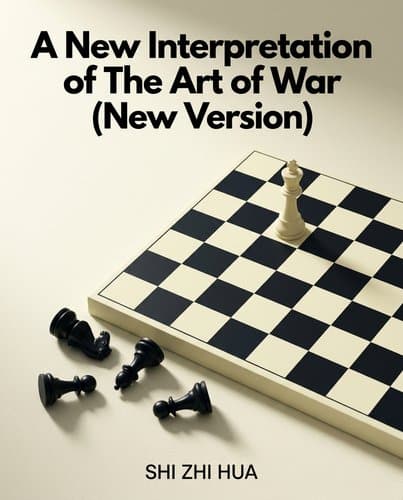
195056956_a-new-interpretation-of-the-art-of-war-new-version
by SHI ZHI HUA
Sun Tzu's ancient treatise reveals that winning without fighting is the highest form of strategy—not a philosophical ideal but a precise system of calculation…
In Brief
A New Interpretation of The Art of War (New Version) (1991) reframes Sun Tzu's classic as a system for making conflict unnecessary rather than a guide to winning battles.
Key Ideas
Calculate strengths before committing to conflict
Calculate before you commit: Sun Tzu's seven elements are a pre-conflict checklist — political unity, terrain, weather, command quality, doctrine, training, and reward consistency. Whoever scores higher on more factors wins. If the math doesn't favor you, don't fight yet.
Control enemy perception to force division
Control what the enemy knows, not just what you do: the goal isn't to be stronger, it's to force the enemy to divide while you concentrate. Create multiple threats so they prepare everywhere; then strike the one place they left thin.
Deploy strengths against enemy weaknesses
Victory through configuration, not improvement: Sun Bin won the horse race not by training faster horses but by rearranging which horses faced which opponents. Ask not 'how do I get better?' but 'how do I deploy what I have so that my weaknesses never meet the enemy's strengths?'
Back deception with real military substance
Deception requires real substance behind it: Zhuge Liang's Empty City bluff was celebrated as legend but critiqued as reckless. The 1948 PLA defense worked because 100,000 real reinforcements were marching toward the city while the bluff bought time. A feint without backup is gambling.
Intelligence as primary weapon, not support
Intelligence is not a support function — it is the primary weapon: Sun Tzu's calculation is explicit. One day of war costs 1,000 pieces of gold and disrupts 700,000 households. A few hundred pieces spent on spies can prevent all of it. Commanders who skimp on intelligence are 'unaware of the interest of the state.'
Character flaws become enemy tactical terrain
Your character is terrain the enemy will try to occupy: the five fatal flaws — recklessness, cowardice, quick temper, excessive honor, compassion — are not moral failings but tactical vulnerabilities. An opponent who knows your temperament will use it against you the way a general uses difficult ground.
Disrupt enemy strategy before engaging forces
Attack the strategy, not the army: the hierarchy matters — disrupt the enemy's plans first, break their alliances second, engage their forces third, besiege their cities only as a last resort. Most people begin at step three or four. The commanders who win decisively usually solve the problem at step one.
Who Should Read This
Readers interested in Business Strategy and Leadership, looking for practical insights they can apply to their own lives.
A New Interpretation of The Art of War (New Version)
By SHI ZHI HUA
13 min read
Why does it matter? Because the generals who win decisively are almost never the ones you've heard of.
The most celebrated battles in history are monuments to failure. Thermopylae, Agincourt, Stalingrad — we memorize them precisely because something went catastrophically wrong, and enormous courage was required to survive the consequences. But what does it look like when a commander gets it completely right? Usually: nothing. A siege that never happens. An alliance that quietly collapses. An enemy army that dissolves before contact because the conditions for its survival were dismantled weeks earlier, from a distance, without a single engagement. Sun Tzu spent his life documenting that invisible category of victory — the kind that leaves no legends, only results. What follows is 2,500 years of strategic logic, pressure-tested from ancient China to the Cold War, built on the uncomfortable premise that if you needed a battle, you'd probably already made a mistake.
The Greatest General Leaves No Legend
The greatest general in history is probably someone you've never heard of. That's the point. Sun Tzu argues that a commander who wins spectacular, hard-fought victories is advertising his own inadequacy — because a truly skilled general arranges conditions so thoroughly that by the time battle begins, the outcome is already decided. Drama in warfare is a symptom of insufficient preparation.
Consider what Sun Tzu says about the ancient masters: they conquered enemies who were already conquered. Their victories earned them no reputation for courage, no famous legends, because nothing remarkable seemed to happen. Winning looked easy — and it was, because they had made it easy. Lifting a feather doesn't prove strength. Distinguishing the sun from the moon doesn't prove eyesight. The master general's victories carry that same uneventful quality, which is exactly what made them masterful.
Flip this around and you can see it clearly in reverse. Sun Tzu describes the impatient general who, lacking the preparation for a proper siege, orders his soldiers to scramble up city walls empty-handed. No ladders, no equipment, no plan — just bodies against stone. A third of them die. The city doesn't fall. That general wasn't bold; he was underprepared and called it aggression. The charge into the breach is what happens when the real work wasn't done first. To any witness watching the masterful general's campaign, the victory looks almost accidental — quiet, undramatic, and somehow inevitable, as if the city simply decided to surrender on its own.
Before the First Arrow: Victory Is a Calculation, Not a Gamble
In the hours after Germany's defeat in World War I, Kaiser Wilhelm II sat with a copy of Sun Tzu's text and read a single sentence: a ruler must not launch a war because he is angry, nor a general fight because he is personally aggrieved. The German emperor's response was as complete a verdict on himself as you could ask for. He said he should have read the book twenty years earlier.
That anecdote is the precise lesson Sun Tzu is teaching in his opening chapter, which is less about the chaos of battle than about the systematic work that happens before it. Sun Tzu's argument is radical: the outcome of a conflict is determined not on the battlefield but in the strategic accounting that precedes it. A general who walks into battle hoping to win has already made a fatal error. The question isn't how to fight — it's whether the calculation favors you enough to fight at all.
The calculation has a structure. Sun Tzu identifies five factors that govern every conflict: the degree of political unity between a ruler and his people, the conditions imposed by weather and season, the advantages or liabilities of terrain, the character of the commander, and the quality of military organization and supply. He then sharpens those five factors into seven comparative questions. One of them is deceptively simple: which side administers rewards and punishments with more consistency? Run that question honestly against Germany in 1914, and the answer is damning. Wilhelm's Reich was a court of personal favor, where advancement tracked loyalty to the Kaiser more reliably than performance in the field. Britain and France had their own dysfunction, but their officer corps operated under clearer institutional rules. A general who had worked through that single question honestly — before mobilizing — might have paused. Sun Tzu's point is that there are six more questions just like it.
The implication is uncomfortable. More calculation wins; less risks defeat; none at all guarantees it, whether you know it yet or not. Wilhelm's regret wasn't that he lost a war. It was that he never ran the numbers before starting one. Rage is not a calculation. Wounded pride is not a calculation. By the time he was reading Sun Tzu in defeat, the calculation had already been completed for him, by history.
Why a Smaller Force Can Destroy a Larger One (If It Controls the Information)
Imagine you're playing cards against someone who can see your hand but whose cards you cannot see. Your opponent doesn't need better cards — they just need to exploit the information gap. That asymmetry is what Sun Tzu is describing in his treatment of void and actuality, and it turns the intuitive logic of warfare on its head.
The common assumption is that the larger force wins. Sun Tzu's counter-argument is mathematical and merciless. If you conceal your own positions while forcing your enemy to reveal his, you can mass your entire strength against a single fraction of his dispersed army. The mechanism is almost elegant in its cruelty: don't let your enemy know where you intend to engage. The moment he doesn't know, he has to defend everywhere — the front, the rear, the left flank, the right. Every soldier sent to reinforce one position is a soldier absent from another. Spread thin enough across enough threats, even the largest army becomes a collection of small, vulnerable detachments. Sun Tzu puts it plainly: when an enemy sends troops everywhere, he becomes weak everywhere. Numerical weakness isn't something that happens to small armies — it's something you manufacture and impose on large ones.
Sun Tzu dismisses the sheer troop count of the kingdom of Yue as strategically irrelevant for exactly this reason. Numbers are only decisive when they can be concentrated and brought to bear. Control the information — conceal your shape so completely that even the best spies find nothing to report — and you prevent the larger force from ever massing against you. Think of water: it doesn't assault the high ground, it flows around it, rushing toward whatever low point is available, taking the shape of whatever ground it finds. An army that moves the same way never offers a fixed target. No constant form means no exploitable vulnerability.
The practical upshot: the battle is won or lost in the intelligence war that precedes it. Control what your enemy knows, and you control how he distributes his forces. Control his distribution, and you've already won the arithmetic.
The Leopard Cat and the Kingfisher: How Inferior Forces Create Overwhelming Momentum
A cat-sized leopard, native to southern China, has solved the problem of fighting a tiger. It doesn't match the tiger's strength — it can't. Instead, it climbs into the branches above a jungle path, waits, and when a tiger passes beneath, drops onto its back and rakes its claws across the tiger's anus — the one spot the tiger's body cannot twist to reach. The tiger roars, thrashes, rolls on the ground. The leopard cat is already gone.
This is what Sun Tzu means by posture. Not the size of your force, but its configuration relative to your enemy's vulnerability. The leopard cat's weapon isn't its claws — it's timing and choice of attack point. The tiger is overwhelmingly stronger and still loses because the fight was structured to make that strength irrelevant before contact was even made.
The kingfisher works the same logic at a different scale. Fifteen centimeters long, it folds its wings and dives vertically into water to catch fish larger than itself — speed and angle doing what size cannot. Sun Tzu calls this shi: momentum so overwhelming, attack so precisely timed, that the outcome is decided before the strike lands.
Scale that up to armies and you get the boulder. Sun Tzu describes one perched on a mountaintop: square objects stay put, round ones roll. The commander's job isn't to make his soldiers braver or stronger — it's to create the slope. Position the army so that, when released, it carries the accumulated weight of terrain, timing, and surprise all in the same direction at once. Individual soldiers don't generate that momentum; the commander's preparation does. Each soldier is just the boulder finally given permission to fall.
Appear Weak Where You Are Strong, Vanish Where They Expect You
The 1948 defense of Shijiazhuang opens with an impossible situation: the PLA holds the city with little more than training regiments, a skeleton force that could not have repelled a serious Guomindang assault. Rather than conceal this weakness through silence, Mao's commanders did something counterintuitive. They broadcast awareness of the planned enemy raid, built conspicuous fake fortifications, and marched 100,000 real reinforcements visibly toward the city. The Guomindang general commanding the potential attack was, by all accounts, the cautious and suspicious type — a man who, when presented with ambiguous information, would always imagine the worst-case scenario for himself. The PLA handed him exactly enough pieces to assemble a terrifying picture. He called off the attack without a shot fired.
Sun Tzu's deeper argument is stranger than planting false information. The goal is to shape the entire environment of the enemy's perception so that his intelligence, his instincts, his fears, and his assumptions all converge on the wrong conclusion. A numerically superior force talked itself out of attacking a city it probably could have taken — not because it was lied to, but because it was given real pieces that added up to a real-looking threat.
But here Sun Tzu — or rather, Shi Zhi Hua reading Sun Tzu — inserts a caveat that the romanticized versions always omit. Zhuge Liang's Empty City gambit, where a lone scholar sat on a city wall playing a lute while an enemy army stood below and eventually retreated in suspicion, is celebrated as a masterstroke of nerve. Shi Zhi Hua calls it adventurism. The bluff worked once, against one particular general, because of one man's specific paranoia. There was nothing behind it. A deception that carries no real force in reserve is gambling with other people's lives — and the same move, tried against a less cautious commander, ends in massacre.
Formlessness beats force. Appearing weak creates the conditions for strength. But only when there is actual strength somewhere in the system, ready to make the deception true if the enemy calls it.
The Spy Who Costs Less Than One Day of War
Intelligence is the cheapest weapon in any arsenal — and the one that makes every other weapon work. Sun Tzu calculated the math with characteristic bluntness: sustaining 100,000 soldiers in the field costs 1,000 pieces of gold per day and throws roughly 700,000 households into economic disruption. Against that staggering daily expenditure, commanders who balk at paying a few hundred pieces of gold for good intelligence are, in his words, failing the state they serve. The spy doesn't just support the war effort. The spy is the reason the war effort stays shorter, cheaper, and survivable.
The most precise demonstration of this comes not from any battlefield but from a rumor. During the long struggle between the kingdoms of Chu and Han, a Han strategist named Chen Ping identified the one advisor keeping the enemy sovereign, Xiang Yu, from making fatal mistakes. That advisor was Fan Zhen — brilliant, loyal, the single mind capable of seeing through whatever schemes Han devised. Chen Ping couldn't defeat Fan Zhen in an argument, so he decided to make Xiang Yu defeat him instead. He fabricated a letter, purportedly from Fan Zhen's nephew — a nephew Fan Zhen knew to be long dead — claiming the young man was happily serving the Han court. The letter found its way to Xiang Yu. Then, when Xiang Yu's own representative arrived at the Han court, Chen Ping staged a deliberate social insult: the lavish feast prepared for the occasion was quietly replaced with a plain meal, as if the visitor had been mistaken for someone else — someone from Fan Zhen's household rather than the sovereign's. Xiang Yu, already a suspicious man, assembled these fragments into a conviction that his most trusted counselor was colluding with the enemy. Fan Zhen was never confronted directly, never given the chance to defend himself. He resigned, died traveling home, and went to his grave without knowing why his master had turned cold. After that, Xiang Yu made every decision alone — and lost everything.
No soldiers crossed a border. No army moved. The entire operation cost the price of some gifts and a forged letter. What Chen Ping destroyed wasn't a man; it was Xiang Yu's capacity to think clearly under pressure. Sun Tzu's five-spy framework — which includes agents specifically deployed to feed enemy commanders false pictures of reality — is designed to manufacture exactly this outcome: an opponent who defeats himself, using his own fears as the mechanism.
The General Who Knows When to Disobey
What does it mean to be the kind of general Sun Tzu most admires — and is that general still possible?
Sun Tzu's answer to the first question is clear: the ideal commander fights when the situation guarantees victory even if his sovereign has forbidden it, and refuses to engage when the situation is hopeless even if his sovereign demands the attack. This is not insubordination dressed up in philosophy. Sun Tzu calls such a general the precious jewel of the state — a moral agent whose loyalty is to the outcome, not the order. The logic is coherent: a sovereign issuing battle commands from a distant palace cannot see the ground, read the enemy's exhaustion, or feel which way the wind is running. The general can. So the general must be free to decide.
Shi Zhi Hua, reading Sun Tzu from the twentieth century, presses hard on exactly this point. Satellite communications, real-time intelligence feeds, and instant command links have dissolved the information gap that made local battlefield autonomy rational. When a sovereign can see the terrain through aerial reconnaissance and update orders by radio, the case for a self-directing general becomes much harder to make. Shi's critique is pointed: local commanders who act on their own judgment inside an integrated information system may seize a tactical moment while surrendering the larger strategic picture that only the center can hold. Sun Tzu's principle was designed for a world where the general and the sovereign were epistemically isolated from each other. That world is gone.
But here is where the argument turns inward, and gets more uncomfortable. If a general is overriding his sovereign's orders based on his own superior judgment, you'd better hope that judgment is actually superior — and not being quietly driven by something else entirely. Sun Tzu lists five fatal character flaws, and reading them, you realize they aren't just tactical vulnerabilities. They're the mechanisms by which a general's disobedience can become self-serving without him ever noticing.
Recklessness makes him easy to kill. Cowardice makes him easy to capture. A quick temper means the enemy can goad him into attacking on unfavorable ground with a carefully timed insult — which is exactly what happened at the Battle of Jingxing in 204 B.C., when Han Xin's subordinate Chen Yu was baited into abandoning a strong defensive position by a provocation to his pride, handing Han Xin one of history's most lopsided victories. Excessive attachment to personal honor makes a general manipulable through his own reputation. Too much compassion for his troops and he can be paralyzed by harassment. The enemy doesn't need to defeat this general's army. They need to find the flaw and pull it.
Sun Tzu's autonomous general is magnificent in theory: he sees what the sovereign cannot, acts when hesitation would be fatal, and answers to outcomes rather than orders. The problem is that the general who convinces himself his sovereign is wrong may be right — or he may be reckless, thin-skinned, and maneuvered by an enemy who read his character before the first shot was fired. The same independence that makes him the jewel of the state also makes him the target.
The Commander Who Wins Without Fighting Is Not Being Cautious — He Is Being Precise
Subduing the enemy without fighting is not restraint — it is efficiency. Sun Tzu's hierarchy of offensive options runs in a precise order: attack the enemy's strategy first, fracture his alliances through diplomacy second, engage his army in the field third, and besiege his cities only when every other option has failed. Most commanders read that list and jump straight to option three. The ones Sun Tzu considers genuinely skilled read it as a descending scale of waste — each step down the list costs more blood and treasure than the one above it, and leaves you weaker even in victory.
The clearest illustration of the doctrine is the Battle of Kuanlin in 354 B.C. The state of Wei had surrounded the capital of Zhao with an overwhelming force. The obvious response — march to Zhao's relief and fight the Wei troops in the field — is exactly what Sun Bin, the strategist credited with rewriting Sun Tzu's principles for a later era, refused to do. Instead, he directed his forces toward the Wei capital itself, the one place the Wei army would have to abandon its siege to defend. He didn't attack Wei's army. He attacked the strategic situation Wei's army depended on. The Wei force, which had been the threat, became the prey: it abandoned the siege, rushed home exhausted, and walked into an ambush. Zhao was saved without the two armies ever meeting on even terms. Sun Bin won by making the enemy move on his schedule, toward ground of his choosing, at a moment of his selection.
What that battle encodes is the same principle running through every chapter of Sun Tzu: force is the instrument of last resort, deployed only when every cheaper lever — intelligence, positioning, timing, diplomatic pressure — has been exhausted or deliberately preserved for something worse. The commander who reaches for his army first is spending the most expensive currency he owns on a problem that may have had a cheaper solution he didn't bother to look for.
The indirect path shows up wherever parties have asymmetric information and the option to force an outcome or engineer one. When Standard Oil wanted a competitor's railroad contracts in the 1870s, Rockefeller didn't fight for the routes — he quietly locked up the barrel supply until the competitor couldn't ship anything regardless of what the railroads agreed to. He attacked the strategic situation, not the enemy. Sun Tzu's consistent argument is that this move, pursued with precision, is almost always the stronger one. The fight you never had to have is the fight you won completely.
What a 2,500-Year-Old Text Can't Decide for You
Here is where the system goes quiet. Sun Tzu hands you an extraordinarily precise instrument — a way of reading every competition, negotiation, and conflict as a problem of information, timing, and configuration rather than raw force. He shows you how to make fighting unnecessary, how to win before the battle begins, how to let your opponent's own assumptions defeat him. You now have a way of reading any competitive situation not for who has more resources, but for who controls what the other side knows, when they know it, and what they'll do with it. What the instrument cannot tell you is whether the thing you're about to win was worth pursuing in the first place. That question sits outside the framework entirely. A state destroyed cannot be rebuilt; the dead stay dead. Sun Tzu knew the cost of war with perfect clarity, which is exactly why he wanted you to avoid it — not because conflict is wrong, but because it is irreversible. The decision about which fights deserve that irreversibility still belongs to you.
Notable Quotes
“A confused army leads to another’s victory.”
“Can troops be made capable of such instantaneous coordination?”
“the momentum is overwhelming and attack precisely timed.”
Frequently Asked Questions
- What is A New Interpretation of The Art of War about?
- This 1991 work reframes Sun Tzu's classic as a system for making conflict unnecessary rather than a guide to winning battles. Through historical examples and strategic analysis, it shows how superior intelligence, deception, and configuration of resources allow commanders—and leaders in any field—to defeat opponents before direct confrontation begins. The book emphasizes strategic preparation and calculation over combat tactics, offering timeless lessons for competition beyond the military domain. It argues that the best victory is the one where fighting never occurs.
- What does this book teach about intelligence in strategy?
- "Intelligence is not a support function — it is the primary weapon" in strategic competition. Sun Tzu's calculation is explicit: one day of war costs 1,000 pieces of gold and disrupts 700,000 households, yet a few hundred pieces spent on spies can prevent all of it. This demonstrates why commanders who underestimate intelligence are "unaware of the interest of the state." The book contrasts effective intelligence with failed deception: a feint without backup fails, while the 1948 PLA defense succeeded because 100,000 real reinforcements marched toward the city, supporting the strategic bluff with substance.
- What is the strategy principle of victory through configuration?
- Victory comes through smart deployment of existing resources, not improvement of capabilities. Sun Bin won a horse race not by training faster horses but by rearranging which horses faced which opponents. The key principle asks: not "how do I get better?" but "how do I deploy what I have so that my weaknesses never meet the enemy's strengths?" This reframing shifts strategy from capability-building to intelligent positioning, allowing weaker forces to defeat stronger ones by asymmetric arrangement. Your strengths engage their weaknesses while your weaknesses hide from their strength.
- How does this book reframe personal character flaws as strategic vulnerabilities?
- "Your character is terrain the enemy will try to occupy." The five fatal flaws—recklessness, cowardice, quick temper, excessive honor, and compassion—are not moral failings but tactical vulnerabilities. "An opponent who knows your temperament will use it against you the way a general uses difficult ground." This interpretation reframes personal weakness not as ethical deficiency requiring moral development, but as strategic liability. Understanding your temperament becomes essential for leadership, not to build virtue, but to prevent adversaries from exploiting those vulnerabilities the way military strategists exploit terrain to gain advantage.
Related Book Summaries
Read the full summary of 195056956_a-new-interpretation-of-the-art-of-war-new-version on InShort