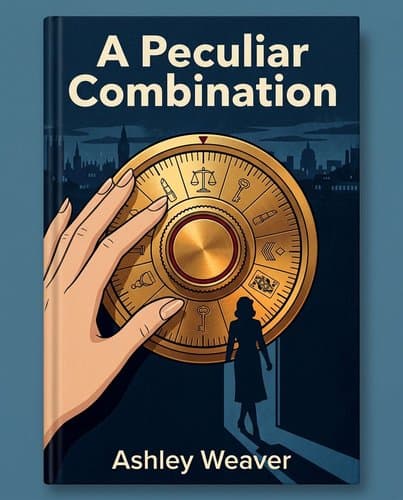
54860475_a-peculiar-combination
by Ashley Weaver
When the law wrongfully executed her mother, Ellie became a thief as quiet revenge—until that same law blackmailed her into its service.
In Brief
When the law wrongfully executed her mother, Ellie became a thief as quiet revenge—until that same law blackmailed her into its service. Now cracking safes alongside a rule-bound earl's nephew, she discovers justice can be chosen even by those the system has wronged.
Key Ideas
Theft driven by genuine grief
A cozy mystery earns its warmth when the protagonist's criminal identity has a real, painful root — Ellie doesn't steal for thrills or necessity; she steals as oblique revenge for a mother the law wrongly executed. The charm only lands because the grief underneath it is genuine.
Philosophy and structure drive attraction
Slow-burn romances work when the friction is philosophical, not just physical. Ellie breaks rules; Ramsey enforces them. She was born in prison; he is an earl's nephew. The attraction is real and mutual — but the structural gap is also real, and the novel never wishes it away.
Coercion transforms into genuine choice
Watch for the moment a coerced character volunteers. In Chapter Eight, Ramsey releases Uncle Mick and formally ends the bargain — and Ellie immediately asks if there's anything more she can do. That is the actual beginning of the story. Everything before is setup.
Restraint perfects genre convention
The best genre fiction honors its conventions fully while knowing exactly one place to resist them. Weaver delivers the wit, the banter, and the climactic embrace — but leaves her hardest moral questions (Jocelyn Abbot, Ellie's mother, the class gap) genuinely unresolved. That restraint is what makes the series worth continuing.
Safecracking defines her authentic self
Safecracking in this novel is not a metaphor — it is Ellie's actual identity. The scenes where she works a combination dial are the scenes where she is most fully herself. Ramsey's approval during the pub tutorial matters to her precisely because she has decided not to want it.
Who Should Read This
Readers interested in Novels and World History, looking for practical insights they can apply to their own lives.
A Peculiar Combination
By Ashley Weaver
9 min read
Why does it matter? Because the safecracker being blackmailed into serving the law has very good reasons not to trust it.
The tin sound when Felix Lacey, Ellie's veteran intelligence contact, raps his knuckles against the prosthetic where his leg used to be. The lipstick smudge below Major Ramsey's lip that Ellie wipes away with her thumb, immediately recasting the gesture as strictly professional. Uncle Mick's spectacularly convenient hand wound that forces his niece into the Torquay operation she's been quietly desperate to join. Ashley Weaver's wartime cozy works in small telling details — and what they add up to is darker than the genre usually allows. Electra McDonnell steals because the law executed her innocent mother, and she has never forgiven it. Now she's been blackmailed into serving that same system — and discovering, against every instinct, that she might want to. The slow-burn romance, the Blitz atmosphere, the locked safes and dead bodies: all of it earns its pleasures because underneath is a woman deciding whether justice can mean something to someone the law has already wronged.
The Most Effective Blackmail Offers You Something You Already Secretly Wanted
The handcuffs click on just after Ellie McDonnell opens a Milner safe in a Belgravia townhouse — gloves still on, no traces left, the diamonds not yet in anyone's pocket. She is very good at this. She has never been caught before. And then the room fills with men, and the arrest that opens the novel announces two things at once: her competence, and her doom.
The men are not police. The building they take her to is not a police station: it's a grand marble-floored townhouse in the same neighborhood, emerald-striped wallpaper, green-carpeted staircase, conspicuously not a cell. Eventually a military officer named Major Ramsey sits across from her in a small cold room and lays out the offer: do one job for British intelligence, and she and her Uncle Mick walk free. The bargain is clear. The threat is real. This is coercion, and it works precisely as coercion is supposed to work.
The coercion has an expiration date. Ellie blows straight past it.
The first mission fails. The safe she came to crack is already empty, the contact long dead on the floor, the documents gone, taken by a British traitor who plans to hand them to the Germans at a party the following evening. Back at Ramsey's office, with Uncle Mick already released and the original bargain technically fulfilled, Ramsey tells her she can go. She held up her end. The arrangement is finished.
She tells him she wants to stay in. That she'd like to see this through.
He hasn't asked. The threat has expired. She volunteers anyway.
Weaver's accounting of this moment isn't heroism or patriotism, exactly. It's something smaller and more honest. Ellie registers, for the first time in a long while, that she is doing something good. Not something profitable. Not something survivable. Something good. She has spent her adult life cracking safes for private gain, and she is excellent at it, but the war has been making her feel useless. There are only so many socks a woman can knit before she starts looking for work that actually matches her.
When Ramsey sets her free, she realizes she doesn't want to be free of the job. She wants to be paid in a different currency than diamonds.
Your Greatest Skill Is the One Thing No One Can Take Credit For
She grew up in Uncle Mick's workshop — a long wall of keys on pegs that rang like a musical instrument when she ran her hand along them, a rolltop desk, and in the back corner a Victorian Chubb safe she named Mr. Chubbs and treated with the quiet respect you'd give a long-standing colleague. She never had a formal lesson; she absorbed it by watching, by listening, by pressing her ear to cold metal until she could feel the minute shift that meant a gate had aligned with its contact point. Uncle Mick confirmed what she'd always half-known: she hadn't been taught so much as born into it.
She explains safecracking to Major Ramsey over drinks: drive cams, wheel packs, the way manufacturing imprecision across three or four discs creates the audible signal that tells you where the combination lies. She has decided not to like this man: he holds power over her and her uncle, speaks in directives, considers her a useful tool. But she can't help warming to the lesson, leaning forward as she talks. When he gives her his full attention, she catches herself wanting his approval. When she gets it, she feels oddly satisfied.
The satisfaction is the tell. In every other register of her life, Ellie manages how she appears: she's an orphan, a criminal, a woman in wartime Britain with no legitimate outlet for her particular mind. Safecracking belongs to her in a way nothing else does. Explaining it to Ramsey, she isn't performing or negotiating. She's just someone who knows something, speaking to someone who doesn't — and for a few minutes, that single fact reorganizes everything between them.
That's what expertise does, when it's genuinely yours. You stop being defined by everything external to it — circumstance, class, the authority someone holds over your freedom — and become the sum of what you can do. Safecracking isn't a skill Ellie happens to have. It's her. The self-respect that carries her through the rest of the novel starts here, in that workshop, with her ear pressed to cold metal.
She Didn't Become a Criminal. She Became Her Mother's Avenger.
Every safe Ellie McDonnell has cracked is, in some private accounting, an act of defiance against the system that destroyed her family.
In December 1915, her father was stabbed to death in his own home. Her mother was convicted of the murder two months later and sentenced to hang, with one complication: she was pregnant. Ellie was born in Holloway Prison six months after the killing, and Uncle Mick took her home. Her mother died of Spanish flu before the state could carry out the sentence, still insisting on her innocence, and was buried in the prison cemetery. Ellie has never visited the grave.
What she has is a single silver-framed wedding photograph: her mother in satin and lace, a barely-there smile on lips that weren't supposed to smile for photographs, eyes full of undisguisable joy. Her father looks like a younger Uncle Mick, same face, handsome mustache, eyes that sparkle. Looking at the two of them, you can see why it doesn't seem possible their union could end in bloodshed. And yet it did, and she believes the wrong person paid for it.
For every locked safe she opened, every law she broke, Ellie felt she was settling a score she could never fully settle.
The scene that lands hardest puts this belief directly in Ramsey's path. When Ellie finally says aloud that her mother didn't kill her father and was sentenced to die for it anyway, Ramsey reveals he has already read the trial transcripts. Because Ramsey reads everything. His verdict: he doesn't see how the jury could have reached any other conclusion. Ellie explains her given name then — Electra, from Greek mythology, the daughter who avenges her father's murder. Her mother chose it deliberately, she says, meaning something by it. Ramsey's response is nearly gentle and devastating: Agamemnon, he points out, was murdered by his wife. He isn't being cruel. He is applying the same logical pressure the jury applied, with the same steady face he uses to read maps and plan operations. That counter-argument lands exactly as the court verdict must have, not with malice, but with the weight of official reason that cannot afford to care how you feel about it.
Ellie's reply (she thinks her mother meant something different) is thin and she knows it. But it points toward what Ramsey doesn't yet know: a naval officer's offhand comment, passed through Felix (the veteran intelligence contact who moves through the mission beside them), that a fellow prisoner at Holloway believed Ellie's mother was the only woman there she ever truly thought was innocent. There were facts, this woman told her son, that never came out in court. The thread is left dangling. The case is not closed.
The spy mission running through the plot is about keeping documents out of German hands. But beneath it is a different investigation — one where the crime happened a quarter century ago, the actual killer may still be walking free, and the only person looking is a woman who learned to crack safes because it was the one useful thing the law couldn't take from her.
Every Time He Calls Her 'Miss McDonnell,' He Is Losing Ground
Caught in the private library of Sir Nigel, their target for the evening, with no documents and footsteps approaching in the hall, Ellie McDonnell has approximately three seconds. She makes the decision before thinking about it: she unbuttons Ramsey's tunic, messes his hair, and pulls him down onto the leather sofa. Ramsey doesn't hesitate. He messes her hair back, slides a hand beneath the hem of her skirt, and kisses her with what she can only describe as full competence. Sir Nigel opens the door, takes one look, says "no need to apologize, old boy," and exits with a smile. They've pulled it off.
In the corridor afterward, Ramsey smooths her hair back into place. She uses her thumb to wipe a lipstick smear from beneath his lower lip. She tells herself, firmly, that she had never imagined doing any of this. The firmness is the giveaway.
The scene is worth more than its obvious charm. It's evidence of how much trust the two of them have built without naming it. Ellie, who grew up watching her uncle study a room before he entered it, read the situation and acted. Ramsey, a man who gives orders for a living, who carries himself as though he has never once done something he didn't first authorize himself to do, simply followed her lead. He trusted her read of the room before she'd finished having it.
Ellie was born in a prison cell; Ramsey is the nephew of an earl. She has spent her adult life exploiting the blind spots of a class system that put her mother in the dock and called it justice. He represents the institutional authority she has organized herself against. Every time he calls her "Miss McDonnell" — the formal address he maintains across the whole novel, clipped and correct — he enacts a distance he needs and she finds galling. Every time she proves a point he didn't ask for, she refuses to stay in the slot the address implies.
Both of them are too honest to pretend the gap doesn't exist. That's what makes the thing between them worth watching. You can feel the trust build in increments: missions shared, secrets traded, the specific way he doesn't turn around in dark houses to check whether she's still following him. And you can feel exactly what it costs.
Weeks into the operation, they stand in dark woods outside a beach house, waiting for a German spy to appear on the coast. Ellie tells Ramsey he seems made of stone. He steps close enough that she can feel the warmth coming off him in the cool night air, and says, in a voice she has never heard from him before: I am definitely not made of stone, Electra.
Her given name. Not her cover name. Not "Miss McDonnell." The name only Uncle Mick and the housekeeper who raised her ever use. A car comes up the drive and the moment closes.
He gave her something without intending to. They both know it.
The Case Closes. The Questions Don't.
What does a cozy mystery owe you at the end?
The traitor Winthrop is intercepted at Torquay before the German agent collects the weapons plans. Jocelyn Abbot — the woman who handed those plans over to protect her captured fiancé — is turned over to the appropriate authorities. By any genre accounting, the book has delivered what it promised.
What it doesn't deliver is agreement about Abbot, and Weaver made that choice deliberately. When Ellie first learns why Abbot cooperated with the Germans, she says Abbot had no real choice: her fiancé was a prisoner of war, the Germans held his survival as the price of her compliance, and anyone might trade state secrets for someone they loved. Ramsey's answer is short and final: she had a choice. Both positions come from people the reader trusts. Ellie has been right about everything that mattered, including things Ramsey dismissed too quickly; Ramsey has been precise and honest throughout, even when honesty cost him. The novel refuses to settle between them, which means it ends up asking a harder question than the spy plot: whether circumstances can genuinely strip a person of moral agency, or whether moral agency is exactly what circumstances cannot touch.
The thread about Ellie's mother is left open with equal care. Felix has written to a naval officer whose fellow prisoner believed her mother was the only woman in Holloway he genuinely thought was innocent. A reply is coming. Not in this book.
What does close is the coercive arrangement, and then Ramsey immediately reopens it in different terms. He tells Ellie she has fulfilled her side of the bargain. She can go. Then, in the same breath: she's still on the payroll, stay out of trouble, be ready when needed. What was blackmail is now an invitation, and she accepts it.
That's the transformation the novel is tracking — not criminal turned law-abider, but a woman moving from choices made for her to choices made by her. Ramsey gives her Gods and Heroes before she goes, his acknowledgment that ordinary people who step up when called matter more than the heroes on the page. She walked through his door under duress. She'll walk back through it because she wants to.
The questions stay open. The door does too.
The Name She Finally Gets Called
The name Electra has always arrived with weight attached. Her mother chose it as a declaration — that her daughter would avenge what the law got wrong — and then died before explaining what avenging was supposed to look like. For years the name meant only grief and a mission without a clear target. Ellie sidestepped it, became Ellie, cracked safes, and called it even.
Ramsey says it twice at the novel's end: once on a beach when she is shaking and the word itself seems to steady her, once in his office followed by the word hero. The name lands differently when it isn't carrying a debt. What Ellie needed wasn't to avenge her mother. She needed someone to give the name back without the grief attached, so she could decide for herself what Electra means — which is another way of saying: what she means.
Notable Quotes
“Come see what you think.”
“Not bad for a night's work,”
“I said, smiling myself for the first time that evening.”
Frequently Asked Questions
- What makes Ellie McDonnell's criminal past compelling in A Peculiar Combination?
- Ellie McDonnell's criminality isn't rooted in thrill-seeking or necessity — she steals as oblique revenge for her mother, whom the law wrongly executed. This genuine grief beneath her criminal identity is what makes the cozy mystery's warmth resonate. Rather than portraying safecracking as a convenient plot device, Weaver grounds Ellie's entire character in this painful history. The novel asks readers to understand how trauma and injustice can drive someone to crime, transforming what could be a lightweight caper into something psychologically complex while maintaining the genre's charm.
- What kind of romance is in A Peculiar Combination?
- A Peculiar Combination features a slow-burn romance between Ellie and Ramsey that works precisely because the friction is philosophical rather than merely physical. Ellie breaks rules while Ramsey enforces them. She was born in prison; he is an earl's nephew. Their mutual attraction is genuine, but the structural gap between them is equally real — and the novel never wishes it away. This refusal to minimize the conflict makes their connection earned and credible. The romance complements rather than overshadows the mystery, deepening both plot and character development.
- What is the significance of safecracking in A Peculiar Combination?
- Safecracking in A Peculiar Combination is not metaphor — it is Ellie's actual identity. The scenes where she works a combination dial are the scenes where she is most fully herself. During the pub tutorial, Ramsey's approval matters to Ellie precisely because she has decided not to want it, adding another layer to their relationship. Through these sequences, Weaver explores how work and identity intertwine, and how mastery of one's craft becomes a form of self-knowledge. Safecracking grounds the novel's emotional arcs in concrete action.
- What makes A Peculiar Combination different from typical cozy mysteries?
- The best genre fiction honors its conventions fully while knowing exactly one place to resist them. Weaver delivers the wit, banter, and climactic embrace readers expect — but leaves her hardest moral questions genuinely unresolved: Jocelyn Abbott, Ellie's mother, and the class gap all linger without neat closure. That restraint makes the series worth continuing. Additionally, Chapter Eight marks a turning point: when Ramsey formally ends their bargain, Ellie immediately volunteers to help him anyway. That moment marks the actual beginning of the story; everything before is setup.
Related Book Summaries



Read the full summary of 54860475_a-peculiar-combination on InShort