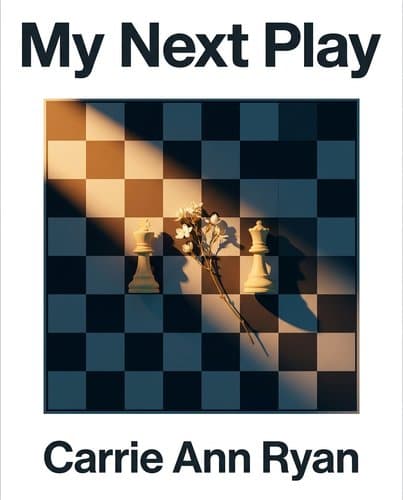
241836652_my-next-play
by Carrie Ann Ryan
Two people fluent in performed okayness—one hiding behind survivor's guilt, one behind cheerful preemptive retreat—discover that a 'just for this year'…
In Brief
My Next Play (2021) is a romance novel that follows two people who have each learned to hide behind carefully maintained personas — avoidance dressed as ease, self-protection dressed as contentment.
Key Ideas
Elaborate justifications mask real avoidance
Avoidance that looks like friendship is still avoidance — and the more elaborate and reasonable the justifications become, the more certain it is that something real is being protected against.
Time-limited intimacy signals constrained desire
'Just for this year' is not a neutral arrangement. Agreeing to time-limited intimacy is itself a choice about how much you're willing to want, and the person who wants more than the terms allow is already in trouble.
Preemptive abandonment mirrors feared rejection
The impulse to leave first — to preemptively end something before it can hurt you — is coherent as self-protection and catastrophic as a relationship strategy. Doing to someone what you fear they'll do to you is still doing it to them.
Survivor's guilt distorts worthiness beliefs
Survivor's guilt doesn't only come from accidents. It comes from any story where you walked away and someone didn't — and it shapes every subsequent decision about whether you deserve good things, including the ones standing right in front of you.
Conditional niceness reveals strategic intent
The moment someone's self-description shifts from 'I'm a nice guy' to a demand for compliance, the niceness was never the point. Restraint that can be revoked under pressure isn't restraint — it's a negotiating position.
Who Should Read This
Readers interested in Novels and Relationships, looking for practical insights they can apply to their own lives.
My Next Play
By Carrie Ann Ryan
13 min read
Why does it matter? Because the person you want is right there, and you've spent months building a very good argument for why you can't have them.
Here's the thing about wanting someone who lives in the same house: you have to get very good at reasons. Miles has his — survivor's guilt worn like a second skin, a twin sister's absence that taught him desire is something that happens to other people. Nessa has hers — one humiliating crush already on the record, a mother newly dead, a smile she's practiced until it almost feels real. They're both performing okayness with genuine skill, and the performance is working, mostly, until it isn't. My Next Play looks like a slow-burn romance about two people circling each other. It's actually a book about the enormous energy required to stay small — and what happens when the thing you've been carefully avoiding walks into a hallway, smells like honey and jasmine, and catches you before you fall.
The Art of Making Yourself Smaller Than You Are
Nessa bumps into Miles at the house party — a blind corner, two people moving too fast — and what follows is a thirty-second hallway exchange she cannot stop cataloguing against her will. His forearms as he pushes up his glasses. The way his throat moves when he swallows. His eyebrows, which she then has to actively diagnose as 'cute' and immediately explain away: maybe she's just transferring the Pacey crush onto the nearest available man who happens to be kind to her. The denial is so thorough, so neatly sorted, that it reads as its own kind of confession. Then: those glasses do warm things. One beer is probably enough.
What makes these two people interesting isn't that they like each other and don't know it yet. They both know it. They're each working very hard to make themselves not know it.
Nessa has a system. She keeps score on her own feelings — labeling them, explaining them away, finding structural reasons they don't count. The night she kissed Miles months earlier (drunk, grieving, at her lowest), she filed it under 'mistake' and sealed the folder. She now treats Miles the way you treat a former bad decision: with careful, performative normalcy. She picks Xander at the end of the party not because she wants him but because he lives at a different address. He's an alibi.
Miles runs a parallel operation. He watches Nessa cross a diner parking lot with Xander the next day and narrates it to himself with practiced flatness: she never notices him, he was always just the roommate, he didn't kiss her back that night because she was drunk and it would have been wrong. All of that is probably even true. The chapter's final line — that he needs a girlfriend, someone who isn't Nessa — has the quality of a resolution made at midnight that you already know won't hold.
These are two people who have gotten very good at arranging themselves so that what they feel stays just out of frame. That arrangement is the story.
Every Almost-Moment Is Also a Lesson in How Well-Practiced Avoidance Can Look Like Friendship
The kitchen near-miss in Chapter 6 is the cleanest proof of what this book is actually doing. Nessa turns too fast, walks into Miles's chest, and both of them freeze — his hands on her hips, her hands on his stomach, a half-second where neither person moves. Then they talk their way out of it. Not awkwardly, not even clumsily: they negotiate. Nessa says kissing him would be a mistake. Miles repeats this back to her with blunt precision, almost as if making her confirm it. She redirects — it's not the kiss itself, she clarifies, it's ruining the friendship — and he offers her the exit hatch: something about whether you're supposed to salt pasta water. The moment dissolves. Relief floods her face, and he clocks it.
What makes this scene quietly devastating is how fluent they both are in it. This isn't two people fumbling toward something. It's two people executing a retreat they've run before. The negotiation has the shape of mutual respect — we care about each other too much to risk this — but the subtext is something else. Miles, lying in bed afterward, names it himself: he had no business having feelings for someone like Nessa, who knew who she was and owned it, while he couldn't account for himself outside of academic ambition. He stares at the ceiling, hands flat on his chest, not moving — like stillness is something he can practice. The tenderness he feels toward her is also, for him, a measure of his own inadequacy. He's not protecting the friendship. He's punishing himself with the thing he wants most by keeping it exactly one step away.
Nessa, for her part, has filed the distance under practicality. She's working, grieving, stretched financially, dating Xander as a kind of proof that she can want something uncomplicated. The retreat from Miles reads like discipline. But she notices the relief on her own face — registers how quickly she took the exit — and that's the tell. The closer they get, the more detailed the choreography has to be.
What Each of Them Is Actually Protecting
What are these two people actually protecting? Not their friendship — that's the official story, the reason they each reach for when things get close. The friendship is the cover. What they're protecting is the self they've carefully rebuilt after catastrophic loss, the one that functions well enough as long as it isn't tested too hard.
Miles's wound has a specific shape. He was the good son — the academic, the careful one, the boy who had never had a drink in his life right up until high school graduation. That night, he decided to prove he was someone else. He drank enough to get his stomach pumped. His twin sister Rachelle, who had always been the one who partied, who got caught with weed at fourteen, who told him she handled this all the time — she got behind the wheel. He knew, somewhere under the alcohol, that she shouldn't. He couldn't make his body act on what he knew. She died. He walked away wearing his seatbelt like muscle memory, which might be the cruelest detail: the habit that saved him was the one he'd followed his whole life without thinking, and the one time he stopped thinking is the thing that killed her.
Everything Miles has done since is organized around that night. The academic scholarships, the TA job, the careful money management, the grad school applications to programs that will pay him rather than indebt him — these read as discipline, but they're penance. He hasn't told anyone the full story. When beer loosens his guard one evening with his roommates and he lets slip that the one person he could talk to is dead, he retreats to his room and physically vomits. His body remembers what his discipline wants to forget. What he's protecting, around Nessa specifically, is the version of himself that functions. She, in his framing, has herself together — she knows who she is and claims it. He doesn't know who he is outside of work and grief. To want her is to measure the distance between them. Keeping her at one step away means he never has to close it.
Nessa's losses run in a different register but arrive at the same place. Her mother's cancer bills are still coming in, her father is close to losing the house, and she is one semester from a degree she can no longer afford to finish. She has never said any of this out loud — not to her closest friends, not to Pacey, not to the women she lives with. When she finally tells Miles at the diner, it comes out in a panicked rush she couldn't stop and immediately wants to take back. The shame is the tell. She has organized her financial crisis the way Miles has organized his guilt: as private evidence of not being enough. What she's protecting isn't a secret. It's a verdict she's been holding against herself, and letting Miles see it means letting someone else see whether it sticks.
'Just for This Year' Is a Container Too Small for What This Already Is
A budget acknowledges what you can't afford. A wish list is what you make when you secretly hope someone will buy you everything on it. Miles and Nessa's arrangement has the form of a budget and the emotional structure of a wish list.
When they finally stop pretending — when Nessa admits she remembers the kiss and Miles admits he's wanted to kiss her for over a year — they negotiate terms for what happens next. Friendship comes first, always. Whatever this is, it ends when the year does. They're both leaving after graduation, so this can't become something neither of them can walk away from. It's presented as wisdom. Two adults who understand the situation clearly and are making an informed choice.
Miles is already somewhere else entirely. The chapter that seals the arrangement is the same chapter where, alone in his own head, he registers that what he wants is for her to be his. Not for a year. Not on terms. He pushes the thought out and keeps going, but it was there, fully formed, before he suppressed it. He calls himself a fool at the end — 'Nessa wasn't for me' — which is exactly what someone says when the person in question already is, and they're trying to talk themselves back to safety.
Because this is avoidance at its most sophisticated, it doesn't look like avoidance. It looks like maturity. 'Just for this year' sounds like two people who've done the math and accepted the answer. But you don't ache to keep someone forever and respond to that by agreeing to let them go in seven months. You don't build a container labeled 'temporary' and fill it with the most careful, attentive version of yourself. What Miles actually does — the way he checks in, the way he shows up, the way he watches her — is not the behavior of someone who has accepted an expiration date. It's the behavior of someone trying to make every day inside the limit count for longer than it can. He calls himself a fool. Nessa wasn't for me. Which is exactly what someone says when she already is, and he's running out of ways to convince himself otherwise.
The Nice Guy and the Man Who Actually Showed Up
Miles's version of care has been accumulating in small, undramatic gestures — the diluted drink, the flowers retrieved from the back seat, the announcement that he'll take the couch — which is exactly what makes the Xander contrast land as something more than bad guy versus good guy. Both men present themselves as attentive. Only one of them is.
Xander is outside Nessa's house when she pulls into the driveway after work, radiating harmlessness so deliberately that when she says it's nice to see him, he reads it as an opening. He wants the next date. He's owed the next date. They went on dates, after all — the word slow and deliberate when she tries to reframe things — and when she says she isn't in a good place for a relationship, he decides the problem is that she hasn't been properly kissed. He grabs her by the shoulders and shoves her back against her own car, his tongue already forcing its way in before she can react. When she pushes free and tells him he didn't have permission, he calls her hysterical. He's not the villain of this scene, in his telling. He's just a nice guy who was trying to show her something.
Miles appears around the corner midway through. He runs this route regularly — established earlier, so his arrival reads as luck rather than rescue fantasy — but what the novel uses the moment for is something else. Nessa has noticed, over months, that Miles tends to make himself smaller than he is: shoulders hunched, glasses sliding, doing his best to take up less space. Not now. He comes to a full stop and stands at his actual height, broad and still, and tells Xander in a voice with no performance in it that he needs to let her go. When Xander grabs her arm hard enough to bruise, Miles doesn't raise his voice. He just doesn't move.
Nessa knees Xander and walks to Miles's side, and afterward he makes her a drink, retrieves the flowers still buckled into her back seat, and tells her he's sleeping on her couch. He doesn't frame any of this as heroism. He frames it as logistics.
Xander claimed the language of care — noticing her, taking care of her, making effort — and used it as leverage. Miles just shows up, mixes the drink, collects the flowers, takes up the couch. Entitlement announces itself. What Miles does doesn't need to.
The Most Precise Cruelty Is Doing to Someone What You're Afraid They'll Do to You
Three things hit Nessa at once: a stalker's letter she initially mistakes for something tender, a tuition bill that makes her stomach drop, and the knowledge that Xander is still out there. Any one of these she could have managed. Together, they confirm a story she's been telling herself since her mother died and the medical bills started arriving — that she is a weight, a problem, a burden dragging toward anyone foolish enough to stand close. Miles has been standing close. So she says it plainly: 'I don't think I can do this, Miles.'
What makes this devastating rather than merely sad is how well-aimed it is. She knows exactly where Miles is softest. She knows he carries his twin sister's death like a verdict on himself, that he has organized his entire life around not being someone who destroys things. To tell him she can't do this — gently, clearly, with no cruelty in her voice — is to hand him a piece of evidence for a case he's already been building against himself. She doesn't scream. She doesn't blame him. She just removes herself, which is the one move he can't argue with because he'll fold it into the story he already believes about what he does to people he loves.
The most precise cruelty you can inflict on someone who loves you is to leave them first, before they get the chance. Nessa doesn't push Miles away in a moment of chaos — she does it with surgical intention, and the intention is the point.
He tells her as he leaves that the only reason he's going is because she asked — unlike Xander, who grabbed and didn't stop. Then he sits in his car outside her house until her friends arrive before driving away. He complies without abandoning her, which is a distinction the novel holds carefully: there is leaving when someone asks, and there is leaving. Miles does the first. He does not do the second.
Nessa slides to the floor behind the closed door and arrives at 'I was nothing. I was only a burden.' The irony is right there on the surface and the novel doesn't look away from it: the instinct that was supposed to protect her is the one doing the damage. The self-sufficiency reflex she built to survive her mother's death is now performing preemptive abandonment on the person least likely to hurt her. She is doing to Miles exactly what she is afraid Miles will eventually do to her.
Stop Pretending the Last Loss Was Your Fault
Miles is in a hospital bed, head stitched, unable to move without pain, when his parents walk through the door. He braces for the version of their faces he knows from the last time — after the accident that killed Rachelle, the disappointment that had shattered him. What he gets instead is his father's expression stripped of everything but grief, and his mother reaching for his hand before she can find words. 'We could have lost you again,' she says. And then his father makes the promise he hasn't made before: we won't take Aaron from you. The family estrangement Miles has been carrying alongside his guilt — treating it as another sentence he'd earned — dissolves in a hospital room, the same category of location where the first wound opened. He hadn't done anything wrong. Not the first time. Not this time. His parents were just so afraid of losing what remained of him that they couldn't stop gripping.
That's the reframe the book has been working toward all along. Miles organized his entire life as a kind of evidence submission — the scholarships, the financial caution, the careful distance from Nessa — because he had filed himself as someone who destroys things he loves. Nessa did the same thing from the other direction, exiling herself before anyone could leave her. Both of them kept scoring the last loss as proof.
When Nessa calls Miles to tell him she got the book deal — her writing, her work, the part of herself she'd never once let anyone underwrite — she tells him before anyone else. His voice goes quiet in a way she's never heard before, something that isn't quite words yet, and when he does speak the pride in it is so clean it catches her off guard. Zero envy. The way someone responds when your win feels like theirs because they were rooting for you the whole time.
That call is its own kind of resolution — two people who spent the whole book protecting themselves from each other's success, and neither of them needed to. Miles carries Nessa upstairs at a party while still recovering from a head injury, and the epilogue gives you his interiority: she was my first love, my first everything. And my next, and my next, and my next. The title of this book isn't about sports. The 'next play' is what you reach for when you finally stop treating the last loss as a verdict. Not a sequel. Not a replacement. The same person, chosen again, forward.
What 'My Next' Actually Means
Nessa spent years leaving before anyone could leave her and called it self-sufficiency. Miles spent years making himself physically smaller — shoulders in, glasses sliding, careful not to want too much — because somewhere under all that discipline was the belief that wanting things was what got Rachelle killed. What 'my next' turns out to mean is the thing you reach for when you finally accept that surviving wasn't a theft. The people who love you are not the last loss wearing a different face. Standing at your full height isn't forgetting. Carrying someone upstairs when you still have stitches isn't recklessness. It's just the next thing, chosen on purpose, by someone who finally stopped filing themselves as evidence.
Notable Quotes
“I'm the nerdy brother—the one who liked playing video games and had glasses from the age of six. I was a geek, a nerd. I could've skipped a couple of grades but decided to stay back because of my sister.”
“My heart ached, and I felt it twist. I let out a breath.”
“Nessa looked at me, her eyes filling with tears because she had heard the past tense. She knew.”
Frequently Asked Questions
- What is 'My Next Play' by Carrie Ann Ryan about?
- My Next Play (2021) is a contemporary romance that explores how two people navigate a relationship while hiding behind carefully constructed personas. The novel examines how avoidance masquerades as ease and self-protection as contentment. It investigates how characters manage their capacity to want through mechanisms like survivor's guilt, preemptive retreat, and intentionally time-limited arrangements. Ultimately, the book is about the cost of finally allowing yourself to want something — and someone — that's genuinely real.
- How does avoidance function in 'My Next Play'?
- In My Next Play, avoidance that disguises itself as friendship remains avoidance, regardless of how reasonable the justifications become. "Avoidance that looks like friendship is still avoidance — and the more elaborate and reasonable the justifications become, the more certain it is that something real is being protected against." The novel demonstrates how people construct elaborate rationales to maintain distance, suggesting that the complexity and logic of these excuses directly correlate with how much they're actually protecting something significant and vulnerable.
- Why are time-limited arrangements problematic in 'My Next Play'?
- My Next Play shows that establishing time-limited intimacy is never a neutral choice. "'Just for this year' is not a neutral arrangement." When two people agree to temporary terms, they're actively deciding how much they're willing to want. The person desiring more than the arrangement allows is already vulnerable and in trouble. The novel illustrates that such agreements create an inherent emotional imbalance, where one partner's deeper feelings transgress the agreed-upon boundaries, making heartbreak inevitable when the predetermined expiration date arrives.
- How does survivor's guilt influence the characters in 'My Next Play'?
- Survivor's guilt in My Next Play extends beyond accidents to any situation where you walked away while someone else didn't, profoundly shaping subsequent decisions about deserving happiness. The character burdened by this guilt questions whether they deserve good things — even the ones literally standing before them. This self-doubt becomes a barrier to accepting love and connection, as the guilt creates a narrative where happiness feels unearned or dangerous. The novel explores how this guilt can sabotage relationships by preventing characters from fully allowing themselves to want and accept what they're offered.
Related Book Summaries


Read the full summary of 241836652_my-next-play on InShort