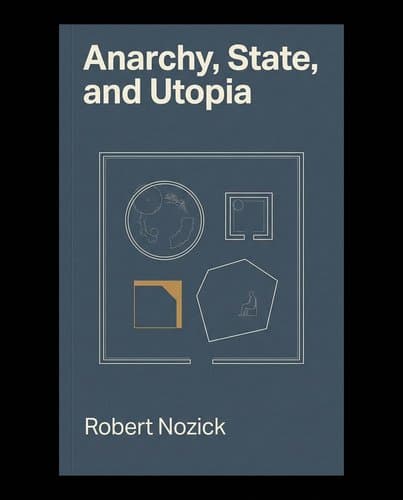
479572_anarchy-state-and-utopia
by Robert Nozick
Rights aren't variables to optimize—they're absolute limits on what any state may do to you. Nozick dismantles every justification for redistribution and…
In Brief
Rights aren't variables to optimize—they're absolute limits on what any state may do to you. Nozick dismantles every justification for redistribution and taxation, revealing that only a razor-thin minimal state can honor all human visions of the good life without violating a single person.
Key Ideas
Aggregate benefit cannot justify individual cost
When justifying any policy by appeal to 'the common good' or 'overall social benefit,' identify the specific person bearing the cost — if they haven't consented, the aggregate benefit doesn't justify the imposition, because there is no social entity that absorbs both the sacrifice and the gain.
Key Takeaway
Rights function as absolute side constraints on what may be done to a person, not as variables in a social optimization. A policy that violates one person's rights to prevent two others' violations has still committed a violation — the math doesn't cancel.
Pattern maintenance requires perpetual surveillance
Any patterned distribution principle — whether based on equality, need, or merit — requires continuous interference with voluntary transactions to maintain. Free people's choices will constantly disrupt any imposed pattern, so maintaining it means perpetual surveillance of private decisions.
Unrequested benefits impose no obligations
Receiving a benefit you didn't request doesn't obligate you to participate in the system that provided it. No one can impose an obligation on you by acting first and conferring unrequested benefits — this dissolves the 'social debt' argument for political obligation.
Minimal state honors diverse visions
The strongest argument for the minimal state isn't 'less government is always better' but that only a framework permitting voluntary communities can honor the full range of human visions simultaneously — socialist communes, religious communities, and libertarian arrangements can all coexist within it, while none can coexist within each other.
Legitimacy requires consensual origin and exit
Before accepting any political arrangement as legitimate, ask whether it could have arisen through steps that violated no one's rights, with each participant genuinely there voluntarily and with a meaningful exit option. This test fails for nearly every existing state — which is Nozick's point, not a flaw in the test.
Who Should Read This
Thoughtful readers interested in Ethics and Policy willing to slow down and wrestle with ideas.
Anarchy, State, and Utopia
By Robert Nozick
12 min read
Why does it matter? Because we've been debating how much the state should do without ever asking whether it may.
Political debate assumes the fight is over quantity: how much redistribution, which regulations, what limits on personal choice. Nobody in mainstream politics asks the more fundamental question, because the answer is uncomfortable. Robert Nozick asked it anyway: does the state have the right to do any of this at all? Starting from a single moral premise almost no one openly rejects — that you cannot sacrifice one person for another's benefit and call it justice — he follows the logic wherever it leads. The destination surprises everyone, including libertarians: a minimal state that isn't a concession to selfishness but the only political structure spacious enough to contain every possible human vision of the good life simultaneously. The argument is precise, the implications radical, and the discomfort is the point.
Taking the Anarchist Seriously Is the Only Way to Defeat Them
Most political philosophy starts with the state as a given and argues about how to arrange it. Nozick starts one step earlier, with a question almost no one asks: should the state exist at all? It's the only defensible starting point, because if the anarchist is right — if any state necessarily violates the rights of the people living under it — then all the arguments about taxation, representation, and redistribution are already rotten at the root.
The anarchist's charge is precise: the state claims a monopoly on force within its territory and punishes anyone who tries to exercise justice privately. But by what right? If a private citizen may punish a murderer, why not you? If the state may, why can't you? The state can't answer this by asserting its own authority — that's the question. And if it can't, then every time it stops someone from defending their own rights, it's doing what a mugger does: imposing force without consent.
Nozick's move is to accept the challenge fully. He asks: if you begin with no state — just individuals with natural rights and the freedom to enforce them — would a state ever emerge through purely voluntary steps that violate no one's rights? If yes, that state is justified. If not, the anarchist wins.
The rest of the book is Nozick's attempt to show the anarchist loses. But the challenge shapes the answer — it determines not just whether a state can exist, but exactly how thin it has to be to pass.
Rights Are Walls Around Persons, Not Weights in a Social Calculation
Think of a hammer. There's no inherent limit on what you can do with it: leave it in the rain, lend it, break it for parts. Now think of a person. Treating someone like a tool means you can use them for others' purposes, sacrifice them when the arithmetic favors it, take from them to give to someone else. Rights are the claim that those moves are simply off the table, regardless of what good might result.
That sounds obvious. But ask how rights are supposed to work inside a moral theory, and a fork appears that most political philosophy takes the wrong way without noticing.
The standard move is to treat a rights violation as one more bad outcome to weigh against benefits. Rights enter the calculation with heavy negative values, but they're still weights. This makes them, in principle, outweighable. Under some circumstances, violating one person's rights might generate enough aggregate good, enough rights-protection elsewhere, to come out ahead. This is what Nozick calls a "utilitarianism of rights": instead of maximizing total happiness, you minimize total rights violations across the population.
He shows this structure leads somewhere monstrous. A mob is rampaging through a neighborhood. You can stop them by punishing an innocent man you know had nothing to do with the outrage that enraged them. The utilitarian-of-rights framework demands you do it. Punishing the innocent man produces fewer total rights violations in the ledger. The arithmetic works. But something has clearly gone wrong.
What's gone wrong is the framing. Rights aren't weights that can be offset by producing rights-respecting outcomes elsewhere. They're walls (what Nozick calls side constraints). The constraint says: whatever goal you're pursuing, you may not pass through this person to reach it. The innocent man's rights determine what you may do in pursuit of other ends, full stop. That punishing him would improve the aggregate score doesn't change what you're doing to him.
The reason this matters comes down to a fact so simple it's easy to talk past: there is no social entity that undergoes costs and receives benefits. There are only individual people, with separate lives. When you sacrifice one person for the good of others, something is done to him for others. He receives no overbalancing benefit — other people do. The phrase "overall social good" implies a unified subject trading present pain for future gain, the way you endure a dentist visit to avoid worse pain later. But society is not a person. That tradeoff only makes sense within a single life.
Once you accept that rights are walls rather than weights, you can no longer justify conscripting one person's welfare — or labor, or earnings — for the aggregate benefit of others. The utilitarian case for an expansive state dissolves — the mode of calculation itself is the mistake.
A State Arose Without Anyone Trying to Create One — and That's Precisely What Legitimizes It
What would happen if you abolished the state and let people protect themselves? Nozick argues that even from that anarchic starting point, a rights-respecting authority would emerge — and that its emergence without any founding compact is precisely what legitimizes it.
Start with the market for protection. In a stateless society, people form mutual-defense associations and, eventually, hire professional agencies. When clients of different agencies come into conflict, only three outcomes are possible. One agency consistently wins its battles — clients of the weaker agency defect to the stronger one, and a dominant agency emerges. Or each agency dominates its own geographic territory, with a de facto border. Or the agencies fight to a costly standstill and negotiate: they agree to submit disputes to a neutral court, developing shared rules about jurisdiction and appeals. In every case, a single authority ends up ruling over each patch of territory. Nobody sat down to design this; competition produced it the way markets produce prices.
That gives you what Nozick calls an ultraminimal state — a dominant agency that protects its paying customers and no one else. Close, but not yet a state.
The compensation principle closes the gap. The dominant agency will prohibit people who haven't subscribed — call them independents — from using their own enforcement procedures against the agency's clients. Those procedures might be unreliable or biased, and the risk falls on clients. But prohibiting someone from defending themselves damages them. Nozick's principle says: if you prohibit a person from an action, even a legitimately risky one, you owe them compensation for that disadvantage. Writing them a check won't do it — the harm isn't financial; being barred from self-defense leaves you exposed, and only protection remedies that exposure. So the compensation that actually addresses the harm is providing the protective services they've been blocked from providing themselves. The agency must cover the independents it has prohibited.
No vote. No contract. No founding act of coercion. The minimal state — one that protects everyone in its territory — falls out of the internal logic of what the dominant agency is already doing. The anarchist's objection was that every real state rests on a moment of illegitimate force. Nozick's answer is that one state, at least, need not.
Any Fair Distribution You Name Will Be Undone by Tomorrow's Voluntary Choices
Think of a square dance where everyone starts in their assigned position — perfectly spaced, perfectly symmetric. The music starts. By the end of the first song, the symmetry is gone: skilled dancers have drifted toward each other, less coordinated couples have edged to the periphery, friends have gravitated back together. Restoring the original formation requires stopping the music. Maintaining it permanently requires that no one ever move freely again.
That's Nozick's argument about patterned justice in miniature. Suppose you've achieved your favorite just distribution — call it D1. Maybe it's perfectly equal; maybe it rewards effort by some formula you find fair. Either way, it satisfies your preferred principle of justice. Now a basketball star is enormously popular, and he negotiates a contract: from every ticket sold to his home games, twenty-five cents comes directly to him. The fans agree. A million people show up over the season, each voluntarily dropping their quarter into his box. He ends the year with $250,000. No one was coerced. No one's share under D1 was taken — each fan parted with their quarter freely, and everyone else kept their original allocation intact.
The new distribution, D2, is highly unequal. Is it unjust?
Here's the trap. If D1 was just and every move from D1 to D2 was voluntary, the only argument for condemning D2 is that the pattern has changed — the snapshot now looks wrong. But what was actually violated? Not a contract. Not anyone's rights. Not anyone's share under D1, which each person freely chose to reduce. The only principle capable of condemning D2 is one that says people may not use their legitimately held resources as they choose — even in exchange for something they genuinely want.
And if you accept that principle, you cannot stop at one correction. Tomorrow's fans will make tomorrow's voluntary choices and the pattern will drift again. The logic doesn't license a single redistribution; it licenses permanent surveillance of every exchange, every gift, every transaction — watching for anything that disturbs the required arrangement. A society committed to any patterned distribution would, as Nozick observes with the calm of someone reading out a geometric proof, have to prohibit free exchanges between willing parties. Not as an extreme measure but as a logical consequence: the pattern can survive only if people cannot freely transact.
This is the reversal. You started thinking the question was "which distribution is fair?" — a question about outcomes. The Chamberlain example shows the real question is "who controls what you do with what you own?" — a question about process. Any answer that maintains the pattern requires monitoring and overriding your choices indefinitely. Liberty and patterned justice don't merely pull against each other. They are in structural conflict.
Nine Steps From Slavery to Democracy Without Escaping Either
That authority has to live somewhere. You work in the city now. Your master — call him what he is — has granted you the freedom to live anywhere, take any job, spend your days as you choose. He asks only that you send back three-sevenths of your wages, reserves the right to recall you to the plantation in emergencies, and restricts activities that might impair your productivity: mountain climbing, cigarette smoking. You have not been beaten in years.
Is this slavery?
Nozick poses the question through nine sequential cases. Case 1 is brutal: complete subjection to a master's whims. Each subsequent case improves conditions or distributes power more widely. By case 5 you're earning wages in the city, surrendering a fraction to the master. By case 6, ten thousand fellow slaves vote on what to do with your earnings, though not you. By cases 7 through 9, you gain voice in discussions, then a vote that counts only in ties, then a full equal vote that makes no difference when you're outnumbered. The series ends at something recognizable as liberal democracy.
Nozick asks which transition ended the tale of a slave. He leaves the question hanging — the implied answer is that none of them did.
The structure of the relationship is unchanged across all nine cases. Someone has authority over what you do with your earnings, what risks you may take with your body, whether you may be recalled. What changes is the number of people holding that authority. A single master becomes a ten-thousand-headed master, then disperses into everyone. But dispersal isn't elimination. The master relationship survives; only the headcount changes.
Nozick reinforces this with a companion fable. People voluntarily sell off separable rights over themselves as stock shares (rights to choose a spouse, take a drug, be drafted), which consolidate and eventually disperse until each person holds exactly one share in every other person. Each step was voluntary. Each step was unobjectionable. The result is the modern democratic state.
The uncomfortable implication: the standard case for democratic legitimacy (that you chose it, that you participate) is much shakier than assumed. You didn't specifically consent to those constraints on your earnings or your body. You simply found yourself in case 9, unsure which step back would have changed anything. What the nine cases expose isn't a verdict on democracy. It's the authority structure underneath: permanent control over your choices and your body, distributed across everyone but not dissolved.
The Minimal State Is Not the End of Utopia — It's the Only Container Spacious Enough to Hold All of Them
What does the minimal state offer someone who actually wants something: a commune, a monastery, a society of shared purpose? The answer most people assume: nothing. Rights protections and a constrained police force, cold machinery for people who'd rather not cooperate at all.
Nozick poses a challenge. Take philosopher Wittgenstein and Yogi Berra. Take Gandhi and Hugh Hefner, Moses and chess prodigy Bobby Fischer, a Hasidic rabbi and Ayn Rand, and add yourself and your parents. Now describe the single society that would best suit all of them. Should it be agricultural or urban? Austere or luxurious? Monogamous or not? Should religion be central or absent? Should it prize athletic heroism or intellectual solitude or sensual pleasure? The exercise collapses almost immediately. These people aren't edge cases. They represent the actual range of what humans have found worth living for. Any answer that suits Gandhi insults Hefner. Any community shaped for Bobby Fischer would be a kind of prison for Yogi Berra.
And yet every utopian author has produced exactly this: one arrangement, confidently declared correct. Nozick notes that even within their ideal communities, no utopian author has everyone doing the same things or filling their days the same way. If internal diversity is unavoidable, why should one community type work for everyone?
Here's what makes the framework more than a shrug. A group of people who want to live communally — pooling income, sharing property, running decisions collectively — can do exactly that within a libertarian society. They agree among themselves; no outside authority stops them. But people who want to live by libertarian principles cannot do so within a socialist state, because the state compels contribution regardless of individual consent. The framework that permits everything contains the framework that permits only one thing. The reverse is never true. This isn't symmetry between two options — it's the difference between a container and a cage.
Nozick ends the book with a line that cuts both ways: the minimal state treats people as inviolate individuals and allows each to choose their life and realize their ends. Then comes the double challenge: how dare any state do more, or less. The "or less" is the half most readers skip. Anarchism fails alongside statism: without the minimal state, nothing prevents the stronger from overriding the voluntary arrangements of the weaker. A framework for freedom that can't protect its own conditions isn't a framework. It's a wish. The minimal state isn't a consolation prize for failed ambition. It's the only arrangement spacious enough to let every kind of ambition breathe.
The Question Hidden Inside "How Much Should the State Do?"
Nozick began where most political philosophers don't: with the anarchist's challenge fully in view and a commitment to answer it rather than talk past it.
What's surprising is where that discipline leads. The minimal state turns out to be not a stripped-down compromise but the only structure that leaves everyone room — communes, monasteries, libertarian homesteads, each pursuing its own version of the good life under the same thin roof. Scale up the state's ambitions and you're engineering someone else's life. Scale down to nothing and you lose the only protection that makes the rest possible. The most permissive arrangement turns out to be the most principled one — a conclusion Nozick didn't set out to reach but couldn't avoid.
The floor and the ceiling, it turns out, are the same wall.
Notable Quotes
“don't leave it out in the rain”
“All along, you were just using me”
“So is this all it comes to: Utopia is a free society?”
Frequently Asked Questions
- What is Anarchy, State, and Utopia about?
- Anarchy, State, and Utopia makes the case that individual rights function as absolute limits on what governments may do — no aggregate benefit justifies overriding them. Nozick systematically dismantles the philosophical foundations of redistribution and the welfare state, and shows that only a minimal state, one that permits voluntary communities of every kind, can legitimately honor the full range of human values. The work presents a comprehensive libertarian challenge to welfare statism, arguing that minimalism is the sole framework respecting individual liberty and enabling diverse communities to coexist peacefully.
- Does Nozick believe individual rights can be overridden for social benefit?
- No. Rights function as absolute side constraints on what may be done to a person, not as variables in a social optimization. A policy that violates one person's rights to prevent two others' violations has still committed a violation — the math doesn't cancel. When justifying any policy by appeal to 'the common good' or 'overall social benefit,' the crucial question is whether each person affected has consented. If a specific person bears the cost without consent, the aggregate benefit cannot justify the imposition. There is no social entity that absorbs both the sacrifice and the gain.
- What does Nozick argue about patterned distributions?
- Any patterned distribution principle — whether based on equality, need, or merit — requires continuous interference with voluntary transactions to maintain. Free people's choices will constantly disrupt any imposed pattern, so maintaining it means perpetual surveillance of private decisions. This demonstrates the fundamental incompatibility between enforcing any particular distributive pattern and preserving individual liberty. Nozick shows that fair or just distributive schemes cannot coexist with freedom. Any attempt to maintain such patterns requires violating the voluntary choices that free individuals continuously make in their economic transactions.
- What is Nozick's strongest argument for the minimal state?
- The strongest argument for the minimal state isn't 'less government is always better' but that only a framework permitting voluntary communities can honor the full range of human visions simultaneously — socialist communes, religious communities, and libertarian arrangements can all coexist within it, while none can coexist within each other. This pluralistic approach reveals minimalism's unique ability to enable fundamentally different ways of life to flourish side by side. The minimal state thus becomes the only political framework that respects both individual liberty and the diversity of human values.
Related Book Summaries
Read the full summary of 479572_anarchy-state-and-utopia on InShort