24612009_every-time-i-find-the-meaning-of-life-they-change-
by Daniel Klein
A man in his eighties revisits a notebook of philosophers' quotes he collected at twenty and discovers that the real gift of philosophy isn't answers—it's…
In Brief
Every Time I Find the Meaning of Life, They Change It: Wisdom of the Great Philosophers on How to Live (2015) revisits a lifetime of collected philosophical quotes to explore what the great thinkers actually offer a person in old age.
Key Ideas
Living Twice to Reveal True Priorities
Try Frankl's exercise: imagine you are living your life a second time and made all the wrong choices the first time around. Notice which choices suddenly feel urgent to change — those are the ones worth changing now.
Wisdom Admired Versus Philosophy Actually Lived
Distinguish between philosophers who interest you and the philosophy you actually inhabit. Klein's insight is that the gap between admired wisdom and lived practice is itself worth examining — not with shame, but with curiosity.
Philosophical Contradictions as Information, Not Flaw
When philosophy seems to contradict itself — Epicurus saying desire less, Sartre saying create yourself, Marcus Aurelius saying act as if this moment is your last — treat the contradiction as information, not a flaw. The competing answers reveal what's genuinely at stake in the question.
Presence is Philosophy, Regardless of Form
'Be here now' is not a mystical instruction but a convergence point across millennia of very different thinkers. Whatever activity most pulls you into full presence — whether intellectual, physical, or relational — is doing philosophical work, whether or not it looks like it.
Accepting Your Actual Self as Starting Point
The person you have actually become — not the ideal self you were optimizing toward — is a legitimate place to start. Making peace with that person is not giving up; it's the precondition for doing anything real with the time that remains.
Who Should Read This
Thoughtful readers interested in Stoicism and Existentialism willing to slow down and wrestle with ideas.
Every Time I Find the Meaning of Life, They Change It: Wisdom of the Great Philosophers on How to Live
By Daniel Klein
10 min read
Why does it matter? Because the philosophy you need isn't in a textbook — it's in the margins of a notebook you gave up on decades ago.
Remember when you first encountered philosophy and hoped it would tell you something useful — how to choose, how to live, what any of it was for? Then the epistemology arrived, and the logic, and the careful academic machinery for asking questions that led nowhere near your actual life, and quietly you put it down. Daniel Klein did the same thing. He kept a notebook of philosophers' quotes for fifteen years, argued furiously with them in the margins, then tucked it in a box somewhere around his mid-thirties and let life happen instead. Decades later, in his eighties, he found it again — and discovered that the questions hadn't dulled at all. Only he had changed: old enough to want answers, and seasoned enough to know they probably don't exist. What he offers instead is something rarer than answers — the company of a man who learned to find that funny.
The Notebook That Confessed Philosophy Had Failed
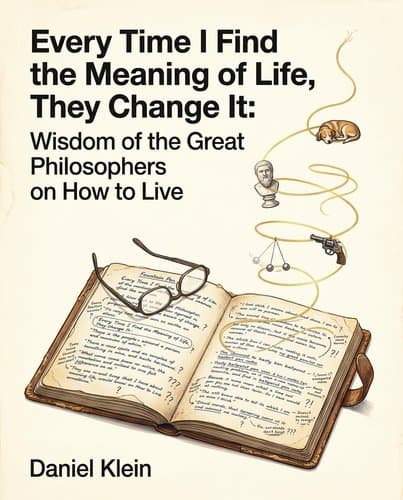
While packing up books one afternoon, Daniel Klein found an old notebook he had almost forgotten, labeled 'Pithies.' He opened it to fountain-pen entries from fifty years earlier, when he was nineteen or twenty and newly enrolled as a philosophy major — convinced that the great thinkers would hand him a blueprint for how to live. The handwriting in those early pages was careful, the marginal comments substantive. Then, somewhere past the midpoint, the pen changed to ballpoint and the comments shrank to two or three words: 'There's got to be a better way.' 'Help!' He closed the notebook, tucked it in a box, and got on with life — spending the next several decades writing quiz questions for game shows, inventing stunts for TV contestants, ghosting material for comedians.
That notebook is the whole book in miniature: a fifty-year philosophical biography compressed into a single object, charting the arc from urgent hopefulness to exhausted surrender. What happened between fountain pen and ballpoint wasn't intellectual failure — it was a collision with a structural problem. The how-to-live question, which had been the central preoccupation of Epicurus, Aristotle, and the ancient Stoics, had been largely abandoned by the academic philosophy Klein was actually studying. Modern philosophers were busy with epistemology and logic: what can we know, what must we assume. The question of how a person should actually spend his days had been handed off to motivational speakers and pop gurus. Philosophy couldn't tell Klein how to live because it had mostly stopped trying.
Rediscovering the notebook from the vantage point of his eighties, Klein finds the last entry belongs to the theologian Reinhold Niebuhr — 'Every time I find the meaning of life, they change it' — with Klein's own gloss scrawled beneath it: 'Now you tell me!' The question hasn't gone quiet. It's gotten louder. What he wants now isn't a final answer but an honest reckoning with why the question keeps moving — which turns out to be the only kind of answer worth having.
The Zoo of Answers Is Funnier Than Any Single Answer
The gallery of philosophers Klein assembles in his notebook doesn't converge on a single answer — it riots. And the riot turns out to be the whole point.
Consider just the hedonists, who supposedly agree that pleasure is the point of life. Epicurus, the careful Greek, says the path to happiness runs through wanting less: stop chasing what you don't have, learn to appreciate what's already in front of you, and an anxiety-free life becomes possible. Then Aristippus looks at that advice and calls it cowardice. For Aristippus, the whole art of life lies in actively engineering your circumstances to maximize pleasure — travel, luxury, sensual adventure, no apologies. Two men, same basic premise, diametrically opposite prescriptions. One says simmer down; the other says go for it.
The comedy deepens with Arthur Schopenhauer, who agreed that pleasure was life's goal and then concluded it was nearly impossible to achieve. His verdict — that life swings like a pendulum between pain and boredom — made him the most famous miserable man in nineteenth-century philosophy. Then his aphorisms made him a celebrity, and he spent his final years attending grand parties with adoring fans. Bertrand Russell called him a consummate hypocrite. Klein reads it differently: Schopenhauer's pessimism had a market. People found something glamorous in being told life was doomed. Which means the same philosophy that diagnosed human happiness as nearly impossible was itself producing happiness — in the philosopher, and in his readers — through its spectacular gloom.
Laid out together, these thinkers look less like a curriculum and more like a party where everyone is loudly right about something and completely incompatible with everyone else. Klein's contribution is to find that funny rather than maddening — and to suggest that staying in the room with all of them is itself a kind of answer.
Camus Was Right That the First Question Is Whether to Bother at All
What if the entire project of finding a philosophy to live by collapses before it starts — not from intellectual difficulty, but from a question most of us treat as rhetorical: is life actually worth living?
Camus thought this was philosophy's only genuine starting point. Every other question — whether to be a hedonist or a Stoic, whether free will exists, whether pleasure or wisdom matters more — is downstream of this one. If a person hasn't genuinely reckoned with whether to stay, they're borrowing answers from philosophers rather than earning their own.
Klein brings the weight of this down from abstraction through the story of a man whose daughter withdrew from her family over several years, spending more and more time alone in the woods, unreachable by the people who loved her. She eventually took her own life. Her father, after years of grief, arrived at a single sentence that named the real tragedy: not that she died, but that she never found a reason to live. The question wasn't rhetorical for her. It was the question.
What stays with Klein is the gap between the daughter's story and Greene's — because Greene found his answer, and the way he found it matters. As a teenager consumed by a suffocating emptiness, Graham Greene used to slip away to Berkhamsted Common with his brother's revolver and play Russian roulette. When the gun clicked without firing, he felt something he hadn't anticipated: an overwhelming rush of happiness, as if a light had come on. The near-death didn't produce a philosophical argument for staying alive. It produced something more direct — an ownership of the decision. He had chosen, in the most irreversible-feeling moment possible, to be here. The reason to live wasn't waiting to be discovered. It was generated by the act of choosing.
William James got at the same logic with a circular little joke: his first act of free will, he announced, would be to believe in free will. You can't reason your way into a reason for living from neutral ground. You have to act, and the act is the answer. That's the structure everything else rests on. Once it's settled — even provisionally, even messily — the zoo of competing philosophies stops being paralyzing and starts being genuinely useful.
You Are Not a Toaster — But Making Peace With Who You've Become Is Harder Than It Sounds
Imagine you could reprogram a toaster to make espresso instead. You'd just be a different appliance with a different function — the same logic applies. But Sartre's point, the one Klein finds more resonant than anything else in the notebook, is that this analogy breaks down entirely for human beings. A toaster's essence — its purpose, its definition — precedes its existence. Someone designed it to toast, then built it. We arrive the other way around: first we exist, then we figure out what we are. No one stamped our function in advance.
For the young Klein, this was genuinely electrifying news. It meant that 'that's just the way I am' was always an evasion — a way of treating yourself as a finished object rather than an ongoing project. You can choose, and choosing is what makes you a person rather than furniture.
But here is where Klein's own experience complicates the theory in ways no philosophy seminar fully prepares you for. He spent the late 1960s trying to inhabit this freedom — earning a conventional living by day writing stunts for a TV game show, then pursuing 'alternative' pursuits at night. One afternoon, walking to the subway in his work chinos and checked shirt, a man in full hippie regalia — bell-bottoms, tie-dye, an elaborate feathered headband — looked him over and snarled: 'Just like I figured. You're uptight.' Klein felt the sting, but he also noticed something. The man's binary world, 'with it' versus 'uptight,' was structurally identical to the high-school in-group logic he was supposedly rejecting. A different uniform, the same herd. Freedom from one tribe's script isn't self-creation — it's just switching scripts.
That observation, small as it seems, carries the real weight of Klein's eventual landing place. After decades of searching for his deepest self, peeling away layer after layer only to find another self hiding underneath, the project starts to feel less like liberation and more like an infinite regress. A friend of his put it cleanly: 'We turned out to be superficial to the core.' What Klein arrives at, somewhere in his later years, isn't giving up on self-knowledge — it's a quieter ambition. Rather than sculpting the ideal authentic self, he'd rather make peace with the self he has actually become, for better and for worse. Not the self he'd imagined becoming as a consolation prize, but as a genuine choice. Sartre would still call this 'authentic,' provided you choose it rather than stumble into it — and Klein, to his credit, seems to know the difference.
The Arch-Skeptic Who Saw a Divine Being and Was 'Slightly Embarrassed'
A.J. Ayer — known as Freddie to his friends — spent decades as Britain's most publicly committed skeptic, the man who demolished metaphysical claims on BBC radio with something close to cheerful contempt. He believed that propositions about God, the soul, or life after death were not merely false but meaningless: there was no conceivable way to verify them, so they didn't qualify as genuine statements at all. Then, at seventy-seven, he choked on a piece of tuna, suffered cardiac arrest, and came back from whatever happened next to tell his doctor, in a confidential tone, that he had encountered a 'Divine Being.' He was, the doctor recalled, 'slightly embarrassed' — not because the experience hadn't happened, but because it was profoundly inconvenient for someone who had built a career on ruling out exactly this kind of thing.
What makes the story more than an amusing footnote is what followed. Ayer didn't convert, didn't recant, didn't write a press release. But he became, in his final year, unusually close to Father Frederick Copleston — the Jesuit priest he had out-argued in a BBC debate on whether God exists years earlier. The two spent long hours together at a London club, talking about who knows what. Copleston attended Ayer's resolutely secular cremation. His former wife's verdict: 'He became so much nicer after he died.'
Klein finds genuine comfort here, and it's not the comfort of someone looking for ammunition against skepticism. It's the comfort of recognizing that even the most rigorous mind in the room can be ambushed by its own experience — and that being ambushed doesn't have to mean capitulating. Ayer weakened his 'inflexible attitude,' as he put it, without pretending the experience was philosophically tidy. He just held it.
Klein's own version arrived more quietly: an emergency appendectomy in the middle of the night, a moment of unconsciousness, then a brief sensation of standing outdoors in pleasant company, nobody speaking, everything peaceful. No divine appearances, nothing like Ayer's vision of a red light governing the universe. Just a stillness he found himself reluctant to leave when the doctors called him back. The plain peacefulness, he writes, stayed with him. Sometimes the transcendent doesn't announce itself. It just visits, briefly, and leaves you with the distinct impression that something was there.
Living Twice: The Only Exercise That Makes Philosophy Feel Urgent
What would you do differently if you knew you'd been doing it wrong the first time around?
Viktor Frankl — the Viennese psychiatrist who survived four years in Nazi concentration camps and came out insisting that meaning, not pleasure or power, is the deepest human drive — built his entire therapeutic method on a version of that question. His instruction was precise: live as though you are living your life for a second time, and as though you acted wrongly the first. Not as though you'd change one or two things, but as though the whole first attempt was a mistake you can now see clearly.
Klein found this genuinely useful rather than merely clever, because the exercise does something none of the abstract philosophical arguments quite manage. It makes the past feel revisable — not actually revisable, but imaginatively present in a way that changes how you weigh the moment in front of you. If you're living the second time, then this conversation, this afternoon, this choice about how to spend the next hour all carry weight they normally don't. You're not preparing for your life anymore. You're already in it.
But there's a trap, and Adam Phillips names it squarely: the more you dwell on how you might have lived differently, the more the unlived life becomes more vivid than the actual one. The regrets and the fantasies start to feel like the real story, while whatever is happening right now quietly slips away. The thought experiment designed to make you present can become just another route to absence.
Frankl says: imagine you did it wrong, so you take the present seriously. Phillips says: stop imagining alternatives, for the same reason. They're contradicting each other and pointing at the same thing.
Marcus Aurelius put it most starkly of all, and Klein returns to him at the end: do every act as though it were your last. Not as a memento mori, but as a practice — a way of making the search feel urgent rather than theoretical. That, Klein concludes, is probably the closest the notebook comes to an answer. Not a doctrine you adopt, but a disposition you keep choosing.
The Search Itself Is the Answer — And Being Here While You Do It Is the Closest Thing to Wisdom
The search for the meaning of life, Klein finally admits, is the meaning of life — and the only real mistake is conducting it absent-mindedly.
By the time he reaches the end of his notebook, Klein has sampled enough philosophies to fill a graduate seminar and found wisdom and absurdity in almost equal measure. He doesn't declare a winner. What he declares instead is a temperament. He calls himself a Cerebral Hedonist — someone whose deepest pleasure happens to come from turning unanswerable questions over in his hands, the way other people get lost in a game of tennis or a difficult soufflé. The label matters because of what he insists it doesn't mean: not a superior form of hedonism, just his particular strain of it. The pleasure justifies itself the same way fly fishing does. The point is that you found the thing that pulls you fully into the present.
That's the quiet synthesis the notebook has been building toward all along. Every philosopher Klein collected — Epicurus arguing for wanting less, Marcus Aurelius insisting you treat each action as your last — was circling the same destination from a different direction. Genuine pleasure, whatever form yours takes, is also a mechanism for arriving in the here and now. The two aren't separate rewards. They're the same reward.
Klein knows how this sounds, which is why he reaches for Walker Percy's character Binx Bolling, who skewers people who go on radio to proclaim their personal credos — all that warm tolerance and belief in human dignity — and notices that every single one of these unique individuals is exactly like every other. Klein quotes the passage as a preemptive strike against himself, then accepts the verdict with a cheerful shrug: 'It is kind of comfy here in the pod.' He's aware that offering a philosophy of life from a philosophy book is almost definitionally ridiculous. He does it anyway, consciously, which is — as Sartre would confirm — exactly what makes it authentic.
The book's last word, quietly, belongs to his dog Snookers, who died of cancer during the final revisions. Klein describes him as his most persuasive teacher on the art of living well. No argument, no aphorism, no system. Just a creature who was entirely here while he was here. That's the whole thing, delivered without footnotes.
The Notebook You Never Finished Is Still Open
Here is what Klein spent fifty years learning, and Snookers knew from the start without trying: the notebook matters less than the fact of returning to it. So ask yourself what yours is — not the philosophy you admire, but the question you keep finding yourself back inside, the one that won't stay answered. Maybe it's about how you spend your mornings, or what you owe the people you love, or whether the life you're living bears any resemblance to the one you meant to live. Whatever it is: not arriving — returning. Klein's genius was to find that funny rather than defeating, to keep cracking the spine with a kind of fond exasperation. Do that. Show up awake while you do it. That's not a consolation prize for failing to find the answer. That's the answer.
Notable Quotes
“There's got to be a better way”
“The final entry was from the theologian Reinhold Niebuhr:”
“Under it I had scribbled,”
Frequently Asked Questions
- What is 'Every Time I Find the Meaning of Life, They Change It' about?
- Every Time I Find the Meaning of Life, They Change It explores how philosophical wisdom applies to living in old age. Daniel Klein revisits collected quotes from great thinkers—Epicurus, Sartre, Marcus Aurelius, and others—filtered through lived experience. Rather than treating philosophy as abstract truth, the book shows readers how to treat philosophical contradictions as useful tools. Klein's key insight is examining the gap between admired wisdom and daily practice with curiosity rather than shame. The book bridges the distance between what we intellectually admire in philosophy and what we actually live, making classical thought practically relevant for how to spend our remaining time.
- What are the key takeaways from Daniel Klein's philosophy book?
- The book teaches four main lessons for living better. First, use Frankl's thought exercise: imagine living your life again with different choices and notice which changes feel urgent—those matter now. Second, recognize the gap between philosophy you admire and philosophy you actually inhabit, examining this gap with curiosity. Third, treat contradictions between philosophers—like Epicurus saying desire less versus Sartre saying create yourself—as information revealing what's genuinely at stake. Finally, 'Be here now' is not mystical but a convergence point across philosophical traditions where any activity pulling you into presence—intellectual, physical, or relational—does philosophical work, whether or not it looks like it.
- What is Frankl's exercise from 'Every Time I Find the Meaning of Life'?
- Frankl's exercise is a powerful thought experiment: imagine you are living your life a second time and made all the wrong choices the first time around. Notice which choices suddenly feel urgent to change—those are the ones worth changing now. This exercise cuts through abstract idealization and forces clarity about genuine priorities. Rather than contemplating distant ideals, it reveals which actual changes would matter most in real life. The urgency felt during this mental exercise indicates your authentic values. This practical method helps distinguish between philosophies you've intellectually adopted and the changes that would meaningfully improve your actual existence.
- How does Daniel Klein suggest handling contradictory philosophies?
- Klein proposes treating philosophical contradictions as valuable information rather than flaws. When philosophers contradict each other—Epicurus saying desire less, Sartre saying create yourself, Marcus Aurelius saying act as if this moment is your last—don't dismiss one as wrong. Instead, recognize that competing answers reveal what's genuinely at stake in the question. These contradictions illuminate different dimensions of the same challenge: how to live well. Rather than forcing yourself into one philosophical camp, the book invites you to treat philosophy as an ongoing conversation where tensions between views highlight important considerations. This approach transforms confusion into insight and lets you inhabit multiple perspectives simultaneously.
Related Book Summaries
Read the full summary of 24612009_every-time-i-find-the-meaning-of-life-they-change- on InShort