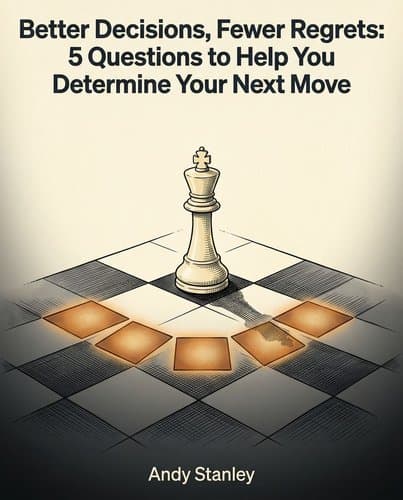
52517557_better-decisions-fewer-regrets
by Andy Stanley
The moment you start selling yourself on a decision is the moment you should stop—self-persuasion is the hidden mechanism behind life's biggest regrets.
In Brief
The moment you start selling yourself on a decision is the moment you should stop—self-persuasion is the hidden mechanism behind life's biggest regrets. Five deceptively simple questions interrupt this pattern before it becomes a story you don't want to tell.
Key Ideas
Internal persuasion signals self-deception in progress
When you catch yourself constructing an internal argument for a decision, treat that as a warning signal — not careful deliberation. Stanley's rule of thumb: you rarely have to sell yourself on a genuinely good idea. The moment internal persuasion starts, pause.
Ask integrity question aloud to yourself
Before any consequential decision, ask the Integrity Question out loud — ideally in front of a mirror, using your own name: 'Am I being honest with myself... really?' The formality of it interrupts the self-deception mechanism.
Legacy question restores crucial long-term perspective
Counter emotional tunnel vision with the Legacy Question: 'What story do I want to tell about this in 10 years?' Future-tense framing restores the context that present-tense emotion filters out — and articulating it out loud, like Joseph did, is more effective than keeping it internal.
Conscience tension deserves attention over rationalization
When something feels wrong but you can't name why, don't rationalize past it. Ask the Conscience Question: 'Is there a tension that deserves my attention?' Pause long enough to let the hesitation clarify — David nearly committed murder because he almost didn't.
Wisdom requires deliberate margin from lines
Replace 'is there anything wrong with this?' with the Maturity Question: 'What is the wise thing to do, given my past experience, current circumstances, and future hopes?' Wisdom requires deliberate margin from the ethical line — not proximity to it.
Love closes every loophole rules leave
For any decision with relational stakes, ask the Relationship Question: 'What does love require of me?' It closes every loophole that rules, principles, and religious texts leave open — which is precisely why it's more enforceable than any rule.
Who Should Read This
People working on personal growth in Decision Making and Self-Improvement, especially those tired of generic motivational advice.
Better Decisions, Fewer Regrets: 5 Questions to Help You Determine Your Next Move
By Andy Stanley
10 min read
Why does it matter? Because the decision-making filter you already use is optimized for regret.
You already have a decision-making framework. You didn't design it — it assembled itself from habit, culture, and whatever felt reasonable at the time. And every time something significant is on the line, it fires automatically. The questions are familiar: Will this make me happy? Will anyone even find out? Reasonable-sounding. Quietly catastrophic. These are, it turns out, the questions most reliably engineered to produce regret.
The problem isn't bad information or weak willpower. It's structural. Desire rewrites the terms before you've noticed the negotiation started, and by the time you do, the momentum is nearly irreversible.
Nearly.
Andy Stanley's answer is five questions. Not rules, not restrictions — precise disruptions placed exactly where self-deception does its worst damage.
You Are a Sucker for You — and That's the Real Source of Your Worst Decisions
Andy Stanley was seventeen when he told a lie so smooth it barely registered as one. When attractive classmates asked whether he played sports, he answered without hesitation: he ran track and played soccer. Technically true — PE class, pickup games. But he knew what they were asking, and he knew what he was doing. What he didn't realize was that the mechanism behind that small deception was the same one driving every major regret of his life.
His central claim is uncomfortable: you have been the primary architect of every bad decision you've ever made. Not the salesperson, not outside pressure — you. You talked yourself in.
The upgrade from want to need happens internally, where your defenses are down, and that private construction is the warning sign.
Genuinely good decisions don't require internal lobbying. When something is right, you tend to know. The moment you catch yourself building arguments to convince yourself, your brain is already working backwards: justifying what your heart decided first.
What makes this dangerous is that it's structural, not a character flaw. Jeremiah, watching a succession of ancient kings ignore his counsel and destroy themselves, wrote that the heart is deceptive above all things and past any cure. He chose "deceptive" deliberately. A purely dishonest heart would be easy to catch. A deceptive one blends truth, half-truth, and untruth in proportions that feel plausible. "Past any cure" is the part that stings: no amount of experience or accumulated wisdom makes you immune.
That's the diagnosis. Before the disruption can do any work, you have to accept that your own mind is the problem — not malicious, but structurally compromised. The only move that helps is the one that feels most unnatural: pause when you hear yourself making the internal case for something, and ask honestly whether it's actually a good idea.
Emotional Tunnel Vision Makes Every Bad Decision Look Inevitable
Imagine you're in a showroom and you've just sat in the car you want. The smell of the interior, the feel of the steering wheel — suddenly every car you've ever owned seems like a mistake. The salesperson knows this. They also know the worst thing they can let you do is walk out. Once you're back on the street, the fog lifts. The emotional pull fades. You're far less likely to buy.
Stanley names this mechanism focalism. When emotion fixes on an opportunity, a person, or a temptation, the brain locks onto it while everything surrounding it blurs: the future, the consequences, even your values. Not because you've abandoned them. Because they've been crowded out. His diagnostic is counterintuitive: the stronger the pull, the more suspicious you should be. Strong emotional appeal isn't confirmation that you're right. It's the mechanism activating.
The antidote he proposes is specific enough to matter. When Joseph, a Hebrew slave working in the household of an Egyptian military commander named Potiphar, was propositioned by his employer's wife, he didn't simply refuse. He narrated his own story back to her, out loud, while she was standing there. He walked through how he'd arrived as a slave with no rights and no future, how he'd earned Potiphar's total trust through years of honest work, how everything in the household had come under his care. Then he asked: how could he throw that story away? He named both versions of the next chapter out loud: the one where he honored his employer's trust, and the one where he didn't.
Stanley calls this "rehearsing the future." Not practicing a speech, but placing the present moment inside the story you'll be telling years from now. Which version do you want? Focalism is what makes the question hard: the present crowds out everything except the appeal directly in front of you. The question works as a counterweight because story is structurally future-tense. It pulls you out of the emotional now and into the eventual, where the feeling has settled and only the decision remains.
The question holds even when the circumstances are genuinely unjust. When Stanley's friend Jimmy was working through a 2.5-year court battle after his wife abandoned him and their two children for another man, then weaponized the kids to extract concessions, Stanley gave him this frame. Every temptation to retaliate, every cutting remark that could slip out in front of the kids, would eventually be part of a story Jimmy told. For months, Jimmy sent the same text: he could still tell his whole story, without needing to skip a chapter. Not triumphant. Just accurate.
The Tension You Can't Explain Is the One Most Worth Listening To
The cave at En Gedi sits in a scrubland bluff on the western edge of the Dead Sea. David and a handful of his men are pressed into the darkness at the far end when they hear footsteps at the entrance. Three thousand soldiers are combing the desert outside. King Saul, whose fear of David had curdled into obsession, had deployed his entire army to hunt him down. The man who just walked into this cave is Saul himself, unguarded, vulnerable, stopping to relieve himself in the first bit of privacy he could find.
David's men don't need to deliberate. They interpret it as a sign from God, the exact fulfillment of the promise David had been making to them around the fire for months: that someday they'd go home. Kill the king, become the king. The logic is airtight. The circumstances are perfect. Everyone around David agrees this is the moment.
So David picks up his dagger and creeps toward Saul through the dark.
He gets close enough to act. And somewhere in that gap — seconds from a decision his men had already made for him, inches from a man who couldn't see him — something shifts. A tension he'd been carrying clarifies into a thought: killing the king doesn't make him king. It makes him the man who murdered the king. Whatever story followed, that would be its first line.
He cuts a corner from Saul's discarded robe and goes back to his men.
Stanley's point here is about how conscience actually operates. The tension David felt had no label, no articulated reason attached. It was just something wrong that he couldn't name, until he paused long enough to let it name itself. Stanley calls these "red flag moments," and the neuroscience is less mystical than it sounds. The brain's threat-detection systems can register a problem before the reasoning centers catch up. The felt sense of wrongness arrives first. The explanation follows, but only if you give it room.
The chapter opens with drunk people to set up the contrast. Alcohol suppresses the part of the brain that registers consequences and quiets the voice that says wait. Inhibitions drop, consequence-detection goes offline. The inebriated person isn't consciously overriding conscience; it's been chemically silenced. The rest of us don't have that excuse. We suppress the signal on purpose, letting the logic of the situation, the perfect circumstances, the expectations of everyone around us carry us through the hesitation without asking what it was.
David stopped. Saul died by a Philistine arrow shortly after, and David became king without committing the act that would have defined him. Stanley's claim isn't that conscience is always right. It's that it's always worth hearing. When something is bothering you and you can't say why, that's the moment to slow down, not speed up.
Most Regrets Start With Something That Wasn't Technically Wrong
The question most people use to screen their decisions is the wrong one. "Is there anything wrong with this?" sounds responsible — it invokes morality, legality, social norms. But it's organized around the lowest possible bar: how close to the line can I get without crossing it?
Stanley catalogs the forms this assumption takes: nothing illegal means it's allowed; nothing clearly unethical means it's acceptable; no rule broken means it's fine; not yet over any line means it's okay. Different filters, same floor. The moment you apply that standard to someone you love, the limit shows. You don't reassure them that nothing's technically wrong. You tell them to be careful, which means you're not worried about what they're actively doing wrong. You're worried about where they're standing.
Think about a toddler at the edge of a swimming pool. Nobody rushes over because the child is doing something wrong. The child isn't even wet. The panic is about something else: there is virtually no margin for error. One small shift and nothing that was fine is fine anymore. You're dry and then you're drowning. The kid isn't breaking any rules. The kid is standing in a place where rules become irrelevant very quickly.
That's the problem with organizing your life around "not wrong." It positions you at the pool's edge. It eliminates the buffer between where you are and where things go badly. Nobody is doing anything wrong, Stanley notes — until they are.
The maturity question replaces the old one: What is the wise thing to do? Instead of asking how close you can get to the line, wisdom asks how much distance you want between yourself and the moment everything changes.
To give the question traction, Stanley runs it through three lenses. Past experience: what patterns does your history reveal? Someone who has spent years finding good reasons to overspend will find one here too. Their history should make them more suspicious of a sudden "unbeatable deal," not less. Current circumstances: what emotional pressures are distorting your judgment right now? Future hopes: does this decision actually move toward the life you want? Together, they make the question yours in a way "is this wrong?" never is. Your vulnerabilities. Your circumstances. Your imagined future.
Most regrets, traced back, don't begin with a clearly bad decision. They start with a string of technically permissible ones that gradually closed off every other option.
Rules Create Loopholes; Love Closes Them
Sierra was fifteen and had already cycled through two foster families when she came back to live with Andy and Sandra Stanley. She'd been in and out of their home for five years, so the honeymoon period was over before it started.
One afternoon she came downstairs, sat at the kitchen counter, and asked: "What are the rules?"
Stanley knew exactly what she was doing. Not a teenager trying to avoid mistakes. A teenager conducting reconnaissance. Finding the edges so she could find the gaps. It was, he suspects, part of why she was on her third foster family.
He went to his office, wrote one word on a 3×5 card, and slid it across the counter.
HONOR.
She rolled her eyes and went upstairs. It didn't work.
But the point wasn't Sierra. Stanley tells rooms of pastors that any rule system, scripture included, can be read to justify almost anything you've already decided to do. He says the room goes quiet. Because they know it's true.
Rules create wiggle room. The more specific the rule, the more precise the loophole. Rule-based ethics collapses into lawyering: technically I didn't, the handbook doesn't mention, there's no law against. The rule was always one edge case from useless.
"What does love require of me?" reorients the question away from what you can justify or get away with, and forces it onto what the other person actually needs. For the same reason, it carries no guaranteed return. The first four questions all pay dividends to the person asking: cleaner motivations, better stories, a conscience you can trust, decisions that hold up. This one is organized around making someone else's life better, which may improve yours. But may not.
The reflex in any difficult moment — the argument you're already in, the conversation you've been avoiding, the request you don't want to honor — is to start from what do I want here? This question makes you start from the other person instead. That's harder. It's also impossible to game.
You can always find language that permits what you want to do. You cannot construct a loophole out of "what does the person across from me actually need?"
The Gap Between Knowing and Doing Is the Entire Problem
The cruelest irony is that the knowing changes nothing on its own. You can hold all five questions in your head right now — completely convinced — and still not ask any of them the next time something feels urgent and inevitable and obviously right. By the time you need them most, the internal sales pitch has already started, the tunnel has already narrowed, and you're already in the cave with the dagger in your hand. The questions only work if you decide, before that moment arrives, to pause anyway.
You can't rewind what you're carrying. But the story you'll be telling in ten years hasn't been written yet. Every decision between now and then is a sentence. The next one that starts to feel like a foregone conclusion — that's where the gap opens. Stop there. Ask anyway.
Notable Quotes
“I don't understand why I did what I did.”
“I don't understand why I decided what I decided.”
“Are you being honest with me? Really?”
Frequently Asked Questions
- What is the root cause of most lasting regrets according to Stanley?
- According to Stanley, self-deception is the root cause of most lasting regrets. When you catch yourself constructing an internal argument for a decision, treat that as a warning signal—not careful deliberation. "You rarely have to sell yourself on a genuinely good idea. The moment internal persuasion starts, pause." This internal argument pattern reveals that you're already compromising on what you actually believe. The book provides five targeted questions designed to interrupt self-deception before a bad decision compounds into lasting regret.
- How should you ask the Integrity Question to interrupt self-deception?
- The Integrity Question should be asked out loud, ideally in front of a mirror, using your own name: 'Am I being honest with myself... really?' The formality of this practice interrupts the self-deception mechanism that typically operates silently. By verbalizing the question and seeing yourself as you ask it, you create accountability that internal reflection alone cannot achieve. This simple ritual forces you to acknowledge reality rather than construct a rationalized version of it. The specificity of asking yourself by name makes the question personal and unavoidable, removing the psychological distance that allows self-deception to flourish.
- What is the Legacy Question and why does future-tense framing work?
- The Legacy Question asks: 'What story do I want to tell about this in 10 years?' This future-tense framing restores the context that present-tense emotion typically filters out. By imagining how you'll narrate this decision in a decade, you escape the tunnel vision of the moment and reconnect with your long-term values. Articulating the question out loud is more effective than keeping it internal—the verbalization creates distance from immediate emotional pressure. This question counters emotional hijacking by forcing you to consider the full arc of consequences, not just the immediate satisfaction a decision promises.
- What does the Relationship Question accomplish that rules and principles cannot?
- The Relationship Question asks: 'What does love require of me?' It closes every loophole that rules, principles, and religious texts leave open—which is precisely why it's more enforceable than any rule. While ethical guidelines and moral codes can be rationalized through clever interpretation, the call to love demands personal accountability and goes beyond technicalities. Love requires sacrificing convenience for the good of others, eliminating the gray areas where self-deception typically hides. By framing decisions through love's lens, you move from external compliance to internal transformation, making justifications for choices that harm relationships harder to construct.
Related Book Summaries
Read the full summary of 52517557_better-decisions-fewer-regrets on InShort