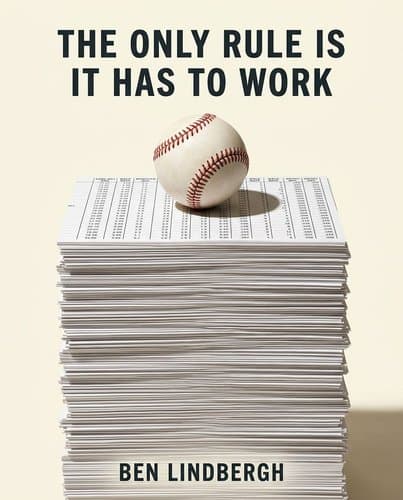
26792284_the-only-rule-is-it-has-to-work
by Ben Lindbergh
Getting inside a real baseball team, two stats-obsessed outsiders learn the hardest lesson in analytics: the gap between knowing the right answer and acting on…
In Brief
The Only Rule Is It Has to Work (May ) follows two baseball analysts who take operational control of a real minor league team for one season to test sabermetric theory in practice.
Key Ideas
Competitive advantage hides in overlooked details
Information advantages come from paying attention to what everyone else treats as a formality — Ben and Sam ran stopwatches at an open tryout while other teams ignored the 60-yard dash, and that's how they found Daniel Baptista.
Timing your evidence for receptive minds
Never make your analytical case while the game is in motion. High-stakes, fast-moving situations activate tribal knowledge and close minds. Save your evidence for calm moments when the other person is already asking questions.
Fix incentives, not just problem people
When you change a manager but not the cultural norms and incentive landscape, you inherit the same instincts in a different body. Diagnose what beliefs the institution rewards before deciding who the 'problem' is.
Persuasion requires patient readiness, not argument
Persuasion works through slow absorption, not argumentation. The practical skill is recognizing when someone is already in question-asking mode — and being ready with evidence in that moment, not in the argument that preceded it.
Judge decisions by information known, not outcomes
Separate process evaluation from outcome evaluation. A .24 correlation on your predictions and the best summer of your life can both be true simultaneously. Judge decisions on what you knew at the time, not on what happened next.
Who Should Read This
Business operators, founders, and managers interested in Decision Making and Organizational Behavior who want frameworks they can apply this week.
The Only Rule Is It Has to Work
By Ben Lindbergh & Sam Miller
10 min read
Why does it matter? Because being right and being heard are completely different skills.
Here is a thought experiment: imagine you are right. Not probably right, not intuitively right — demonstrably, statistically, irreversibly right. And it doesn't matter. The person who needs to act on what you know is standing fifteen feet away, the game won't pause for the right argument, and the conversation is already over. Ben Lindbergh and Sam Miller spent careers proving things about baseball from the outside. Then they got inside — actual authority over an actual professional team — and found that the distance between knowing the correct answer and being able to implement it isn't a baseball problem. It's the problem. This book is what it looks like when two very smart people finally get close enough to touch it.
The Spreadsheet Found the Players. That Was the Easy Part.
Paul Hvozdovic drove cross-country with no GPS — just printed pictures of freeway interchanges, a back seat accumulating Burger King bags and Red Bull cans, and instructions to head toward something called wine country in northern California. He'd been cut by an independent league team paying $600 a month, which put him nine promotions from the majors. The Sonoma Stompers were offering $500 a month and ten promotions from the majors. He took the deal. His girlfriend of four years, who had watched him disappear every summer for jobs that barely counted as such, sent him a breakup text on Opening Night of the team that had just released him.
He didn't know why Sonoma wanted him until the team banquet, where Ben Lindbergh and Sam Miller (two editors-in-chief of Baseball Prospectus who had talked their way into running a real professional roster as a live experiment) explained: they'd sorted a spreadsheet of 2014 college seniors by Column R, a composite metric that park-adjusted strikeout and walk rates against schedule strength. Paul Hvozdovic, who had struck out 100 batters while walking only 8 in his senior year at Division II Shepherd University, going 11-1 with a 1.80 ERA, was at the top. They had never watched him pitch, never held a radar gun for him, never assessed the way he handled pressure or carried himself in a dugout. They had a number, and the number said he was the best senior pitcher in college baseball. So they called his agent.
Paul looked at them the way a reasonable person looks at a situation that has upended his relationship and redirected his life based on a column in a spreadsheet. "Your spreadsheet's some shit," he said.
The spreadsheet was right. Paul threw three shutout innings on Opening Day, working 17 fastballs and 14 changeups through the strike zone with the kind of deception that makes hitters look stupid. The data had found someone genuinely overlooked: a pitcher who had produced at an extraordinary level and, because his school was small and his opponents weren't scary enough names on a scouting card, had slipped entirely through the conventional system. The same process found Kristian Gayday, the best Division I hitter in the 2014 draft class by their metrics, whose back injury had erased his showcase results at exactly the wrong moment.
Lindbergh and Miller had a thesis: a market inefficiency existed in players like Paul. The information was sitting in public college stats, waiting for someone to build park factors and schedule adjustments and sort the results. They were right.
But there's a gap between finding the right people and doing something useful with them once they arrive. You can sort Column R and find the top of the list. You can't sort for whether a player's teammates will make room for him, whether a manager will trust him in a tight game, whether the people living together for a summer will cohere into something that wants to win. The spreadsheet was the easy part. The authors were about to discover what the hard part looked like.
The Closer Is the Closer Because He's the Closer
Correct reasoning loses in real-time baseball because the game moves faster than anyone can act on it.
The seventh game of the 2015 season makes this concrete. The Stompers' best reliever, Sean Conroy — two hits, zero earned runs allowed across the entire season to that point — is sitting in the bullpen unused while a left-hander faces three right-handed batters in a 4.08 Leverage Index situation. The number means the plate appearance matters four times more than an average one. The reasoning for using Conroy is simple: he's right-handed, he's better, and those are the biggest outs of the game. He doesn't enter. The left-hander, Paul Hvozdovic, throws an 83 mph fastball to Matt Chavez, who deposits it in center field for a three-run homer. The Stompers lose 10-6.
Afterward, Miller follows manager Fehlandt Lentini for a postgame explanation. The case is clear: Conroy was available, Conroy was better, the moment called for the best arm they had. Miller makes the argument. Fehlandt's complete response: "The closer's the closer because he's the closer." Then he leaves.
The answer makes complete sense inside the game. Roles create certainty. If a manager knows his closer appears in the ninth with a lead, everyone (catcher, infielder, pitcher) can plan around that. Shifting the closer into the seventh based on leverage introduces doubt at the exact moment the game demands reflex. The answer sounds circular because it is circular. But circularity is a feature when there's no time for derivation.
The structural trap they fell into all season was timing. The game was already happening while they were making their arguments. Fehlandt, who played center field himself (independent ball managers often do), managed from his position in the outfield. Every call to the dugout ran through a walkie-talkie. When they needed to tell the bullpen to get Conroy up now, what came through was "frrrsheefeergrrrr." They had one bullpen catcher, which meant only one pitcher could warm up at a time. By the time Miller had assembled a case for Conroy in the seventh, the opposing hitter had already lined a double into the gap.
Knowing the right answer is a different skill from delivering it at the speed the game demands. Sabermetrics had given them the first. There was no spreadsheet for the second.
Fire the Manager. Hire the Same Manager.
Fehlandt Lentini picks up his severance check, hears he's being traded to the Bridgeport Bluefish — a rival independent league team, framed as a cost-cutting move — and delivers his verdict: "That's the worst place in the league, there's no chance." He grabs the check and walks out. From the hallway, his voice carries back one last time: "Hi-LAR-ious." That night the Stompers win 9-2. Players note the dugout feels looser. The problem, it seemed, had a name.
Six weeks later, during a lineup argument on the right-field line, Yoshi (Takashi Miyoshi, the new manager, believed to be the first Japanese-born manager in American professional baseball) chest-jabs Sam Miller and tells him: "You don't understand. You don't know baseball." The same territorial boundary, the same dismissal, the same refusal to treat the front office as anything but an intrusion into the game's actual authority structure.
Ben and Sam had replaced Fehlandt with someone they expected would be different: more analytically open, more willing to act on the data. Yoshi had sought them out before Opening Day asking for "all the evidences." He was, by disposition, a genuinely different person. None of it mattered.
Theo Fightmaster, the team's owner-operator and the person who had recruited Ben and Sam in the first place, eventually said the quiet part: "Yoshi is probably 95 percent the same as Feh." He wasn't being cruel. He was describing something structural. Managers in this game inherit a set of beliefs about how baseball authority works: who speaks, who listens, who gets to have opinions about lineup construction. Those beliefs don't belong to any individual manager. They belong to the job. The moment Yoshi took the job, the job made the same demands it had always made. The chest-jab wasn't a personality quirk. It was the position talking.
The spreadsheet could find overlooked players. It couldn't find a version of "manager" that didn't come pre-loaded with a century of unwritten rules about who baseball knowledge belongs to. Ben and Sam fired the manager and hired the same manager. The gap they needed to close wasn't personal — it was institutional.
The Only Time Data Changes Behavior Is When Someone Is Already Asking
Sam Miller walks into Yoshi's office with a day of grievances organized in his head. He'd been rehearsing a diatribe — every mismanaged bullpen decision, every time the data had pointed clearly toward a move and the game had lurched the other way instead. He had the examples. He had the structure. He was ready.
Yoshi speaks first. He pulls out that night's lineup and asks what Sam thinks.
The diatribe disappears. Sam looks at the card and starts answering the question. He suggests moving Taylor Eads into the DH slot against the opposing lefty; Yoshi agrees. He recommends dropping the middle-of-the-order shortstop against the same pitcher; Yoshi pulls up the numbers and nods. "Good evidences," he says, a phrase the team had adopted as shorthand for approval. Four lineup suggestions. Four agreements. Then Yoshi asks Sam to compile a statistical case to help get their best opposing hitter promoted out of the league, because the manager who might take him is smart, Yoshi explains: "He's like you." Sam walks out and writes to Ben: "I just spent a day demonizing this wonderful man. I'm a monster."
Every point in that diatribe was probably correct. The bullpen had been mismanaged. The data was real. None of it mattered until Yoshi sat down with an open question. The question changed behavior; the argument would have changed nothing.
You can't manufacture the moment. You can be right for weeks while someone isn't asking. Ben and Sam had spent months learning exactly this — the walkie-talkie delivering static from center field, the single bullpen catcher who could only warm one arm at a time, the postgame conversation that ended with "the closer's the closer because he's the closer." Each was a failure of timing, not of reasoning.
But this time someone had asked, and the reasoning worked. Sam proposed capping Matt Walker's outing at five innings, telling him at the start so he wouldn't spend the game pacing himself for nine. Yoshi agreed and followed through. Walker handed the ball over calmly, without theater. Sean Conroy entered in the fifth, two full innings before any traditional save situation.
In the ninth, with two runners on and Matt Chavez — hitting .371 on the season with eighteen home runs, batting .481 against the Stompers specifically — stepping in as the tying run, Yoshi left Conroy on the mound. A plan had been made together, and the plan held. The fastball caught the inside corner at Chavez's knees. Sam nearly cried. Players high-fived Ben and Sam through the dugout line. Isaac, who had caught the game, found Ben afterward and mimed a puckered butthole: shared terror, shared relief, the thing had actually worked.
The win didn't come from a better argument. It came from being there when the manager was already asking.
A .24 Correlation and the Best Summer of His Life
Andrew Parker sends a ball so high and deep toward left-center that the infield umpire doesn't wait for it to land — he just starts jogging out, arm already circling for a home run. The whole Stompers bench floods onto the field. For six seconds, in the eighth inning of a one-game Pacific Association championship, the Stompers lead 5-3 and Ben Lindbergh is briefly, completely happy.
Then Zack Pace, the opposing left fielder nearest the play, appeals. The umpire reverses to a ground-rule double; two runs score instead of three. Tie game. Months later, Pace says the ball grazed the top of the fence, inches from his glove, and never actually cleared. The Stompers insist it did. The Pacific Association has no replay system. They will never know.
Sean Conroy surrenders a walk-off single in the ninth on a flat slider, and the Stompers lose a one-game championship by one run.
Four months later, Sam Miller writes Theo a letter and performs a forensic audit of the entire project. His and Ben's pre-season projections correlated with actual player performance at .24 — a "weak positive correlation," which is statistician language for barely better than guessing. They'd predicted Kristian would outperform Joel, who led the team in on-base percentage for most of the season. Ben had wanted to cut Mark Hurley just before Hurley became one of the league's best hitters. They successfully lobbied to drop Mochizuki in the batting order, and he hit .389/.494/.597 in August. Sam even sent a player an encouraging email using batted-ball data to explain that bad luck was masking his true talent; the player hit .174 the rest of the way.
But their spreadsheet-sourced pitchers posted a 4.39 ERA. Everyone else posted 6.29. And three players — Sean Conroy, Dylan Stoops, Santos Saldivar — had been playing weekend rec-league baseball before the Stompers found them. Now scouts knew their names.
Here's the distinction the book finally earns: a rigorous process that produces a .24 correlation is more valuable than a sloppy one that happened to work, because only the first kind can be improved. The spreadsheet found real market inefficiencies. The gut calls were mostly wrong. Those are two different problems, and naming them separately is the work that makes a second attempt better.
In that same letter, Sam draws a line between two kinds of players. The first type plays because it's worth doing. The second type stays because they believe they're one break from making it. Sam declines Theo's offer to manage in 2016. His daughter's first day of kindergarten falls during the season's final week, and he can't convince himself he belongs to the second type. He always knew he was the first. He tells Theo it was the best summer of his life. Then he declines, with a heavy heart, and means both things completely.
The Scorecard Is in Cooperstown
Five months after Pride Night, Sean Conroy and Isaac Wenrich happened to be standing in front of the same Hall of Fame display case in Cooperstown — separately, by coincidence — and texted each other about it. The scorecard from that night had made it there. The .24 correlation hadn't. The disputed call hadn't.
Here's what that tells you. Ben and Sam built the most rigorous process a two-person front office ever ran in independent ball — spreadsheet pitchers who posted a 4.39 ERA against everyone else's 6.29, projections that barely beat random, a championship lost on a call nobody could verify. The best summer of Sam's life was also a partial failure. Neither fact cancels the other. That's not a consolation — it's the actual argument. Build the best process you can, and measure yourself by whether it was worth running.
Notable Quotes
“Everybody was like, '0–2, he's gonna fucking ambush one,'”
“Definitely on the warning track,”
“I don't slide if it's not in play.”
Frequently Asked Questions
- What is The Only Rule Is It Has to Work about?
- The Only Rule Is It Has to Work documents how two baseball analysts take operational control of a minor league team for one season to test sabermetric theory in practice. Ben Lindbergh and Sam Miller demonstrate that the hardest problem in evidence-based decision-making is not knowing the right answer but building the trust and conditions to act on it. A lesson that applies far beyond baseball, the book reveals how practical obstacles to analytical thinking—like tribal instincts and institutional incentives—often matter more than having access to good data or sound analysis.
- What are the key lessons about persuasion and decision-making in The Only Rule Is It Has to Work?
- Persuasion works through slow absorption, not argumentation, according to Lindbergh and Miller. The practical skill is recognizing when someone is already in question-asking mode—and being ready with evidence in that moment, not in the argument that preceded it. Never make your analytical case while the game is in motion; high-stakes situations activate tribal knowledge and close minds. Instead, save evidence for calm moments. Additionally, when changing leadership without altering cultural norms and incentive structures, you inherit the same instincts in a different body, so diagnose institutional beliefs before assigning blame.
- How do you find competitive information advantages according to The Only Rule Is It Has to Work?
- Information advantages come from paying attention to what everyone else treats as a formality. Ben and Sam discovered this by running stopwatches at an open tryout when other teams ignored the 60-yard dash—that's how they found Daniel Baptista. This small edge in observation translated into a key discovery. The lesson extends beyond baseball: competitive advantage emerges not from analyzing what everyone already scrutinizes, but from carefully attending to details others overlook. Success requires discipline to notice small signals and commitment to measuring what others dismiss as routine, turning overlooked formalities into decisive advantages.
- What does The Only Rule Is It Has to Work teach about evaluating decisions?
- Separate process evaluation from outcome evaluation. A .24 correlation on your predictions and the best summer of your life can both be true simultaneously—both facts about the same season. Judge decisions on what you knew at the time, not on what happened next. This approach prevents hindsight bias from distorting assessment of past choices. By evaluating decision-making processes rather than outcomes alone, leaders and analysts avoid assuming poor results indicate flawed thinking, when in reality the framework was sound given available evidence. This distinction fundamentally improves how organizations learn from experience.
Related Book Summaries

Read the full summary of 26792284_the-only-rule-is-it-has-to-work on InShort