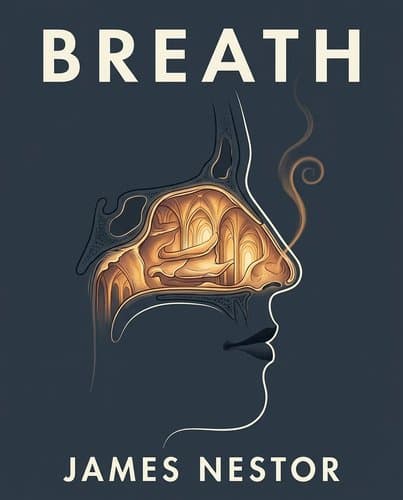
48890486_breath
by James Nestor
The simplest thing you do 25,000 times a day, you're probably doing wrong—and it's silently destroying your sleep, focus, and health.
In Brief
The simplest thing you do 25,000 times a day, you're probably doing wrong—and it's silently destroying your sleep, focus, and health. Nestor reveals how nasal breathing, a 5.5-second rhythm, and full exhalations can undo damage that no drug has been able to fix.
Key Ideas
Nasal breathing increases oxygen and prevents snoring
Breathe exclusively through your nose during the day and sleep — nasal breathing releases nitric oxide that boosts oxygen absorption by 18% compared to mouth breathing, and tones the soft tissue at the back of the throat to prevent snoring.
Lip taping eliminates snoring and sleep apnea
Tape your lips shut during sleep with a small piece of surgical tape over the center of the mouth. In the Stanford study, this reduced Nestor's snoring from four hours to ten minutes within days, and eliminated sleep apnea events entirely.
Five-point-five breaths per minute synchronizes body systems
Practice 5.5-second inhales followed by 5.5-second exhales — roughly 5.5 breaths per minute — for at least ten minutes daily. This rhythm was independently discovered by Buddhist, Catholic, Taoist, and Native American traditions, and has been confirmed in controlled studies to synchronize the heart, circulation, and nervous system to peak efficiency.
Full diaphragm engagement acts as second heart
Prioritize a full exhalation before taking the next breath. Most adults engage only 10% of their diaphragm's range, which overburdens the heart and elevates blood pressure. The diaphragm acts as a second heart — its full movement drives blood circulation.
Breath-holding calms panic better than deep breathing
For anxiety or the onset of panic, try breath-holding rather than deep inhalation. Raising CO2 through breath retention calms the chemoreceptors that trigger the panic response; deep inhalation purges CO2 and can make the response worse.
Crunchy foods build jawbone and widen airway
Eat harder, crunchier foods regularly. The mechanical stress of chewing stimulates stem cell release in facial sutures, building new jawbone and widening the airway. This remodeling remains possible into your 70s.
Who Should Read This
Science-curious readers interested in Sleep and Mental Health who want to go beyond the headlines.
Breath
By James Nestor
10 min read
Why does it matter? Because you've taken roughly 20,000 breaths today and almost certainly gotten most of them wrong.
You do it from the moment you're born until the moment you die — roughly 25,000 times a day, without a single conscious thought. Breathing feels like the least interesting thing about you. It turns out it may be the most important. Researchers, including a chief rhinologist at Stanford, have quietly confirmed what ancient Indian, Chinese, and Greek physicians argued for millennia: nine out of ten people breathe in ways that are damaging their health, and the consequences accumulate invisibly across decades — worsening asthma, anxiety, sleep, blood pressure, and even the shape of the face. The fix requires no prescription, no equipment, no money. Just eleven seconds: 5.5 in through the nose, 5.5 out. But before that can land, you need to understand just how badly things went wrong — and how long we've known.
Two Volunteers Deliberately Broke Their Health in Ten Days — One Breathing Habit at a Time
James Nestor is lying in bed on the second night of a ten-day experiment, unable to sleep. Silicone plugs are jammed in both nostrils, sealed with surgical tape. Every 3.3 seconds, a blast of unfiltered air enters through his mouth — drying his tongue, irritating his throat. A pulse oximeter glows on his wrist. A phone app is recording audio through the night. He's not being treated for anything. He did this on purpose.
The experiment was designed with Dr. Jayakar Nayak, chief of rhinology research at Stanford. The protocol was simple: Nestor and a breathing researcher named Anders Olsson would spend ten days breathing only through their mouths, then ten days breathing only through their noses. Dozens of markers would be measured throughout: blood pressure, heart rate variability, snoring duration, oxygen saturation, bacterial cultures.
After just 24 hours of mouth breathing, Nestor's snoring had jumped 1,300 percent — from virtually nothing to 75 minutes per night. By the end of ten days, he was experiencing 24 sleep apnea events a night, during which his blood oxygen dropped below 85 percent. (Below 90 percent, tissue can't receive adequate oxygen.) His blood pressure had spiked 13 points into Stage 1 hypertension territory. Heart rate variability, the nervous system's ability to shift between stress and recovery, collapsed. He woke repeatedly, parched and needing to urinate.
Olsson's numbers were, if anything, worse: he'd gone from zero snoring to over four hours a night.
None of these numbers reflected a condition either man had walked in with. They'd made themselves measurably sicker, in ten days, by changing one thing: which hole in their face they used to breathe.
Then they switched. Ten days of nasal breathing later, Nestor's snoring fell from four hours to ten minutes. His apnea events dropped from 24 to zero. Blood pressure normalized. So did Olsson's.
Humans Are the Only Mammals to Routinely Have Crooked Teeth — and It's Not Because of Bad Genes
The Stanford experiment was ten days of damage compressed. The bone record shows the three-century version.
Of the 5,400 mammal species on Earth, humans are the only ones to routinely have misaligned jaws and crooked teeth. It's not a genetic quirk. It's a species-wide deformity, and it arrived very recently.
Orthodontist Marianna Evans spent years X-raying skulls in the basement of the University of Pennsylvania Museum of Archaeology and Anthropology, more than a hundred specimens ranging from a few hundred to several thousand years old. Persian prisoners, Egyptian Copts, Bedouin nomads — not one had ever seen a dentist, and every skull showed the same thing: wide forward-projecting jaws, broad nasal passages, perfectly straight teeth. The modern skulls she compared them against (her own patients, contemporary specimens) showed the exact reverse: recessed chins, shrunken sinuses, crowded teeth. The shift happened not over millennia but within a few generations.
The long-term mechanism: when human ancestors learned to cook food, the calorie surplus grew a larger brain, which borrowed space from the front of the face. The larynx then descended to enable speech, compressing the throat further. Each adaptation narrowed the airway a little more.
But the sudden mass collapse visible in Evans's data came roughly 300 years ago, when industrialized milling made soft food universally available. Without hours of daily chewing, the jaw stopped receiving the mechanical load that signals bone growth. The masseter needs that load to build facial bone. Take away the load, and the face turns in. The corollary: that same mechanical stimulus can regrow bone even in adulthood.
Researchers reached this conclusion at least three times — in the 1800s, 1930s, and 1970s — and each time it vanished.
Fifty Tribes, Zero Orthodontists: What a Nineteenth-Century Painter Found About Why Some Peoples Never Got Sick
In 1830, George Catlin abandoned a law career in Philadelphia to become a portrait painter, then abandoned that too — and spent six years documenting 50 Native American tribes across the Great Plains. He covered more ground than Lewis and Clark, living among the Lakota Sioux, the Mandan, the Crow, and dozens of others who shared almost nothing: different diets, customs, languages, territories.
What stopped him was what they all shared. Across all 50 tribes, men stood six feet or taller, with teeth so uniformly straight Catlin compared them to piano keys. Nobody seemed to get sick. The facial deformities that would later crowd Marianna Evans's patient files were nearly absent. Every tribe traced this to a single practice they called their great secret of life: breathing through the nose, always, from birth. Mothers sealed newborns' lips after feeding. They'd stand over sleeping babies and pinch mouths shut if they opened. Some strapped infants to boards that made mouth breathing physically harder. The habit, built in infancy, lasted a lifetime.
The mouth moves air from outside to inside. The nose does something to it first: filters it, warms it, and makes nitric oxide as air passes through, which opens blood vessels and lets the lungs pull in roughly 18 percent more oxygen per breath.
Catlin understood this firsthand. He'd been a lifelong mouthbreather — by his 30s, spitting blood, his friends certain he had lung disease. He forced himself to breathe nasally through what he called "sternness of resolution and perseverance," and every symptom disappeared. He lived to 76, about double the average life expectancy of his era, and credited nasal breathing alone.
The Choir Conductor Who Cured Emphysema Patients — by Teaching Them How to Breathe Out
Nasal breathing fixes the input. Breathing's real work, as Carl Stough spent a career proving, happens on the way out.
In 1958, the East Orange VA Hospital in New Jersey called to ask if a choir conductor might know something about breathing that their doctors didn't. He walked in to find rows of emphysema patients on gurneys, jaundiced, mouths open, oxygen tubes doing little. The nurses had propped them upright to ease inhalation. Stough saw immediately that this was the wrong problem to solve.
Emphysema, he realized, is a disease of exhalation. Patients couldn't expel stale air, so fresh air couldn't enter. Their diaphragms had atrophied from years of disuse. The diaphragm is what Stough called the "second heart": when it drops on an inhale, negative pressure draws blood into the heart; when it rises on the exhale, blood gets pushed back out. It does this 50,000 times a day. Most adults use only about 10 percent of its full range. Stough's patients were using even less.
He worked their chest walls loose by hand, then had patients exhale to a slow count. When they ran out of voice, he made them keep counting: mouths still moving, no sound, until nothing was left. One man who couldn't last 15 minutes without supplemental oxygen stretched that to eight hours. Another left the hospital to captain a boat to Florida.
Ten years later, Stough trained Olympic runners preparing for the 1968 Mexico City Games. He told sprinters to exhale at the starter pistol so their first new breath would be deep and full. The U.S. men's team won 12 medals and set 5 world records. Lee Evans — the man on the Olympic podium in the Black Panther beret — credited Stough directly: "Through my work with Dr. Stough, I knew I had to exhale."
Stough's method was never adopted into clinical medicine. Emphysema is still listed as incurable. The protocols are unchanged; they say nothing about how you breathe out.
Breathing Faster Doesn't Give Your Cells More Oxygen — It Gives Them Less
Think of oxygen delivery like a bus route. The buses, red blood cells loaded with hemoglobin, circle the body constantly. But a full bus that never opens its doors delivers nothing. Something has to signal the doors to open, to drop off passengers exactly where they're needed.
That signal is carbon dioxide.
In 1904, Danish physiologist Christian Bohr discovered that CO2 is the trigger. When it builds up in a tissue, it loosens hemoglobin's grip on oxygen, forcing a release right where the cell needs it. Exercising muscles generate more CO2, so they attract more oxygen — automatically, in proportion to demand. Breathe faster and purge that CO2, and the doors stay shut. Blood arrives saturated with oxygen and leaves that way too. The pulse oximeter looks perfect. The cells starve anyway.
Yale physiologist Yandell Henderson demonstrated what this means at the extreme. He fitted dogs with masks connected to hand bellows and controlled their breathing precisely. Pump faster (more oxygen in, more CO2 out) and heart rates climbed from 40 to over 200 beats per minute. Muscles failed. Dogs spasmed and lapsed into coma. Push far enough and they died, killed by their own breath: blood too full of oxygen and too empty of CO2 to release what it was carrying. Slow the bellows and the survivors recovered immediately. Dogs forced to breathe only slightly above their metabolic need (the range many humans sustain habitually) grew anxious, glassy-eyed, and confused, indistinguishable from an animal in the grip of a panic attack. Henderson's conclusion: "Carbon dioxide is the chief hormone of the entire body."
This inverts everything. The advice to take a deep breath and release all that CO2 runs the delivery mechanism backward.
Buddhist Monks, Catholic Priests, and a Soviet Cardiologist All Discovered the Same Breathing Rate
CO₂ is the delivery signal: it tells blood to release oxygen. The practical question is what rhythm keeps it in its working range. A Ukrainian cardiologist named Konstantin Buteyko spent the 1950s measuring the breathing of more than a thousand patients at a research institute in Akademgorodok. His asthmatic patients breathed 15 or more liters per minute and carried around 4 percent CO₂; the healthiest breathed 5 to 6 liters per minute and carried 6.5 to 7.5 percent. Chronically low CO₂ was the mechanism: tissues stayed oxygen-starved no matter how hard patients breathed. He spent the rest of his career teaching them to breathe less. The right rate had already been found, not once but across at least twelve cultures with no contact with each other.
In 2001, researchers at the University of Pavia fitted subjects with sensors measuring blood flow, heart rate, and nervous system activity, then asked them to recite two things: a traditional Buddhist mantra and the Latin Catholic rosary, the Ave Maria chanted back and forth between a priest and congregation. Both produced almost exactly the same breathing rate: 5.5 breaths per minute. At that rate, blood flow to the brain increased and the heart, lungs, and circulatory system locked into synchronized rhythm. Cardiovascular coherence: every system at peak efficiency. When subjects returned to normal breathing, the synchronization dissolved. A few slow breaths brought it back.
Two traditions converging is a coincidence. Buddhist Om chanting, the Kundalini sa ta na ma, and prayer forms from Hawaiian, Native American, Taoist, and African practice all independently settled on the same rhythm: roughly six seconds in, six seconds out. Cultures sharing no language, no geography, and no theology stumbled onto identical timing.
The number underneath all of them is the same: 5.5-second inhales, 5.5-second exhales, 5.5 liters of air per minute. The prescription costs nothing and requires no equipment. Ten thousand years of careful human attention — most of it aimed at something divine — already knew it.
A Woman Who Couldn't Feel Fear for Thirty Years Finally Screamed — at One Breath of Gas
For three decades, nothing scared S.M. She walked into thunderstorms. She approached strangers with the intimacy of old friends. A rare genetic disease had destroyed her amygdalae (the structures universally assumed to be the brain's fear alarm), and with them, any capacity for fear. Researchers tried horror films, live snakes, haunted houses. Nothing worked.
Then Justin Feinstein, a researcher studying anxiety, handed her a mask and told her to take one breath: 35% carbon dioxide.
For the first time in thirty years, she screamed. She grabbed the desk. Her arms flew. The panic was total.
The amygdalae, it turns out, aren't the only fear circuit. Deeper in the brain stem, a cluster called the central chemoreceptors monitors CO2 in the blood. When levels rise — from suffocation, drowning, or a single breath from a foil bag in a Tulsa research lab — they fire an alarm so primitive it predates the amygdalae by hundreds of millions of years. Destroy every known fear center in the brain. This one survives.
When anxiety spikes, everyone says take a deep breath. That advice does the opposite of what it promises: deep breathing purges CO2, and Alicia Meuret at Southern Methodist University found that panic attacks are reliably preceded by drops in CO2. The reflex people reach for makes things worse. Patients in her study who slowed their breathing, letting CO2 rebuild, could stop attacks before they peaked.
"Take a deep breath" turns out to be wrong. The accurate instruction: breathe slower and less, let CO2 climb back to where it belongs. The fear isn't primarily a thought that needs managing. It's a chemistry problem that can be solved with chemistry.
There Is One Situation Where Breathing More Is Exactly the Right Answer
If everything in this book leads toward breathing less, slower, and through your nose — why would anyone deliberately breathe faster, harder, and far more than their body needs?
Radboud University, 2011: researchers injected Wim Hof, a Dutch mail carrier turned extreme athlete who had simplified Tibetan breathing techniques into something any healthy person could learn, with a component of E. coli bacteria. The normal response is fever, nausea, flu-like collapse. Hof breathed a few dozen heavy Tummo breaths (the Tibetan technique at the core of his method) and showed nothing. He got up and had coffee.
Three years later, the same team split 24 healthy men into trained and untrained groups, then injected both with the same endotoxin. The trained group controlled their heart rate, temperature, and immune response on command. Inflammation markers in long-term practitioners dropped 40-fold within weeks. The mechanism: deliberate overbreathing releases adrenaline, cortisol, and norepinephrine on demand — the same hormones that flood the body under real attack. Brief, controlled exposure appears to prime the system.
The logic is the same as exercise: damage the muscle to make it stronger. Nestor doesn't paper over the tension. Slow nasal breathing optimizes your resting state. Deliberate extreme overbreathing is a different tool: a periodic shock to train your emergency response. The two approaches don't cancel each other; they work on different timescales for different purposes. The hard part isn't learning both. It's knowing which problem you're actually trying to solve.
The Prescription Has Always Been Eleven Seconds Long
Here's the thing that stays with you after all of it: every culture that paid close attention to breathing — Buddhist monks, Catholic congregations reciting the rosary, Kundalini practitioners, Taoists — arrived at the same number without ever talking to each other. Five and a half seconds in, five and a half out. Nobody patented it. No pharmaceutical company funded the research. The people who listened carefully enough just kept finding the same thing. None of this costs anything. No equipment, no prescription, no appointment. What's strange isn't the simplicity — it's that modern medicine has barely glanced at it. And that's the question Nestor leaves you with, the one that outlasts the book: if this much follows from something as basic as how air enters your body, what else are you doing automatically that you could simply do better?
Notable Quotes
“she said in a staccato Ukrainian accent. She was pointing at the nasal apertures, the two holes in the back of the throat that connect to the nasal passages. She turned the skull around so it was staring at us.”
“Why would we evolve to make ourselves sick?”
“That's what we're trying to find out,”
Frequently Asked Questions
- What is 'Breath' by James Nestor about?
- Breath examines "how modern humans have lost the ability to breathe correctly — and what that costs in health, sleep, and performance." Drawing on science, ancient practices, and self-experimentation, Nestor shows "how simple changes to how you breathe — nasal, slow, and diaphragm-driven — can reverse chronic conditions and sharply improve wellbeing." The work encompasses techniques from nasal breathing to specific breath ratios and practices, demonstrating that conscious breathing modifications can profoundly affect sleep quality, oxygen absorption, and overall health.
- What are the main breathing techniques recommended in Breath?
- Nestor recommends several breathing practices backed by scientific evidence. "Nasal breathing releases nitric oxide that boosts oxygen absorption by 18% compared to mouth breathing, and tones the soft tissue at the back of the throat to prevent snoring." He also recommends practicing "5.5-second inhales followed by 5.5-second exhales — roughly 5.5 breaths per minute — for at least ten minutes daily." For managing anxiety or panic, Nestor suggests "breath-holding rather than deep inhalation" because "raising CO2 through breath retention calms the chemoreceptors that trigger the panic response."
- What are the benefits of nasal breathing according to Breath?
- Nasal breathing provides multiple physiological advantages detailed in the book. "Nasal breathing releases nitric oxide that boosts oxygen absorption by 18% compared to mouth breathing, and tones the soft tissue at the back of the throat to prevent snoring." The practice can eliminate sleep-related breathing issues entirely, as demonstrated through self-experimentation with lip taping, which "reduced Nestor's snoring from four hours to ten minutes within days, and eliminated sleep apnea events entirely." These benefits extend to cardiovascular efficiency and nervous system regulation, enhancing overall sleep quality.
- How can lip taping improve sleep according to James Nestor?
- Lip taping during sleep forces nasal breathing by preventing mouth breathing. According to Nestor, "tape your lips shut during sleep with a small piece of surgical tape over the center of the mouth." Results from the Stanford study showed that "this reduced Nestor's snoring from four hours to ten minutes within days, and eliminated sleep apnea events entirely." By maintaining nasal breathing throughout the night, the mouth stays closed, allowing the body to benefit from increased nitric oxide production and preventing the airway collapse that causes snoring and sleep apnea.
Related Book Summaries

Read the full summary of 48890486_breath on InShort