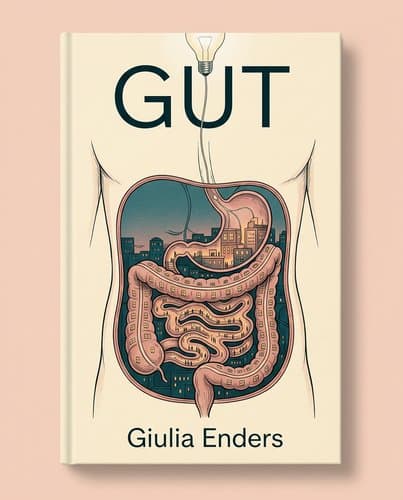
23013953_gut
by Giulia Enders
Your gut contains its own nervous system, 70% of your immune cells, and trillions of microbes that directly influence your mood—and most doctors still treat it…
In Brief
Your gut contains its own nervous system, 70% of your immune cells, and trillions of microbes that directly influence your mood—and most doctors still treat it like a simple tube. Giulia Enders reveals the elegant science behind digestion, from why squatting beats sitting to how unabsorbed fructose silently drains your serotonin.
Key Ideas
Squatting reduces toilet straining time
Approximate squatting posture on a standard toilet by leaning forward and putting feet on a low footrest — it straightens the rectum and measurably reduces straining time
Strategic timing enhances teeth cleaning
Brush teeth both before bed (to reduce the bacterial overnight party) and after waking (to clean up after it) — the timing difference is mechanistically meaningful, not habit superstition
Fructose intolerance causes mood depression
If you experience unexplained low mood or depression, ask your GP about a fructose intolerance test — tryptophan loss via unabsorbed fructose is a documented serotonin-depletion pathway that most doctors still don't check
Bristol Scale assesses digestive health
Read your stool on the Bristol Stool Scale: Types 3–4 are healthy; anything outside that range for extended periods warrants investigation; slow-sinking stool indicates active gut bacteria, which is a positive sign
Space meals for gut cleaning
Leave roughly five hours between meals when possible — this allows the 'migrating motor complex' (the gut's housekeeper) to complete its cleaning cycle, which constant snacking prevents
Wait days after strong laxative
After a strong laxative, wait three full days before concluding it didn't work — the entire large intestine may have been emptied, and re-dosing before day three creates a needless vicious cycle
Cold-pressed olive oil blocks fat
Choose cold-pressed extra virgin olive oil over other cooking fats when possible — it blocks the enzyme that creates fat from spare carbohydrates and contains oleocanthal, which acts like low-dose ibuprofen
C-section babies need Lactobacillus support
For C-section-born infants, ask a pediatrician about Lactobacillus supplementation — the research shows it reduces allergy risk specifically in this group, with no effect on vaginally-born babies who already received the coating
Plant proteins complement across entire day
When combining plant proteins, you don't need to hit all essential amino acids in one meal — just across the day: beans with any grain, or complete plant proteins like quinoa, soy, or buckwheat fill the gaps
Cool starches create resistant starch
Boiling potatoes or rice and then cooling them before eating converts some starch into resistant starch — a form that feeds beneficial gut bacteria rather than being absorbed, making cold potato salad microbiome-friendlier than hot
Who Should Read This
Science-curious readers interested in Nutrition and Biology who want to go beyond the headlines.
Gut
By Giulia Enders & Jill Enders
11 min read
Why does it matter? Because the gut is running half your mental and physical life without your knowledge.
You probably think of your gut the way you think of your plumbing — functional, unglamorous, best ignored unless something goes wrong. Here's what nobody told you: that tube running through your torso contains its own nervous system as complex as your spinal cord, manufactures ninety-five percent of your body's serotonin, houses two-thirds of your immune system, and sustains a microbial civilization of a hundred trillion organisms that influences your mood, your weight, your memories, and quite possibly your personality. Most doctors couldn't tell you what the enteric nervous system does. That ignorance has a cost — in chronic conditions dismissed as stress, in psychological suffering with a physiological source, in the bloating or fatigue or low-grade misery that modern people carry around and assume is just how life feels. Giulia Enders, a gastroenterologist who first came to this subject as a baffled patient, is here to correct the record.
Your Body Has Two Brains, and You've Only Been Listening to One
Your gut has its own brain — same signaling chemicals, same nerve-insulation materials, same receptor types as the one in your skull — and you've been crediting your head with work the two of them did together.
The enteric nervous system, the dense web of neurons lining your digestive tract, is as large and chemically complex as the brain. It manufactures 95 percent of the body's serotonin. This is why antidepressants like Prozac reliably cause nausea and diarrhea in roughly one in four patients: the drug can't tell your two brains apart, so it treats both of them simultaneously. That's not a side effect so much as a reveal — proof that your gut runs the same emotional hardware your head does.
The clearest demonstration of what this second brain actually does came from an experiment by Irish neuroscientist John Cryan in 2011. Cryan's team was studying depression in mice using a test called forced swimming: drop a mouse in water too deep to touch the bottom, and see how long it keeps trying to reach dry land. Mice with depressive tendencies stop quickly and go limp. Cryan fed half his mice a strain of gut bacteria called Lactobacillus rhamnosus and watched what happened. The bacteria-fed mice swam longer, showed lower stress hormones in their blood, and performed better on memory tests. The gut was apparently changing how the brain handled adversity. Then Cryan's team surgically severed the vagus nerve — the long cable running from the gut up through the chest and neck to the brain — in both groups. The behavioral differences vanished entirely. Without that physical connection, whatever the gut had been telling the brain went silent.
That result matters because it's anatomically specific. The gut isn't influencing mood through some vague systemic effect; it's sending targeted messages up a dedicated line. Those messages reach brain regions governing fear, memory, and motivation — including the insular cortex, which neuroscientist Bud Craig argues is where human self-awareness originates. The insula assembles incoming body-state signals like pixels into a running image of who you are, refreshed roughly every forty seconds. Sit with that for a moment: the thing you experience as a continuous, unified self is being partially rebuilt from gut dispatches, over and over, all day long. It's less a fixed identity than a feed.
Two Sphincters Are Having a Philosophical Debate Every Time You Need the Bathroom
Think of your gut as a border crossing staffed by two very different officials. The first checks everyone's passport — brisk, rule-bound, deeply concerned with what the line outside looks like. The second has only one job: keep the interior running smoothly, and couldn't care less about the queue.
Every time you feel the urge, they're actively negotiating. Most people know only the outer sphincter — the one you consciously tighten when you decide this is not the moment. But just inward of it sits a second one, run by an entirely separate nervous system, the unconscious one. Its only allegiance is to your body's comfort. Social embarrassment is not in its job description.
Here's what actually happens. The inner sphincter opens just enough to let a tiny sample reach the zone between the two muscles, where sensor cells read it — solid or gas — and relay that verdict to the brain. The brain cross-references it with everything around you: whose living room are you in, who is sitting across from you, how long is the drive home. Takes seconds. Then it sends instructions back down, and the outer sphincter clamps tighter or stands aside. If it clamps, the inner sphincter retracts the sample and waits. Its motto is essentially: eventually, yes.
Chronic override scrambles that loop. Always wrong time, always wrong place — and the inner sphincter gradually loses its ability to read the signals accurately. The constipation that follows is partly a communication breakdown, not a mechanical failure.
A posture fix goes with this. An Israeli physician named Dov Sikirov had 28 people defecate in multiple positions and timed them. Sitting on a standard toilet: 130 seconds on average, incomplete sensation. Full squatting: 50 seconds, satisfying. The difference is a muscle that wraps around the rectum like a lasso when you sit, kinking it the way a bent garden hose blocks water. Squatting straightens that kink. The 1.2 billion people worldwide who still squat to defecate have almost no incidence of diverticulosis — the painful intestinal pouching common in the West. You don't need to abandon your toilet: lean forward, put both feet on a low footrest, and the geometry takes care of itself.
Saliva Contains a Painkiller Stronger Than Morphine — Your Body Just Won't Let You Get High on It
Your saliva contains a painkiller stronger than morphine. The compound is called opiorphin, and scientists didn't know it existed until 2006. You produce it in deliberately small quantities — enough to take the edge off, not enough to sedate you — because your mouth needs it. The oral cavity has more nerve endings packed into it than almost anywhere else in the body, which is why a strawberry seed wedged between molars can command your entire attention, and why a mouth ulcer the size of a pinhead feels, to the person enduring it, like a small catastrophe. Opiorphin keeps all that sensitivity from becoming unbearable. Chewing increases its production, which is why a sore throat genuinely does feel better after a meal — and why early research suggests opiorphin may have antidepressant properties, raising the possibility that the comfort in comfort eating has a real biochemical basis.
Opiorphin is just the headline, though. Saliva is filtered blood: the salivary glands sieve out red blood cells but let calcium, hormones, and immune compounds through. One consequence is that calcium-rich saliva pooling near your lower front teeth slowly coats them — hardening enamel, which sounds useful right up until it fossilizes stray particles into tartar, whose rough surface gives harmful bacteria better grip than smooth enamel ever would. Another is that saliva carries proteins called mucins that discharge from the salivary openings in microscopic nets, catching bacteria before they can establish themselves. The system is deliberately calibrated not to sterilize the mouth completely, because benign bacteria already occupying that space are the first line of defense against more dangerous pathogens crowding in.
Blood Types Exist Because of Bacteria — Without Your Microbiome, Any Donor Could Give You Blood
Why do blood types exist? If the immune system's job is to recognize self from foreign, it ought to be stamped into your DNA from birth — a fixed setting, unrelated to anything living inside you. Here's the strange truth: blood types aren't really fixed at birth. They're a consequence of who moves in afterward.
Red blood cells carry protein markers on their surface that look, to the immune system, uncomfortably like bacteria. Gut bacteria train the immune system to recognize these markers as belonging to the body — to file them under 'self' and leave them alone. If your blood cells carry the type-A marker, your immune system has learned that lesson specifically: A is us, leave it alone. Present it with type-B blood, and the immune system reads the unfamiliar marker as a bacterial infiltrator and attacks, causing the donated cells to clump into dangerous clusters.
But that lesson requires a teacher. Newborns, who haven't yet built up substantial gut bacteria, haven't received the training. This is why a newborn can theoretically accept blood from any donor without incompatibility — the immune system simply hasn't learned to treat foreign blood markers as threats. Once gut flora develops and the immune training begins in earnest, the window closes. Blood types, in effect, crystallize out of microbial experience.
About 80 percent of the immune system lives in the gut, and this is why. That's where the densest bacterial population is, so that's where immune cells need to be educated — learning to tolerate the trillions of harmless residents while distinguishing them from genuinely dangerous arrivals. Cells that attack the body's own tissue are eliminated before they ever reach the bloodstream. The gut runs a continuous training operation that determines how your immune system will behave everywhere else in your body for the rest of your life.
The First Hours of Life Program Your Immune System for Decades
Picture the delivery room. A baby, minutes old, is passed to a nurse — skin to skin, a warm bundle against a stranger's hands. That ordinary moment is also a microbial lottery, and the ticket your immune system draws in those first hours is one it will spend years trying to cash.
Here's what birth method actually determines. Babies who travel through the vaginal canal are coated, in transit, by the mother's Lactobacillus bacteria — microbes that have been curated by acid selection, meaning only the hardiest, most protective strains survive in the birth canal in the first place. The baby arrives pre-inoculated. The C-section baby skips that corridor entirely and meets instead whatever happens to be on the nurse's hands, the room's faucet, the congratulatory flowers, the visiting grandparent's dog. The skin flora of a hospital room is not curated. It is not protective. It is just whatever was there.
Three-quarters of newborns who pick up typical hospital pathogens are C-section babies, and the immune consequences stretch forward for years — higher rates of allergies, higher rates of asthma. The mechanism is timing. The immune system is in its most impressionable training window in those first weeks, learning to distinguish friend from foe. What it meets first shapes those lessons permanently. By age seven, the gut flora of C-section and vaginally born babies looks roughly similar. But the training window closed long before that.
The partial fix is telling. Giving C-section newborns a dose of Lactobacillus measurably lowers their allergy risk. The same treatment given to vaginally born babies does nothing at all — they already got everything Lactobacillus could offer, delivered by their mother's body at the exact moment the gut was ready to receive it. You cannot recreate the timing of birth in a capsule, but you can close some of the gap.
Nobody told you the delivery room was a microbial handoff. The stakes were always there. They were just too small to see.
A Third of All Humans Are Hosting a Parasite That Makes Them Worse at Avoiding Danger
In the 1990s, Oxford researcher Joanne Webster put infected rats into an enclosure with four boxes, each containing a different liquid: water, rat urine, rabbit urine, and cat urine. Every rat that had never encountered a cat instinctively avoided the box with cat pee — that avoidance is biological, ancient, written into rodent nervous systems. But the infected rats didn't avoid it. They went in and stayed. Some seemed actively drawn to it. The only difference between them and the normal rats was a single-celled parasite called Toxoplasma gondii living in their brains.
The manipulation is precise. Toxoplasma doesn't scatter randomly through brain tissue — it colonizes three specific areas: the amygdala, which processes fear; the olfactory center, which handles smell; and the prefrontal region that generates what you might do next — the mental menu. Settle into those three addresses and you can, apparently, dim fear, redirect what smells attractive, and tilt the balance toward riskier options on the menu.
The jump to humans is uncomfortable. Researchers screened 3,890 Czech army recruits for toxoplasma and tracked them over the following years. Carriers had significantly higher accident rates, and the effect was sharpest in those who were also rhesus-negative — a blood-type factor that apparently amplifies the parasite's influence. The infection doesn't announce itself. It produces no reliable symptoms in healthy adults. It just quietly skews the odds.
Here's the part that's hard to sit with: roughly one in three people alive right now carries this parasite. Your personal probability of being a host, expressed as a percentage, is approximately your age in years. If you're forty, there's roughly a forty percent chance Toxoplasma gondii has set up residence in your amygdala and is doing something to the calculus of risk you experience as your own judgment. You wouldn't know. Most people never find out. The infection doesn't feel like anything — which is precisely what makes it so strange to reckon with. Your sense of how cautious you are, how much a given danger registers, may be partly shaped by a parasite doing something you'd never feel.
Your Depression Might Be a Digestion Problem You Haven't Tested For
What if years of treating depression as a brain chemistry problem left the actual cause sitting in your gut, unexamined?
Here's a pathway most doctors haven't added to their diagnostic checklist. Tryptophan — the amino acid your body needs to manufacture serotonin — doesn't travel alone through the digestive system. During absorption, it latches onto fructose molecules and hitches a ride into the bloodstream. That works fine until there's more fructose than your gut can actually absorb. When excess fructose gets shunted into the large intestine unprocessed, the tryptophan bound to it goes along — and exits the body entirely, never converted into anything. No tryptophan reaching the blood means less raw material for serotonin. Less serotonin means the biological substrate for depression is being assembled, meal by meal, in the gut.
The scale of the exposure matters. A generation ago, the average person took in roughly 16 to 24 grams of fructose daily — some fruit, a little honey, not much else. The average American now consumes close to 80 grams a day, because food manufacturers discovered fructose is cheap, shelf-stable, and easy to add. It's in the ketchup on your fries, the yogurt you consider a healthy breakfast, the salad dressing you chose specifically because the salad felt virtuous. More than half the population exceeds the gut's natural absorptive capacity at that intake level. For people with genuine fructose malabsorption — about 40 percent of the Western population — even moderate amounts cause the same tryptophan drain. Some of them have been prescribed antidepressants without anyone checking whether the problem was the salad dressing.
The intervention that follows from this is genuinely testable. Remove added fructose from your diet for two weeks — not fruit necessarily, but processed sources — and watch what happens to your mood, your concentration, and that restless need to graze between meals. It won't tell you whether you have celiac disease or a genetic intolerance. But it will tell you whether your gut has been quietly filing your serotonin precursors in the wrong bin, and whether the brain you've been trying to fix was waiting on a digestion problem to resolve first.
The Cholesterol Cure That Scientists Missed for Forty Years Because They Forgot to Ask About Bacteria
In the 1970s, a group of American scientists traveled to Kenya to solve what looked like a nutrition paradox. The Maasai warriors they were studying ate almost nothing but meat and milk — the kind of diet that, by every standard of the era, should have produced dangerously high cholesterol. Instead, their blood lipid levels were remarkably low. The scientists were convinced the milk itself held the answer. They tested cow's milk, camel's milk, even rat's milk. They ran an experiment so determined it bordered on comedy: they gave Maasai men Coffee-mate — the powder, not milk at all — with extra cholesterol stirred in. Still the cholesterol levels didn't rise. The mysterious protective ingredient, whatever it was, had survived the substitution. The scientists wrote it up, published it, and never figured out what they were missing.
What they were missing was the bacteria. The Maasai drank their milk curdled, and curdling requires bacteria. Those bacteria had colonized the Maasai gut and kept working long after the meal was finished. Switching from fermented milk to cholesterol-spiked powder made no difference because the bacteria were already there, doing their job regardless. The data was complete; the question just hadn't included microbes yet.
Decades later, researchers ran the experiment properly. A 2011 Canadian study gave 114 volunteers twice-daily yogurt containing a specially resilient strain of Lactobacillus reuteri. Six weeks later, their LDL cholesterol had dropped by nearly nine percent — roughly half the reduction you'd expect from a mild statin prescription, and without the side effects. The mechanism runs through something called BSH genes: bacteria carrying these genes modify bile, the body's fat-transport fluid, so that cholesterol dissolved in it can't be reabsorbed. It exits instead of recirculating.
Which means the Maasai warriors weren't metabolically unusual. They just had the right tenants. Feed those tenants fermented foods and fiber that reach the large intestine intact, and they do measurable work on your cholesterol before it ever hits your blood. The scientists in Kenya were one hypothesis away from seeing it. They just didn't think to ask who else was at the table.
Antibiotics Are Doing Something to Your Gut That Lasts Two Years After You Stop Taking Them
Every time you take a course of antibiotics, roughly a quarter of your gut bacteria die — and the survivors can take up to two years to fully clear from your system. Not the bacteria the drug killed. The ones it couldn't.
Here's what most people don't know: an antibiotic tablet doesn't travel directly to the infection. It passes through your entire digestive tract first, saturating your gut before it reaches the bloodstream and eventually the blocked nose or infected ear it was prescribed for. The microbiome takes the hit before the pathogen does. Some bacteria survive that hit — not by luck but by engineering. Some pump the drug back out through tiny cell-wall mechanisms, like emergency workers bailing out a flooded room. Others disguise their outer surfaces so the antibiotic can't recognize what it's trying to destroy. These are the bacteria that remain in your gut long after the course ends, passing their resistance strategies forward through generations. Researchers can detect elevated populations of these survivors for up to two years after a single course of treatment.
In Germany, one in four people takes antibiotics every year, mostly for colds — which are caused by viruses, against which antibiotics do precisely nothing. Each unnecessary course selects for resistant bacteria and contributes to a population of survivors that no existing drug can reliably kill. Thousands of people die from resistant infections every year, often when their immune system is already compromised. Very few new antibiotics are in development because pharmaceutical companies have calculated it's not profitable enough.
Two things are worth knowing. Always complete a prescribed course: stopping early kills the weaker bacteria while sparing the most resistant ones, which is exactly the wrong outcome. And be careful traveling — one in four people returns from abroad carrying highly resistant bacteria they didn't leave home with.
When the microbiome is devastated badly enough — as with Clostridium difficile, which can cause bloody, intractable diarrhea for years after antibiotic treatment — the most effective cure isn't another drug. It's a transplant of healthy donor stool, complete with its entire microbial community, achieving a 90 percent success rate for cases that nothing else has touched. The gut, it turns out, is best restored by exactly what it lost.
The Organ That Was Hiding in Plain Sight
The gut spent millions of years building its nervous system, curating its microbial population, and rehearsing its immune responses before any human thought to write any of this down. The science is genuinely young — most bacterial species in your gut have never been studied, and the researchers who will study them haven't graduated yet. But here's what you can actually do today: lean forward on the toilet, eat fermented food, leave five hours between meals when you can, and learn to read your stool the way a sailor reads weather — consistency, color, and whether it sinks or floats all mean something, and it takes about two weeks before you stop being surprised by what you notice. None of that is a cure for anything. It's just the beginning of paying attention to an organ that has been sending you messages your whole life, patiently, in a language you're only now starting to learn.
Notable Quotes
“It's just a bit of wind.”
“I've had a look and we're at Great-Aunt Bertha's, in the living room. We might get away with breaking a little wind if we can squeeze it out silently—anything more solid might not be such a good idea.”
“If it's gotta come out, it's gotta come out!”
Frequently Asked Questions
- What is the book 'Gut' by Giulia Enders about?
- "Gut" explores the digestive system as a complex, intelligent organ with its own nervous system, immune defenses, and microbial ecosystem. The book draws on current research to explain how gut health influences mood, immunity, and chronic illness. Enders and Enders deliver concrete, evidence-based guidance on digestion, diet, and the microbiome to help readers make smarter decisions about their bodies. The work emphasizes that the gut is far more sophisticated than traditionally understood, and maintaining proper digestive health can prevent chronic diseases and improve overall wellbeing.
- What practical advice does 'Gut' offer for improving digestion?
- "Gut" provides several evidence-based strategies for digestive health. The authors recommend leaving roughly five hours between meals to allow the gut's natural cleaning cycle, known as the 'migrating motor complex,' to function properly. For bowel health, consulting the Bristol Stool Scale helps identify if digestion is optimal — Types 3–4 indicate healthy digestion. The book also suggests adopting a squatting-like posture on the toilet by leaning forward with feet elevated, which straightens the rectum and measurably reduces straining time. Cold potatoes and rice are also recommended, as cooling converts starch into resistant starch that feeds beneficial bacteria.
- How does 'Gut' explain the connection between digestive health and mood?
- The book explains that gut health significantly influences mood and mental wellbeing through the gut-brain axis and the microbiome's role in regulating neurotransmitters. If you experience unexplained low mood or depression, the book recommends asking your GP about a fructose intolerance test. According to the research cited, "tryptophan loss via unabsorbed fructose is a documented serotonin-depletion pathway" that most doctors don't check. The gut's microbial ecosystem plays a crucial role in producing serotonin and other mood-regulating chemicals. This demonstrates that digestive health is intrinsically linked to mental health outcomes.
- What does 'Gut' recommend about digestive health for C-section-born infants?
- For C-section-born infants, the book recommends asking a pediatrician about Lactobacillus supplementation. According to the book, "the research shows it reduces allergy risk specifically in this group, with no effect on vaginally-born babies who already received the coating." This recommendation addresses a specific problem: vaginal delivery naturally exposes infants to beneficial bacteria that support immune development, while C-section births bypass this exposure. Lactobacillus supplementation can help restore beneficial microbial colonization in C-section-born infants. This represents targeted, evidence-based advice for addressing health disparities from birth method.
Related Book Summaries


Read the full summary of 23013953_gut on InShort