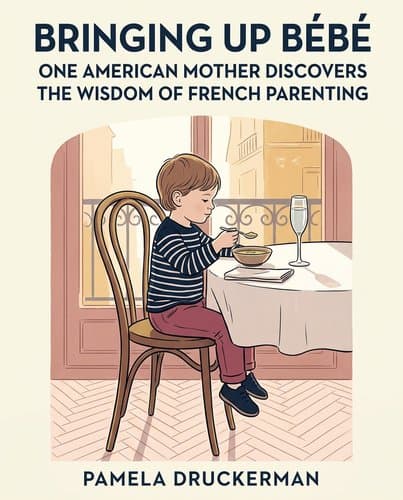
13152287_bringing-up-b-b
by Pamela Druckerman, Abby Craden
French children eat vegetables, sleep through the night, and play independently—not by accident, but because French parents master one counterintuitive skill…
In Brief
French children eat vegetables, sleep through the night, and play independently—not by accident, but because French parents master one counterintuitive skill: a firm, unwavering 'cadre' that grants children genuine freedom within clear limits, turning calm authority into the ultimate parenting superpower.
Key Ideas
Clear boundaries enable genuine freedom
Establish a 'cadre' — be very strict about a few non-negotiable things (bedtime, mealtime, greeting adults) and genuinely relaxed about everything else. The frame is what makes the freedom inside it real.
Calm conviction beats negotiated discipline
Practice the 'fully felt no': authority doesn't require volume, it requires conviction. A calm, certain refusal works better than a negotiated one because it signals that the rules are stable, not up for debate.
Patience develops through practice, not instruction
Give children regular, small opportunities to wait rather than patching every moment of frustration. The marshmallow research confirms that patience is a learnable skill, not a personality trait — and it develops through practice, not instruction.
Repeated exposure dissolves food neophobia
Apply the tasting rule to food: children don't have to finish anything, but they have to taste it. Serve the same vegetable in multiple preparations over weeks; neophobia dissolves with repeated low-pressure exposure.
Greetings teach that others matter
Treat 'bonjour' and 'au revoir' as non-negotiable — not for the sake of politeness, but because greeting another person is how a child learns they are not the only one in the room with feelings and needs.
Unobserved play builds self-entertainment capacity
Resist narrated play. Children benefit from periods of unobserved, unmediated activity — both because it builds the capacity to self-entertain and because it signals that the parent trusts them to manage without constant direction.
Autonomy expresses respect and trust
Reframe autonomy as respect, not neglect. Letting a child go backstage alone, resolve a playground dispute without mediation, or walk slightly ahead on the sidewalk isn't indifference — it's the concrete expression of believing they are capable.
Who Should Read This
Readers who connect with first-person stories about Child Development and Family and want to see the world through someone else's eyes.
Bringing Up Bébé: One American Mother Discovers the Wisdom of French Parenting
By Pamela Druckerman & Abby Craden
10 min read
Why does it matter? Because the exhausting way you're parenting might be making your children less happy, not more.
Picture this: an American family at a French seaside restaurant, one parent shoveling food while the other blocks escape routes, both leaving apologetic tips for the wreckage. At the next table, a French family the same age eats a three-course meal. Nobody is negotiating with a toddler. Nobody is bribing anyone. The children are just — calm. Not sedated, not cowed. Actually happy. Druckerman watched this scene and couldn't explain it, which turned out to be exactly the right response. The explanation, she eventually discovers, isn't a stricter bedtime or a cleverer distraction technique. It's a completely different answer to the question of what a child actually is. French parents aren't running a tighter version of the same program. They're running different software. And once you see what that software does — to mealtimes, to sleep, to the lifelong ability to wait for a marshmallow — you can't unsee it.
Something Invisible Is Happening at the Next Table
Picture a seaside restaurant in the south of France. Pamela Druckerman and her husband are tag-teaming their way through dinner — one parent shoveling food while the other runs interference on their eighteen-month-old daughter Bean, who has already dismantled the salt shaker, shredded several sugar packets, and launched a small quantity of calamari into the surrounding airspace. They've pre-ordered everything at once, they're eating in shifts, and they'll leave a tip large enough to apologize for the debris field around their table.
At the next table, a French family with a child about Bean's age is having a meal. Multi-course. Unhurried. The child is sitting in her high chair eating fish. No shrieking, no orbiting the room, no arc of torn napkins on the floor. The parents look, inexplicably, like people on vacation.
A Princeton economist's research puts a number to what Druckerman is sensing: American mothers in Columbus, Ohio, reported that looking after their children was more than twice as unpleasant an experience as French mothers in Rennes said it was. Twice. The gap isn't small, and it isn't explained by the restaurant she happened to choose.
Druckerman's first instinct is to reach for the obvious explanations — genetics, bribery, old-fashioned severity. But the French children around her don't look subdued or frightened. They're animated and curious; their parents are warm. Whatever is keeping those kids in their chairs isn't fear. It's something she can't name yet.
Back home in Paris, the pattern holds. In hundreds of hours at French playgrounds, she has never once watched a French child throw a full tantrum. French friends take phone calls without suddenly having to go. French toddlers eat vegetables. French infants routinely sleep through the night before they're three months old.
Something invisible is operating in French family life — a shared set of assumptions so taken for granted that French parents can barely articulate them when asked. Whatever it is, it seems worth finding.
Children Are Rational Beings — and the French Have Always Known It
The entire architecture of French parenting rests on a single premise most Western parents would find startling: your baby is a rational person, right now, and deserves to be treated like one.
This idea has a specific origin. Françoise Dolto was a mid-twentieth-century French psychoanalyst who argued that infants understand language from birth — not the words exactly, but the meaning, the intent, the emotional truth behind them. Her conclusion was radical: parents who coo and distract are doing their children a disservice. If your baby is getting a painful shot, explain what's happening and why. If you're leaving for work, say so honestly. Don't perform comfort; offer respect. This 'emancipation of babies,' as it became known, filtered so completely into French culture that today's parents absorb it without knowing Dolto's name.
The proof that this works comes from a scene Druckerman witnessed herself. Her friend Lara — French, calm in the way that seems impossible until you watch it operate — is in a room with ten-month-old Bean, who is systematically pulling books off a low shelf. An American parent in that moment typically oscillates between distraction tactics and futile commands. Lara just looks at Bean and says, quietly and plainly, that we don't do that here — 'doucement,' gently. Bean stops. Not because she was scared. Because she was addressed.
What makes this more than anecdote is that developmental psychologists at Yale have found that infants have a rudimentary moral sense and can track probabilities in ways that suggest genuine reasoning. Put plainly: a baby watching two puppets — one helpful, one obstructive — will reliably reach for the helpful one. They're not just reacting to stimuli. They're keeping score. The old assumption was that infant consciousness was just noise, a blooming buzzing confusion, a mind too overwhelmed to track anything. The Yale findings suggest something closer to the opposite: a small person actively making sense of the world, responsive to the logic of it.
Once you accept that premise, the French approach stops looking like a set of clever tricks and starts looking like a coherent system. You don't manage an animal. You negotiate with a person.
The Cadre: Why Freedom Requires a Frame
The word cadre means 'frame,' and it comes from Rousseau — whose ideas about childhood still circulate in French households the way common sense does. His argument was simple: pick a small number of things to be absolutely firm about, then let the child roam freely inside those limits. Today that frame typically covers eating, sleeping, and screen time. Everything else is liberty.
Fanny, a Parisian publisher with two young children, told Druckerman that she considers herself strict — but what she means by that is precise. There are a handful of rules she never relaxes, because she's noticed that yielding on them sets everything back. Outside those rules, her daughter Lucie picks her own outfits, chooses her own DVDs, moves through the day with real autonomy. The cadre isn't designed to hem children in; it's designed to give them a world stable enough to actually inhabit.
The sandbox is where Druckerman feels this in her body rather than just her head. Her neighbor Frederique watches her chase her son Leo around the playground for twenty minutes, calling out futile nos, and offers a quiet diagnosis: the nos aren't wrong, they just aren't believed. Not by Leo — by Druckerman herself. Frederique coaches her to stop shouting and start meaning it. On the fourth attempt, something shifts. The no isn't louder; it comes from a more settled place. Leo walks toward the gate, looks back, and stops. Then he just plays.
That's the move the cadre makes. A firm outer frame, held with genuine conviction, creates a large safe interior where children can actually relax. The French don't see firmness and freedom as opposites. They see them as a system — each one making the other possible.
Waiting Is a Skill, and French Parents Teach It Without Knowing They're Teaching It
Is patience something children have, the way some people have perfect pitch — or is it something they can actually learn? Walter Mischel spent decades at Columbia answering that question, and the answer changes how you see every French four-year-old calmly eating a three-course lunch.
Mischel's marshmallow test is simple to describe and almost painful to watch. A researcher leads a young child into a room, sets down a single marshmallow, and explains the deal: wait until I come back and you get two. Leave for fifteen minutes. Of 653 children who took the test in the late 1960s and early 1970s, only one in three held out for the full time. Most lasted about thirty seconds. Mischel followed up with these same children as teenagers and found a striking correlation: the kids who had waited longer were calmer under pressure, better at concentrating, less likely to fall apart when things went wrong.
But here's the part that reframes everything. The children who succeeded weren't white-knuckling it. They weren't staring down the marshmallow with gritted teeth. They were singing to themselves, poking at their shoelaces, inventing small games with their fingers. The ones who failed were fixated on what they couldn't have. Willpower isn't really about resistance — it's about learning to redirect your attention, to wait without suffering through every second of the wait. And children learn this the same way they learn everything else: by practicing it repeatedly, in low-stakes situations, from an early age.
Druckerman recognizes this immediately as a description of French domestic life. The four-meal schedule that French babies are eased onto by around four months — morning, noon, a late-afternoon goûter around four-thirty, then dinner at eight — isn't primarily about nutrition. It's a daily architecture of small waits. Not because anyone sat down and decided to teach patience. Because that's just how the day works, and a child's hunger learns to fit inside it.
French parents talk about following their children's rhythms, and they mean it sincerely. But the rhythm they're nudging children toward is the four-meal rhythm, the daily architecture of small waits that makes room for everyone — a child who can wait his turn, who isn't patched with snacks between every transition, who has learned, in the most ordinary way, that frustration passes. The French word is attendre: to wait, but also to expect. Both meanings seem apt.
The Hyperparenting Trap: How Total Child-Centeredness Produces More Anxious Children
A New York playground, a Tuesday afternoon. Druckerman is watching toddlers orbit the miniature equipment when a mother walks in and immediately begins narrating her son Caleb's every movement. 'Do you want to go on the froggy? Do you want to go on the swing?' Caleb ignores this and bumbles around on his own, so she tracks him, keeping up the commentary. 'You're stepping, Caleb!' Then a second mother arrives with a blond toddler in a black T-shirt. Her son drifts toward the gate to stare at the lawn — not stimulating enough, apparently — so she picks him up and holds him upside down, shouting 'You're upside down!' while he drinks milk from her breast. Druckerman watches and recognizes the whole scene. She's an American mother too. She knows exactly what these women are feeling: the low hum of obligation, the sense that any lull in engagement is a small failure. That recognition is the uncomfortable part.
What's striking isn't the behavior itself — it's that nobody's embarrassed by it. They're broadcasting, not whispering. Michel Cohen, a French pediatrician who treats New York families, knows this world well. His advice, delivered without ceremony: you don't have to talk, sing, or entertain constantly. Children don't need a continuous soundtrack of adult enthusiasm. Quiet is not neglect.
The intensive American model isn't just exhausting — it's built on a mistaken picture of what a child actually is. If you believe your toddler's future depends on the density of your engagement on any given afternoon, then narrating a trip down the slide isn't neurotic; it's responsible. But that belief is the trap. The child who is never left alone to bumble learns that bumbling requires an audience. The mother who performs constant stimulation signals, paradoxically, that her child cannot manage a moment without her. Both end up more anxious than when they started.
'Bonjour' Is Not a Nicety — It's an Existential Requirement
Americans treat politeness as a transaction. You ask for something, you say please. Someone helps you, you say thank you. The child is a receiver, the adult a giver, and the magic words mark the exchange. France runs on an entirely different philosophy — and the word that exposes it is bonjour.
Failing to say bonjour in France isn't a lapse in manners. It's closer to a denial of someone's existence. Druckerman's friend Benoît, a professor, puts it plainly: greeting is how you recognize another person as a person. Skip the bonjour and you haven't been impolite — you've erased someone. There's a French phrase for the child who fails to greet: a shadowy presence — someone hovering at the edge of the room who hasn't quite arrived yet. The child greets, therefore he is.
This is why Esther, a Paris lawyer, treats bonjour as non-negotiable in a way that please and thank you never quite are. When guests come to the house and her daughter fails to greet them, the child doesn't join dinner. Not as punishment exactly — more as a logical consequence. You haven't entered the room yet. Esther admits the resulting bonjour isn't always heartfelt. That's fine. 'It's the repetition, I'm hoping,' she says. The sincerity comes later; the habit comes first, because the habit is the whole point.
What makes this more than a social convention is the argument buried inside it. Please and thank you position the child below the adult — asking, receiving, grateful. Bonjour and au revoir put them on the same plane. The child isn't a small supplicant working the room for favors; she's a person acknowledging another person, which is something adults do with each other. French parents want their children to understand they are there to give, not just to receive. Bonjour is the daily practice of that idea.
Food Is Not a Battle — It's an Education
Sandra Merle is running through the winter Christmas menu with a group of crèche chefs when someone suggests foie gras as the appetizer. Nobody laughs. Merle, the chief nutritionist for Parisian crèches, steers them toward duck mousse instead — they eventually land on fish with broccoli mousse, two cow's milk cheeses, and a chocolate sundae topped with whipped cream for the afternoon goûter. The children eating this meal will be two and three years old.
Druckerman sits in on this Commission Menus meeting — state-employed chefs gathering every two months to decide what the city's crèches will serve — and the first thing she notices is what's absent from the conversation: the concept of kids' food. Nobody suggests chicken fingers. The word ketchup never comes up. When a leek soup gets pulled from the rotation, it's because the children ate leeks the previous week, not because leeks are too grown-up. Variety, color, and texture are the only constraints on the menu. One chef mentions offhandedly that the sardine mousse she'd been serving was a hit — the toddlers spread it on bread themselves.
The operating assumption in that room is the same one French parents carry home: a child's palate isn't a fixed thing you work around, it's something you gradually introduce to the world. A food critic who used to hate kimchi spent six months eating it everywhere he could find it — ten restaurants, ten attempts — until it had become his national pickle. His conclusion, that almost no taste is innately repulsive, just unfamiliar, is what French parents apply instinctively to their children from the first spoonful of pureed leek.
The method is patient and specific: offer a food, accept the refusal, offer it again prepared differently, never replace it with something easier. The tasting rule — you don't have to finish it, but you do have to taste it — is less a rule than a philosophy. The fear of new foods dissolves with exposure. The cadre holds the boundary; inside it, the child is slowly becoming someone who knows what things taste like.
A Child Trusted to Wait, Wander, and Forget to Not Be a Marionette
The night of Bean's first dance recital, Druckerman does everything an American parent would do: checks the white leggings twice, delivers her daughter to an assistant at the theater door, and then simply lets go. She never meets the teacher. She has no idea what Bean has been rehearsing for months. When the curtain opens, she discovers, along with the rest of the audience, that her five-year-old has learned a ten-minute routine by heart — full costume, full makeup, deliberately jerky marionette arms. The girls are charmingly out of sync with each other, like marionettes who've had too much cognac. Druckerman sits there processing that she was not consulted, not updated, and not necessary. Then Bean emerges from backstage with a look of quiet disappointment. 'I forgot to not be a marionette,' she says. The teacher's relationship was with Bean, not with her mother — and Bean took it seriously enough to have opinions about her own performance.
That scene captures the final turn the book makes. Throughout, the French model has looked like a series of restraints — the cadre, the firm no, the waiting, the structured meals. But here it resolves into something else: a child trusted enough to be left alone with her own small stakes. Druckerman watches French parents let children on scooters race ahead toward sidewalk corners, trusting they'll stop — while she grips Bean's wrist beside her, just in case. The same moment, twice: an adult resisting the urge to insert themselves between a child and a manageable difficulty.
The American fear is that stepping back is abandonment. The French reframe is that stepping back is respect — and that hovering is, at bottom, a quiet insult. It says: I'm not sure you can handle this. A child who is always caught before she falls never discovers she can catch herself. Bean came offstage not crushed but thoughtful, already analyzing what she'd do differently. That's not a child who was neglected. That's a child who was taken seriously.
What the Calamari Was Really About
There's a version of that seaside restaurant scene where nothing changes — where Druckerman goes home, reads a sleep-training book, and optimizes her way toward a slightly less chaotic dinner. But that's not what happened. What happened was a shift in the underlying picture: a child isn't a fragile project you manage around the clock, she's a small person who can handle a wait, a new flavor, a corner approached at speed. Once you see that, the constant intervention stops feeling like love. It starts feeling like a quiet insult — a running statement that you don't quite believe she can do it. And there's something uncomfortable in recognizing that: all that hovering wasn't protection, it was doubt. The techniques matter less than the premise. Trust a child to taste the leek, to stop at the gate, to walk offstage and form her own opinion about how it went — and you're not being hands-off. You're being honest about who she already is.
Notable Quotes
“I served mousse of sardines, mixed with a little cream,”
“The kids loved it. They spread it on bread.”
“They love soup; it doesn’t matter which beans or which vegetables,”
Frequently Asked Questions
- What is Bringing Up Bébé about?
- This book examines French parenting philosophy and practices that produce notably calm, self-sufficient children. Pamela Druckerman draws on her experience raising children in Paris to distill French parenting approaches into actionable principles. The core practices include establishing firm boundaries while allowing genuine freedom, practicing delayed gratification, teaching food education, and fostering real autonomy. Rather than constant negotiation and mediation, French parents emphasize respect for children as capable individuals, clear non-negotiables like bedtime and greetings, and periods of unobserved play. The book argues that these principles help parents raise patient, self-reliant children without exhausting negotiation or helicopter parenting.
- What is the 'cadre' concept in Bringing Up Bébé?
- The 'cadre' is Druckerman's term for establishing firm boundaries on a few non-negotiable things—bedtime, mealtime, greeting adults—while remaining relaxed about everything else. "Be very strict about a few non-negotiable things (bedtime, mealtime, greeting adults) and genuinely relaxed about everything else. The frame is what makes the freedom inside it real." This selective strictness paradoxically creates more freedom because children know exactly where the limits are. Without arbitrary rules constantly shifting, kids feel secure and develop genuine autonomy within those clear boundaries, reducing constant power struggles that plague permissive parenting.
- How does Bringing Up Bébé explain teaching patience to children?
- Druckerman argues that patience is a learnable skill, not an inborn personality trait—it develops through practice, not instruction. She recommends giving children regular, small opportunities to wait rather than immediately soothing every moment of frustration. The book cites the marshmallow research as evidence that delayed gratification builds through experience. By allowing children to experience manageable periods of waiting—for meals, for attention, for their turn—parents systematically strengthen this capacity. This approach avoids both constant negotiation and the parenting trap of patching every frustration, letting children develop genuine patience naturally.
- What is the tasting rule in Bringing Up Bébé?
- The tasting rule is Druckerman's approach to handling picky eaters: children don't have to finish anything, but they have to taste it. Rather than forcing consumption or accepting refusal, parents serve the same vegetable in multiple preparations over weeks. This repeated low-pressure exposure gradually dissolves neophobia—the fear of new foods. By separating tasting from finishing, the rule removes the power struggle while still building familiarity and expanding preferences. This respectful yet structured approach treats food education as a developmental skill, not a battle.
Related Book Summaries

Read the full summary of 13152287_bringing-up-b-b on InShort