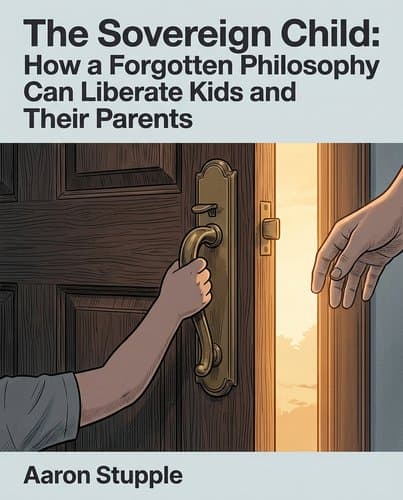
222825841_the-sovereign-child
by Aaron Stupple
Every bedtime battle, forced apology, and chore chart is quietly undermining the trust and curiosity you're trying to build. Stupple reveals how treating…
In Brief
Every bedtime battle, forced apology, and chore chart is quietly undermining the trust and curiosity you're trying to build. Stupple reveals how treating children as rational minds—not behavior problems to manage—creates kids who actually want your guidance when it matters most.
Key Ideas
Understand appeal before stopping behavior
Replace 'what rule applies here?' with 'what does my child find appealing about this, and how can I re-create that in a way that works for both of us?' — the wall-drawing problem only gets solved when you ask why the wall is attractive, not how to stop the behavior.
Treat children with spouse-level respect
Use the spouse test before any intervention: if you wouldn't use praise as manipulation, physical force 'for their own good,' or ignore a 'no' with your partner, don't do it with your child.
Abandon forced chores, work together
Drop chores as a requirement immediately — not because tidiness doesn't matter, but because forced chores reliably produce resentment of the very work ethic and family contribution you're trying to build. Ask instead, accept 'no,' and do tasks alongside them.
Stop talking when explanations fail
When verbal explanations stop working, stop talking. Continued talking doesn't clarify — it becomes a punishment the child agrees to just to make it stop, which poisons future conversations.
Trust matters more than compliance
On high-stakes risks like drugs, hitting, or dangerous streets, rules destroy the trust a teenager needs to actually ask you for help. The goal isn't compliance — it's being the person they come to when something goes wrong.
Experience builds self-knowledge, not management
Treat food, sleep, and screen access as domains of self-knowledge your child needs to build through direct experience, not domains you manage on their behalf. Mediated experience prevents the very discovery it's meant to protect them toward.
Remove one rule, observe changes
Start with one low-stakes rule and remove it for two weeks. Notice what changes — in your child's behavior, in the dynamic between you, and in how often you feel like an adversary rather than a collaborator.
Who Should Read This
Thoughtful readers interested in Family and Child Development willing to slow down and wrestle with ideas.
The Sovereign Child: How a Forgotten Philosophy Can Liberate Kids and Their Parents
By Aaron Stupple
11 min read
Why does it matter? Because every rule you set for your child is quietly teaching them the wrong lesson.
Every rule you set for your child is teaching them something — just not what you think. The bedtime is teaching them that their body's signals are less trustworthy than a clock. The forced apology is teaching them that someone else's comfort matters more than their actual feelings. The "two more bites" is teaching them to ignore hunger, not respect food. We enforce these things because we love them, because we're responsible, because that's what good parents do. But what if the enforcement itself — not the chaos it prevents — is the thing quietly doing damage? Aaron Stupple spent years inside a nearly-forgotten philosophy built by a physicist and an educator who asked a genuinely uncomfortable question: what if children don't need to be managed at all? What they built isn't a parenting style — it's a complete philosophy of how knowledge grows, and it changes everything.
The Parent as Gatekeeper Is the Wrong Job Description
Most parents assume their job is to manage children well — to set the right limits, choose the right enforcement strategies, and hold the line with enough consistency that good habits eventually take root. Aaron Stupple's argument is that this entire framework is pointed at the wrong target. Rules don't teach children how the world works; they teach children how to navigate the person enforcing the rules. A completely different education, and one that actively crowds out the real thing.
The philosophy Stupple draws on — Taking Children Seriously, developed in 1990s Oxford by physicist David Deutsch and educator Sarah Fitz-Claridge — starts from a different premise: parenting is a knowledge-building project. A child's job is to develop a working understanding of how to eat, rest, pay attention, and eventually sustain a life. That understanding only comes through direct experience, which means it requires freedom. Rules don't constrain bad choices; they constrain the very process by which a child learns to make choices at all.
Here's where Stupple reaches for an analogy that's hard to shake. When a houseguest arrives, you ask what they'd like to eat. You accommodate their preferences. You might suggest something they haven't tried, but you don't enforce a clean-plate policy or decide they've had enough. You extend them the basic dignity of self-determination, partly out of politeness, partly because you know it's not actually your call. Stupple's question is disarmingly simple: why don't children get that?
The usual answer is that children don't know enough to make good decisions. But consider what happens when a parent manages a child's food intake to prevent poor choices. The child never learns what fullness actually feels like, or what happens to their energy after three cookies versus one, or how their mood connects to what they ate. Instead, they learn to read parental expressions — to figure out what's allowed, what can be snuck, and what triggers a lecture. Not self-knowledge. A skill set that's nearly useless once the parent is out of the room.
The rules-based approach doesn't fail because parents apply it badly. The question worth sitting with is what it's actually solving for — and the answer is uncomfortable.
Enforcement Doesn't Shape Children — It Scars Them
Imagine being a competent adult — capable, well-intentioned — assigned to work in the direct physical presence of your boss, all day, every day. Nothing dramatic happens. No criticism is leveled. But the boss is watching. You know a rule could be triggered at any moment, over something you haven't even thought of yet. You start monitoring yourself constantly, anticipating rather than acting. That low-grade vigilance — that permanent alertness — is exactly what it means to be self-conscious, and it is the essential ingredient in both anxiety and low self-esteem. Now consider that a child lives this way without even knowing why the boss is there.
Aaron Stupple identifies four ways that rule enforcement damages children, and the teeth-brushing standoff — mundane, nightly, universal — is a useful thread to run through all of them.
Start with the relationship. When you control access to something a child wants, you become a gatekeeper, and gatekeepers are obstacles. The child's mind, which is genuinely brilliant at learning, pivots immediately to the problem of getting past you. Can I wear her down? Can I lie? Can I find another adult who'll say yes? This isn't a character defect; it's a rational response to an arbitrary barrier. Once the child is maneuvering around you, trust erodes on both sides — and no amount of enforcement reverses that.
The damage to the child's self-concept is quieter but just as serious. An adult who gets a parking ticket understands the rule applies to everyone; it isn't personal. A child forced to brush her teeth doesn't have that context. She just knows that wanting to skip it got her scolded, which means something about her wanting must be the problem. When a child's desire is repeatedly treated as the threat, she starts to believe her own instincts are untrustworthy. That's the seed of self-doubt, and it can outlast childhood by decades.
Third: the child never actually learns what the teeth-brushing is for. Forced compliance teaches one thing — how to avoid consequences. If every encounter is engineered around threats, the child never engages with what teeth actually are, why they decay, what plaque does. The underlying reality stays invisible. She learns to read the parent, not the problem.
Which is exactly where the fourth damage lands. A teenager who has spent years reading parents instead of problems grows into someone who reaches for an authority figure before trying anything on her own — emailing the professor before opening the textbook, asking what to order before looking at the menu. In a world where no expert has final answers on diet, sleep, or almost anything that matters, that's a crippling reflex to have installed.
Taken together, the four describe not a single bad outcome but a whole posture toward the world — reactive, anxious, other-directed — that rules-based parenting quietly installs.
Every Rule Problem Has a Win-Win Solution — If You Stop Reaching for the Hammer
The scene: a toddler standing at the wall with a marker in her hand, having produced something she's clearly proud of. The parent's first instinct — almost everyone's first instinct — is to take the marker away and announce the rule. Aaron Stupple had that same instinct. What stopped him was a question he forced himself to ask before reaching for the hammer: why does she actually want to draw on the wall?
The answer was obvious once he looked at it honestly. A wall is large. It doesn't slide around. You can press hard without anything shifting. For a small child learning to make marks, those are genuinely good reasons to prefer it over a sketchbook. Stupple didn't need to punish his daughter for discovering this — he needed to reproduce those features somewhere that wouldn't require repainting.
He started by taping large sheets of paper flat to the dining table, set his daughter up on top so she didn't have to wrestle with a chair, and made sure everything she needed was within reach. She still went back to the walls sometimes, so he bought washable markers and kept a spare can of wall paint on hand for anything that needed covering. Eventually he got her an easel — a permanent broad, stable surface that was always available. One episode of toddler graffiti had, over a few iterations, produced a complete system. The wall-drawing stopped, not because it was forbidden, but because the better option was right there.
What that sequence looked like in practice: first, understand what the child is actually after — not what she's doing wrong, but what problem she's solving for herself. Second, guess at solutions that give her the same thing in a form that also works for you. Third, test the guesses, expect most of them to fail, and keep going. The whole sequence depends on taking the child's internal logic seriously rather than treating her desire as the problem to be extinguished.
Most parents short-circuit it at step one. When a toddler does something unwanted, the emotional urgency of the moment pushes immediately toward correction — and once you've decided the wall-drawing stops, you're not asking why it started. You're just going for obedience, and you'll get obedience and nothing else: the child stops drawing on the wall in front of you and finds another wall when you're not around.
The win-win doesn't require surveillance. It works because both people actually got what they wanted. That's not a coincidence — it's the definition. And Stupple argues there is always one available, which sounds like wishful thinking until you watch the logic unfold in enough specific cases. The solutions are never generic. They're native to the particular situation, arrived at by understanding this child, this wall, this moment. That specificity is a feature: the more precisely you understand what you're actually dealing with, the more obvious the answer tends to be.
Your Child Isn't Defying You — They're Building a Mind
What if the way you think about learning is the reason parenting feels so exhausting? The standard mental model — call it the bucket theory — treats a child's mind as a container. Your job is to pour in the right knowledge: correct facts, good habits, sound values. Control what goes in and you control what grows. Restrict bad influences, mandate good ones, and the child is shaped accordingly. This model is wrong, and the way it is wrong matters more than almost anything else in this book.
Karl Popper, the philosopher who spent a career studying how knowledge actually grows, documented why. Knowledge cannot travel from one mind to another the way water moves between cups. Consider what happens when someone gives you directions on the street. You hear sounds. Those sounds vibrate your eardrums, which fire signals up your auditory nerve, and then your brain has to do something remarkable: it has to guess. You guess at what the words meant, guess at the speaker's frame of reference, construct an internal map from scratch. If the person has a heavy accent, you guess at the words before you can even start on the meaning. None of that guessing is happening in the speaker. It is happening in you. The local who told you to turn right did nothing except vibrate some air. You did all the actual work.
This is not a quirk of directions. It is how all knowledge works. Every fact a child appears to absorb is actually a theory the child constructed — a best guess assembled from available signals and then tested against experience. The teacher's explanation, the parent's correction, the book's argument — these are all just air vibrations and ink marks until a mind reaches out and builds something from them. You cannot pour knowledge into a child because there is no pour. There is only the child's own process of conjecture and revision, running constantly, whether you are helping it or not.
For parenting, the implication is uncomfortable. If knowledge is always built from the inside, then what external control actually controls is not the child's mind — it is the child's access to the raw material minds use to grow. Restrict what a child encounters, and you are not shaping their development. You are interrupting it. The bucket theory promises that careful control produces a well-formed child. What it delivers instead is a child who has had fewer problems to think through, fewer guesses to test, fewer chances to build anything sturdy.
This is why the win-win approach Stupple describes is not simply kinder than conventional parenting. It is more accurate. It starts from what minds actually do rather than from a flattering but false picture of adult influence. If a child's knowledge has to be built by the child, then the parent's job is not to fill them but to think alongside them — to be the interesting problem, the useful friction, the person who takes their guesses seriously enough to engage with them. That is a different job than enforcer or gatekeeper, and it turns out to be a much less exhausting one.
Modern Parenting Is an Ancient Technology for Suppressing Creativity
Modern parenting is not a neutral baseline. It is a specific historical technology, engineered over tens of thousands of years for a specific purpose: keeping creative minds from changing things.
Deutsch has a blunt explanation for why this feels so natural to us. Ancient clans survived not by innovating but by preserving — passing down hard-won knowledge about fire, poison, hunting, and social organization without letting any of it drift. The threat wasn't ignorance; it was modification. A creative mind that improves on the old way of making fire might accidentally lose it entirely. So static societies developed tools to prevent exactly this: taboo, shame, the threat of violence, and the social terror of excommunication. Children were the critical mechanism. Each generation had to absorb not just the knowledge but the suppression — the shame of nonconformity had to be installed early enough and deeply enough that adults would reliably install it in their own children without being told to.
This is why adults reflexively crack down on whatever children find most enjoyable. Stupple identifies the pattern precisely: excessive fun almost always signals deviation from the norm, because conformity is almost never wildly fun. The new food, the new technology, the new game — any outsized delight in something unfamiliar trips a wire that static societies spent millennia sharpening.
The Enlightenment dismantled this logic everywhere except one place. Western science, politics, and economics have all absorbed the principle that criticism improves things and that errors are navigational data rather than moral failures. Children have not made that list. The authoritarian treatment of kids looks natural to us because it is ancient, not because it is correct. Understanding this changes what's at stake. Deutsch puts a number on it: if the brief window of open inquiry in ancient Greece had continued rather than being crushed, we would currently be living through the results of two thousand years of industrial and scientific progress rather than two hundred. The parent cracking down on something a child finds delightful at the dinner table is not making a small domestic call. They are making a civilizational one.
You Don't Have to Change Everything at Once — But One Thing You Can Drop Today
What if abandoning rules feels impossible because you're imagining doing it all at once? That's the wrong picture — and the right one is much less dramatic.
Chores are the one place where Stupple drops the incrementalism entirely. Don't phase them out — rescind them today. The reasoning is worth sitting with: forcing a child to do chores doesn't build a work ethic or a sense of family belonging. It builds resentment of those exact things. The child who empties the dishwasher because Dad will get angry otherwise is learning to associate domestic contribution with coercion. If you actually want your kid to value keeping a home, coercion is the most reliable way to prevent that. Stupple's alternative is simple: ask if they want to help, and accept no as a complete answer. His six-year-old now volunteers to set the table and pulls her younger sister along with her. His son has no interest yet — and forcing it would only delay whatever authentic interest might eventually appear.
For everything else, Popper's insight about incremental change applies directly. Utopian leaps fail not because the destination is wrong but because the gap is too wide to cross without losing your footing. The answer is one small, reversible step: watch what happens, then adjust. Don't declare the family rule-free. Find one rule nobody particularly likes and loosen it. If something goes wrong, reinstate it. Move bedtime thirty minutes later for a week. Let the kids plan one dinner. Stop demanding two more bites of broccoli. Each of these costs very little if it doesn't work, and each opens a door you didn't know was there.
Here's a useful test for any rule you're considering dropping: would you use the same tactic with another adult? Not a confrontational adult — just your partner, or a friend staying in your house. If the answer is no, you're probably holding onto the rule because you can, not because it's working. That distinction, once you see it, is hard to unsee. And it turns out the method it points toward — curiosity, problem-solving, genuine negotiation — is one most parents already know how to use. They just haven't tried it with the short people yet.
The Person Who Opens the Door
There's a moment in the book that earns everything that came before it. A one-year-old in pajamas, stomping through ice-crusted puddles — sitting down in the freezing water, pressing dirt to her lips, laughing at all of it. Her father wanted her dry and warm. She wanted to know what cold actually feels like from the inside. He almost stopped her.
That's the whole argument, finally made visible. You have spent this entire book being asked to give up control, and what you're being offered in return isn't chaos — it's this: a child who knows things because she discovered them, who trusts you because you never became the obstacle. Your job was never to keep her from the puddle. It was to open the back door, follow her out, and have the warm bath ready when she'd learned enough for one morning.
Notable Quotes
“getting it into their heads.”
“Thou shalt not draw on the walls.”
“If it’s so important, why can’t you explain its importance to my own satisfaction?”
Frequently Asked Questions
- What is The Sovereign Child about?
- The Sovereign Child applies epistemic autonomy principles to parenting, arguing that rules, coercion, and managed behavior actively undermine a child's ability to build knowledge and self-direction. Rather than controlling behavior through rules and punishment, the book offers parents concrete tools to replace control with collaboration. The approach reduces conflict while raising children who are genuinely capable of guiding themselves. Drawing on philosophy, Aaron Stupple challenges traditional parenting paradigms and provides strategies based on understanding why children find certain behaviors appealing, rather than simply trying to stop those behaviors. The goal is reframing the parent-child relationship from adversarial to collaborative.
- What are the key principles for replacing control with collaboration in parenting?
- Stupple recommends replacing behavioral rules with curiosity: ask 'what does my child find appealing about this, and how can I re-create that in a way that works for both of us?' — the wall-drawing problem only gets solved when you ask why the wall is attractive, not how to stop the behavior. Apply the spouse test before any intervention: if you wouldn't use praise as manipulation, physical force 'for their own good,' or ignore a 'no' with your partner, don't do it with your child. Start by removing one low-stakes rule for two weeks to observe changes in behavior and family dynamics.
- What does The Sovereign Child recommend about chores and household responsibilities?
- The book advises dropping chores as a requirement immediately because 'forced chores reliably produce resentment of the very work ethic and family contribution you're trying to build.' Instead, ask children to help, accept 'no,' and do tasks alongside them. When verbal explanations about chores stop working, the approach is clear: 'When verbal explanations stop working, stop talking. Continued talking doesn't clarify — it becomes a punishment the child agrees to just to make it stop, which poisons future conversations.' This preserves intrinsic motivation and fosters genuine family participation rather than mere compliance.
- How does The Sovereign Child approach high-stakes issues like drugs and safety?
- On high-stakes risks like drugs, hitting, or dangerous streets, Stupple argues that 'rules destroy the trust a teenager needs to actually ask you for help.' The goal isn't compliance—it's being the person they come to when something goes wrong. The book also treats 'food, sleep, and screen access as domains of self-knowledge your child needs to build through direct experience, not domains you manage on their behalf. Mediated experience prevents the very discovery it's meant to protect them toward.' The approach prioritizes maintaining trust and enabling direct learning.
Related Book Summaries
Read the full summary of 222825841_the-sovereign-child on InShort