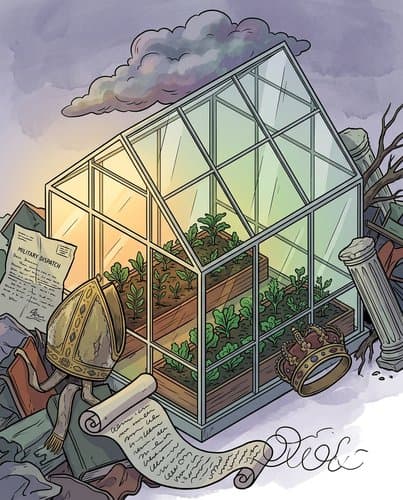
19380_candide
by Voltaire, Rockwell Kent, Walter Jerrold, Don Hagen, Sara Gioacchino Corcos
Voltaire's razor-sharp satirical masterpiece dismantles centuries of 'everything happens for a reason' thinking by dragging its naive hero through war…
In Brief
Candide (1759) uses a darkly comic tale of relentless misfortune to dismantle the philosophical optimism of Voltaire's era.
Key Ideas
Philosophy as Self-Protection in Disguise
When a philosophy requires suffering to be 'necessary' or 'for the best,' check whether it is explaining the world or just protecting the person explaining it — the two look identical from the inside
Correctness Without Action Breeds Its Own Paralysis
The alternative to blind optimism is not pessimism; Martin gets every argument right and improves nothing — being correct about misery is its own kind of paralysis
Defending Positions to Protect Our Reputation
Pangloss's real sin is not stupidity but intellectual cowardice: he admits, when pressed, that he maintains his doctrine because 'it wouldn't be proper to recant' — a warning about how often we defend positions to protect our reputation rather than because we believe them
The Problem Is What We Think We Need
Eldorado — the place where everything genuinely is fine — is the book's most uncomfortable scene, because Candide leaves it voluntarily; Voltaire suggests we would all do the same, which means the problem isn't the world, it's what we think we need from it
Small Practical Work Beats Grand Philosophy
The Turk's answer — work keeps away boredom, vice, and poverty — is not inspiring; it is deliberately small; Voltaire's point is that grand philosophical systems are less useful than a twenty-acre farm you actually tend
Common Suffering Undermines Self-Pity Through Solidarity
Universal suffering, as the old woman's wager implies, is not a reason for despair but a form of solidarity — the discovery that almost everyone has cursed their life doesn't make life worse, it makes self-pity slightly ridiculous
Who Should Read This
Thoughtful readers interested in Classics and Literary Fiction willing to slow down and wrestle with ideas.
Candide
By Voltaire & Rockwell Kent & Walter Jerrold & Don Hagen & Sara Gioacchino Corcos
14 min read
Why does it matter? Because every system of thought that promises to explain away suffering is itself a lie — and Voltaire knew it in 1759.
Picture a young man in Westphalia who has it all figured out. He lives in the finest castle in the world — it has a door and windows, after all — under the tutorship of a philosopher who has proved, to his own complete satisfaction, that every event in human history is precisely as it should be. Then someone kicks him out. What follows is Voltaire's gleefully brutal experiment: take one idealist, one airtight optimistic system, and introduce both to actual history — wars, inquisitions, earthquakes, slavery, and the sugar trade. The system doesn't bend. It shatters on contact. But here's the uncomfortable part: the pessimist waiting on the other side isn't right either. Candide is a book about how every grand theory of suffering — the one that explains it away and the one that wallows in it — is finally just another way of refusing to act. The only answer Voltaire trusts is embarrassingly small, stubbornly concrete, and grows in a garden.
The Most Dangerous Idea in the World Is the One That Makes Suffering Sound Reasonable
Picture the most comfortable possible world. You are Candide, a gentle, credulous young man living in a Westphalian castle so magnificent that its greatness is demonstrated by the fact that it has — and here Voltaire pauses, deadpan — a door. And windows. Your tutor, Dr. Pangloss, has an answer for everything, delivered with the confidence of a man who has never been wrong because his system makes being wrong impossible. Noses, he explains, were shaped to hold spectacles — and from examples like this, Pangloss constructs an entire universe where whatever exists must be right. Therefore — and this 'therefore' is doing enormous work — we live in the best of all possible worlds.
You laugh at Pangloss. The logic is absurd, the circularity almost musical in its confidence. But his reasoning is not a parody of bad thinking. It is bad thinking's finest hour. Pangloss takes whatever exists, declares it necessary, and from necessity deduces goodness. Suffering fits into the plan. Cruelty serves a purpose. Every disaster is, on close inspection, a feature. When life is going well, 'everything happens for a reason' is a very easy thing to believe.
Candide believes it completely. He is in a warm castle, he has philosophy to explain the universe, and there is a seventeen-year-old named Cunegonde who makes the whole arrangement feel divinely ordained. Then she drops a handkerchief. He picks it up. A kiss follows — nervous, electric, quickly discovered — and the Baron throws Candide out with a series of kicks that carry, in miniature, the entire argument of the novel. The world does not care about Pangloss's system. It just keeps kicking.
The joke lands on you too, because Voltaire spent the whole first chapter making sure you were comfortable inside the delusion before he collapsed it.
War Looks Like a Parade Until You Walk Through the Village Afterward
Voltaire's comedy has teeth. The battle between the Bulgars and Avars arrives dressed as spectacle — trumpets, drums, precision formations — and the narrator describes the cannon fire producing a harmony 'never heard in hell.' Thirty thousand people die, tallied with the cheerful briskness of a parade announcer counting floats. That's the joke's surface. The point underneath is that this is exactly how armies and kings and newspapers describe war: as pageantry, as heroism, as the necessary cost of some larger good.
Then Candide walks through the village afterward, and Voltaire makes you see what the parade language is designed to prevent you from seeing. Women with children pressed to their bloodied chests. Girls mutilated after what the narrator blandly calls 'satisfying the natural needs of several heroes.' The ground carpeted with brains and severed limbs, still twitching. Candide picks his way through all of it — and here is the genuinely disturbing part — still narrating his own experience in the vocabulary of cause and effect. Grief acknowledged, lesson filed, philosophy intact.
Pangloss's optimism was always a system for looking away. Walking through the wreckage of two villages burned in accordance with 'international law,' it becomes something darker: a mechanism for surviving horror without being changed by it. If suffering is necessary, you don't have to feel it. If atrocity serves the best of all possible worlds — and with warmth and food and Cunegonde nearby, that idea costs nothing — you can step over the quivering limbs and reason calmly about what comes next. The joke isn't that Pangloss is a fool. It's that his foolishness is useful.
Optimism Is Most Obscene When It Has the Most to Explain
Think of someone who explains away every car accident by saying the universe needed those particular people to be late that day. The explanation is frictionless — it survives any evidence, accommodates any outcome, and costs its author nothing. That is the version of Pangloss that emerges in Chapters 4 through 6, and it is no longer just absurd. It is something closer to monstrous.
The turn comes when Candide encounters his old tutor begging in the street, so ravaged by syphilis he is almost unrecognizable. Asked to explain his condition, Pangloss obliges with enthusiasm. He traces the disease's path backward through a chain of lovers — a Franciscan friar, a Jesuit novice, an old countess, a cavalry captain, and eventually a sailor who crossed the ocean with Columbus. Rather than treating this lineage as a record of human misery, Pangloss treats it as evidence of divine design. Without syphilis originating in the Americas, he argues, Europe would have no chocolate and no cochineal dye. The disease was the price of a good cup of cocoa, and the price was worth it.
This is where Voltaire's joke sharpens into something with an edge. The genealogy of suffering Pangloss traces is real: real people infected, real bodies wrecked, Paquette the maid likely dying of it as they speak. Pangloss knows all this and folds it calmly into his ledger under 'necessary costs.' The logic doesn't just excuse suffering — it requires it. Misery is the system's load-bearing wall; remove it and the whole beautiful architecture collapses. Anyone who objects simply hasn't thought things through to the conclusion. Pangloss has lost an eye and an ear to his 'cure,' and he remains completely serene.
The bill comes due when the Lisbon earthquake kills thirty thousand people and the authorities decide, with bureaucratic confidence, that burning a few heretics will prevent any further geological disruption. Candide is flogged in careful rhythm with the church choir. Pangloss is hanged — apparently killed, though that's Voltaire's world, where nothing stays dead for long. The earth immediately shakes again anyway. Standing there beaten, bloodied, and newly bereft of everyone he loved, Candide produces his first genuine crack in the philosophical facade: if this is the best of all possible worlds, what do the others look like?
It is not a refutation. It is something smaller and more honest — a person finally letting the facts be as bad as they actually are.
The Contest Nobody Wants to Win: Who Has Suffered Most?
Who gets to claim the worst life? Cunegonde thinks she does. She catalogs her traumas — raped twice by soldiers, stabbed in the belly, her family slaughtered, her noble lineage dissolved into servitude as a cook — with the confidence of someone who has already won the argument before it began.
The old woman listens, then offers a single counter: if you saw my backside, you would suspend judgment.
What follows is one of the most precisely aimed passages in the novel. The old woman is the daughter of Pope Urban X himself, raised in palaces that made German castles look like stables, and promised to a prince who died of poisoned chocolate days before the wedding. Captured by pirates, sold into slavery, she survived plague in Algiers, was traded across three continents, and eventually ended up trapped in a fort on the Sea of Azov during a Russian siege. When the starving Janizary soldiers had already eaten both eunuchs and were debating what came next, a pious Muslim chaplain proposed a solution he considered merciful: remove only one buttock from each woman in the harem. Not both. Just one. Heaven, he assured them, would look favorably on such restraint. A French surgeon later treated the survivors and remarked, without apparent irony, that this sort of thing was entirely standard military practice — one of the rules of war.
The chaplain's logic is the same logic Pangloss applies to earthquakes: catastrophe reframed as acceptable cost, cruelty laundered through the vocabulary of mercy and procedure. The surgeon's cheerful normalization is the real punchline. He is the optimist of field medicine.
The old woman's wager at the end of her story is the section's genuine payload. She challenges Cunegonde to question every passenger on their ship — if even one has not regularly cursed his own existence and believed himself the most wretched person alive, she will accept being thrown overboard. It is not a boast about her own suffering. It is a hypothesis about all of them. Suffering, Voltaire is arguing, is not Candide's particular bad luck, not Cunegonde's aristocratic tragedy, not the old woman's spectacular fall from papal luxury. It is the water everyone is swimming in, and the fact that almost no one drowns — that people go right on living despite every reason not to — is the strangest, most stubborn thing about being human.
The Perfect World Exists — Candide Chose to Leave It Anyway
Candide picks up a child's discarded toy from the dirt — a small round stone, unremarkable — and realizes it's an emerald the size of his thumbnail. The village children have been playing quoits with rubies and gold nuggets, and when he runs to return them to their teacher, the schoolmaster smiles politely, drops the jewels back in the dust without a second glance, and walks away.
This is Eldorado, and the joke lands precisely because Voltaire actually means it. No prisons. No courts. A gallery of scientific instruments two thousand paces long. A king who greets visitors with a hug rather than ritual prostration, and who, when asked for permission to leave, grants it immediately on the grounds that detaining anyone would be tyranny. The city's public squares are paved with stones that smell of cinnamon. The inns require nothing in return. The citizens don't pray — they have nothing to ask for, so they give thanks instead and leave it at that.
Candide stays a month, then decides to go.
His reasoning is worth sitting with, because it's not irrational exactly — it's just so thoroughly, recognizably human that it hurts a little. If they stay, he tells Cacambo, they'll be just like everyone else here. But if they leave loaded with Eldoradan gold, they'll be richer than every king in Europe, beyond the reach of the Inquisition, and able to buy Cunegonde's freedom. Cunegonde, who has survived massacre and years of servitude, exists in Candide's mind less as a person than as a destination for his suffering.
Voltaire doesn't editorialize. He just lets Candide pack his sheep.
The satire cuts in two directions at once, and Voltaire seems genuinely unwilling to resolve the tension. On one side: Candide is walking away from the one place in the novel where Pangloss's formula is literally true — where everything actually is fine, where the useful and the pleasant have been unified — to pursue wealth and status in a world that has done nothing but destroy him. On the other: what else would a person do? The perfect world offers no stakes, no longing, no recovery. The thing that makes life feel like life is exactly the thing Eldorado has eliminated — and Candide, who has suffered enormously, chooses to go back for more. Whether that's folly or just the stubbornness of being human, Voltaire declines to say. The next stop is Surinam, where the world will remind Candide, efficiently and without mercy, what he signed up for.
'That's the Price of the Sugar You Eat in Europe': When Optimism Becomes Complicity
Outside Surinam, Candide encounters a man lying in the dirt with his left leg and right hand missing. He is waiting for his master, the Dutch merchant Vanderdendur, who is responsible for both absences. The man explains the arithmetic of the sugar industry with a kind of exhausted patience: workers who lose a finger in the mill have the whole hand taken. Workers who run away lose a leg. He has qualified on both counts. Then he turns the knife: his mother sold him on the Guinea coast for about ten coins, consoling him that he now had the honor of serving white masters. He may have made his parents' fortune. They did not make his. And every Sunday, the Dutch preachers tell him that all humans are children of Adam, equal before God. If that's true, he observes without raising his voice, no one has ever treated their relatives quite so badly.
This is the moment Candide finally names the thing he has been unable to name across the entire novel. When Cacambo asks what optimism even means, Candide supplies the definition: a mania for insisting everything is fine when everything is going wrong. He weeps looking at the man. The philosophy that made earthquakes acceptable, that folded plague and war and rape into the ledger under 'necessary costs,' cannot survive a specific face and a specific account of what was done to it. The enslaved man does not argue with Pangloss's system. He describes his two stumps and mentions the price of sugar in Europe, and the system collapses under its own implication: someone's comfort required this, the logic blessed it, and the preachers confirmed it on Sundays.
Optimism, Voltaire is saying here, is not just wrong. It is the story that makes atrocity feel like housekeeping — the arrangement that lets everyone upstream sleep soundly while the sugar mill runs.
The Pessimist Gets the Best Lines and Changes Absolutely Nothing
Martin is almost always right, and it helps him not at all. That is Voltaire's second trap — the one waiting for every reader who spent the previous chapters nodding along at Pangloss's absurdity and thinking: yes, obviously, this is the smarter position.
When the Spanish ship sinks the Dutch pirate vessel during the Atlantic crossing, a hundred passengers drown alongside the captain who had robbed Candide. Candide reads this as cosmic justice. Martin's counter is cleaner and, on the evidence, correct: the scoundrel got what he deserved, and the devil drowned everyone else. No system, no purpose, just the chaos of a broadside aimed at the waterline. Martin wins the argument. Then they sail on, and nothing changes.
The pattern holds everywhere. Martin is right about Paris — a city where everyone chases pleasure and almost no one finds it, and where he knows this firsthand. He is right about human nature when he compares men to hawks: hawks eat pigeons because that is their character, and when Candide reaches for 'free will' as the thing that makes humans different, the ship docks mid-sentence and the question evaporates unanswered. He is right about Senator Pococurante, the Venetian nobleman who has dismissed his Raphael paintings as too dark and his Homer as repetitive. Candide watches all this and mistakes joylessness for wisdom, thinking a man unmoved by everything must be above everything. Martin corrects him with a single image: a stomach that rejects every food is not refined. It is diseased.
Then Martin uses this insight and does exactly nothing with it. He articulates the diagnosis, pockets it, and continues traveling on Candide's money toward a destination he cares nothing about. The pessimist and the optimist end up in the same place: a complete account of reality that makes no demands on its holder. Pangloss explains suffering away. Martin predicts it with precision. Voltaire seems to find both positions equally ridiculous — and equally comfortable for the person holding them.
Pangloss Didn't Believe His Own Philosophy — He Just Couldn't Afford to Admit It
What if Pangloss doesn't actually believe a word of it? Not because he's too dim to notice the gap between his doctrine and reality — but because he noticed, weighed the cost of admitting it, and decided the admission was too expensive?
Chapter 28 hands you the evidence. By this point Pangloss has been hanged by the Inquisition, purchased as a corpse, split open with a surgeon's scalpel from navel to collarbone, sewn back together by a frightened barber, beaten a hundred times on the soles of his feet, and chained to a galley oar. Candide asks him directly: after all that, do you still think everything is for the best? Pangloss's answer skips the philosophy entirely. He doesn't cite evidence. He doesn't gesture at some larger pattern that redeems his suffering. He says: I'm a philosopher, and it wouldn't be proper for me to recant, since Leibniz cannot be wrong. Professional reputation. That's the whole argument. The doctrine survives not because it explains the world but because abandoning it would mean admitting he built his life on nothing.
That's a harder charge than stupidity. A fool can be forgiven for not seeing what's in front of him. Pangloss has seen exactly what's in front of him — every lash of it — and chosen the fraud anyway. His optimism isn't a cognitive error. It's a career move.
Stop Explaining. Start Working. The Garden Is the Only Honest Answer.
An old Turkish farmer is sitting outside his door under an arbor of orange trees when Candide and the others pass by, still rattled from news that two viziers and a mufti have just been strangled in Constantinople. Pangloss, constitutionally unable to let a moment pass without interrogating it, asks the old man for details. The farmer says he has no idea what the man's name was. He has never learned the name of any vizier. He sends fruit to the city to be sold; what the city does with itself afterward is not his concern. Then he brings them inside, and his children serve mocha coffee and candied citron and boiled cream while his daughters perfume the visitors' beards, and the old man mentions, almost in passing, that he farms twenty acres with his family and finds it sufficient: the work keeps away boredom, vice, and poverty. Three things. That's the whole philosophy. He doesn't write it down.
Candide walks back to the farm turning this over, and something finally clicks into place — not a revelation, more like the sound of a very long argument running out of road. When Pangloss, true to himself until the end, attempts one final speech connecting every humiliation of Candide's life — the kicks out of the castle, the Inquisition's lash, the galley oar, the lost Eldoradan sheep — to the bowl of pistachio nuts and candied citrons now sitting in front of them, Candide lets him finish. Then he gives his famous last word: tend the garden. Pangloss tries to agree by citing Genesis. Martin endorses the principle by excising the theology. And then, for the first time in the novel, everyone stops talking and does something.
The accounting of what follows is deliberately unglamorous. Cunegonde, whose legendary beauty had powered Candide's entire journey across two continents and several near-deaths, is by now weatherbeaten, red-armed, and sharp-tongued. She becomes an excellent pastry cook. Brother Giroflée, who had been miserable inside a monastery and equally miserable outside it, picks up a hammer and turns into an honest carpenter. The farm produces.
Voltaire does not let you mistake this for happiness. The world is still genuinely terrible — viziers are still being strangled, Pangloss still doesn't quite believe what he's saying, and the garden is small. What the ending offers is narrower and more honest than happiness: the recognition that explaining suffering has never once reduced it, and that the only move available to a person who has seen what Candide has seen is to stop constructing systems and start tending something real.
The Garden Is Small on Purpose
What has changed is only this: Candide stops asking the world to make sense and starts asking what needs doing before dark. That is a very small move, and Voltaire knows it. He also knows it is the only move that has never once made things worse. Every system that came before it explained everything and improved nothing. The garden just grows. That might be enough. Voltaire isn't sure, and neither should you be.
Notable Quotes
“is to embrace the king and kiss him on both cheeks.”
“It's a foolish thing to do,”
“What are you doing here in such a terrible state?”
Frequently Asked Questions
- What is Candide about?
- Candide (1759) uses a darkly comic tale of relentless misfortune to dismantle the philosophical optimism of Voltaire's era. The novella follows its title character through catastrophic events that test his faith in the doctrine that all is for the best. Through this journey, Voltaire systematically exposes how abstract philosophical systems are often designed more to protect their defenders' reputations than to explain reality truthfully. The work ultimately argues that honest responses to an indifferent world require abandoning grand theories in favor of modest, practical action—tending what is within our reach rather than theorizing about what lies beyond it.
- What does Candide argue about philosophical systems and intellectual honesty?
- When a philosophy requires suffering to be justified as 'necessary' or 'for the best,' we must ask whether it explains the world or simply protects the person explaining it. Pangloss's real sin isn't stupidity but intellectual cowardice: he admits that he maintains his doctrine because 'it wouldn't be proper to recant.' This reveals how often we defend positions to preserve our reputation rather than examine whether we actually believe them. Voltaire's critique extends beyond attacking optimism to indict any worldview that prioritizes self-protection over honest engagement with reality and suffering.
- Is pessimism the solution that Candide proposes?
- No. Voltaire presents pessimism not as the solution but as another form of paralysis. Martin, the pessimist character, gets every argument right and improves nothing; being correct about misery is its own kind of deadlock. The book rejects both blind optimism and despairing pessimism in favor of a third path: honest acknowledgment of suffering combined with modest, practical effort. This appears in the Turkish farmer's philosophy—that work keeps away boredom, vice, and poverty—not because it's inspiring, but because it's deliberately small enough to accomplish and real enough to matter in daily life.
- Why is Eldorado the most uncomfortable scene in Candide?
- Eldorado—the place where everything genuinely is fine—is the book's most uncomfortable scene because Candide leaves it voluntarily. Voltaire suggests we would all do the same, which means 'the problem isn't the world, it's what we think we need from it.' This insight reveals that even paradise cannot satisfy us if our desires remain boundless. The scene leads directly to Voltaire's final wisdom: universal suffering is not a reason for despair but a form of solidarity. The discovery that almost everyone has cursed their life makes self-pity slightly ridiculous and connects us to common humanity.
Related Book Summaries
Read the full summary of 19380_candide on InShort