30289_the-republic
by Plato
The quality of your life isn't determined by wealth or reputation—it's determined by whether reason, appetite, or ego is running your inner life.
In Brief
The quality of your life isn't determined by wealth or reputation—it's determined by whether reason, appetite, or ego is running your inner life. Plato's ancient blueprint for justice doubles as a diagnostic for why the most power-hungry people are always least fit to wield it.
Key Ideas
Soul's Inner Order Equals Happiness
Asking 'does justice pay?' is really asking what's governing your inner life — whether reason, spirit, or appetite is running the decisions you make. Plato's answer is that this question about internal order *is* the question about happiness.
Test Your Beliefs Against Cynicism
The cynical view — that justice is just power dressed up as morality — isn't stupid. It's the starting point Plato takes seriously enough to spend ten books refuting. Dismissing Thrasymachus too quickly means you've never actually tested your own commitments.
Appetite's Dominance Breeds Tyranny
The tripartite soul gives you a diagnostic tool: when you're consumed by appetite or reputation-chasing at the cost of what you actually know is right, you're experiencing in miniature the same disorder Plato says defines the tyrant's psychology.
Reluctant Leaders Govern Most Justly
The people most qualified to lead are often those least corrupted by wanting to. Plato's reluctant-ruler paradox applies beyond politics: be suspicious of whoever wants authority most, and of any system that rewards the desire for power rather than the capacity to exercise it well.
Public Opinion Becomes Democracy's Tyrant
Democratic culture's deepest danger, per Plato, isn't bad leaders — it's that public opinion becomes the only measure of good and evil, training everyone to track what the 'great beast' rewards rather than to think independently about what's actually true or good.
Reason's Choice Remains Always Available
The souls who choose badly in the Myth of Er aren't malicious — they're uneducated. They lived by habit and never learned to think carefully about what kind of life is worth having. This means the choice to reason clearly about how to live is always available, and always consequential.
Who Should Read This
Thoughtful readers interested in Classics and Ethics willing to slow down and wrestle with ideas.
The Republic
By Plato & Desmond Lee
10 min read
Why does it matter? Because Plato's real argument isn't about politics — it's about whether your inner life is governed by wisdom or appetite.
You've probably suspected, at some point, that the cynics are right — that justice is a story the powerful tell everyone else while privately doing whatever serves them. Plato doesn't wave this away. He invites it into the room, gives it its most ferocious voice (a man named Thrasymachus who can barely contain himself), and lets it make its full case: justice is the advantage of the stronger, full stop. Then he spends ten books arguing not that this is immoral, but that it's wrong — factually, structurally wrong about what freedom actually means. His real claim is that the tyrant, who seems to have escaped every constraint, is more enslaved than anyone. The Republic is a sustained argument that the architecture of your soul (not your power or reputation) determines the quality of your life.
The Cynic Has a Real Argument: Justice Might Just Be Power in Disguise
The room goes quiet when Thrasymachus finally snaps. He's been sitting through the whole polite back-and-forth, Socrates gently demolishing one definition of justice after another, and now he explodes into the conversation like a man who's had enough. Socrates would later say the sight of him was enough to make him flinch. Thrasymachus doesn't ask to speak; he roars.
Every government, he says, makes laws in its own interest and calls compliance "justice." The tyrant who seizes cities by fraud and force escapes punishment; he's called happy and blessed by the very people he's subjugated. The honest citizen, meanwhile, pays more in taxes, sacrifices time for public duties, gets nothing in return, and is quietly resented for refusing to help friends break rules. Justice, Thrasymachus says flatly, is another person's good. It benefits the ruler. It costs the ruled.
Socrates does eventually refute him — or thinks he does. He shows that real expertise always serves its subject (the doctor serves the patient, not himself), and that injustice taken to its logical end makes cooperation impossible even among thieves. Thrasymachus blushes, acquiesces, and goes silent.
Then Glaucon speaks. And here's what's genuinely disturbing: Glaucon believes in justice. He says so explicitly. But he doesn't think Thrasymachus has been answered, not really. What Socrates proved is that justice pays off. What Glaucon wants to know is whether justice is good in itself, for what it does to the soul of the person who has it, regardless of reward or punishment. Strip away reputation entirely. Then make your case.
That's the challenge the entire Republic is built to answer. And it starts from the honest admission that the cynical position has real teeth.
Give Anyone an Invisibility Ring and They'd Do the Same Thing
Imagine you found a ring that made you invisible whenever you turned it on your finger. Not a fantasy. Treat it as a given. What would you actually do?
Glaucon tells the story of a shepherd who finds exactly such an object: a gold ring pulled from the finger of a corpse inside a hollow bronze horse buried underground. He discovers by accident that turning the ring's bezel inward makes him vanish. He tests it, confirms it works, then does what anyone would do. He gets himself appointed as a royal messenger, travels to court, seduces the queen, conspires with her to murder the king, and takes the kingdom.
Glaucon's point isn't about this particular shepherd. It's that no one — not the shepherd, not you, not the most conspicuously virtuous person you know — would behave differently. The only thing that makes most people just is that they can be caught. Remove that constraint and you remove justice. The ring simply reveals what's always been true: justice is something we perform for an audience, not something we choose.
Then Glaucon sharpens it further. To really test justice against injustice, he says, you have to strip both men of their reputations and see what remains. Not a comparison of ordinary outcomes (those depend too much on luck and social position) but a pure thought experiment. Take the most thoroughly unjust man alive, but give him a flawless reputation for justice. Let him marry well, rule cities, cultivate the gods with lavish offerings, accumulate allies. Now take the most genuinely just man alive and give him the opposite: a reputation for wickedness he hasn't earned. Watch what happens to him. He gets beaten, tortured, imprisoned, and eventually killed — precisely because he refuses to seem like something he isn't.
If justice is still worth choosing after you've walked through that, Glaucon says, then Socrates has a real case to make. He's not convinced there is one.
Justice Isn't a Social Contract — It's a Kind of Psychological Health
What if justice has nothing to do with how you treat other people?
Plato builds his answer with a methodological trick: study justice in a city first, then look for the same pattern in a single soul. A city is just when each class does its own proper work: rulers govern, soldiers defend, craftsmen produce, and none of them poach each other's roles. Now apply the same lens inward. If the city's structure mirrors the soul's structure, the soul must also have distinct parts with distinct functions.
To prove the soul has parts at all, Plato needs evidence that it can be divided against itself. He finds it in a man named Leontius, walking back into the city. At the execution ground, he spots a pile of fresh corpses. He feels two things at once: disgust, and an urge to look. He covers his eyes. Fights it. Loses. Finally he forces his eyes open, rushes toward the bodies, and turns on his own desire: fine, you wretches, look as long as you want. That self-directed contempt is the tell. Something in Leontius, distinct from both his reason and his appetite, is furious at his appetite for winning. Plato calls it spirit: the faculty that takes sides — usually with reason against desire, though bad education can corrupt it. Children have it before they have reason. Animals have it. It's what makes a person who's done wrong accept punishment without resentment, and what makes the same person boil when they believe they've been wronged.
So the soul has three parts: reason, spirit, appetite. Justice, in the individual, is what happens when those parts hold their proper relation — reason ruling, spirit as its ally, appetite following rather than commandeering. When that structure holds, the person is genuinely self-governing, at peace, no part staging a coup against the others. When appetite or spirit overrides reason, that's injustice. Not a breach of social contract. An internal civil war.
The question "does justice pay?" eventually feels, in Socrates' own word, ridiculous. It's like asking whether it's worth having a functioning body. Health isn't a strategy. It's a statement about what kind of thing you are.
The Just City Plato Builds Is Founded on a Deliberate Lie
The ideal city Plato builds rests on a story its founders know to be false — and Socrates admits this before he's even finished telling it.
The moment arrives near the end of Book 3. Socrates wants to give the guardians a reason to love their city more than any abstract argument could produce. So he proposes what he calls a "royal lie": a founding myth to be introduced gradually, first to the rulers, then the soldiers, then everyone else. Before he speaks it, he says he barely knows how to look his interlocutor in the face. The hesitation matters: Plato will later describe the philosopher's defining trait as a visceral love of truth, a horror of falsehood so deep it amounts to a kind of instinct. The discomfort Socrates feels here is the discomfort of a man about to do the one thing his nature most forbids.
The myth goes like this: citizens were not educated. They were formed underground, in the womb of the earth itself. When they were complete, the earth released them. God mixed different metals into each class: gold into rulers, silver into auxiliaries, brass and iron into workers. Social mobility is built in (a golden parent can produce a silver child who must descend), but the core hierarchy is divinely ordained.
When one of Socrates' companions asks whether people will actually believe this, Socrates doesn't claim they will. "Not in the present generation," he says. But their children might. And their grandchildren certainly could.
That's the sentence worth sitting with. The philosopher-kings who are supposed to rule by virtue of their love of truth are being asked to spend their lives maintaining a fiction, waiting for it to take hold across generations. The lie isn't a temporary scaffold — it's the foundation.
The People Most Qualified to Rule Are the Ones Least Willing to Do It
The lie holds the city together from the outside. But what about the people Plato says actually see through it?
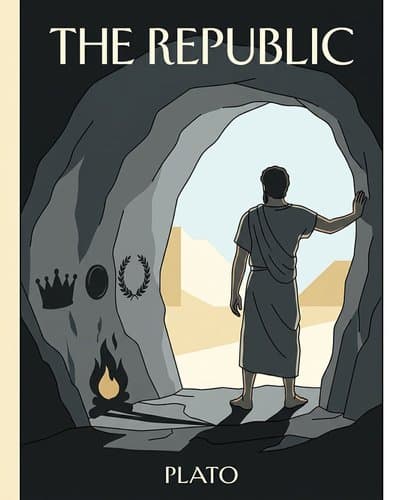
Picture the freed prisoner the moment he comes back down. He left the cave in pain — the light burned his eyes, real objects seemed less convincing than the shadows he'd spent his life reading. Slowly he adjusted: reflections first, then solid things, then the night sky, and finally the sun itself, which he came to understand as the source of everything visible. Now Plato says he has to go back. Descend the tunnel, re-enter the darkness, take a seat among people who've never moved.
He won't be welcomed. His eyes, readjusted to brilliance, will fail in the dimness. His former companions will be faster at the only skill they value: predicting which shadow follows which. They'll conclude the journey ruined him, and that anyone who tries the same route deserves to be killed.
What makes the allegory sting is how reasonable the prisoners are. They aren't stupid or malicious. They're experts at what they can see. Their problem is that what they can see is a wall of shadows cast by a fire, and they have no way to know it. The philosopher isn't smarter — or not only smarter. He's been somewhere they haven't. He's seen the thing that the shadows are shadows of.
And that's exactly why he doesn't want to come back.
Plato is explicit about this. Philosophers who've reached genuine understanding of what's truly real (what Plato calls the Good) find political life degraded. They're being asked to leave behind what's real and argue about representations of representations. Of course they'd rather not. Socrates calls their reluctance natural. He compares it to asking someone who's finally found sunlight to live underground again, among people who'll resent him for it.
The solution Plato proposes is compulsion. The state must require them to return and govern. Not because they want to, but because they owe it: they were educated at the city's expense, shaped by a community, and the law aims at the good of the whole rather than any single class's comfort. The most reluctant ruler is the best ruler precisely because he isn't governing to satisfy an appetite for power.
But notice what Plato leaves out. Who does the compelling? The philosophers haven't yet taken office; they're being compelled into it. Whatever authority compels them must already exist, must already be legitimate, must already know that these particular people are the ones who've genuinely seen the Good. Plato gestures past this problem rather than solving it. The paradox at the system's center isn't a flaw he missed. It's the tension he was honest enough to leave visible.
The Tyrant, Who Seems the Freest, Is the Most Enslaved Person Alive
Imagine a wealthy man with fifty slaves. In a city, he's protected. The whole legal order shields him. Now a god drops him in a wilderness, alone with those same fifty people and no law to enforce his authority. He has to start flattering them, making promises, cajoling the people he used to command, because now they decide whether he lives.
That's the tyrant's situation. He looks like the freest man alive: he has men killed by accusation, redistributes property, commands armies. But he's made himself so threatening that every capable or virtuous person near him is dead, exiled, or cowering. What's left are flatterers and people he's bribed. He cannot travel freely, cannot form a real friendship, lives (in Plato's words) like a woman hidden in a house, permanently surrounded by people who would destroy him the instant they could.
The deeper slavery is internal. The tyrannical soul is ruled by a master appetite that works exactly as the tyrant himself works over others: demanding to be fed, never satisfied, multiplying its demands. He spent his own inheritance first, then stole from his parents, then moved to burglary and temple-robbing. Every satiation produces more hunger. He is not a man who has desires; he is a man his desires have. The freedom that looked so enviable (license to do anything, answer to no one) is bondage to impulses that compound faster than they can be fed, with no ceiling and no peace.
Plato quantifies this with characteristic audacity — the king lives 729 times more pleasantly than the tyrant — and the claim underneath the number is serious: inner disorder is measurable as suffering. The tyrant isn't just less happy than the just man. He is the logical endpoint of what you get when appetite rules reason rather than the other way around: enslaved to insatiable wants, beholden to the worst people alive, beset by a fear that never lifts. He has everything except the one thing that makes having things good.
The Souls Who Choose Wrongly Do So From Habit, Not Malice
In the book's final pages, Plato imagines a soldier named Er who dies in battle, watches souls choose their next lives in the underworld, and returns to tell what he saw.
The man who draws the first lot rushes forward. He came from heaven, spent his previous life in a well-ordered state, and was considered virtuous by every measure. Now he faces a spread of lives — tyrannies, private lives, athletes, animals — and in an instant, without examining anything, seizes the greatest tyranny available. Only after choosing does he look at what he took. He is fated to devour his own children. He beats his chest and blames fortune, the gods, anything but himself. What failed him wasn't character. It was that he'd never practiced asking what makes a life worth having.
Plato's diagnosis is precise. The man's virtue was a matter of habit: he did the right things in an environment that rewarded them, without ever asking why. When the structure of that community was gone and the choice was entirely his own, there was nothing under the habits to guide him.
The prophet had announced it plainly: virtue is free, and each soul gets more or less of it depending on how they honor or neglect her. The responsibility belongs to the chooser. God is justified. But that warning only helps someone who already knows what to look for — which requires the very examination the man skipped.
The Republic's final answer, after ten books of argument, is a demand. Justice is worth having, but grasping why requires examination of what a good life is, not the luck of living in circumstances that make decency easy. The souls who choose badly in Er's vision aren't villains. They lived decently, never noticed it was an accident, and had nothing to fall back on when conditions changed. Habit, by itself, won't hold.
The Pattern Laid Up in Heaven
In the vision that closes the Republic, Odysseus draws the last lot and, without hesitation, picks the life everyone else passed over: quiet, private, belonging to no one. The man who spent twenty years clawing his way home, who watched companions die for glory that turned to ash — he's done. He knew what ambition cost because he paid it. That's Plato's final move, and it's a strange kind of dare. The ideal city may never exist. But its pattern, Socrates says, is available to anyone willing to look at it honestly — not as a political scheme but as a mirror. What's running your decisions: reason, reputation, appetite? Philosophy, in the end, is just refusing to let that be you.
Notable Quotes
“the wise to go to the doors of the rich”
“Better to be the poor servant of a poor master,”
“His mind has a soil deep and fertile, Out of which spring his prudent counsels.”
Frequently Asked Questions
- What is The Republic about?
- The Republic examines whether justice—properly understood as the right ordering of reason, spirit, and appetite within the soul—is the true basis of human happiness. Plato builds his case through politics, psychology, and metaphysics, showing why wisdom is the only legitimate foundation for authority. The work presents a sophisticated argument that internal order directly determines whether a person experiences genuine happiness or merely its illusion. Readers gain a rigorous framework for understanding their own psychological states and evaluating what actually makes a life worth living.
- How does Plato use the tripartite soul as a diagnostic tool?
- The tripartite soul—divided into reason, spirit, and appetite—provides a framework for diagnosing internal disorder in your own life. When you're consumed by appetite or reputation-chasing at the cost of what you actually know is right, you're experiencing in miniature the same disorder Plato says defines the tyrant's psychology. This diagnostic tool shows that justice is not merely an abstract ideal but a practical measure of psychological health. By understanding these three parts and their proper hierarchy, readers can evaluate their own decision-making patterns and recognize when the wrong forces are governing their choices.
- What does Plato say about leadership and power?
- Plato argues that those most qualified to lead are often least corrupted by the desire for power. He presents his famous reluctant-ruler paradox: people motivated by ambition for authority are precisely the wrong people to have it, since hunger for power clouds judgment. Instead, be suspicious of whoever wants authority most, and of any system that rewards the desire for power rather than the capacity to exercise it well. This principle extends beyond political systems to any domain where authority is distributed, revealing that wisdom and power should align only when power-seeking is absent.
- Why is Plato critical of democratic culture?
- Plato's critique of democracy centers on systemic corruption of independent judgment. The deepest danger isn't bad leaders but rather that public opinion becomes the only measure of good and evil, training everyone to track what the 'great beast' rewards rather than to think independently about what's actually true or good. This cultural pattern destroys the conditions necessary for wisdom and genuine justice. Citizens become enslaved to public sentiment instead of developing the rational self-governance Plato sees as essential to happiness and a well-ordered soul.
Related Book Summaries



Read the full summary of 30289_the-republic on InShort