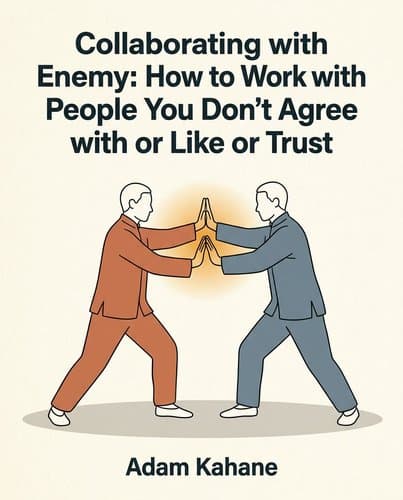
32478572_collaborating-with-the-enemy
by Adam Kahane
Real collaboration isn't about harmony or consensus—it's about staying in productive tension with people you may never agree with, like, or trust.
In Brief
Real collaboration isn't about harmony or consensus—it's about staying in productive tension with people you may never agree with, like, or trust. Kahane reveals why conflict-averse teamwork is itself a form of control, and how embracing your own complicity unlocks progress on the problems that matter most.
Key Ideas
Assess power dynamics before collaborating
Before choosing to collaborate, assess the power landscape honestly: collaboration makes strategic sense only when you genuinely cannot succeed alone and neither side has enough power to impose its will. Choosing to force, adapt, or exit is sometimes the accurate read of a situation — not a failure of principle.
Engagement replaces agreement on solutions
When a complex collaboration stalls, check whether you're demanding a single agreed-upon problem definition and solution plan. Wicked problems don't yield to this. The bar for moving forward together is not agreement on the answer — it's a shared willingness to keep engaging with the situation.
Recognize the seduction of enemyfying
Notice the emotional signature of 'enemyfying': the feeling of righteous certainty that the other party is the villain and you're the victimized hero. It's seductive because it simplifies a complex situation. It's counterproductive because it reproduces the dysfunction you're trying to fix.
Balance asserting with genuine engagement
Stretch collaboration requires both asserting (pushing for what matters to you) and engaging (genuinely opening to what others see). When you catch yourself stuck in only one mode — either keeping the peace at the cost of your position, or pushing so hard others stop engaging — consciously practice the other.
Sentence stubs expose communication modes
Use the four sentence stubs to catch your communication mode in real time: 'The truth is...' signals you're downloading. 'In my opinion...' signals debating. 'In my experience...' signals dialoguing. 'What I am noticing here and now is...' signals presencing. You cannot move toward creative listening without first noticing where you are.
Describe your role in stuckness
When a project feels stuck and your attention keeps going to what others need to do differently, write a second description of the situation from the inside — what you yourself are doing that contributes to the stuckness, and what you would need to change. This is the only description you can act on.
Who Should Read This
Business operators, founders, and managers interested in Negotiation and Leadership who want frameworks they can apply this week.
Collaborating with the Enemy: How to Work with People You Don't Agree with or Like or Trust
By Adam Kahane
12 min read
Why does it matter? Because the version of collaboration you've been taught is secretly a form of control.
The word "collaboration" practically glows with virtue. Of course we should work together. Of course the alternative (forcing, fighting, walking away) is worse. Adam Kahane spent twenty-five years designing high-stakes collaboration processes, bringing generals and guerrillas into the same room, brokering conversations across the fault lines of apartheid and civil war. And then he would go home and fail spectacularly with his own colleagues, sending three defensive emails in a row, nursing revenge fantasies for months, slowly realizing he was the enemy in his own story. The diagnosis he eventually reached is uncomfortable: the version of collaboration most of us believe in — find common ground, manage conflict, keep things civil — is itself a kind of control, and it breaks down precisely when it's needed most. What works instead is harder, stranger, and considerably less reassuring.
Collaboration Is One of Four Options — and Sometimes Forcing or Walking Away Is the Honest Choice
Most of the time, when someone says "we need to collaborate," what they mean is "we need to talk instead of fight." Collaboration gets treated as the civilized alternative to conflict — the path that good-faith people take and that only the dogmatic or power-hungry refuse. Adam Kahane spent years as a professional facilitator before he saw how badly this framing narrows the picture.
Collaboration is one of four responses available when people face a shared problem. They can collaborate, engaging across differences to create something none could build alone. They can force, using whatever power they hold to make others comply. They can adapt, which in practice usually means staying at the table while quietly lowering expectations about what's achievable. Or they can exit, withdrawing entirely. All four are legitimate. Each is rational under the right conditions.
The clearest illustration comes from the Sustainable Food Lab, a multi-organization project Kahane helped design to address global food system challenges. Three organizations declined to join, and each refusal was a coherent strategic decision. A large multinational chose to work independently; collaboration would have required sharing the proprietary knowledge that gave it competitive advantage, essentially subsidizing rivals. A labor union said it would participate once it had equal standing at the table, not before — joining from a position of weakness would have locked in the very asymmetry it was trying to escape. A government regulatory agency concluded that participating would compromise the independence it needed to enforce rules on the same companies it would have been sitting alongside. Each was reading its situation clearly and choosing accordingly.
The conventional view, that declining to collaborate signals bad faith, would have pressured all three to join anyway, producing dysfunction (the company sandbagging from inside), regulatory capture (the agency too entangled to act), or a union whose participation ratified its own marginalization. The right question is never "why won't they collaborate?" but "given their actual position, which of the four options serves them best?"
A union saying "not until we have equal power" is correctly diagnosing that collaboration under unequal power often functions as a sophisticated form of forcing with a friendlier face. A regulator stepping back is protecting the independence that makes it useful in the first place. The choice not to collaborate can be the most honest reading of a situation available. Kahane would come to recognize the same dynamic in his own partnerships, where he was the one failing to read the situation clearly.
Thirty Leaders Walk Into a Room, and Every Single One Begins with 'The Truth Is...'
In 2010, after months of violent clashes between pro- and anti-government factions in Bangkok, Kahane spent three days meeting with thirty of Thailand's top leaders: politicians, military figures, activists, and intellectuals from opposite sides of a conflict that had left people dead in the streets. He was there to understand what had happened.
What he noticed wasn't the disagreements. It was the sameness of how every single person began. Regardless of which side they'd been on, regardless of what they believed had caused the violence or who deserved blame, all thirty opened their account with the same phrase: The truth of this situation is...
Each person spoke with the quiet certainty of someone who had figured out what others had missed. Each held the definitive view. Which meant the other side needed to come around: listen, recognize their errors, accept correction.
The standard approach to collaboration works when a single correct answer exists. Gather the right people, establish a shared diagnosis, agree on a plan, implement it. In 1973, two social scientists named Rittel and Webber gave a name to problems where that precondition fails: wicked problems. What they meant is that some challenges resist a single agreed description and have no objectively correct solution. The model doesn't fail in those situations because it's applied badly. It fails because it assumes a shared truth the situation cannot provide.
Rittel and Webber explain the structural problem. What they don't explain is why people defend their version of events even after you point the flaw out. At a climate negotiation in Copenhagen, Kahane had a brief exchange with Anja Koehne, a Berlin researcher who had spent years studying political identity and why groups in conflict hold their positions even as negotiations collapse around them. She described a certain kind of national stubbornness with a phrase he said "penetrated me like an arrow": feeling superior as a condition of being. She meant that people clutch their rightness not because they've weighed the evidence carefully but because being right is part of how they hold themselves together. Admit you were wrong, and you don't just lose a point in the argument — you lose a piece of who you are.
The thirty Thai leaders weren't being dishonest or irrational. They were doing what people reliably do in high-stakes disagreement: protecting the self through certainty. Any collaboration model that requires surrendering that certainty demands something most humans can't give — and blames the people, not the design, when it fails.
The Expert on Collaboration Sent Three Defensive Emails — and Wished His Own Colleagues Would Disappear
November 2015, somewhere in Latin America. Kahane is three days into facilitating a workshop with 33 national leaders (generals, politicians, human rights activists, trade unionists), all brought together to address what the organizers called "the devastating nexus of insecurity, illegality, and inequality." The room is tense but functioning. People who normally won't speak to each other are cautiously starting to exchange views.
Then, on the final morning, the 11-person organizing team gets into an argument about what went wrong: methodological confusions, communication breakdowns. Some organizers think Kahane has done a bad job, and they circulate a critical note among themselves. One member forwards it to him.
What Kahane does next is the story. He sends one defensive email explaining why his choices were correct. Then another. Then a third. He knows he made some mistakes, but admitting them now feels dangerous. He decides the critics are villains. He stops wanting to resolve the conflict and starts wanting the people raising it to disappear.
He is, at this exact moment, in a 33-person room designed to break a national cycle of mistrust and fragmentation. Inside his own small team, he is generating mistrust and fragmentation. He is not modeling the alternative. He is enacting the problem.
Kahane names what he did "enemyfying": the habit of treating people you disagree with as enemies, not just opponents to be reasoned with but sources of harm to be neutralized. The grammar never changes: I see the situation clearly. You have a blind spot. They are the obstacle. It doesn't matter who's in each position. The move is always the same.
What makes enemyfying hard to resist is that it feels like clarity. It simplifies an overwhelming situation into something manageable: here are the good actors, here are the bad actors, now we know what to do. Mencken put it cleanly: there is always an easy solution to every human problem — neat, plausible, and wrong. Enemyfying is that solution. It feels righteous and energizing, which is why it narrows the space for actually solving anything.
The harder truth embedded in Kahane's three emails: the collaboration expert, the person whose professional identity rests on working across differences, did not respond to conflict by rising above it. He did what people reliably do. He assigned blame, protected himself, and wished his opponents would cease to exist. The book's most useful admission is not a framework or a methodology. It's that Kahane was simultaneously running a process to address a nation's dysfunction while reproducing that same dysfunction inside his own team. If the person with the most experience in cross-difference collaboration defaults to enemyfying under pressure, the question isn't whether you do this. It's when.
A Paramilitary Warlord Called Off an Assassination Because of a Guitar Night at a Scenario Workshop
Sometime in 1996, a scenario workshop in Colombia brought together guerrillas, paramilitaries, government officials, and business leaders to imagine possible futures for their country. One night they stayed up late playing guitar and sharing whiskey. Among them was Iván Duque, a commander with the AUC, the paramilitary organization responsible for thousands of murders. Also in that room was Jaime Caicedo, secretary general of the Colombian Communist Party, the kind of man the AUC killed for a living.
Years later, Kahane learned what the guitar night had made possible. Carlos Castaño, the AUC's notorious boss, had located Caicedo and dispatched fighters to kill him. Duque refused. "You can't kill him," he told Castaño. "We were on the Destino Colombia team together." The assassination was called off.
That story seemed to confirm everything Kahane believed about collaboration at the time: that bringing enemies into the same room, getting them to connect as human beings, was what did it. People who had shared a table and a guitar couldn't murder each other. The relationship was the intervention.
But Kahane carried a nagging counterexample he couldn't explain. In 2008, a Guatemalan activist named Clara Arenas told him that she and her colleagues had taken out a full-page newspaper ad announcing they were done with dialogue. Their reasoning wasn't emotional. It was structural. The price of a seat at the table was demobilization. You couldn't participate in government-sponsored dialogues while also organizing strikes and marches against the government. Dialogue was functioning as a trap: join us in conversation, and stop causing us trouble.
Kahane respected Arenas and knew she was pointing at something real. But he couldn't fit it into his framework, so he filed it away as an unresolved tension.
The clarity came later, watching Thailand's military stage a coup that cited the need to suppress street protests so that orderly dialogue could resume — peace, and suffocation, at once.
The reframe crystallized. Engaging (listening, building connection, opening to what others see) is one drive. Asserting (pushing for what matters to you, fighting for your position) is the other. Both are necessary. Neither can be chosen at the expense of the other. For Arenas's colleagues, asserting meant organizing the strikes and marches that gave them leverage; engaging meant taking a seat at the table where that leverage could be used. What Arenas understood was that dialogue without the right to assert is just an elegant form of control. Her colleagues weren't rejecting collaboration because they were stubborn or unreasonable. They were protecting the lever that gave their voice any weight at all.
The guitar night in Colombia didn't work because Duque and Caicedo reached agreement. They almost certainly held irreconcilable views about guerrilla struggle, land reform, and how to build a just society. What the workshop created wasn't consensus; it was a bond strong enough to override a kill order. The metric isn't alignment. It's whether something real happens that wouldn't have happened otherwise.
Former Bogotá mayor Antanas Mockus put the bar precisely: "The most robust agreements are those that different actors support for different reasons." People don't need to want the same thing or believe the same story. They need enough of a shared stake in the situation to keep working on it. That's not a lower standard than harmony. It's the only standard that survives contact with the kind of conflict where the issues actually matter.
You're Not Stuck in Traffic. You Are Traffic.
When you're late to a meeting because of traffic, the standard explanation is passive and blameless: something external happened to you. But if you say "I'm late because I am traffic," the grammar shifts completely. Now you're inside the system, contributing to the same congestion slowing everyone else down. And the only question with any leverage becomes: what might I do differently?
That shift — from observer to participant, from "they" to "we" to "I" — is the third and hardest stretch. Kahane found it most clearly in his own failure.
In 2005, he led the Bhavishya Alliance, an ambitious coalition of twenty-six organizations working to reduce child malnutrition in India. They assigned fifty-six staff members to collaborate full-time for eight weeks, building initiatives that could actually move the needle. As the deadline closed in, Kahane's leadership contracted: he gripped the plan tighter, pushed harder, distanced himself from the team's actual experience. On the final day, proposals went to the organization heads — and almost none were approved. The team felt blindsided. Kahane felt devastated and then, for months afterward, furious. He catalogued every way he had been mistreated. He understood he'd made some mistakes, but he was waiting for the others to own theirs first.
Then he came across a pamphlet by Martin Buber that cut through everything. Buber wrote that seeing yourself only as one individual set against others was the fundamental error — the only place to begin is with yourself, not after others do, not when it's fair, but first.
Kahane recognized the error exactly. He had been tracking what others owed him rather than asking what he had contributed and what he might do differently. The second question is the only one that produces any leverage.
This doesn't mean you're always wrong or always at fault. It means the question "what must I do next?" is the only one over which you have any control. Focusing on what they should do keeps you in the spectator position, watching the play, wishing the actors would perform better.
Wolfe Lowenthal, a tai chi instructor writing about push hands — a partner exercise — put the inversion cleanly: when you can't deal gently with a hard opponent, that difficulty reveals your own stuckness, not theirs. The adversary you find most frustrating is the most useful one you have. They show you exactly where you haven't stretched yet.
Your enemies can be your most useful teachers. That's not consolation. It's a practice instruction.
Your Hardest Opponent Is Your Most Useful Teacher
Kahane is honest about the prerequisite for any of this: none of it works while you're still clutching your own rightness. The moment you feel most certain that the other person is the problem, you are the furthest from being able to do anything about it.
What the push-hands teacher understood — and what Kahane took years and several embarrassing chapters of his own life to learn — is that your most infuriating opponents are not in the way of the work. They are the work. Their resistance finds exactly the places where you're still braced, still guarding, still unwilling to move. In practice that might look like sitting across from someone whose logic you find maddening and, instead of reaching for your counter-argument, noticing the specific thing in you that needs to win. The discomfort never fully resolves. You just get quicker at noticing what it's pointing at.
Notable Quotes
“After listening to Ochaeta's story, I understood and felt in my heart all that had happened. And there was a feeling that we must struggle to prevent this from happening again.”
“I am firm, you are obstinate, he is a pig-headed fool.”
“I see things differently, you are wrong, she is the enemy.”
Frequently Asked Questions
- When should you actually collaborate with people you disagree with?
- Collaboration makes strategic sense only when you genuinely cannot succeed alone and neither side has enough power to impose its will. Assess the power landscape honestly before choosing to collaborate—"Choosing to force, adapt, or exit is sometimes the accurate read of a situation — not a failure of principle." This means not all difficult relationships warrant collaboration. Sometimes the most strategic choice is disengagement or unilateral action. The decision should rest on genuine mutual dependency and realistic power analysis, not on assumptions that collaboration is always preferable.
- How do you move forward when a complex collaboration feels stuck?
- When collaboration stalls on complex problems, check whether you're demanding a single agreed-upon problem definition and solution plan—wicked problems don't work that way. "The bar for moving forward together is not agreement on the answer — it's a shared willingness to keep engaging with the situation." Release the expectation that consensus on the problem or solution is necessary. Instead, focus on maintaining genuine engagement with other parties even amid persistent disagreement. This fundamentally shifts what success means in collaborative work.
- What does 'enemyfying' mean and why should you avoid it?
- "Enemyfying" is the emotional pattern of feeling "righteous certainty that the other party is the villain and you're the victimized hero." It's seductive because it simplifies a complex situation, but "It's counterproductive because it reproduces the dysfunction you're trying to fix." When you notice this emotional certainty arising in yourself, pause and recognize your own complicity in the situation's dysfunction. Moving beyond the simplified villain-and-victim narrative is essential for genuine collaboration and breaking the cycles that perpetuate conflict.
- What are the four communication modes Kahane identifies for difficult collaborations?
- Kahane identifies four communication modes you can catch using sentence stubs: "The truth is..." signals downloading (stating your position), "In my opinion..." signals debating (arguing for your view), "In my experience..." signals dialoguing (sharing what you've learned), and "What I am noticing here and now is..." signals presencing (observing the present). "You cannot move toward creative listening without first noticing where you are." Stretch collaboration requires both asserting what matters to you and genuinely opening to what others see—practice the opposite mode when stuck.
Related Book Summaries
Read the full summary of 32478572_collaborating-with-the-enemy on InShort