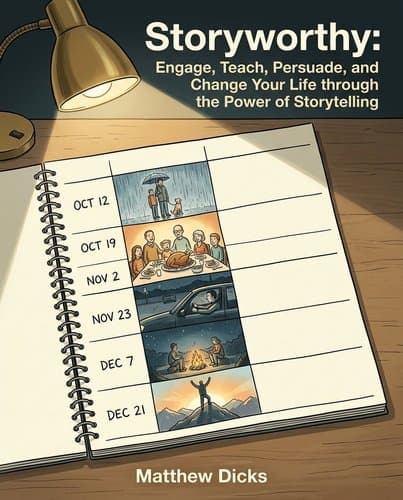
37786022_storyworthy
by Matthew Dicks
Every powerful story hinges on a single five-second moment of genuine change — and training yourself to find those moments in your ordinary, uncomfortable…
In Brief
Every powerful story hinges on a single five-second moment of genuine change — and training yourself to find those moments in your ordinary, uncomfortable, embarrassing days will make you both a magnetic storyteller and someone who actually notices their own life.
Key Ideas
Daily documentation trains the story-finding eye
Start a two-column spreadsheet today: date in the left column, a one-to-two sentence description of the single most storyworthy moment from your day in the right. Five minutes max. Do this every day. The habit doesn't find stories — it trains the eye that finds them.
The five-second moment defines everything
Every great story reduces to one 'five-second moment' of genuine change — a tiny instant when the teller became a different version of themselves. Find that moment before you find anything else. Until you have it, you don't have a story, only events.
Start at emotional opposite of climax
Begin your story at the emotional opposite of your five-second moment. If you exit understanding that friends can replace family, open in a moment of genuine loneliness. The arc is the argument.
Name the elephant within 30 seconds
Name your story's central need, want, or problem within the first 30 seconds — Dicks calls this the Elephant. Without it, the audience has no reason to lean forward. They'll be politely waiting for you to get to the point.
Bury key details to surprise audiences
Surprise is the only mechanism that makes a listener cry. Bury your story's most important detail inside clutter or disguise it with a laugh. If you flag it, you've already defused it.
Withhold resolution to extend impact
Never end on your own redemption. Withholding the tidy resolution keeps the coat on — audiences carry a story longer when the world is still slightly broken at the end.
Use causation, not mere sequence
Connect your story's scenes with 'but' and 'therefore,' not 'and.' Causation is story. Sequence is a list.
Vulnerability grants others permission to share
When you share something difficult and true in public, you give other people permission to share what they've never told anyone. The real stakes of learning to tell your story aren't on any stage.
Who Should Read This
People working on personal growth in Public Speaking and Persuasion, especially those tired of generic motivational advice.
Storyworthy: Engage, Teach, Persuade, and Change Your Life through the Power of Storytelling
By Matthew Dicks & Dan Kennedy
11 min read
Why does it matter? Because your most extraordinary experiences are probably your weakest stories.
Your instinct says the person with the most dramatic life has the most to say. It's a reasonable instinct. It's also completely wrong. Matthew Dicks — who eventually wrote this book with journalist Dan Kennedy — has died twice, had a gun pressed to his temple, survived wrongful arrest, and was once homeless. None of that made him a great storyteller. What did was learning to pay a certain kind of attention: to the moment his dog looked up at him in a rainstorm, to the flash of jealousy he felt toward a teammate, to the tiny, shameful things most people would rather forget. This book is the method he built for capturing those moments, understanding why they move people, and shaping them into something an audience will still be thinking about days later. Your extraordinary life is not the prerequisite. Your ordinary Tuesday is.
Your Most Dramatic Experiences Are Probably Your Worst Stories
Matthew Dicks is sitting at a wobbly table in the Nuyorican Poets Café in Manhattan, praying the host doesn't call his name. Nine names have been drawn from the tote bag on stage. His isn't among them. He's already composing the story he'll tell his friends — heroic attempt, name stuck in the bag, dignity intact — when Dan Kennedy reads the final slip: "Matthew Dicks."
He doesn't move. His plan: stay perfectly still until the host assumes no one answered and draws another name. It has already happened once tonight. Then his wife Elysha's foot finds his shin.
His friends had pushed him here for two years, convinced his life was extraordinary material. He'd been resuscitated by paramedics twice. Pulled from a burning house by firefighters. Arrested and tried for a crime he didn't commit. A gun pressed to his head, the trigger pulled. They were certain a man who had literally died on the side of a road had stories to tell.
He wins on a story about wanting his high-school pole-vault teammate to fail, wanting it badly, pettily, so he'd look better in front of the rest of the team.
That gap is Dicks's central argument. The dramatic biography his friends catalogued was supposed to be the asset. It turned out to be nearly irrelevant. What connected wasn't any of those experiences: a confession of small, embarrassing jealousy that everyone in that packed room had felt.
He sees the same gap in his car-crash story: no one cries when he describes his head going through the windshield, but the tears come when the emergency room doors open and his friends, teenagers in ripped jeans, are standing in the doorway waving — because his parents had gone to check on the car first. The crash happened to one person. That moment at the ER doors happened, in one form or another, to most of the room.
The Five-Minute Daily Practice That Teaches You to See Your Own Life
Homework for Life is how you stop waiting for the dramatic moment and start seeing what's already there.
It's 2 AM and Dicks is on Main Street in Valentine-themed satin boxer shorts (a gift from his mother-in-law, a detail he prefers not to think about), being drowned by a sudden downpour his dog Kaleigh apparently saw coming. She had led him out of bed, around the block, and onto the busiest street in town, looking riotously happy the whole time. Dicks stood on that corner, soaked through, with two sides of the block still to walk, and he did something he hadn't been capable of five years earlier: he stopped, looked down at her, and recognized what he was actually looking at. Kaleigh was fourteen. She'd already survived a ruptured disk and back surgery. This might be the last time they ever walked in the rain together.
That shift (from "I am being punished by a dog" to "this is beautiful and I need to hold it") didn't happen by accident. It happened because Dicks had been practicing Homework for Life: every evening, sitting down and asking himself one question. If he had to tell a five-minute story from today, what would it be? Not the most dramatic moment — the most storyworthy one, even if it seemed trivial. Then writing it in two columns on a spreadsheet: the date, and the scene in a sentence or two. Just enough to find his way back.
That night's entry read: Walked Kaleigh. 2:00 AM. Underwear. Birds. Rain. Beauty.
Beyond stockpiling material, the practice develops a lens that works while you're still inside the moment. On that corner, the lens was working. So when he looked at Kaleigh's wagging tail in the downpour, a memory surfaced that he hadn't touched in decades. He found himself thinking about Measleman, the beagle from his childhood, and then realizing for the first time as an adult, not a boy, what his father had actually lost when his parents split. Not just the house and the family. The dog too — the dog that went to the man who had taken everything else. He had never framed it that way until that corner, in the rain, with Kaleigh.
That's the hidden engine of the practice. It captures the present and cracks open the past. Memories you didn't know you'd lost come back as the lens sharpens. Dicks now has more than five hundred untold story ideas after six years of nightly entries, but the ones that move him most are the recovered ones: the moments that were already gone until the habit brought them back.
Two columns, five minutes, every night: a date and a scene in a sentence or two, just enough to find your way back. The result, Dicks says, is that time stops evaporating; you stop saying "I can't believe that was a year ago" because you haven't lost a day to forgetting.
Every Great Story Is Really About One Moment That Lasted Five Seconds
Think of a story the way most people think of a road trip: the experience is the journey, the accumulation of miles and detours and scenery. By this logic, a better trip means more ground covered, more remarkable sights. But Dicks argues that's exactly wrong. A story isn't a road trip — it's a photograph. And the photograph is always of one moment: the instant the light was perfect and something true was visible. Everything else is just getting to that spot.
Dicks calls this the five-second moment: a genuine instant of human transformation. Not an event. Not a sequence. Not even a scene. One heartbeat of change: falling in love, finding forgiveness, discovering something about yourself that rewrites everything you thought you knew. Every detail in a story exists to bring that moment into focus. Cut anything that doesn't serve it. Strengthen anything that does.
His clearest example is Jurassic Park. Most people assume the film succeeded because the dinosaurs looked real for the first time — the technology was genuinely new and the creatures were terrifying. But the dinosaurs aren't the story. They're enormous and exciting, good for building suspense, but not the reason the film still works.
Jurassic Park is about a paleontologist named Alan Grant who cannot bring himself to like children. His partner Ellie wants more than what they have, and children are the wall between them. Grant calls kids noisy, expensive, smelly. In the film's opening scene, he shows his contempt by using a fossilized velociraptor claw to terrorize a boy at a dig site.
Surviving the island, Grant ends up responsible for two children. He saves their lives. They get into his bones.
The story ends in a tree at night, with both kids tucked against him. Tim delivers a terrible dinosaur joke. Grant laughs. Actually laughs. Lex asks if he'll stay awake all night to protect them. He says yes. Then Grant reaches into his pocket, pulls out the velociraptor claw, and lets it fall to the ground.
That's the film. Grant has evolved (a word that fits him exactly), and everything that follows is housekeeping: velociraptors in the kitchen, an electric fence, an escape. Exciting, but finished. The story was over in that tree, in that laugh, in a fossil hitting the grass.
Grant used the claw at the start to frighten a child he despised. By the end he drops it because he's holding something he didn't expect to want. It carries the transformation in something small enough to see.
Strip the island away and you still have a story. Strip the transformation away and you have expensive special effects. The smaller and more specific the moment, the more universal the connection — the man learning to love children travels everywhere that the dinosaurs can't.
Your Ending Is Already Written — It Tells You Where to Begin
The five-second moment is the blueprint for where the story starts. Once you know your ending, your beginning writes itself: find the emotional opposite of where you'll land, and open there.
Dicks proves this with "Charity Thief," a story about the night he stole change from a stranger's doorstep to buy gas home. It ends with a revelation: he has been wallowing in self-pity while the widower he just deceived will be alone behind his blue door for many nights to come. The ending is I know nothing about real loneliness. So the opening must place him in the opposite condition — certain he is uniquely, hopelessly alone. He's twenty, a McDonald's manager at $7.25 an hour, with a mother on welfare, a missing brother, an absent father, and not a single person he can reach by phone. Gripping the steering wheel at a Citgo station, staring at fall foliage, he imagines his future as an unbroken chain of moments when he'll need help and find none. The arc only works because the two poles point in opposite directions.
The second rule refines the first: start as close to the ending as possible. Dicks once opened a car-rental story at a Connecticut airport, then revised it onto the plane, then into the Boca Raton terminal, and finally to a rental counter feet from where the scene would resolve, cutting two airports, a flight, and 1,200 miles of setup. The reason is practical. Written stories sit still; readers can pause and catch up. Spoken stories keep moving, and every unnecessary scene is time listeners spend treading water instead of following.
Find the opposite. Start there. Then get as close to the ending as you can.
Audiences Don't Follow Stories — They Follow Stakes
Getting the structure right tells you when to pause. Getting the audience to care before you start pausing — that's a different problem.
Why do some stories hold you hostage while others let your mind drift to what you're having for dinner? The answer isn't quality of experience — it's whether the storyteller gave you something to want from the start.
Dicks calls this the Elephant: a named need, want, or problem within the first thirty seconds. Die Hard plants one before a single shot is fired. McClane arrives carrying an oversized stuffed animal, his wife's housekeeper is told to make up the spare bed "just in case," and he explains he didn't move west. That's the Elephant: a marriage failing from opposite coasts. The terrorists and the explosions are just stakes layered on top of that original one. When McClane removes his wife's Rolex at the end, both problems resolve at once.
Stakes tell the audience what to want. Surprise is how you pay it off — and the two only work together if the important moment stays hidden. In real life, grief and love produce tears on their own. In storytelling, you only have words, and words have to manufacture surprise or they produce nothing. The most important moment in your story should be hidden so well that the audience doesn't know it's the important moment until it goes off.
Dicks illustrates this with a story about the time his girlfriend's father served him his own pet rabbit as Thanksgiving stew. To protect the reveal, he buries it inside a list of desperate attempts to impress a formidably masculine man — someone who kept rabbits out back and thought of them as food, not pets. The rabbit is just one item in a long inventory, mentioned in passing, almost funny. When the man asks what he thinks of the stew, the audience still doesn't know what they've been hearing. A second later, they do. The most important detail was the bomb. It had to feel like nothing at all.
Telling the Truth Requires Knowing What to Leave Out
Outside Housing Works bookstore in New York, Dicks steps onto wet cobblestones replaying the evening. He'd just told "Charity Thief" at a Moth StorySLAM (the story of deceiving homeowners into giving him gas money) and he'd just lost by a tenth of a point. Then hands grabbed his shoulders from behind. George Dawes Green, The Moth's founder, spun him around.
"You ruined that story. Don't ever tell that ending again. No one wants redemption. Everyone wants the clown."
The ending Green meant: after the story, Dicks had spent years sliding dollars into McDonald's charity canisters until he'd repaid $604, twenty times what he'd stolen. Elysha finally told him he could let it go. He'd included it in the performance. It felt like the honest thing to do.
It cost him the win. And Green was right.
Dicks's metaphor: a story is a coat you put on the audience. The goal is to make it impossible to take off. Tell them the debt is paid and the world is whole again. The coat slides right off. Withhold the redemption, and the world stays broken in their minds. Days later, they're still thinking about the man who stole from a widower and never made it right. The coat clings.
Dicks calls these moves permissible lies: strategic manipulations of true material for the audience's benefit. You cut the hitchhiker Randy from "Charity Thief" because knowing he's hiding behind a tree puts the audience behind the tree, not on the porch with the widower. You reorder events so laughter lands before tears, because that sequence hurts more — laughter drops the audience's guard, so the grief arrives without armor.
One rule covers all of it: never add something that wasn't there. Manipulate what exists. Cut anyone who doesn't serve the five-second moment. End before the bow gets tied.
The complete record isn't the truest story — it's just the longest one.
The Storyteller Who Bares Their Soul Becomes Someone Others Trust With Theirs
After a storytelling show, a woman is waiting for Dicks at the foot of the stage. She wants to tell him something. She has never told anyone that she was pregnant, and she has never told anyone that she lost the baby. She tells him first.
This happened four separate times. Four women, four shows, four secrets no one else had ever heard, and in each case Dicks was the first. He called his wife Elysha after the first one, baffled. Her explanation stopped him cold: when you stand on a stage and talk honestly about your own worst moments, you don't just perform for people — you become safe to them. The woman can unburden herself to someone she knows she can trust, then walk out the door and never see him again. The intimacy is real, but the stakes of it are low. She gets to lay something down and keep walking.
Every technique — the five-second moment, the Elephant, the permissible lies, the strategic placement of humor before grief — serves this: the audience stops watching you and starts trusting you. And once they trust you, they fill the space your vulnerability opened with their own.
Dicks sees this in his classroom too. He tells his students about the time he was arrested. The next morning, a boy quietly mentions that his father is in prison. The vulnerability in the room gives permission for more of it.
Storytelling, it turns out, is not a performance skill you deploy on stages or in conference rooms, though it works there too. It's a way of moving through the world that changes how people experience you. You learn to see your own life clearly enough to speak honestly about it. In return, people bring you things they've been carrying alone.
The Moment You've Already Lived Without Knowing It
The spreadsheet Dicks asks you to keep isn't really about stories. It's about refusing to let your life disappear on you. Most days evaporate — you couldn't say what happened Tuesday two weeks ago if someone offered you money. The practice forces a different relationship with ordinary time: you look at your day and ask what actually mattered, and slowly, the looking changes what you see. A wet sidewalk at 2 AM stops being an inconvenience and becomes something you'll remember when you're old. The small, embarrassing truth you've been sitting on starts to feel less like a liability and more like a door. And when you finally walk through it in front of other people, they walk through theirs. That's the whole return on investment. Not a better story. A life you were actually present for.
Notable Quotes
“Yes, the actual Ten Commandments. The original stone tablets that Moses brought down from Mount Horeb and smashed, if you believe that sort of thing.”
“If you believe that sort of thing.”
“Who knows . . . lightning . . . fire . . . the power of God or something.”
Frequently Asked Questions
- What is the five-second moment in storytelling according to Storyworthy?
- The five-second moment is the single instant of genuine personal change at the core of every story. According to Dicks, "every great story reduces to one 'five-second moment' of genuine change — a tiny instant when the teller became a different version of themselves." You must identify this moment before developing anything else, because without it, you don't have a story, only events. This moment is the emotional core that transforms a sequence of incidents into a meaningful narrative that can move and persuade your audience.
- How do you find stories to tell using the Storyworthy method?
- Start a two-column spreadsheet and record the date on the left and a one-to-two sentence description of the most storyworthy moment from your day on the right, spending five minutes maximum. According to the book's key takeaway, "The habit doesn't find stories — it trains the eye that finds them." Over time, this daily practice sharpens your awareness of the small, meaningful instances of change and emotion that make compelling narratives. You'll develop the ability to recognize storyworthy moments as they happen, transforming your daily life into a rich reservoir of material for powerful stories.
- How should you structure a story according to Storyworthy?
- Structure your story by beginning at the emotional opposite of your five-second moment—if your story shows that friends can replace family, open in genuine loneliness, because "the arc is the argument." Name your story's central need, want, or problem within the first 30 seconds; Dicks calls this the Elephant, which gives your audience a reason to listen. Connect scenes with "but" and "therefore," not "and." Causation is story. Sequence is a list. Finally, never end on your own redemption; withholding resolution keeps audiences carrying your story longer.
- Why is surprise important in storytelling according to Storyworthy?
- Surprise is the only mechanism that makes a listener cry. You must bury your story's most important detail inside clutter or disguise it with laughter—if you flag it explicitly, "you've already defused it." When you share something difficult and true in public, you give other people permission to share what they've never told anyone. The real stakes of learning to tell your story aren't on any stage; they're in giving others courage to be vulnerable. Storytelling becomes a bridge between isolation and authentic human connection.
Related Book Summaries
Read the full summary of 37786022_storyworthy on InShort