57190925_do-walk
by Libby DeLana
Every rubber-soled step silently severs your body's electrical circuit with the Earth—the same circuit that regulates inflammation, cortisol, and sleep.
In Brief
Every rubber-soled step silently severs your body's electrical circuit with the Earth—the same circuit that regulates inflammation, cortisol, and sleep. Twenty minutes barefoot on soil, sand, or grass each day may be the simplest, most evidence-backed health intervention modern footwear quietly took from us.
Key Ideas
Daily barefoot walking on earth
Walk barefoot on natural or conductive ground (grass, soil, sand, concrete) for 20–30 minutes daily. Rubber, vinyl, and synthetic flooring block all electrical transfer — the surface material is the whole variable.
Water conducts Earth's natural electrical charge
Use water as a grounding medium: ocean swimming, lake wading, mineral hot spring soaking, or holding a running metal faucet all conduct Earth's charge, provided the water flows through metal pipes into the ground.
Conductive sleep mats enable overnight grounding
A conductive sleep mat connected to a wall ground port delivers continuous overnight grounding — the format most studied for chronic pain, cortisol reduction, and sleep quality improvement.
Audit electromagnetic load at workstations
Audit your workstation's EMF density. Multiple wireless devices and screens concentrated in a small space create a compounding electromagnetic load that Step Sinatra's case suggests is distinct from any single device's known risk.
Leather soles restore natural electron transfer
Shift toward leather-soled or purpose-made conductive footwear for daily walking. Standard athletic and rubber-soled shoes block all electron transfer — the problem the book traces to mass adoption in the 1950s.
Combine grounding with anti-inflammatory PAMM diet
Combine daily grounding with the PAMM diet: olive oil, cold-water fish, vegetables, legumes, and elimination of refined sugar and white flour. Both interventions target the same downstream problem — chronic inflammation — through different entry points.
Low-intensity outdoor time boosts mental health
Low-to-moderate outdoor activity (walking, gardening) improves self-esteem more than high-intensity exercise outdoors. The intensity minimum for grounding's psychological benefits is lower than most wellness practices require.
Who Should Read This
People working on personal growth in Fitness and Sleep, especially those tired of generic motivational advice.
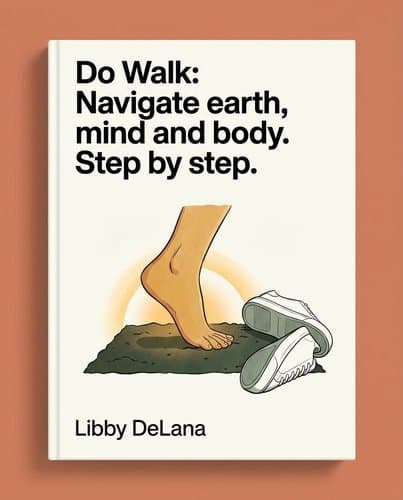
Do Walk: Navigate earth, mind and body. Step by step.
By Libby DeLana
9 min read
Why does it matter? Because the most evidence-backed health practice may be the one you abandoned the day you put on your first pair of rubber-soled shoes.
Medicine has spent billions trying to solve chronic inflammation — the slow fire underneath heart disease, diabetes, autoimmune collapse, the diseases that now define modern life. It has studied diets, drugs, sleep protocols, stress interventions. What it largely ignored was a variable so fundamental, so embarrassingly simple, that it got dismissed before it could be seriously tested: whether your body maintains electrical contact with the ground you stand on. Somewhere in the postwar consumer boom, rubber-soled shoes replaced leather, and the circuit quietly broke. Nobody announced the change. Nobody measured what it cost. The evidence that followed — peer-reviewed, double-blind, and in one case carried by a cardiologist to the edge of his own death — suggests the cost has been steep. This is a book about what happens when you reconnect.
Chronic Inflammation Has a Missing Variable: The Electrical Circuit Modern Footwear Cut
The diseases that define modern health — diabetes, heart disease, chronic inflammation — arrived in force at a specific moment in history, and the timing points somewhere unexpected. Not to fast food, which came later. Not to sedentary screen life, which came later still. The timing points to shoes.
Dr. Stephen Sinatra spent fifty years as a cardiologist watching inflammatory disease rates climb. When he mapped the trajectory against what he knew about grounding, something locked into place: diabetes incidence in the United States tracked almost perfectly with the expansion of rubber-soled athletic footwear, both curves bending sharply upward from the 1950s onward. That isn't coincidence. Earth's surface carries a mild negative charge, a reservoir of free electrons. When skin touches ground, those electrons move into the body and neutralize the positively charged molecules that drive inflammation. Rubber stops that transfer. When shoe manufacturers replaced leather soles with synthetics in the 1950s, they created a permanent electrical barrier between the human body and the ground it walked on. The exchange stopped. Most people alive today have never experienced a day without that insulation.
A Navajo elder named Hosteen Begay called asphalt "the curse of the white man." He wasn't speaking metaphorically. He was describing a severance that came in one rubber sole at a time.
A Canadian research team tested the mechanism directly. Two groups of rats, fed identically: one grounded, one not. Over months, the grounded rats consistently showed lower blood sugar. Same food. Different electrical connection. Different metabolic outcome.
Today, more than 130 million Americans have diabetes or pre-diabetes, roughly one in three people. Diet contributes. Inactivity contributes. But a cardiologist with half a century of practice argues that a product sold at the neighborhood sporting goods store removed a biological input the body had always counted on, and nobody thought to replace it.
You have been walking on rubber your entire life.
Dave Asprey Did the Same Experiment Twice and Got Opposite Results — He Had the Wrong Variable
What those statistics describe at scale, Dave Asprey lived out in two London trips. He was flying California to Cambridge every month, and the jet lag was destroying him. On his first arrival, London offered something rare — actual sunshine. He took his mat to a park, went barefoot on the grass, and worked through a yoga session. No jet lag. No sore joints. His thinking was sharp. He wrote it down as a solved problem: post-landing exercise resets the body's clock.
The next trip, the city returned to form: gray, damp, the kind of overcast that drives you indoors. He exercised on carpet. His joints ached. His brain ran slow. The jet lag hit harder than ever. Same exercise. Same duration. Opposite result.
Asprey, who trained as an engineer before becoming a biohacker, eventually found Dr. Sinatra's research on grounding and rewrote his conclusion. It had not been the exercise at all. The variable was his bare feet on the earth. The grass had been the treatment. Carpet was the control.
You can trust the reasoning and still notice what he missed: outdoor sunlight, fresh air, open sky, and bare contact with real ground all changed between those two trips at once. An engineer should know when four things changed at once. The earth may well be the critical factor (the prior section makes a serious case for the electron exchange), but this experiment cannot isolate it. Asprey selected one variable from four. His story is memorable precisely because it sounds like a controlled test, and it almost is.
What it does establish: something physical changes when you stand barefoot on actual earth in natural conditions, and rubber soles on an indoor floor do not replicate it. Whether that something is electrons, sunlight, fresh air, or all three combined remains open. The effect of losing it, apparently, does not.
The Doctors Ran Every Test. No Cancer, No HIV, No Lyme. The Cause Was His Desk.
Step Sinatra had nine or ten computers on his desk, and a dozen more at the desks pressed against his on the trading floor. He often worked with two cell phones, one at each ear. The days ran seventeen hours, seven days a week, with wires running beneath his feet. Fifty traders in a room so saturated with electromagnetic frequency it registered, though nobody measured it, as its own kind of environment. He was twenty-two years old and making a million dollars.
By twenty-six, he weighed 87 pounds.
The collapse was slow enough that he explained it away: stress, bad diet, not enough sleep. He quit the trading desk and moved to Colorado, then Hawaii, then California, chasing recovery. His weight kept falling. He tried a raw food clinic in Florida, where he lost another 45 pounds in a single month — a third of his body weight. His veins had shrunk so badly the physician treating him couldn't insert an IV. His father, Dr. Stephen Sinatra, arranged emergency transport on a private jet to a Connecticut hospital that specialized in a cardiac catheter procedure previously used only on premature infants. One bed remained when they arrived.
The hospital ran every test available. Leukemia — no. Cancer — no. HIV — no. Lyme disease — no. Every diagnosable condition returned negative. The doctors told him he had a 1% chance of surviving the night. The cause, as far as standard medicine could determine, did not exist.
That is the diagnosis modern medicine cannot write. Not a pathogen with a name, not a tumor with a location. A sustained, years-long environmental assault on every system of the body (metabolic, endocrine, immune) that left no fingerprint medicine could read. The body breaks down; the tests come back clean; the cause is still in the room.
Step survived. His recovery required two changes: removing the technology and returning to the earth. Not medication, not surgery. He removed the environmental input and restored the biological contact that had been absent for years. He eventually grounded so deliberately that he ran a copper wire from the Mediterranean Sea into his house so he could sleep connected at night.
The surgeons told him he would never urinate normally or have a normal erection — both, in their assessment, permanent. He refused both predictions. Within three months, both had resolved.
His case established what standard diagnostics were structurally unable to see: chronic, high-density EMF exposure can produce total systemic collapse without a single identifiable disease marker. The cause was his desk. The treatment was dirt.
He spent a decade and every dollar he had earned chasing a cure across continents. The answer, when he found it, cost nothing. He would later use the word a cardiologist would reach for: "The best healing modality," he said, "was right under my feet."
Nine Participants Had Ketchup in Their Veins. The One Who Grounded Daily Had Red Wine.
Clint Ober — the former cable installer who first proposed that people needed to be grounded the way electrical systems are — kept excusing himself. Every fifteen to twenty minutes, he stepped outside in bare feet, stood on the ground, then came back in. The nine other people in the room, most of them medically trained and including Dr. Stephen Sinatra, stayed seated throughout. None of them knew there was a cordless phone hidden somewhere nearby. None of them could feel the frequency it was putting out. Then they all held out their arms and had blood drawn.
Under the microscope, nine samples showed blood with the consistency of ketchup. Ober's moved like red wine.
The difference, Sinatra argues, was the twenty years of daily grounding and the barefoot breaks Ober kept taking during the session itself. Ketchup-thick blood is a clinical risk marker: it clots more readily, inflames vessel walls, and forces the heart to pump harder. Blood that flows freely delivers oxygen efficiently and resists the micro-clotting that precedes cardiovascular events. After the blood draw, the group went outside, took their shoes off, and walked on grass and concrete, avoiding asphalt, which they say blocks electron transfer. Back inside, they retested. Everyone's blood had thinned.
A demonstration with ten people in a room is not a clinical trial, and Sinatra knows it. He followed it with a proper double-blind study conducted alongside researcher Gaétan Chevalier: twenty-four subjects, controlled conditions, blood viscosity down 283% after two hours of grounding. The study was published in a peer-reviewed journal in 2013. The authors connect it directly to COVID-19: the disease killed through pulmonary blood clotting, and grounded patients in an Iraqi hospital study recovered faster across nine symptom categories, including fever, chest pain, and difficulty breathing, with fewer clots.
The blood was just the beginning. A study in Integrative Medicine: A Clinician's Journal measured heart rate variability in 27 subjects after twenty minutes of grounding. HRV is, in Sinatra's framing, the single most predictive marker of sudden cardiac death risk. Improvement appeared at twenty minutes and deepened with extended exposure. A cortisol study had twelve participants sleep on conductive mattress pads for eight weeks: eleven fell asleep faster, all twelve woke less often. A Penn State neonatal unit found that premature infants in grounding conditions showed improved vagal tone — a measure of how well the autonomic nervous system regulates the heart — which the authors read as evidence that the nervous system can register the electrical character of its environment. These are small studies, some with methodological limits. The effect sizes are consistently large. They are published.
Sharon Whiteley is one of the book's three co-authors. She is also the co-inventor of grounding shoes, which she sells through two companies, Pluggz and Harmony783, alongside grounding mats and EMF-protective apparel. Chapter 4 presents her business biography as continuous with her conversion experience: she discovered grounding at a conference, survived a heart attack she attributes partly to her grounding practice, and built companies to bring the technology to others. The narrative is sincere. The survival story is real. She believes deeply in what she is selling. She is also selling it. That does not make the studies wrong. It does mean the lens has a commercial prescription ground into it. The sample sizes are small. The effect sizes are large. The financial interest sits undisclosed. The most defensible position this book allows is to hold all three facts at once.
The Practice Costs Nothing and You Are Already Within Reach of It — Including the Kitchen Faucet
What equipment does daily grounding require? The answer, after chapters of electron physics and clinical trials, is: sometimes none at all. The most accessible version is a running tap in your kitchen.
Flowing tap water contains dissolved minerals and salts. It moves through metal pipes set into the ground below your house. Hold a running metal faucet and the circuit closes: your skin, the water, the metal, the earth. You are grounded in the same sense that walking barefoot on wet soil grounds you.
The same principle scales up. An ocean is a superb conductor: salt and minerals in suspension, continuous contact with the seafloor. A lake or river works with less mineral content but the same mechanism. A saltwater pool functions too, provided the water contacts a metal drain pipe connected to the earth. Your kitchen, your backyard, the shoreline: every point on that scale closes the same circuit.
The therapeutic threshold is lower than almost any wellness intervention. Barton and Pretty's 2010 multi-study analysis in Environmental Science and Technology found that twenty minutes in nature lowered stress hormones, improved mood, and raised self-esteem. The counterintuitive result: low-to-moderate activity — walking, gardening — produced greater self-esteem gains than high-intensity exercise. Those are also the activities with the most direct skin contact with soil. The entry requirement is a short walk, not a fitness regimen.
Dr. Sinatra frames grounding as the connective tissue between every other preventive health practice: the anti-inflammatory diet, daily movement, sleep. All of them attack chronic inflammation. Grounding, in his argument, is the electrical precondition that makes the others work better. Eat well, move daily, sleep connected to the earth's charge: the three reinforce each other in ways that none accomplish alone.
The first session is as close as your nearest running tap.
The Last Prescription
Dr. Stephen Sinatra spent fifty years asking why people get sick. He watched the curves climb — inflammation, diabetes, cardiovascular disease — and traced them to a circuit the modern world had quietly broken. He participated in the studies himself. He stood barefoot on the earth and had his blood drawn and watched the numbers change. He wrote it all down, finished this book, and died before it reached a single reader.
The prescription he left you costs nothing. No physician needs to write it. No pharmacy can fill it. Step outside. Remove your shoes. Stand on the ground for twenty minutes.
That is the final instruction from a cardiologist who spent the last year of his life writing this prescription down. The answer was outside the whole time.
Notable Quotes
“When Dr. Sinatra first explained grounding to me,”
“I went to see him in the hospital,”
“a 1 percent chance of making it through the night.”
Frequently Asked Questions
- What is Do Walk about?
- Do Walk argues that disconnecting from the Earth's surface through rubber-soled shoes and synthetic flooring drives chronic inflammation, and that daily barefoot contact or grounding tools can reverse it. The book provides specific, evidence-backed practices including barefoot walking, conductive sleep mats, water immersion, and diet changes that all target the same root cause—loss of electrical contact with Earth. By reestablishing this connection through multiple channels, readers can address chronic inflammation and improve overall health and wellbeing.
- What are the main practices Do Walk recommends for grounding?
- Do Walk recommends four primary interventions: Walk barefoot on natural or conductive ground (grass, soil, sand, concrete) for 20–30 minutes daily, since rubber and synthetic flooring block electrical transfer. Use water as a grounding medium through ocean swimming, lake wading, or mineral hot spring soaking. Use a conductive sleep mat connected to a wall ground port for continuous overnight grounding—the format most studied for chronic pain, cortisol reduction, and sleep quality improvement. Combine grounding with the PAMM diet of olive oil, cold-water fish, vegetables, and legumes while eliminating refined sugar and white flour.
- What does Do Walk say about footwear and electron transfer?
- Do Walk recommends shifting toward leather-soled or purpose-made conductive footwear for daily walking, since standard athletic and rubber-soled shoes block all electron transfer. The book traces this problem to mass adoption of rubber-soled shoes in the 1950s, when widespread disconnection from Earth began. By switching to conductive footwear, people maintain electrical contact with Earth while walking in urban environments where barefoot walking isn't practical. This addresses the foundational problem the book identifies: modern shoe technology's insulating effect blocking Earth's electron transfer.
- Does Do Walk recommend outdoor exercise for mental health?
- Do Walk notes that low-to-moderate outdoor activity—walking and gardening—improves self-esteem more than high-intensity exercise outdoors. This suggests the intensity minimum for grounding's psychological benefits is lower than most wellness practices require. Combined with barefoot contact or grounding tools, even gentle outdoor movement provides mental health benefits. This approach makes grounding accessible to people of varying fitness levels, emphasizing that you don't need strenuous exercise to experience the psychological and physical benefits of reconnecting with Earth's natural charge.
Related Book Summaries


Read the full summary of 57190925_do-walk on InShort