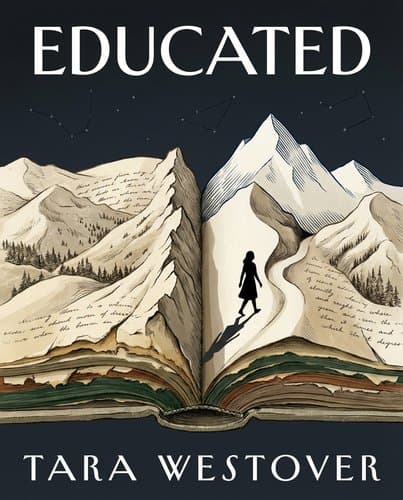
Educated
by Tara Westover
A woman who never set foot in a classroom until age 17 recounts how education didn't just teach her facts—it forced her to choose between the family and reality she'd been handed, and the self she had to become by claiming the right to define her own story.
In Brief
Tara Westover's memoir of growing up in a survivalist family in rural Idaho with no formal education, and her path from that isolated mountain to a PhD at Cambridge. The book reveals how education is not just learning facts but choosing whose version of reality you will live inside — and paying the full cost of that choice in lost family, lost certainty, and a self rebuilt from scratch.
Key Ideas
The stories you inherited are
Recognize that the stories you inherited from your family of origin are not neutral facts — they are a worldview designed to keep you inside it. Examining them is not disloyalty; it is the beginning of honest thinking.
Doubt planted by others is
When someone close to you consistently makes you doubt your own memory of events they were present for, that doubt is not humility — it is the mechanism of psychological control. Tara's double journal entry is a model: write what you actually remember, and don't surrender it to someone else's certainty.
Leaving a controlling environment takes
Leaving a controlling environment is not a single decision but a series of small ones — each requiring you to trade a piece of your identity for a piece of your freedom. Knowing this in advance means the grief of each small loss doesn't have to feel like a sign you've chosen wrong.
Education changes you irreversibly and
Education — formal or otherwise — changes you irreversibly. The people who loved who you were before may not be able to love who you become. This is a real cost, not a temporary discomfort. Naming it honestly is more useful than pretending transformation is painless.
People who harm us are
The people who harm us are rarely purely harmful. Tara's inability to reduce Shawn to a villain is not weakness but accuracy. Holding complexity about the people who shaped you — seeing both the horse rescue and the parking lot — is harder than choosing a story, and more true.
Who Should Read This
Anyone navigating a difficult family system, first-generation college students, people recovering from controlling relationships, educators seeking to understand what learning really costs, and readers drawn to memoirs about identity and self-determination
Summary
Why does it matter? Because the self you were given and the self you choose are not the same thing — and knowing the difference costs more than anyone warns you.
You probably think education is about learning things you didn't know before — facts, dates, the name of a painting, how a theorem works. But there's another kind of education, slower and far more costly, that has nothing to do with classrooms. It's the process of deciding whose version of reality you're going to live inside.
Tara Westover grew up in a household where the government didn't know she existed, where hospitals were instruments of Satan, and where her father's fear-saturated interpretation of the world was simply the air everyone breathed. She didn't escape that world through rebellion. She escaped it through accumulation — one uncomfortable truth at a time, each one widening a fracture she couldn't close even when she desperately wanted to.
The cost of that kind of knowing is the people who taught you everything you once believed.
The World That Made Her: A Place With Its Own Gravity
A seven-year-old girl stands on an abandoned red railway car beside her family's barn on a mountainside in rural Idaho, watching the school bus roll past on the highway below without slowing. She already understands, at seven, that this one fact — more than anything else about her family — is the thing that sets them apart. No school. No birth certificates for four of the seven children. No medical records, no doctor, no formal existence in the eyes of the state. By Idaho's reckoning, Tara Westover simply isn't there.
But she is very much somewhere. The world she inhabits is precise and alive: conifers swaying in the mountain wind, sagebrush shivering, a hillside of wild wheat bending in waves across the slope. Her father is at the back door threading callused hands into welding gloves. Her mother is at the stove. Her brothers are outside testing the weather. The rhythms of the day are exact and legible in a way that formal schooling never promised to be. Her education is the mountain itself — its seasons, its dangers, its silences — and the family's conviction that when the rest of civilization collapses, they will be the ones who know how to survive it.
Her father, Gene, anchors this world with a founding myth. On the face of Buck's Peak, when the spring snowmelt arrives at just the right angle, you can see the outline of a woman's body in the rock and timber: ravines for legs, a spray of pines for hair. He called her the Indian Princess. Native people, he said, had watched for her reappearance each spring as a signal that winter was over, that it was time to come home. All of Gene's stories mapped back to this mountain, this valley, this particular patch of Idaho. It is a complete cosmology, internally consistent, and it offers something that outside institutions rarely do: the feeling that you belong to a place that has belonged to your family for generations.
What makes Educated so disorienting to read is that you're required to hold two things at once from the very first pages. The world Gene built was also a world of military-surplus rifles buried near the railway car, of survival packs slept with like stuffed animals, of a father who wept telling his children about a mother shot at a window while holding her baby — then watched his own family internalize that image until it became their private myth of what the government would do to them. The beauty is real. The danger is real. And leaving will cost exactly as much as both of those things put together.
Violence Doesn't Announce Itself — It Accumulates
The most insidious thing about psychological control is that the person inside it becomes its principal architect. Shawn doesn't just hurt Tara — he trains her to explain it away, and the training is so effective that she does it automatically, before the bruises even form.
It starts as background noise. On a cross-country trucking run with Shawn, he teaches Tara a wrist-control technique in a New Mexico parking lot, framing it as self-defense. The hold works by folding your opponent's wrist until the pain in the joint leaves their whole body no option but to comply. Tara can barely make it work on Shawn in practice. Weeks later, he uses it on her in a bathroom, her nose scraping the toilet bowl, her face scraping the floor, her arm wrenched behind her back until she apologizes. The lesson had always been a rehearsal. She just didn't know for what.
The pattern escalates along a curve that keeps resetting her sense of normal. He calls her a whore for trying lip gloss. He rolls every window down in January and engages the child locks, laughing for twelve miles while she begs him to stop. Then one morning she wakes to his hands around her throat, her skull slamming against itself. Their mother sobs in the background but doesn't intervene — it takes Tyler, a brother who almost never comes home, appearing unexpectedly from the stairwell and throwing Tara his car keys to get her out. What Tyler makes impossible to ignore, Tara would genuinely have preferred to forget: she tells him so afterward, with complete sincerity, explaining that if he hadn't witnessed it she could have blacked out and eventually stopped believing it had really happened. That's not weakness. That's a survival system working exactly as designed.
What follows isn't a new story — it's the same story viewed from a different angle, the one that shows the internal mechanics. The double journal entry is where you see the machinery most clearly. After Shawn drags her from a car in a grocery store parking lot — wrist cracked, ankle buckled, shirt ridden up while he pins her arms to the icy asphalt, his face wearing what she later describes as calm unhurried pleasure — Tara goes home and writes two accounts. The first is specific and honest: she names what happened, names his expression, recognizes that her humiliation was not an accident but the point. The second, written minutes later, is a revision: it was a misunderstanding; if she had asked more calmly, he would have stopped. She doesn't destroy either entry. That refusal — to let one version of herself erase the other — is the first crack in the architecture. She has no name for what she's doing. But something in her understands that surrendering her own account to someone else's certainty is the real danger, and she won't do it, even when she desperately wants to.
How do you hold in your mind the same person who saves your life and the person who breaks your wrist? That same night Tyler throws her the keys, Shawn places a blood-covered knife in Tara's palm and says, 'If you're smart, you'll use this on yourself.' Their mother's response: 'That's uncalled for.' The same hands. The same person. Tara doesn't ask you to reconcile it — she asks you to sit with it.
The Paradox of Shawn: The Person Who Saved You Can Also Be the Person Who Breaks You
How do you hold in your mind the same person who saves your life and the person who breaks your wrist? Tara never fully resolves this, and the memoir is more honest for refusing to.
On a summer mountain in Idaho, Bud the horse bolts in a blind panic up a ravine, Tara's foot slipped through the stirrup up to the calf, her grip on the saddle horn the only thing between her and being dragged skull-first over rock. Every instinct she possesses — honed across years of breaking feral horses with her grandfather — screams at her to let go, take the fall clean, rely on herself. That doctrine had kept her alive in the junkyard, on a dozen bucking horses, in situations where waiting for rescue only made things worse. She holds on instead, trusting Shawn to catch up on an unbroken mare that had never been ridden hard. She describes in precise detail the impossible sequence he would need to execute: forcing a green horse into a gallop, steering without any trained language between them, leaning out of the saddle to snatch the reins from the weeds at speed. She knew it was impossible even as she imagined it. He does it anyway. That moment is not sentimental. It's evidence. Shawn is genuinely capable of the extraordinary act of care.
Which is what makes the parking lot outside a Stokes grocery store so harrowing. Shawn spots a red jeep belonging to Charles, a young man Tara has been careful to present herself cleanly to, and decides she's going inside — grease-stained, work-dirty, her constructed self stripped away. When she refuses, he wrenches her from the car onto icy asphalt, pins her arms above her head while her shirt rides up and her jeans peel down, bends her wrist until the bone cracks, buckles her ankle. What she sees on his face when she looks up changes everything: not rage, not frustration, not even cruelty in the hot sense. Only a calm, unhurried pleasure. She understands in that moment, even as part of her immediately starts arguing against the understanding, that her humiliation wasn't incidental. It was what he came for.
The book refuses to dissolve this paradox. Shawn is the boy with baby teeth that never fell out — the stubborn relics of a childhood gone wrong — a man who could ride an unbroken horse into a miracle and also find satisfaction in watching his sister beg. The same hands. The same person. Tara doesn't ask you to reconcile it. She asks you to sit with the fact that you can't.
Every New Truth Creates Distance — Education as a Slow Estrangement
A girl raises her hand in a college art history class and asks what a word in an image caption means. The room doesn't quiet — it stops. Papers freeze mid-shuffle. The professor says "Thanks for that" and turns back to his notes. Her classmate tells her afterward: it wasn't a joke. The word was Holocaust.
Tara goes to the computer lab and reads about it for the first time. She had understood it, to the extent she'd understood it at all, as something like the Boston Massacre — a small confrontation, a handful of people killed by an overreaching government. The actual number is six million. The gap between her prior version and the real one isn't a matter of missing a detail. It indicts an entire education — or the absence of one — and the mother who delivered it.
Education, for Tara, is less a filling-in than a reckoning. In American history, she assumes her professor's reference to "1963" is a misprint for "1863" when he begins describing the civil rights movement. She'd believed that after emancipation, justice had simply been accepted and the matter closed. Then she learns that Emmett Till was murdered in 1955, the year her mother was four years old, and something in her mind shifts its weight. The distance between history and her own life suddenly measures in the wrinkles on a living face rather than in centuries. Knowledge like that doesn't feel like acquisition. It feels like losing ground under your feet.
The hardest reckoning comes from a computer search on Ruby Ridge — a standoff her father had turned into the family's founding myth of government persecution, proof that the authorities would murder people like them for resisting state brainwashing. What she finds instead is Senate hearings, Department of Justice investigations, wrongful death settlements in the millions, major newspaper coverage, a book co-written by Randy Weaver himself. The cover-up her father described had somehow produced one of the most publicized accountability processes in recent American history. The actual trigger for the standoff wasn't homeschooling — it was Weaver selling sawed-off shotguns at an Aryan Nations gathering. For one bitter moment she thinks her father lied. Then she retrieves the vocabulary she'd learned minutes earlier in Psychology 101 — paranoia, delusions of persecution — and understands something worse: he believed it. His mind had taken someone else's tragedy and written himself into the center of it.
What none of this feels like, crucially, is freedom. Each fact Tara acquires is also a wedge. To know what she now knows about Ruby Ridge is to understand that the fear she grew up inside — the survival packs, the buried rifles, the apocalyptic vigilance — was built on a story deformed by her father's mind before it ever reached her. You can't unknow that about someone you love. The distance that knowledge creates is real, and it doesn't feel like liberation. It feels like grief.
The False Dawn: When a Mother Finally Says the Right Words
Think of someone who has been holding a locked door against you for years. Then one night, exhausted and alone, they open it — just for a moment. You walk through. You feel the warmth of the room. And then, weeks later, you discover they have quietly locked it again, and are telling everyone you were never invited inside.
That is the structure of what happens across these two chapters. After Tara's sister Audrey sends an email — one long unpunctuated paragraph, riddled with spelling errors — revealing that Shawn had done to her exactly what he had done to Tara, their mother initiates a late-night online conversation that reads like the turning point the reader has been waiting for. She does not get defensive. She does not accuse Tara of misremembering. She says she had seen something ugly and refused to look at it. She admits she had sided with Shawn because Tara appeared strong and he appeared damaged — an admission so clear-eyed it almost sounds like wisdom. Then she writes the line Tara calls the one she had been searching for her whole life: you were my child. I should have protected you. In that moment, Tara describes becoming a different person, inhabiting a different version of her own past. The effect is total and immediate.
But a mother's words in a private digital window at midnight are not the same as a mother's choices when a patriarch is standing in the room. Within weeks, when Tara's father visits Audrey in person — grave, reverent, invoking the Atonement of Christ — Audrey recants everything. She tells their father that Tara provoked her, that Tara walks in the realm of Satan, that she must not be allowed to call unsupervised. The woman who had written I will probably lose without you now describes her sister as a corrupting influence requiring containment. Their mother, who had said she was stronger now, says nothing to stop any of it. The confession that had felt like bedrock turns out to have been weather.
This is not a plot twist. It is a structural truth about how these systems sustain themselves. What mothers say in emotional moments and what they do when patriarchal loyalty is tested are two different things. The gap between those two chapters is where the book's most unresolved wound lives.
The Harvard fellowship arrives during this period, and Tara receives it with near-total indifference. She had begun, she writes, to understand what her education was costing her — and to resent it. That resentment is the book's sharpest edge. The family does not fail to support her ambitions. The problem is that the more she knows, the less room she occupies in the story they need to tell about themselves. Education did not take her family from her. It made her impossible to absorb back into a system that could only survive if everyone agreed on what had happened.
The doctorate is real. So is the distance it required.
What It Costs to Keep Your Own Mind
The triumph of a self-made mind is also, always, a bill coming due. By the time Tara Westover becomes Dr. Westover — nearly a decade after she first walked into a classroom at Brigham Young University — she has Cambridge, Harvard, a dissertation, and a flat in London. She also has parents she will not see again for years, a sister who called her an instrument of Satan, and a brother whose relationship with their father will never fully recover from the letter he wrote on her behalf. That is the arithmetic of the ending. The celebration and the cost are the same event.
The scene that crystallizes it happened before the doctorate, in a cave-dark Harvard dorm room where her father sat on the only bed because his health was too fragile for the floor. He had flown across the country — a man who never traveled — not to see where she studied but to save her from it. He prophesied disaster in the specific register of Old Testament certainty: she would be broken utterly, she would cry to God for mercy, and God would not hear her. Then came the offer embedded in the curse. All she had to do was accept a priesthood blessing, let him lay his scarred, knotted hands on her head and exorcise whatever had made her say what she'd said about her brother Shawn. Her sister had taken that deal. Tara understood in that moment exactly what the deal cost: not a recantation but a self. What her father wanted to cast out wasn't a demon. It was her.
She said no. He left five hours before his flight rather than sleep in the same room as the devil he believed she'd become.
The bathroom mirror scene she identifies as the actual turning point came later, during a confrontation with Shawn that involved a knife. The drama wasn't the knife. It was the moment she reached inward for the sixteen-year-old girl she had always been able to summon — the obedient daughter who smoothed things over and absorbed the version of events her family required — and found that self simply gone. That girl had always been available before, no matter how much Tara appeared to have changed. That night she wasn't. The choices made afterward belonged to someone new.
She names that newness plainly in the book's final lines. Transformation. Metamorphosis. Falsity. Betrayal. She calls it an education. The word carries its full weight here — not a credential but a remaking, the slow acquisition of a self that could not be built inside the world that made her. The doctorate is real. So is the distance it required. She is safe and celebrated and estranged from the mountain that shaped everything she knows how to love. That's not a flaw in the outcome. It's the price of the outcome, paid in full.
The Question Worth Carrying Forward
There is no clean name for what Tara Westover finally possessed. She had the credential, the fellowship, the locked-from-the-inside apartment in London where no one could tell her what she'd seen or hadn't. She had, at last, the uncontested right to her own memory. And she had almost no one left to tell it to.
What the book ultimately asks you to reckon with: selfhood, earned the hard way, does not arrive with company. Every true thing she learned cost her a person. By the end, the education was complete, and so was the accounting. Transformation and loss were never opposites in her story. They were the same motion, running in the same direction — she steps fully into herself and finds she is estranged from the mountain that shaped everything she knows how to love.
Notable Quotes
“I could stand in this wind, because I wasn't standing in it alone.”
— Tara Westover, On finding strength through education and the support of people who believed in her capacity to grow
“Everything I had worked for, all my years of study, had been to purchase for myself this one privilege: to see and experience more truths than those given to me by my father.”
— Tara Westover, Westover reflecting on the real purpose of her education — not credentials, but the right to her own perception
“I am not the child my father raised, but he is still my father.”
— Tara Westover, The irreducible tension between transformation and belonging that defines the memoir's ending
Frequently Asked Questions
- What is Educated by Tara Westover about?
- Educated is a memoir about growing up in a survivalist family in rural Idaho with no formal schooling, and the author's journey from that isolated world to earning a PhD from Cambridge University. It traces how education forced Westover to choose between the family narrative she had inherited and her own experience of reality.
- Is Educated a true story?
- Yes, Educated is a memoir based on Tara Westover's real life. She grew up without birth certificates, medical care, or formal education, and her brother's physical abuse and her father's paranoid worldview are documented through her own memories and journal entries. Some family members dispute her account, which is itself a theme of the book.
- What are the main themes of Educated?
- The central themes are the cost of self-invention, the tension between family loyalty and truth, the mechanics of psychological control, and the irreversible nature of genuine learning. Westover shows that education is not just acquiring knowledge but rebuilding your identity — and that this process creates distance from the people who shaped you.
- Why is Educated so popular?
- Educated resonates because it speaks to universal experiences — leaving home, questioning inherited beliefs, choosing who you want to become — through an extreme and gripping story. Westover's writing is precise and unsentimental, and the book refuses to offer easy resolutions, which makes it feel honest rather than inspirational.
- How long does it take to read Educated?
- The full book is about 334 pages and takes most readers 6-8 hours. Our summary distills the key narrative arc and insights into a 14-minute read, covering the essential journey from Buck's Peak to Cambridge and the psychological costs of that transformation.
Related Book Summaries

Read the full summary of Educated on InShort