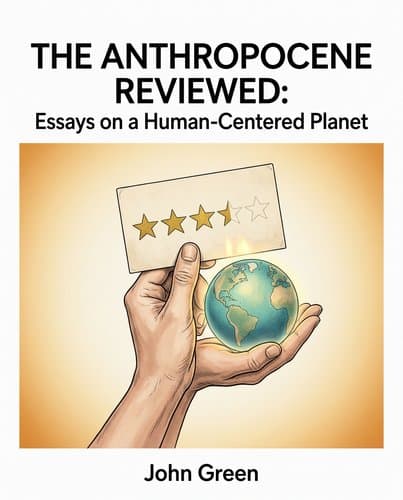
The Anthropocene Reviewed
by John Green
Rating everything from sunsets to the Plague on a five-star scale, John Green turns fierce attention to ordinary life into a practice for surviving grief, wonder, and the strange helplessness of being human in an age where our species reshapes planets but can't protect the people we love.
In Brief
John Green rates facets of human life — from Canada geese to cave paintings to a Jimmy Stewart film — on a five-star scale, using each review as a way to explore what we actually value when we pay close attention. The book argues that vulnerability, not cynicism, is the prerequisite for seeing beauty, and that the strange condition of being powerful as a species but helpless as individuals is something to inhabit honestly rather than resolve.
Key Ideas
The five-star scale forces honest
The five-star rating scale was designed for data aggregation, not human expression — when you use it earnestly, you're forced to ask what you actually value rather than what you're supposed to value.
Noticing small things grounds you in living
Paying fierce attention to small things (a song, a sunset, a dog's belly, a cave painting) is not sentimentality — it is the specific practice by which a person stays connected to their own life.
Species-level power with individual helplessness
The Anthropocene's central condition — species-level power combined with individual helplessness — is not a paradox to resolve but a dissonance to inhabit honestly.
Hope arrives as a specific
Hope is sometimes not an attitude but a specific artifact (a film, a song, a hot dog at a street cart) arriving at the moment you most need it; utility earns five stars, not quality.
Standing present with suffering is
When someone you love is suffering and you cannot fix it, staying present — 'don't just do something, stand there' — is not passivity but the hardest form of care.
Cynicism is a failure of
Hiding behind irony and the armor of cynicism is a failure of attention, not a sign of intelligence; vulnerability is the prerequisite for seeing beauty.
Your contribution matters because it
Your contribution to the world matters not because it will last or be attributed to you, but because it permanently, if slightly, changes the larger sphere — paint your layer and let it be covered.
Who Should Read This
Readers navigating depression or grief who want company rather than advice, essay lovers who enjoy David Sedaris or Annie Dillard, anyone who has felt disconnected from their own life by irony or performance, and people curious about what it means to pay genuine attention in an age of distraction
Summary
Why does it matter? Because the things you dismiss as trivial are the only map you have of what you actually love.
One week after finishing a walking path he'd built in his backyard, John Green collapsed onto his kitchen floor and couldn't get up. Inner ear disease. The world wouldn't stop spinning. And lying there, unable to read or parent or perform being himself for an audience, he realized something uncomfortable: he had been renting out his personality for so long he wasn't sure what was left underneath. The Anthropocene Reviewed is what happened when he decided to stop writing in code. It's a book of essays that rate ordinary things — sunsets, Canada geese, scratch 'n' sniff stickers, a goalkeeper's wobbly legs during a penalty shootout — on a five-star scale, which sounds like a gimmick until you realize that what we choose to pay attention to is the most honest autobiography any of us will ever write. Green's argument, built from history and science and genuine embarrassment, is that the world is simultaneously catastrophic and astonishing, and that choosing to notice it fully isn't weakness. It's the only way through.
The Rating Scale You've Been Using Was Never Designed for You
In late 2017, John Green reached into a drawer looking for ChapStick and the world collapsed. His balance quit. The room rolled and pitched, his eyes shook in their sockets, and he ended up in a hospital — diagnosed with labyrinthitis, an inner ear disorder that kept him bedridden for weeks, unable to read, watch television, or be present with his children. All he had was his own mind, which kept circling back to something that had been quietly wrong before the vertigo ever started. During that year's book tour, an interviewer had asked whether he, like a character in his novel, experienced panic attacks while kissing. Green answered honestly, then felt himself recede — as though the self he was describing belonged to a press cycle rather than to him. Weeks in bed with nothing to do but think clarified what that feeling actually was: he had been performing himself for so long that he had become a product.
Sarah read his early drafts — detached, third-person essays on things like Canada geese — and told him the framing was wrong. In the Anthropocene, she said, no one gets to stand outside the subject and observe. Everyone is already in it. A review is never really about the restaurant or the park bench; it's about what it felt like to be a specific person there. Once Green accepted that, the five-star format stopped looking like a gimmick. It became the only honest structure available: a scale built for human participation, not professional distance.
We Are Powerful Enough to Drive Species Extinct and Powerless to Get Our Kids to Eat Breakfast
Consider the Canada goose. By the early twentieth century, the giant subspecies had been hunted nearly to oblivion through a particularly cruel method: hunters would capture geese, clip their wings, and stake them on ponds, where their honking drew wild flocks directly into gun range. When the practice was banned in 1935, the birds recovered — slowly, then explosively, to somewhere between four and six million today. The reason for that explosion is us. We carpeted suburbs and parks with Kentucky bluegrass, a plant of almost no practical use to humans that geese find irresistible. We dug the artificial ponds and retention lakes they love. We pressed roughly 75 to 80 percent of ourselves into urban areas, and the geese followed at almost the same ratio. They are not living alongside human civilization so much as inside the habitat it accidentally built for them. As individuals, none of us decided this. No one voted to create a goose paradise. It emerged from millions of separate choices — where to build, what to plant, which laws to pass — that together rewrote the ecological map.
Green captures this with a wry precision: as a species, he writes, we decide which creatures flourish and which vanish. But as an individual, he cannot get his children to eat breakfast. The lawn he mows every week is planted with a grass that is only 160 years old as a suburban institution. The car he drives to soccer practice depends on an invention that didn't exist 160 years ago, for a sport that didn't exist 160 years ago. Nearly everything that feels like bedrock human life is recent, contingent, constructed — including the honking birds treating his backyard like a buffet.
A Cave We Had to Seal to Save — and the Replicas We Built Instead
In September 1940, four boys with oil lamps descended into a cave in southwestern France and found walls covered in horses, bison, and woolly rhinoceroses — paintings nearly 17,000 years old, made by artists who built scaffolding to reach the ceilings and blew pigment through hollowed bones to leave their marks. One of those boys, a thirteen-year-old Jewish refugee named Simon Coencas, had already been displaced once by the Nazi occupation. Days after the discovery, his family fled again, this time to Paris, where they were betrayed. His parents were murdered. Simon spent the rest of the war hiding in an attic. He wouldn't see the friends he'd found that cave with for 46 years. When Pablo Picasso visited Lascaux in 1948, he stood in front of those ancient paintings and said, simply, 'We have invented nothing' — meaning it as a compliment to the Paleolithic artists who had made them.
Eventually, the cave had to be closed — not to protect visitors, but to protect the art from them. Human breath alone, exhaled by thousands of tourists, grew mold and lichen across paintings that had survived 170 centuries without us. So we sealed it. And then, because we couldn't bear to lose access entirely, we built elaborate replicas — Lascaux II, III, and IV — where the hand stencils and charging animals have been painstakingly re-created for people who will know, the whole time, that they are looking at a copy.
Green calls this 'Peak Anthropocene absurdity,' and it is. But he refuses to leave it there. The replicas are ridiculous and genuine at once, which is exactly what grief looks like when it's also love. We couldn't stop ourselves from wrecking the original. We could stop ourselves from wrecking it further. Sometimes that's what hope actually looks like: not saving the thing, but building a shadow of it and agreeing, together, that the shadow matters.
The Five-Star Film That Saved His Life Starred an Invisible Rabbit
There is a note Green still has. It was left on his desk at a Chicago book review magazine while he was in the bathroom — vomiting, probably from the two two-liter bottles of Sprite that had been his entire diet for weeks, since his body had stopped accepting solid food. The note was from his publisher, Bill Ott, a man Green describes as something out of a noir novel — sharp, funny, a little intimidating. Green had just tearfully tried to quit his job. Ott had talked him out of it, told him to take a leave instead, said don't take this the wrong way, kid, but the magazine will survive without you for a few weeks. Then Ott wrote the note: come back soon, and in the meantime, watch Harvey.
This was late 2001. Green had recently broken up with someone he'd expected to marry, was living alone in their old apartment, and had spent at least one Sunday on the linoleum floor of the kitchen unable to get up, staring through a Sprite bottle at the window, watching the bubbles grip the glass and eventually let go. He called his parents that evening. They drove through the night from Florida — fifteen hundred miles — and were at his door within twelve hours. He moved home, started therapy, took medication he didn't believe would help because he was convinced the problem wasn't chemical. He thought the problem was him, at the center of him, irreparably.
That winter, his parents and he watched Harvey, a 1950 film he had avoided for years on the reasonable grounds that black-and-white movies were universally terrible. It stars Jimmy Stewart as Elwood P. Dowd, a gentle alcoholic whose closest companion is a six-foot-tall invisible rabbit. The film gives him a philosophy, borrowed from his mother: you can move through the world being very smart, or being very pleasant. Elwood tried smart for years. He recommends pleasant.
Green writes that in December 2001, there was possibly no one on earth who needed to hear that more than he did. He had been treating his own value as a calculation — usefulness, productivity, functioning. Elwood offered a different accounting entirely. You could be broken, disconnected from consensus reality, and still be kind, still be worth loving. That's not a philosophical position Green reasoned his way into. It was a specific line of dialogue arriving at a specific hour of need. He gives Harvey five stars — not for its cinematography, not for its craft, but because it was there, and because that, sometimes, is what saves you.
The Song That Only Becomes Great When Everyone Sings It Together
John Green makes this case through a piece of musical theater with embarrassingly blunt lyrics. 'You'll Never Walk Alone,' born from a 1945 Rodgers and Hammerstein musical called Carousel, promises that at the end of every storm there's a golden sky and the sweet silver song of a lark. At the end of actual storms, Green notes, there are downed power lines and flooded rivers. The imagery is obvious, the comfort almost insultingly tidy. And yet in 1963, when a Liverpool band called Gerry and the Pacemakers released their version, fans of Liverpool Football Club began singing it on the terraces, and something shifted. The song stopped being about what the words said and became about who was saying them. Liverpool manager Bill Shankly told the band's singer: you've given us a song. Forty years later it would be sung at the funerals of supporters, and in the same stadium, the same week, after a victory. Former Liverpool player Kenny Dalglish said it covers adversity and success with equal weight — which means its actual subject isn't weather or larks. It's the act of continuing, together.
The song's strongest defense came in March 2020, when a group of British paramedics stood on one side of a glass wall and sang it to their colleagues working in an intensive care unit on the other side. Nobody in that hospital believed in a golden sky. They knew exactly how bad things were. The song didn't ask them to pretend otherwise. It asked them to keep walking toward whatever came next, inside earshot of each other.
Green points out that the word encourage literally means to put courage into someone. The cheesiness of the song is, in a way, the point — it's stripped down enough that anyone can hold it, and communal enough that it only becomes itself when everyone sings. You can't see the wonders coming any more than the terrors. Sometimes the best available technology for surviving that uncertainty is a very simple song, sung loudly, with other people who are also afraid.
History Repeats Because We Keep Deciding the Last Time Doesn't Apply to Us
The Black Death killed perhaps half of all Europeans between 1347 and 1351. Cairo, then the world's largest city outside China, lost a third of its population in eight months. In Florence, a city of over a hundred thousand, roughly eighty percent died in four months. And what did that catastrophe produce? Misinformation. The flight of the wealthy from cities. The demonization of a marginalized group — Jewish communities were blamed for poisoning wells, and entire towns were burned on that basis, even after Pope Clement VI pointed out that the plague was killing Jewish people too. Facts did not slow the conspiracy. The poor died in dramatically higher numbers. Parents refused to bury their own children. The bell-ringers stopped tolling for the dead because the bells would never have stopped.
The human response to catastrophe is a template. We fill in the names and dates and the current crisis feels unprecedented, but the template is ancient, and recognizing it is both horrifying and, strangely, the only available comfort.
The detail Green keeps returning to is a single repetition across centuries: people dying alone, cut off from those who loved them. A Franciscan friar left blank parchment at the end of his plague journal for whoever might survive to finish it. A Florentine chronicler wrote the phrase 'and the plague lasted until...' and died before he could complete the sentence. Sit with that for a moment. Then: centuries later, a physician writing in a medical journal described a woman watching her husband die over a video call. The technology changes. The separation doesn't.
But here is what else the historical record contains: Ibn Battuta, the great medieval traveler, described the residents of plague-struck Damascus in 1348 — Muslims, Christians, and Jews — marching together through the city, the powerful going barefoot alongside everyone else, united not in certainty but in shared vulnerability. Crisis reliably produces scapegoating. It also, sometimes, produces that. Green refuses to pretend the two cancel each other out, or that solidarity is the more likely outcome. But he insists that both responses are real, both are human, and only one of them is a choice worth making again.
What You Cannot Say to a Dying Friend Matters More Than What You Can
When Amy Krouse Rosenthal — a writer who had helped launch Green's career, who had once hired a complimenter to walk through a theater telling strangers nice things about their shoes — called to ask for his advice after a cancer diagnosis, Green fell apart. She wanted to know what he had learned from young dying people: how her children would handle it, whether they would be okay. He knew what he should have said. He even writes it out in retrospect: they won't be okay, but they will go on, and the love you gave them will go on with them. Instead, while crying, what came out was: 'How can this be happening? You do so much yoga.' He describes this as possibly the stupidest thing anyone has ever said to a dying person. He suspects she at least got some use out of it as a story.
What he did with that failure matters more than the failure itself. He doesn't frame it as a communication problem, something that better words or more therapy could have fixed. He reaches back to his old chaplaincy supervisor, who gave him a piece of guidance that sounds like a riddle: don't just do something — stand there. In context it means that when someone is suffering beyond repair, the instinct to produce comfort, to generate words equal to the moment, is exactly wrong. The presence is the thing. The willingness to stay inside the unbearable with someone, without flinching away into helpfulness. Green couldn't do that with Amy, and he knows it, and he says so plainly, without the self-exoneration of explaining how hard it was. He just says: I failed her, and she forgives me, and I wish I had said nothing at all.
Fifteen years after his chaplaincy, he typed a child's unusual name into a search bar and found a Facebook profile: an eighteen-year-old, alive, into John Deere tractors. The child had been a three-year-old burn victim Green had prayed for every night, not because he was certain prayer worked, but because he believed, tenuously, in mercy. The yoga comment didn't work. The prayer probably didn't either. The standing there — that's all any of it ever was.
Showing the World Your Belly Is the Only Way to Actually See It
Imagine wearing a one-way mirror as a visor. You could see everything around you — but only as a dim, flattened reflection of itself, safely framed, never quite real enough to hurt you. In the eighteenth century, tourists actually carried a version of this device. Called a Claude glass, it was a small, darkened, slightly convex mirror. You would turn your back on a beautiful landscape and study its reflection instead — compressed, softened, made to look like a painting. Thomas Gray said it was the only way he could truly see a sunset. The absurdity is the point: to protect yourself from beauty, you had to refuse to face it.
Green recognizes himself in that posture. His name for the modern equivalent is the armor of cynicism — the habit of labeling spectacular things as "photoshopped," of never giving anything five stars because a perfect score would mean you'd actually been moved, and moved is the same as exposed. The posture feels like discernment. It is, in fact, a Claude glass. You get a tidier version of the world. You miss the world.
The image that cracks this open for him is his late dog, Willy. On early evenings, Willy would race around the yard in delighted, purposeless circles — and then, exhausted, he would roll onto his back and offer up his belly: the one place where ribs offer no protection. Green kept marveling at the audacity of that. To trust something that could hurt you with the softest part of you — not because you'd calculated the risk, but because you were so present in the moment that armor hadn't occurred to you.
Green knows he can barely manage it himself. He knows that if someone lands a punch where he is earnest, he won't recover. And so he looks at sunsets through the glass: first they're photoshopped, then they become evidence of something larger, and none of it is actually seeing them. The breakthrough is less philosophical than physical — a choice to turn toward the scattered light with his belly out, to drop the critic's veto and let the thing be what it is. He paraphrases Toni Morrison: at some point, the world's beauty becomes enough. You don't need to document it or improve on it. The sunset doesn't need to earn five stars through an audition. It just needs you to face it.
Vulnerability isn't the reward you get after you've seen something beautiful. It's the prerequisite. The Claude glass gives you a picture. Turning around gives you the thing.
The Ball of Paint Weighs Two and a Half Tons and No One's Layer Is Visible Anymore
What if the work you do only matters when people can see it — when it survives, when it carries your name forward? That assumption is so deep it barely feels like an assumption. It feels like gravity.
Green dismantles it with a baseball. In 1977, a man named Mike Carmichael in Alexandria, Indiana painted a baseball with his three-year-old son. Then they painted it again. Then again. Friends came and added coats. Eventually strangers started showing up, and Carmichael let them paint it too, handing them the brushes himself, providing the paint for free. Over four decades, more than twenty-six thousand layers accumulated. The ball now weighs two and a half tons and lives in its own small house. No visitor's layer is visible. Every coat has been buried under someone else's. That is the point.
Green drove to Alexandria during a period when something had broken in him that he could only describe through an Emily Dickinson image — a plank in reason giving way. He was drowning. He added his own layer of light blue, knowing it would be covered within hours. What he found there wasn't resolution. It was reorientation. The ball looks nothing like the baseball it started as, and every person who ever stood there with a brush is part of the reason — invisibly, permanently, irrevocably.
The Anthropocene's quieter demand is this: not that your contribution last, but that it change the sphere, even fractionally. A Mountain Goats lyric Green calls almost scriptural puts the same thing from the other direction: 'You were a presence full of light upon this Earth / And I am a witness to your life and to its worth.' To be a witness. Not to record it. Not to make it permanent. Just to see it fully while it's here.
You add your layer. You face the thing directly, belly out, no glass between you and it. Then someone else paints over you. The ball keeps growing.
Earth Loving Earth, For Now
Here is what Hank Green's book leaves you with, if you let it: you are the universe briefly organizing itself into something that notices the universe. Earth, looking at Earth. A species reviewing itself — awarding stars to sunsets and hot dogs and invisible rabbits, knowing the ratings will be buried, knowing the cave will be sealed, knowing the paint layer will be covered before the brush is even dry. That is not a reason to stop paying attention. It is the only reason to start. The golden sky may be a fiction. The wonders are no more predictable than the terrors. But you are here now, temporarily departed from equilibrium, briefly capable of turning toward it, brush in hand, with nothing between you and the light. So the question the book earns the right to leave with you is simple and not simple at all: given the time you have, what will you choose to see?
Notable Quotes
“You can move through the world being very smart, or being very pleasant. I tried smart for years. I recommend pleasant.”
— John Green, Quoting the film Harvey, which Green credits with helping him survive a depressive episode — the line became a personal philosophy
“You do not rise to the level of your hopes. You fall to the level of your systems.”
— John Green, Green adapting James Clear's formulation to describe how attention — not aspiration — determines what your life actually looks like
“I give sunsets five stars.”
— John Green, The book's quiet thesis statement: choosing to face beauty directly, without the protective filter of irony, is the hardest and most necessary act
Frequently Asked Questions
- What is The Anthropocene Reviewed about?
- It is a collection of personal essays in which John Green rates aspects of human-centered life on a five-star scale — everything from sunsets and Canada geese to the Plague and scratch-n-sniff stickers. Each review becomes a meditation on attention, grief, beauty, and what it means to be human in an age defined by both immense collective power and profound individual helplessness.
- Is The Anthropocene Reviewed worth reading?
- Yes, especially if you value essays that combine deep research with raw personal honesty. Green writes about depression, friendship, and wonder without sentimentality or cynicism, and the five-star conceit gives each piece a surprising emotional precision. It is widely considered his best work.
- What does 'Anthropocene' mean in the title?
- The Anthropocene is the proposed current geological age, defined by human activity's profound impact on the planet's ecosystems and climate. Green uses the term to frame his central question: what does it mean to be a species powerful enough to reshape the earth but individually unable to protect the people we love?
- Is this book fiction or nonfiction?
- It is nonfiction — a collection of personal essays adapted and expanded from Green's podcast of the same name, with six new pieces exclusive to the book. While Green is best known as a YA novelist, this is memoir-driven nonfiction that blends history, science, and deeply personal reflection.
- What are the best essays in The Anthropocene Reviewed?
- Standout essays include the Lascaux cave paintings (on preservation and loss), Harvey (on depression and the film that helped save his life), 'You'll Never Walk Alone' (on communal hope), the Ball of Paint (on anonymous contribution), and the final essay on sunsets. Each builds from an unlikely subject into something unexpectedly moving.
Related Book Summaries
Read the full summary of The Anthropocene Reviewed on InShort