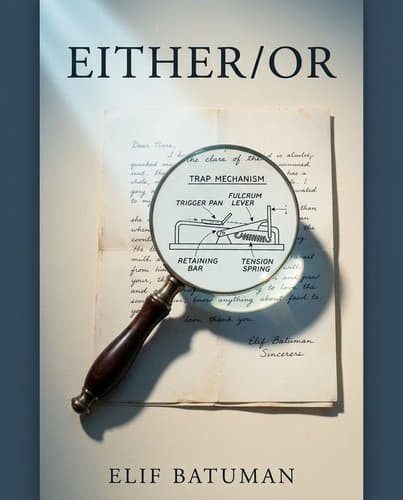
58890783_either-or
by Elif Batuman
Self-awareness turns out to be both the sharpest tool for processing heartbreak and the thing that makes every wound more elaborate.
In Brief
Self-awareness turns out to be both the sharpest tool for processing heartbreak and the thing that makes every wound more elaborate. One woman's attempt to live like a novel reveals why naming a pattern and escaping it are never the same thing.
Key Ideas
Frameworks metabolize suffering but amplify wounds
Using literary frameworks to process romantic pain makes the pain more elaborate, not smaller — frameworks are tools for metabolizing suffering, not avoiding it. The same intelligence that builds the framework amplifies the wound.
Honesty and strategy yield incompatible outcomes
Honesty and romantic strategy are not just different tactics — they produce genuinely incompatible outcomes. Tatiana's letter was admirable. And she didn't get Onegin. The novel holds both truths simultaneously without resolving them.
The Rules work by engineering desire
The Rules are not cynical manipulation tactics for insecure people — they are a coherent diagnosis of romantic dynamics that most people refuse to face. The disturbing part is not that they work but why: they treat the other person's desire as a system to engineer rather than a person to respond to.
Self-awareness cannot break inherited patterns
Self-diagnosis does not produce immunity. You can recognize the family pattern, name the dynamic, quote the relevant Kierkegaard passage, and still be fully inside it. Seeing clearly is not the same as escaping.
Stop reading your life, start authoring
The aesthetic life as a framework for living eventually requires you to stop being a reader of your own story and start being the author — which means not waiting for the right circumstances, the right person, or the right city to make life feel like a novel.
Who Should Read This
Readers interested in Literary Fiction and Novels, looking for practical insights they can apply to their own lives.
Either/Or
By Elif Batuman
11 min read
Why does it matter? Because being the most perceptive person in the room doesn't protect you from suffering — it just makes your suffering more precise.
The consolation intelligent people reach for in their twenties is that consciousness is a kind of armor. Recognize the trap. Name the mechanism. Hold it at analytical distance. It loses its grip on you. Selin reads Kierkegaard on seducers, Pushkin on women who write letters they shouldn't have written, and maps, with clinical precision, exactly the playbook that undid her. She can describe the architecture of her own suffering as it happens. She does, constantly. It does not help at all. Either/Or is the story of a woman who brings a graduate seminar's worth of intellectual equipment to the oldest human disaster — falling for someone who won't fall back — and discovers that diagnosing a trap perfectly and escaping it are not the same skill. That gap is where the whole novel lives.
The Most Self-Aware Person in the Room Is Still Bleeding
It is the first week of sophomore year at Harvard, and Selin is at a dormitory computer terminal at midnight, using a Unix command called "finger" to find out where Ivan is. She already knows he's online — she typed his username and the system told her: logged in at Berkeley, mail last read twenty-eight seconds ago. He is sitting somewhere in California, looking at a screen just like hers, thinking about something for twenty-eight seconds, and that something is not her.
This is what a brilliant mind does with pain: it builds instruments. The inbox had nothing from him — only a three-month-old defensive email, sent before the summer that had changed everything, arriving now like a final verdict because there was nothing after it. So she reaches for "finger" instead. Then she notices his "plan" field — a Unix file where you could post anything, which appeared whenever someone looked you up. Ivan has posted a quote from King Lear: "Thou, nature, art my goddess; to thy law / My services are bound." She doesn't recognize it, but the footnote-looking citation tells her it's Shakespeare, and Shakespeare can be looked up, and looking things up is something she is extremely good at.
She walks to the liquor store down the street that also sells CliffsNotes. She learns that the speech belongs to Edmund, the illegitimate son of the Earl of Gloucester — a seducer who casts himself as nature's own, courts two women while plotting power that isn't his, and speaks directly to the audience, asking for complicity. The phrase "natural child," she learns, was a period synonym for bastard. Nothing she learns about Edmund makes her feel better.
The shape of Selin's mind is also the shape of her problem. She reaches for a framework the way other people reach for ice cream — reflexively, with genuine faith that understanding helps. Usually it does. But some wounds don't close when you name them; they just become more precisely located. She now knows exactly where Ivan is (Berkeley, twenty-eight seconds idle), exactly what archetype he may have cast himself as, and exactly how little any of it changes anything. The mind that builds frameworks is the same one making the wound more elaborate.
The Emails You Thought You Invented Were Following a Playbook
She is sitting on a round step stool at the bookstore, reading the section of Kierkegaard's Either/Or she wasn't supposed to jump to — "The Seducer's Diary" — when the nausea arrives. Not metaphorical nausea.
The diary belongs to Johannes, a fictional seducer whose method is to bring a girl to the precise threshold where she would give up everything, and then stop. No declaration, no advance, no evidence of his involvement. She is left doubting whether anything real occurred. Johannes considers this restraint a form of artistry: the cleaner the exit, the purer the operation. No spectators, no proof. Only the girl, continuing to spin.
Selin has just spent a semester being asked by a student health psychologist (repeatedly, patiently, with the tone of someone who has said this many times before) whether what happened with Ivan might have been in her imagination.
The recognition is physical before it is intellectual. She has been reading a description of what happened to her, written in 1843, by a Danish philosopher, about a character who never existed. The email exchanges she and Ivan had (the ones that felt like a private language they were inventing in real time) were not new. The alternation between anguished letters and ironic in-person meetings where the letters were never mentioned but always present: the seducer explains this as technique, as craft that can be learned.
Then the additional information, which is worse: the seducer learned his techniques from previous young women. They were, he explains, his best teachers. Which means the method improves with use. Which means Selin's capacity to read situations with literary precision, to feel the subtext, to take the unsaid seriously, made her a more responsive instrument, not a harder target. The self-awareness she had always relied on to stay a half-step ahead of her own experience turned out to be the quality the technique was designed for.
That same afternoon, for tutorial, she watches The Usual Suspects. Kevin Spacey builds an entire false identity from words that happened to be visible in a police detective's office (manufacturer names, brand labels) so that the story's meaning was technically present in the environment all along, waiting to be needed. Selin leaves mid-discussion, sits in an empty classroom, and remembers things Ivan had said over the summer: you're easy to convince. And: I was wondering when you were going to stop me.
The technique designed to make a girl feel uniquely seen depends entirely on that girl's desire to be seen. The framework doesn't crack because it was wrong. It cracks because it was right — which is, as you might expect, much worse.
Tatiana Was Right. The Rules Prove It. Neither Can Save You.
Does loving someone honestly make you a better person, or does it just make you easier to hurt?
Selin gets both halves of this answer in the same academic year, six months apart.
In the fall, she walks through campus with her roommate Svetlana, memorizing stanzas from Pushkin's verse novel for a memorial service. The technique is called the method of loci: you place each item you want to remember at a landmark along a familiar route, then retrace the walk in your mind. They start at their old freshman dorm (where Selin had written her letter to Ivan) and head toward the river. She has chosen the harder assignment: Tatiana's letter, the famous passage where a provincial teenager writes to a man she barely knows and hands him complete power over her fate.
At the dorm's blank brick facade, she recites the opening line and is stopped by a single phrase she hadn't registered before. Tatiana says she would never have written if things could have stayed as they were — if she could only see Onegin once a week, exchange a few words, and then "think and think about one thing" until next time. That was it. That was all Selin had wanted, too.
Pushkin himself steps in to defend Tatiana against readers who call her impulsive: the coquette calculates; Tatiana simply loves, completely and without strategy. The women who would condemn Tatiana are confusing strategy with virtue. Selin recognizes this as the governing thesis of her entire family: honest love is not merely more dignified than game-playing, it is more moral. The women in her family who had been prostrated by suffering — in Turkish, kendini yerden yere attı, throwing herself from floor to floor, over and over — had at least not been liars. And the men who chose the coquettes had revealed themselves as unworthy. Good riddance. (That the suffering continued after the good riddance was a fact she preferred to set aside.)
Then, in April, she picks up The Rules: Time-Tested Secrets for Capturing the Heart of Mr. Right.
The book is a manual for exactly the behavior Pushkin mocked: never show interest, never initiate, cultivate uncertainty. Selin opens it expecting to feel superior. Instead she finds something she cannot dismiss: the list of prohibited behaviors is a precise inventory of what Tatiana did. And Tatiana — she has to hold this — did not get Onegin. A person who had followed the Rules would have. Eugene Onegin proves this with its own ending: after Tatiana marries someone else and stops caring, Onegin throws himself at her feet. The formula worked; it just worked too late.
The Rules identifies "smart, educated women" as its worst students, because they believe their degrees entitle them to display their personalities. They always get their comeuppance. There is nothing technically false in this.
But the strange turn is one Selin makes without the book's help. She rereads the Rules ("avoid staring romantically into his eyes," "act independent so he doesn't feel you're expecting him to take care of you") and recognizes what they actually are. These are the rules one wishes one's mother would follow. Not strategies for attracting a man. A child's quiet wishes for how to be loved without being consumed by the weight of someone else's need.
Which produces the question she can't unask: had she made Ivan feel the way she sometimes felt about her own mother?
Tatiana was right. Pushkin said so. The Rules proves she was right and still lost. Neither conclusion addresses what Selin now suspects: that being right was never the issue.
Sex Was the Thing That Made Childhood Finally End
Selin works out the theory first, the way she always does. By February she has reasoned herself to a conclusion: the Russian word for "novel" — roman — also means love affair, which implies sex; falling in love is the only force that makes you want to learn another person's country; her failure to really absorb Hungary might therefore be caused by not having had sex. This is the logical structure. She is aware it is logical. She decides to act on it.
She cold-emails a Polish graduate student she met once at a party (she had to get his name from Şahin afterward, since she never retained it during the introduction) and is careful about what she asks for. He calls. Three days of unusual peace follow, which she notes with precise surprise: the problem is settled in advance, so for once she can stop cycling through it.
The scene happens on a desk. He has pushed his computer to one side to make room. Her head keeps hitting the window; outside is the river, and across it, Ivan's old dormitory. The pain doesn't soften — she means "unimaginable" literally, because she had in fact been unable to imagine it, had occupied herself instead with thoughts of the machinery required to manufacture a condom, the industrial mystery of why anyone named a contraceptive after a story about walls getting breached. When he says he is barely inside, there is audible panic in his voice. Blood gets on the skull-print pillow. He tries not to show he's upset about it; she finds this reaction — considerate enough to conceal it, not considerate enough to not feel it — more precisely revealing about who he is than anything else that happened.
Afterward, walking home, she realizes she doesn't feel guilty about not working. The first time she can remember. The next day the bleeding stops and the exemption closes with it. What she registers is something more like administrative finality than romantic transformation — a grace period expiring. You might expect the act to feel like arrival. What it actually does is return her to time: the ordinary, pressured condition of having things yet to do, and no longer holding the particular not-having-done-it in reserve.
The theory was correct. It just didn't describe what the theory, enacted, would feel like.
The Pharmacist Doesn't Know About Kierkegaard
Selin arrives in Turkey with the equivalent of a very good shelf of books. She has Kierkegaard for seduction and self-deception, Pushkin for the ethics of honest love. These are not decorative — she reaches for the right framework the way other people reach for a map. The frameworks have names for what has been happening to her.
Then, in Antalya, she meets Koray.
He is beautiful at the bus station (the kind of face you'd find on an ancient vase) and offers to carry her backpack. That evening they go out, and somewhere between the beer garden and the ATM he seized her arm and marched her to, she understands that the intelligence she had read as personality is something else entirely. He simply does not process situations the way she does. There is no subtext to decode because there is no text.
A literary framework should arrive. Dora does (the Freudian case study who didn't know she wanted what she got), but she's useless here. The question isn't what Selin secretly wants. The question is how to get out of a dark street where a man is holding her arm.
What comes out is not philosophy. "If we don't have condoms," she says, "I'm going to stand right here and create a scene." She hadn't planned to say it. It just came out. So she is allowed to make demands. They find a pharmacy. Inside, intending to ask for condoms, she hears herself ask for a way out: "Is there another door?" The pharmacist says the phone is broken. He wants her to understand he won't help. She pays for the condoms and leaves anyway.
She gets through the night. Locks herself in the bathroom; he passes out. She calls her mother from the ER at dawn about a UTI, and her mother gives exact, calm instructions. The doctor charges five dollars.
The summer reveals something quieter than a breakthrough. The frameworks were never load-bearing — they were the way she practiced noticing. You can trace the training, if you want: the Kierkegaard, the Pushkin, the two semesters of surviving on close reading. But what you do at speed, in the dark, with someone holding your arm, turns out to need no name.
Isabel Archer Didn't Know She Was Inside a Great Novel — Selin Does
The difference between a woman who lives inside a great novel and a woman who writes one is whether she knows which story she's in. Isabel Archer doesn't know — she ends up married and miserable in a palace, having furnished the plot of a masterpiece she'll never read. Tatiana doesn't know either. Both of them could have written the book. Neither of them did.
Selin is reading The Portrait of a Lady on a bus in Turkey when she reaches James's preface — written in old age, convoluted, a little embarrassing — and finds he has named her actual problem. He calls Isabel a "wind-blown germ," marvels that such a slight personality should merit a whole novel, then declares that tracing the origins of one's own imagination is impossible, not worth attempting. He never explains why he didn't find his own life interesting enough to write about. Selin works it out: he was probably gay, which was illegal, which meant he had to find a germ and then forget where it came from so it wouldn't feel like theft. The English country house, the unreliable narrators — a man writing around the life he couldn't claim.
The cost of not writing about your own life is that someone else gets to name it. Isabel gets called a "slim shade of a presumptuous girl." Madame Bovary has to be too dumb to write her own novel — that's Flaubert's job security. Selin's problem is the opposite: she can only write about people she actually knows, feels traitorous even trying to disguise them. But she has read Breton. Breton calls it monstrous to change even a person's hair color. Her inability to fictionalize is not a flaw but a principle.
She arrives in Moscow without her backpack — lost somewhere between connections — and it doesn't matter. She is in Russia because she looked at world literatures and chose, not because of Ivan or anyone who wanted her there. The passport official made it clear she was not welcome. She's there anyway. The gap between her life and her favorite books feels, for the first time, like it might close. She will do what James called impossible: trace where everything came from, figure out what she was doing and why.
What the Seducer Never Counted On
The seducer's method keeps you inside a story someone else is narrating, wondering what the subtext means, reaching for Kierkegaard to explain what just happened to you. The whole architecture depends on you not picking up the pen.
Selin arrives in Moscow without her luggage and it doesn't matter. She was never there for the reason she thought she was. The frameworks weren't a defense against experience — they were the practice of seeing it clearly enough to write it down. She knows which story she's in. She was taking notes the whole time. That is the only difference. And it is everything.
Notable Quotes
“like the heroine of an immoral novel.”
“One must always be thinking,”
“I am not sure it's not a greater happiness to be powerless.”
Frequently Asked Questions
- What is Either/Or by Elif Batuman about?
- Either/Or (2022) follows a young woman who tries to build her life as a conscious work of art, drawing on literature, philosophy, and Kierkegaard to navigate early adulthood and romance. The novel explores how self-awareness sharpens both insight and suffering, revealing the tension between living aesthetically and taking action. It examines whether we can truly author our own stories or whether we remain readers trapped in narrative frameworks. Through the protagonist's journey, Batuman interrogates how intellectual sophistication both enables and complicates romantic and emotional life.
- What are the key takeaways from Either/Or?
- Either/Or reveals that literary frameworks intensify romantic pain rather than diminish it—they are tools for processing suffering, not escaping it. The novel argues that honesty and romantic strategy produce incompatible outcomes, holding this contradiction without resolution. Crucially, Batuman shows that self-diagnosis offers no immunity from familiar patterns; recognizing dynamics intellectually doesn't prevent living them. Finally, the novel suggests that embracing an aesthetic life requires action: "the aesthetic life as a framework for living eventually requires you to stop being a reader of your own story and start being the author—which means not waiting for the right circumstances, the right person, or the right city to make life feel like a novel."
- What does Either/Or reveal about romantic relationships and strategy?
- Batuman argues that honesty and romantic strategy are fundamentally incompatible, producing genuinely different outcomes. The novel examines The Rules not as cynical manipulation but as a coherent diagnosis of romantic dynamics that most people ignore. However, the disturbing insight is not that they work, but why: "they treat the other person's desire as a system to engineer rather than a person to respond to." Either/Or holds this paradox without resolving it—acknowledging that sometimes the honest, vulnerable approach (like Tatiana's letter to Onegin) doesn't secure romantic reciprocation, yet strategy that succeeds misses something essential about human connection.
- Is Either/Or worth reading?
- Either/Or is worth reading if you're interested in how intellectual sophistication shapes emotional experience. Batuman explores the paradox that the same intelligence enabling deep self-awareness also amplifies romantic suffering. The novel shows that literary frameworks don't resolve life's contradictions but rather metabolize them—turning heartbreak into narrative material. If you appreciate philosophical fiction that holds tensions without easy resolution, and want to understand how consciousness both helps and hinders love, Either/Or offers profound insights. It's particularly valuable for anyone navigating the gap between how they intellectually understand relationships and how they actually experience them.
Related Book Summaries


Read the full summary of 58890783_either-or on InShort