69947_excuse-me-your-life-is-waiting
by Lynn Grabhorn
Feelings aren't reactions to your life—they're the electromagnetic force that creates it. Learn to deliberately generate the emotional state of already having…
In Brief
Excuse Me, Your Life Is Waiting: The Astonishing Power of Feelings (1999) argues that feelings are not reactions to circumstances but the mechanism that creates them.
Key Ideas
Reframe focus toward desired states
When you notice a 'Negative Want' forming — 'I want to get out of debt,' 'I want to stop being sick' — check where your focus actually lands. The grammatical frame doesn't matter; the emotional charge does. Reframe toward the desired state, not away from the unwanted one.
Emotional alignment through why-questioning
Use the why-chain to move from concept to feeling: keep asking why you want something until the answers produce a genuine physical warmth or excitement. That's the vibrational alignment point — not the intellectual picture of the outcome.
Present tense scripting activates feeling
Practice scripting in present tense, spoken aloud or written as if chatting with a friend about something that already happened. Sensory and emotional detail are mandatory. Future tense creates yearning (lack-focus); present tense generates the feeling of already having.
Physical sensation confirms frequency shift
Notice the solar plexus rush — the WHOOSH — when you experience strong emotion. You can generate it deliberately: start with a warm facial smile, pull it inward, then intensify toward appreciation or excitement. Use it as a real-time indicator that you've shifted frequency.
Prepave events through genuine anticipation
Prepave important encounters before they happen: spend two to three minutes intending the atmosphere and outcome you want, not from anxiety but from genuine anticipation. This is distinct from scripting — it works for imminent events, not long-term desires.
Appreciation breaks negative feedback cycles
When the feedback loop is running hard (one bad thing after another), the cause is vibrational — not the individual events. Switching focus to something genuinely appreciated, even something unrelated to the problem, interrupts the cascade faster than addressing each event directly.
Who Should Read This
People working on personal growth in Self-Improvement and Positive Psychology, especially those tired of generic motivational advice.
Excuse Me, Your Life Is Waiting: The Astonishing Power of Feelings
By Lynn Grabhorn
9 min read
Why does it matter? Because your feelings are not responses to your life — they are the cause of it.
You've probably already tried positive thinking. Visualized the outcome. Stayed optimistic. And it worked — sometimes, inconsistently, in ways you couldn't reproduce. Lynn Grabhorn spent years studying the physics of thought and had the same experience: knowing more than almost anyone about how the mind works, and her own life stayed exactly where it was. The problem, she eventually discovered, wasn't her thoughts. It was her feelings — sending out a signal that had nothing to do with what she was consciously thinking. Grabhorn's claim is stark: feelings aren't emotional weather, a side effect of circumstances. They're electromagnetic frequencies, and those frequencies are how your circumstances get built. Think whatever you want — if your feelings are tuned to lack or low-grade dread, that's what you keep manufacturing. This book is about how to change the channel.
The Problem With Positive Thinking Isn't Positivity — It's That It Targets the Wrong Thing
A ranch overlooking Big Sur. Million-dollar price tag. Buyer and seller had both agreed. Lynn Grabhorn, then a newly minted land broker in Central California, had done everything right, and she knew it. She also knew, with equal certainty, that something was about to go catastrophically wrong.
It did. On the exact day the deal was set to close, the buyer found legal grounds to walk. Then a second deal collapsed the same way. Then a third. Each time, Grabhorn's mentor Tom said the same thing: she had sabotaged the deals with her own fear, and if she wanted them to close, she needed to feel the handshakes happening, feel herself celebrating — to inhabit the outcome emotionally before it arrived. She thought he was being mystical. She dismissed him, abandoned real estate for a mortgage business, and spent years buried in books about positive thinking.
Tom wasn't being mystical. He was pointing at something Grabhorn's decade of study had circled around without landing on: thought alone doesn't drive anything. What drives outcomes is the emotional charge behind a thought — the feeling it generates, radiating outward as electromagnetic vibration and drawing back circumstances that match it. Grabhorn's deals died not because she thought negative thoughts. They died because she felt terror. That feeling — not her strategy, not her contracts — was transmitting at a frequency that made collapse inevitable.
The distinction matters because positive thinking, as it's usually taught, works by substituting one thought for another: catch the negative, replace it with a positive. Grabhorn is saying that operation doesn't reach the actual lever. You can think "this deal will close" while feeling dread in your gut, and the dread wins every time. Feeling is the mechanism. Thought is just the input.
Every Emotionally Charged Thought Is an Order — Whether You Meant to Place It or Not
Your emotional state doesn't just color your experience — it places orders for more of it. Grabhorn's mechanism is precise: hold any thought with genuine emotional charge for roughly sixteen seconds and you've started a pull that draws matching circumstances toward you. The thought doesn't have to be consciously negative. The feeling is all that counts.
Here's the book's most counterintuitive claim. Statements like "I want to get out of debt" or "I want to stop being sick" feel positive — you're naming a desire. But the emotional weight of those phrases lands on debt and sickness, not on abundance and health. The focus determines the frequency, and the frequency determines what gets pulled in. You can't aim a magnet at the thing you're trying to escape and expect it to repel.
Skip was a food enthusiast who liked surprising his wife with new restaurants. One evening a couple nearby erupted into a loud, escalating fight that shredded the atmosphere from beginning to end. Skip was furious. He complained to the manager, grumbled through dessert, and kept replaying it on the drive home. Both of them went to bed still grousing. The next three times they went out, they encountered (in sequence) a bickering couple, a wailing child, and a drunk who couldn't keep his voice down.
Grabhorn's reading: Skip wasn't simply unlucky. Each time he replayed the first incident, he reloaded the frequency and sent it back out. The universe delivered matching frequencies. The surface changed with each visit, but the vibrational content was identical. The frequency didn't care whether the disruption came from strangers fighting or a crying child. It just filled the order.
The feedback loop seals itself because living with more of what you didn't want makes it easier, almost automatic, to keep focusing on the Don't Want.
There's no floor to this. Grabhorn isn't describing catastrophic anxiety. She's describing mild, ambient concern: the ordinary hum of "I hope this doesn't get worse" that most people wouldn't recognize as an active force. Every degree of that low-frequency output is a placed order. Sixteen seconds is the trigger. Everything after that is compounding interest. The same mechanism, Grabhorn insists, runs in reverse.
The Feeling You're Chasing Isn't Hope — It's the Sensation of Already Having It
What's the difference between picturing yourself in a new house and feeling at home in it?
Grabhorn says that gap is everything. Visualization, picturing what you want, is how most people understand attraction. But she argues that most visualization quietly transmits the wrong signal. Imagining a desire you don't yet have tends to generate longing, which is just another name for lack-focus, and lack-focus places an order for more lack. The target emotional state isn't confidence or optimism. It's the warm, already-landed sensation of something that belongs to you.
The tool for getting there is a why-chain. In one of her seminars, a participant said she wanted a summer cottage by the ocean. Flat delivery, no charge behind it. Grabhorn kept asking why. The first answer came back as what Grabhorn calls a "Don't Want": she hated being housebound. Grabhorn kept going. By the fifth exchange, the woman was describing a gray Cape Cod cottage on the dunes, white trim crisp against weather-beaten shingles, painting at sunset, feeling "real and alive" beside the water. Each answer raised the temperature until the cottage wasn't a concept anymore — it was a sensation. The chain works because each "because" gives the mind something to inhabit. You can't feel a category; you can feel white trim. Keep asking why, Grabhorn says, until you're no longer talking about the want. You're living inside it.
Here the book lands its most counterintuitive instruction: stop looking at the current bad condition entirely. The present mess (the empty account, the failing business) is only the residue of past feeling states. It has no authority over what comes next. But focusing on it does. Every moment of attention on an unwanted condition reloads the frequency and places the same order again.
Liz was a widow in her sixties, in an Arizona house she couldn't afford, with a painting career that wasn't earning. Nothing was selling, and every conversation looped back to that same fact. Grabhorn eventually stopped taking her calls until Liz was ready to stop rehearsing the problem. When she did, Grabhorn steered her away from the money entirely and toward the house itself: why she loved it, what it felt like. Liz landed on a single word — safe. From that anchor, Grabhorn redirected her to imagine making easy payments not from desperation but from the joy of already being there. Three months later, Liz had her first gallery showing and a paid mural commission.
The feeling came before the evidence. That's the whole sequence.
Your Solar Plexus Gives You a Real-Time Readout on Your Own Vibration
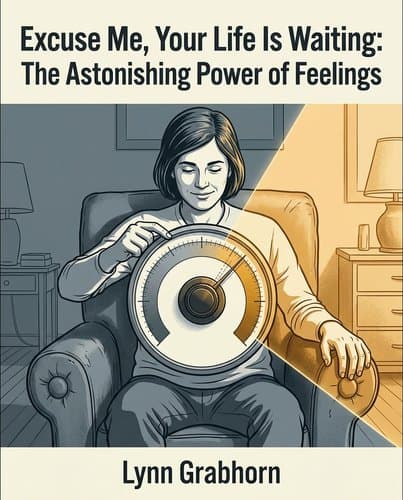
Driving between mortgage appointments, Grabhorn was doing what she'd been practicing (what she called "running her energy," deliberately inflating an internal sense of uplift) when it hit her: a rush in the solar plexus, identical to swerving to avoid a crash or the split second of being told she was fired. She called it WHOOSH. It was, she realized, exactly like a car's temperature gauge: you don't need to open the hood to know the engine is overheating. The needle tells you instantly, and in time to act. She'd been carrying this instrument her whole life and ignoring it.
The mechanism made sense once she traced it. Fear and joy land in the same spot because any intense charge — dread or delight — produces the same gut drop. The body doesn't distinguish terror from exhilaration at the chemical level; both feel like a roller coaster going over the crest. Grabhorn began using the WHOOSH as a real-time instrument: a big rush meant she was genuinely vibrating high; nothing at all meant she was flat-lining.
Better still, she found she could generate it deliberately. The sequence takes two seconds. Start with a genuine facial smile (warm and tender, not performed), then pull that warmth inward until it becomes a soft internal hum. Replace it with a chosen elevated emotion: deep appreciation, or the light unreasonable joy of being tickled pink. Hold it. The WHOOSH confirms the shift happened.
The mortgage collapse later proved the inverse. When interest rates rose and dread took over, she couldn't produce the buzz no matter how hard she tried. Negative focus had become too dominant. The meter wasn't malfunctioning — it was reading accurately. She just hadn't known yet what to do with an accurate reading.
Scripting, Prepaving, and the Technique That Turned Around a Failing Real Estate Office
Chuck owned a real estate firm in Washington state and had run out of options. A regional slump had gutted the market, his agents were threatening to leave, and every conventional fix (bigger ad budgets, more canvassing, sharper pricing) had made no difference. When Grabhorn met him for lunch, he'd stopped looking for answers. He'd decided there weren't any.
She started with a single question: why did he want more money? His first answer was a Don't Want — he wanted to pay his bills. She kept asking why. The chain looped through feel better, stop being uptight, stop feeling bad, until it cracked: "I want to feel free." That was the actual want. She had him say it directly. I want $60,000 so I can feel free. Then pushed further: what would that freedom look like? He and his wife had a retirement dream they'd never let themselves inhabit: Bermuda. She had him describe it in detail. The whole room shifted. He stopped talking about a balance sheet and started living somewhere else, genuinely inhabiting a future he'd been treating as forbidden.
That sensation — not the dollar figure but what the dollars would fund — was what she sent him back with. The instruction for each agent: triple your three-month target, then forget the number entirely. Script toward what the money represents. Talk about it out loud, in present tense, as if it's already yours. Ten minutes a day. She also had Chuck prepave the kickoff meeting: spend a few minutes before walking in, not rehearsing what to say but feeling his people as already open, already with him. That's the practice. You shape the emotional temperature of a room before you arrive in it.
Ten weeks later, sales arrived from directions no one had targeted: an agent's aunt relocating from out of state, Army families newly transferred to a nearby base, a referral from someone who "would never speak to him again." The one non-participant quit the business.
The Framework's Logical Endpoint: If You Attract Everything, You Attracted This Too
Grabhorn's framework is a total causation system: everything that happens to you, without exception, you attracted. The cheerful examples in earlier chapters make this easy to miss. But she follows the logic wherever it leads, and it leads somewhere uncomfortable.
A friend's mother was killed on a freeway when a teenager dropped a boulder from an overpass onto the passenger side of her car. The obvious reading: a freak accident, two unconnected strangers in the wrong place at the wrong time. Grabhorn's reading: a vibrational match so precise it was nearly inevitable. Mrs. T. had spent years smiling pleasantly while nursing deep resentment — outwardly warm, inwardly closed. The teenager had spent years feeling inferior and enraged. Both sat at the same low number on Grabhorn's one-to-ten vibrational scale, with ten being the highest frequency and damage-attracting bodies sitting well below five. Their electromagnetic signatures matched. The laws of frequency did the rest. Had it not been the boulder, she argues, something equally devastating from another matching frequency would have found Mrs. T. anyway. The responsible party, by Grabhorn's logic: Mrs. T. herself. She was the primary attractor. The teenager was simply the frequency she drew in.
The framework has no off switch for severity. The same physics caused Skip's restaurant disruptions to repeat across four consecutive dinners and crumbled Grabhorn's real estate closings. Grabhorn extends it explicitly: rape occurs when a person vibrating fear and a person vibrating rage find each other electromagnetically and become cocreators. Children born into disability or poverty absorbed negative vibrations from their parents before birth. The persecuted are often the more powerful attractors in situations of prejudice, because attending to injustice amplifies the very frequency that draws more of the same. Driving all of it is what Grabhorn calls Life force — the energy that flows through the body when emotion isn't blocking it, channeled through a valve that every negative feeling narrows. Open the valve fully and nothing in this world can harm you. Close it, and you become the kind of frequency that boulders find.
What Total Agency Actually Costs
The tools work. Run the why-chain and something shifts; script toward the feeling rather than the concept and the shift is measurable. You can run these experiments without accepting a word of the underlying physics. But the framework won't let you stay agnostic for long. Grabhorn's system has no setting for "partially true." The same laws that redirect Chuck's real estate career also explain Mrs. T.'s death. Fully open what she calls the valve — the flow of Life force that every negative feeling pinches off — and nothing bad can reach you: tornadoes curve around your house, you somehow book the wrong flight, the boulder finds a different car. The promise and the accusation are the same sentence. It costs exactly everything.
Notable Quotes
“Sweetie, you blew 'em away with your fears. You gotta feel those tender little suckers close, feel yourself shaking everybody's hand, and feel yourself out there celebrating. You gotta know it's going to work, honey, or trust me, it never will. If you can't feel it happening, it won't.”
“was what you did. The dictator of this stern way of life was her dad, who was also the minister of their church and a third generation minister at that! So this”
“was so deeply ingrained in her by her dad, Pat truly believed this to be appropriate behavior. And it might have been, had it not been for the strong inner feelings of animosity that went along with her smiles.”
Frequently Asked Questions
- What is a negative want in Grabhorn's approach?
- A negative want is when you frame your desire around what you don't want rather than what you do—such as 'I want to get out of debt' or 'I want to stop being sick.' The critical insight is that your emotional focus matters more than grammatical framing. When you focus on lack or avoidance, you generate that vibrational frequency instead. Reframe toward the desired state (abundance, health) rather than away from the unwanted one, because your feelings, not your words, create your circumstances.
- How does the why-chain technique reach vibrational alignment?
- The why-chain moves from intellectual concept to genuine feeling by asking yourself repeatedly why you want something—not for logical answers, but to follow the emotional thread. Continue until you reach a moment of physical warmth or excitement. That unmistakable sensation signals you've reached vibrational alignment. The goal isn't intellectual imagination of outcomes; it's to generate genuine emotion that attracts what you desire. The physical feeling is your confirmation that frequency has shifted.
- What is scripting and why does present tense matter?
- Scripting means writing or speaking about your desired outcome in present tense, as if it already happened—like casually chatting with a friend about a past event. Sensory and emotional detail are mandatory; vague descriptions won't work. Future tense creates yearning (lack-focus); present tense generates the feeling of already having, shifting your vibrational frequency to match your desire. This shift in felt experience attracts corresponding circumstances into your life.
- What is the solar plexus rush and how do you generate it?
- The solar plexus rush—the 'WHOOSH'—is a physical sensation signaling you've achieved vibrational alignment. Generate it deliberately: start with a warm facial smile, pull that warmth inward toward your solar plexus, then intensify toward appreciation or excitement. Use it as a real-time indicator that you've shifted frequency successfully. This tangible sensation confirms whether your emotional focus has truly changed, providing practical, measurable feedback on your inner state shift.
Related Book Summaries
Read the full summary of 69947_excuse-me-your-life-is-waiting on InShort