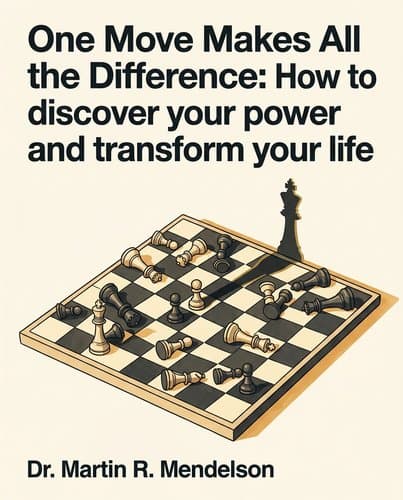
234773209_one-move-makes-all-the-difference
by Dr. Martin R. Mendelson
Frustration isn't a sign to quit—it's a signal you're close to something that matters. Dr. Mendelson reveals how one internal decision to redirect that energy…
In Brief
One Move Makes All the Difference: How to discover your power and transform your life (2025) reframes frustration as a diagnostic tool and redirects its energy toward meaningful progress.
Key Ideas
Control your response before the situation
When frustration hits, diagnose your response before diagnosing the situation — yielding, resisting, and ignoring are all forms of letting the event control the outcome (E+R=O)
Deep frustration reveals genuinely important goals
Use frustration intensity as a compass: deep, persistent frustration usually points at a goal that genuinely matters, not evidence you should quit
Reframe questions from complaint to growth
Ask 'How can I make the most of this situation?' instead of 'Why is this happening to me?' — the question you ask determines which part of your brain goes to work
Root-cause limiting beliefs, don't surface-fix
Audit your self-limiting beliefs for their origin: if you don't trace them to their source, addressing them at the surface means they'll resurface — 'Robert Xerox' is not a cautionary tale about negativity but about skipping root-cause work
Audit standard, timeline, and effort balance
Set expectations using three diagnostic questions: Was the standard too high or too low? Was the timeline realistic? Was the action commensurate with the expected result?
Choose which emotion anchors your mindset
Practice the harbor rule daily: both faith and fear will enter your mind — your only job is deciding which one you let anchor
Wrong activities cause frustration, not wrong goals
Focus on the 20% of activities yielding 80% of results; frustration is often a signal that you're grinding on the wrong 20%, not that the goal is wrong
Perseverance is a choice, not a trait
Treat perseverance not as a trait you either have or don't, but as a decision made in the specific moment when stopping feels reasonable — Edison's proximity principle: you may be one trial away
Who Should Read This
Readers interested in Self-Improvement and Motivation, looking for practical insights they can apply to their own lives.
One Move Makes All the Difference: How to discover your power and transform your life
By Dr. Martin R. Mendelson
11 min read
Why does it matter? Because your default response to frustration is the thing actually blocking you — not the frustration itself.
Most people treat frustration like a storm — something to outlast, push through, or escape as quickly as possible. That assumption is costing you everything. Because frustration isn't random interference. It's directional. It shows up precisely where you care most, where your potential is closest to the surface, where something real is almost within reach. The book you're holding doesn't offer another strategy for managing frustration or building resilience against it. It offers something stranger and more useful: the argument that frustration is the fuel of your next breakthrough, and that the only thing standing between you and that breakthrough is one internal decision — made in the next sixty seconds — about what you do next.
You're Not Fighting Frustration — You're Fighting Your Own Responses to It
Your frustration is not the problem. Your response to it is — and that distinction opens up something the frustration itself has been hiding from you.
Jack Canfield's equation cuts through cleanly: Events plus Response equals Outcome. The event is neutral. What determines whether frustration becomes a dead end or a doorway is the move you make next. Most people never examine that move. They feel the weight of blocked goals, unmet expectations, mounting pressure — and they react from instinct. That instinct almost always misfires.
The three default reactions people bring to frustration are yielding to it, resisting it, or pretending it isn't there. On the surface they look different — one person gives up, another fights, another pushes the feeling underground. But they produce the same result: more anxiety, more fear, less capacity to act. None of them are responses to frustration. They're surrenders to it wearing different costumes.
Consider what this looks like when the stakes feel real. A Fortune 500 CEO named Nathan Jones noticed he was gaining weight and committed to losing ten kilograms in a month. He lost two. That gap — eight kilograms short of his target — triggered something that had nothing to do with fitness. He stopped generating ideas. He stopped asking for help. The frustration didn't just sit in one corner of his life; it colonized his thinking. A man paid to solve complex problems at scale became unable to solve a problem about his own health, not because the problem was hard, but because his response to missing a goal had switched off the part of his mind that generates options.
That's the mechanism worth seeing clearly. Frustration, left unaddressed, doesn't just feel bad — it actively narrows what you're able to perceive. Goals that were visible before become invisible. People who could help become people you don't think to call. The frustration convinces you the walls are closer than they are.
Change the response, and the outcome changes. The event stays the same. What Jones lost wasn't eight kilograms — it was access to himself.
The Frustration You Feel Is Proportional to How Much the Goal Actually Matters
Why do some setbacks roll off you while others stop you cold for weeks? The answer isn't about resilience or willpower. It's about how much the blocked goal actually matters to you. Frustration scales with stakes. A minor irritation points at a minor concern. A frustration that follows you into sleep, that spills into unrelated conversations, that shuts down your thinking — that one is pointing at something you genuinely care about. The intensity is the signal.
Stop treating frustration as random noise and it hands you a map. The question shifts from "why does this keep happening to me" to "what does the depth of this feeling tell me about what I'm actually after?"
The next step on that map is locating the root. There's a line between frustration that originates inside you — eroding confidence, conflicting goals, fear of judgment — and frustration that comes from external conditions you can't directly control: an unresponsive colleague, a market that won't cooperate, a deadline someone else set. The two require entirely different responses. Managing the symptom without finding the source means the same pressure surfaces again, wearing a different face.
Here's where people go wrong. Someone is passed over for a promotion and spends months resenting a manager who, honestly, may have been working with incomplete information. The frustration feels external — it has a name, a face, a meeting room where it happened. But underneath it is a confidence deficit: a private suspicion that they haven't yet built the case for their own value. They keep pulling on the external rope when the knot is tied on the inside. Nothing moves.
Jim Rohn's sailing image captures the external side precisely. You cannot dictate which direction the wind blows. Fighting it is wasted energy. What you control is how you set the sails — how you position yourself in relation to conditions you didn't choose and can't change. The frustration that comes from trying to control the wind will always be worse than the frustration of learning to read it.
So: where does yours live? Is it internal — a gap between what you believe about yourself and what you're demanding of yourself? Or external — a circumstance that genuinely isn't yours to command?
What Frustration Is Actually Costing You (Beyond the Obvious)
Think of frustration as a slow leak in a tire. You can drive on it for a while — the car still moves, the radio still plays — but the damage is accumulating with every mile. By the time you feel the wobble, you've already compromised the rim.
Frustration works exactly like this. The feeling itself is just the warning light. The real cost is structural — and it spreads.
Consider what happens inside a single relationship when frustration goes unmanaged. You're angry at a situation, not a person, but the person is there and the situation isn't. Words come out that were never supposed to exist — a spouse hears "I made a mistake to have married you" — and the moment those words land, the damage is done. No retraction reaches as deep as the original wound. Frustration borrowed the relationship to express itself, and the relationship paid the price.
That's the pattern worth sitting with: frustration rarely stays contained to the thing that caused it. It migrates. It bleeds into how you see your own potential — confidence erodes, risk starts looking like certain failure, and compliments from people who genuinely admire you stop registering. It warps your perception of what's possible. And then, quietly, the time you might have spent moving toward your goals gets redirected into replaying what went wrong.
That last one is the most expensive. Every hour spent grieving what should have been is an hour not spent building what could be.
Frustration isn't just an unpleasant feeling to wait out. Left alone, it is actively dismantling things you've spent years constructing. The question isn't whether to deal with it — it's how much you can afford to lose before you do.
The Reframe That Changes Everything: Frustration Means You're Still in the Game
At 65 years old, Harland Sanders packed a pressure cooker and a single chicken recipe into his car and started driving. For two years he crisscrossed the United States, walking into restaurants, making his pitch, and being shown the door. The count of rejections before a single yes: 1,009. Not 20, not 100 — 1,009. The math of that is worth sitting with. Most people fold at the first no. Most people treat the tenth no as confirmation that they were wrong to try. Sanders treated the thousandth no as Tuesday.
Here's the reframe the book is quietly insisting on: frustration is not a stop sign. It's a sign that you're still in motion, still in contact with something you genuinely want. The people who never feel frustration are the ones who stopped wanting anything difficult. Sanders wasn't frustrated despite the 1,009 rejections — he was frustrated because of them, and he drove anyway. That's not a personality type. That's a decision about what the frustration means.
Edison put his version of the same logic into a single sentence: his success came not from brilliance or luck but from the ability to keep working on one thing without stopping. Not inspiration. Not talent. Continuity. Every failed attempt was data, not defeat — a narrowing of the field, one wrong answer eliminated, the right answer slightly closer.
The reader who is deep in a frustrating stretch — the project that won't move, the goal that keeps slipping — tends to read that frustration as a message from reality: you're not meant for this. But every person you've pointed to as proof of what's possible felt exactly what you're feeling. The people you most admire were not the ones who avoided frustration. They were the ones who hit 1,009 rejections and went looking for number 1,010. The frustration you're feeling right now is not evidence that you should stop. It's evidence that you haven't stopped yet — and that gap is everything.
Fear Is Just Frustration With a Costume On
Fear is not a separate problem from frustration — it is what frustration becomes when you leave it alone long enough. The two travel together so reliably that wherever you find one, the other is already in the room.
Here is the mechanism: frustration is blocked energy, a goal that hasn't moved yet. Fear is the story your mind tells about what that blockage means. Once that story takes hold, the original frustration stops being a signal you can act on and becomes a prison you can't see past. The FEAR acronym names this precisely — False Evidence Appearing Real. The obstacle looks like proof you were wrong to try. The rejection looks like a permanent verdict. The gap between where you are and where you want to be looks like a canyon rather than a distance. None of that is real, but all of it feels real, and that distinction is what costs you.
Marianne Williamson's inversion cuts to the core of why this happens. Most people, she argues, aren't blocked by the fear that they can't do something — they're blocked by the fear that they can. That they've been holding back from a version of themselves they haven't had the courage to become. Playing small feels like safety. It keeps you below the line where risk lives. But it produces exactly the frustrated stagnation you were hoping to avoid.
The harbor metaphor gives you a working image for what managing this actually looks like. Both faith and fear are always incoming — they sail into your mind whether you invite them or not. You cannot keep them from arriving. What you control is which one you allow to anchor. Fear that docks and stays rewrites your map. Fear that passes through — named, acknowledged, sent on — leaves room for something more useful to take its place. You are not trying to become fearless. You are learning to be a more selective harbor master.
17 Questions That Turn Frustration Into Forward Motion
What if the problem isn't the frustration itself, but the questions you're asking about it?
Anthony Robbins built an entire coaching philosophy on a deceptively simple observation: quality questions create a quality life. Follow that to its conclusion and most people aren't suffering from bad luck or weak willpower — they're suffering from bad questions. And the most common bad question, the one almost everyone defaults to in a hard moment, is some version of "why has this happened to me?" That question aims backward. It puts you at the center of a story where the world is the actor and you are the acted-upon. It generates more resentment, not more options.
The shift the book proposes is specific: replace backward-looking questions with forward-facing ones. You're stuck in traffic that isn't moving, already late, frustration building. The default question — why does this always happen to me — produces nothing but heat. Swap it for "how can I make the most of this situation?" and the traffic hasn't changed, but your relationship to the next thirty minutes has. Suddenly there's an audiobook chapter to finish, notes to dictate, an outline to sketch. The event stayed identical. The question changed the outcome.
The same logic applies when the frustration is bigger — a business that isn't growing, a goal that keeps slipping. Before concluding that reality is failing you, Robbins says, ask three things: Was the goal specific enough to actually act on? Was the timeline honest? Was the effort proportional to what you wanted? Expecting to build a million-dollar business in its first year isn't a bold goal — it's an unexamined one. The frustration that follows isn't the business telling you to quit. It's the timeline telling you to recalibrate. The lever was always in your hands. You just needed the right question to find it.
The Internal Levers: Belief, Expectation, and the Words You Use on Yourself
Think of your mind as a thermostat, not a thermometer. A thermometer reads conditions and reports them back. A thermostat reads conditions and then overrides them. Most people are running their lives on a thermometer — measuring how frustrating things are, reporting it accurately, and then wondering why nothing changes. The book's argument is that belief, expectation, and the words you use on yourself are the actual thermostat settings. Change those, and the room temperature changes. Leave them alone, and all the willpower in the world is just you blowing on your hands.
Expectation is where this gets concrete. The book draws a distinction that most self-help thinking quietly evades: frustration that feels like injustice is usually a category error. Dennis Wholey's line captures it without mercy — expecting the world to treat you fairly because you're a good person is roughly like expecting a bull not to charge because you're a vegetarian. Your virtue is real. The bull does not care. When you expect outcomes that have no mechanism to produce them, the frustration that follows isn't the world failing you. It's your expectation failing you. The correction isn't to feel less — it's to ask three diagnostic questions: Was the standard realistic? Was the timeline achievable? Was the action actually proportional to the result you wanted? Those questions turn a grievance into a blueprint.
Beliefs are the deeper setting. The book draws a clean binary: empowering beliefs versus self-limiting ones, and the one that dominates is whichever gets fed more attention. Self-limiting beliefs — I'm not worthy, I'm from the wrong background, I'll never be enough — rarely originate inside you. They arrive from family, peers, teachers, culture, and they lodge themselves so early that by the time you're an adult they feel like facts rather than inherited opinions.
Speech is the mechanism that connects all of this. The book makes a point about inner dialogue that's easy to miss: speaking empowering words while genuinely believing the opposite produces nothing. The mouth and the heart have to align. But the feedback runs both directions — deliberate, consistent speech can gradually reshape what the heart believes. Practice the right words for 21 days and what started as performance begins to feel like identity. You're not deceiving yourself. You're adjusting the setting, one degree at a time.
Where You Point Your Attention Is Where Your Life Goes
Twelve spies walked into the same territory, ate the same food, saw the same cities. When they came back to report, they split ten-to-two. The ten described giants so large they felt like grasshoppers by comparison. The two described a land flowing with milk and honey. Same terrain, same journey, same evidence — and two completely different realities constructed from it. The book uses this story to make an argument that sounds simple until you sit with it: attitude isn't downstream from circumstances. It is the lens that determines which circumstances you actually perceive.
This is the shift the prior sections have been building toward. You've already seen how your responses to frustration shape outcomes more than the frustrating event itself, how fear is just blocked frustration wearing a story, how the questions you ask determine what options become visible. All of that is true — but it depends on something more foundational. Where you point your attention determines which version of reality you inhabit. The ten spies were not lying. They genuinely saw giants. The two were not deluding themselves. They genuinely saw abundance. Both groups were looking at the same land. The difference was entirely internal, and it was entirely decisive.
Anthony Robbins put the mechanism plainly: most people never achieve what they want because they never direct their focus. They scatter it, dabble, master nothing, and wonder why forward motion stalls. Focus isn't a personality trait you either have or lack. It's a skill you aim deliberately, and what you aim it at grows.
Attitude and focus are not rewards for things going well. They are the cause of things going well. The two spies who saw abundance had already decided, before they walked into the territory, what they were looking for. They weren't more optimistic by nature. They were more deliberate in aim. You make that same decision every time you walk into difficult terrain. The question is whether you're making it consciously.
Success Is Buried on the Other Side of the Frustration You're Standing in Right Now
Perseverance is not a personality trait you either have or lack — it is a decision you make in the specific moment when stopping feels easiest. That distinction matters enormously, because it means the choice is available to you right now, wherever you're standing.
Anthony Robbins puts it in terms that function as the thesis of everything you've read in these pages: all successful people eventually discover that success is buried on the other side of frustration. Not around it, not before it — through it. The people who reach their goals are not the ones who experienced less resistance. They're the ones who kept moving after the resistance arrived. Edison made the same observation from his own laboratory floor: most people who fail don't fail because success was impossible. They fail because they stopped within reach of it.
That's the only argument perseverance needs to make. You already have the toolkit — the ability to read frustration as signal rather than verdict, to ask better questions, to reset your expectations and redirect your attention. None of that requires new circumstances. It requires one internal move: not stopping. The moment you treat perseverance as a decision rather than a disposition, it stops being something you admire in other people and becomes something you can choose in the next five minutes. The frustration you're feeling is not the door closing. It's the door, and you're still standing in front of it.
The One Move That Was Always Available
Everything you've encountered in these pages points to the same compressed truth: the event never had the power you gave it. Colonel Sanders knew this at 65, on the road, after a thousand closed doors. Edison knew it somewhere between experiment four hundred and the one that finally held light. They weren't extraordinary people who happened upon extraordinary patience — they were ordinary people who kept making one ordinary decision in the specific moment when stopping felt reasonable. That decision is available to you right now, in whatever frustrating stretch you're currently navigating. The gap between what happens and how you respond has always been there, even when you couldn't feel it. Step into that gap deliberately. The response you practice today is the one that becomes automatic tomorrow — and the door you keep walking through, even when nothing feels like it's opening, is the one that eventually does.
Notable Quotes
“And be not conformed to this world: but be ye transformed by the renewing of your mind, that ye may prove what is that good, and acceptable, and perfect, will of God.”
“everything produces after its kind.”
“I've come to believe that all my past failure and frustrations were actually laying the foundation for the understandings that have created the new level of living I now enjoy.”
Frequently Asked Questions
- What is the E+R=O framework and how does it help manage frustration?
- E+R=O (Event + Response = Outcome) reframes frustration by separating what happens from how you respond. The work emphasizes that yielding, resisting, and ignoring are all passive responses that let the event control your outcome. Dr. Mendelson argues you must diagnose your response before diagnosing the situation—your choice of response determines whether frustration becomes a tool for progress or proof you should quit. This framework shifts control from external circumstances to your deliberate decision-making.
- How should you interpret intense frustration according to this book?
- Deep, persistent frustration serves as a compass pointing toward goals that genuinely matter rather than evidence you should quit. The work teaches readers to flip the typical interpretation: instead of asking 'Why is this happening to me?', ask 'How can I make the most of this situation?' This reframing activates problem-solving areas of your brain. Frustration intensity signals you care about the outcome, making it valuable diagnostic information about your priorities rather than a stop sign.
- What are the three diagnostic questions for setting realistic expectations?
- The book prescribes auditing expectations through: Was the standard too high or too low? Was the timeline realistic? Was the action commensurate with the expected result? These questions help identify whether frustration stems from unrealistic expectations rather than actual failure. By tracing expectations to their source, you prevent recurring frustration cycles. This diagnostic approach treats expectation-setting as a skill requiring systematic evaluation rather than intuition.
- How does the Pareto principle apply to managing frustration about goals?
- The work uses the 80/20 principle to reframe goal frustration: focus on the 20% of activities yielding 80% of results. When frustration peaks, you may be grinding on ineffective activities rather than the goal being wrong. This principle redirects effort toward high-impact work. Combined with the harbor rule—deciding daily whether faith or fear anchors your mind—it prevents exhaustion from misaligned effort and preserves perseverance for activities that actually drive meaningful progress.
Related Book Summaries



Read the full summary of 234773209_one-move-makes-all-the-difference on InShort