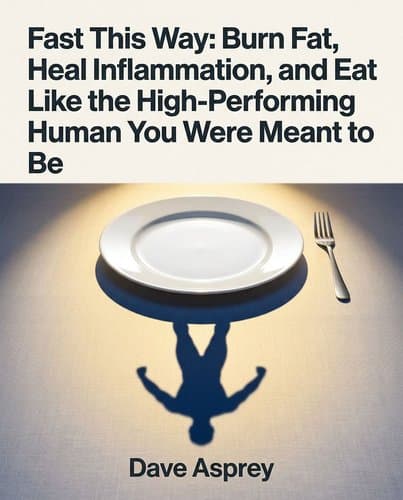
54026608_fast-this-way
by Dave Asprey
Hunger is biology you can master; cravings are manufactured signals engineered to own you. Learn to tell the difference through strategic fasting—and reclaim…
In Brief
Fast This Way: Burn Fat, Heal Inflammation, and Eat Like the High-Performing Human You Were Meant to Be (2021) teaches you to distinguish biological hunger from engineered craving — and use fasting as the tool for mastering both.
Key Ideas
Bulletproof Coffee maintains ketones without hunger
Replace breakfast with Bulletproof Coffee (grass-fed butter + C8 MCT oil) to enter fasting without hunger pain — fat keeps ketones elevated without triggering protein metabolism or spiking insulin, so autophagy continues while the 'I'm starving' signal stays silent.
Manufactured cravings subside within twenty minutes
When a craving hits during a fast, wait 20 minutes before acting on it — biological hunger stays steady; manufactured craving (amplified by gluten's and dairy's morphine analogs) subsides on its own once you stop feeding the signal.
Fasted HIIT at fast-end maximizes hormones
Exercise at the end of your fast, not at the start — fasted HIIT at 1–2 PM for a standard 16:8 faster triggers the largest testosterone and HGH spikes; breaking the fast afterward with protein and fat maximizes the muscle-repair signal that follows.
Women's alternating fasting prevents metabolic stress
Women should fast every other day rather than daily — the amygdala reads consistent daily caloric restriction as famine stress and suppresses gonadotropin-releasing hormone, cascading into disrupted ovarian function; every-other-day fasting delivers the biological benefits without triggering the emergency response.
Raw honey stabilizes nocturnal fasting glucose
If you wake around 3 AM unable to get back to sleep while fasting, eat a small amount of raw honey before bed — the brain needs a glucose surge for nighttime glymphatic cleaning; without glycogen reserves, it fires a cortisol alarm that wakes you before the cleanup is complete.
Activated charcoal binds bacterial craving signals
Take 1–10 capsules of activated charcoal (1,000 mg) when cravings spike during a fast — gut bacteria stressed by food deprivation produce lipopolysaccharides that the brain reads as emotional distress and interprets as hunger; charcoal binds those toxins before they reach the bloodstream.
Cycling fasting protocols prevents metabolic adaptation
Deliberately break your fasting pattern at least once a week — the body adapts to consistency and gets metabolically lazy; cycling between 16:8, OMAD, and protein fasts forces the metabolic flexibility that is the actual goal, not adherence to any single protocol.
Linguistic fasting trains want versus need
Test every 'need' statement by appending 'or I will die' before acting on it — most collapse into wants instantly, and training this distinction in language is the same neurological practice as training it with food; start with one day of linguistic fasting to build the muscle.
Who Should Read This
People working on personal growth in Nutrition and Fitness, especially those tired of generic motivational advice.
Fast This Way: Burn Fat, Heal Inflammation, and Eat Like the High-Performing Human You Were Meant to Be
By Dave Asprey
10 min read
Why does it matter? Because the hunger you feel right now is probably not hunger at all.
You assume four days without food ends one of two ways: you collapse, or you quit. Dave Asprey did neither. He walked out of a desert cave feeling sharper, lighter, and genuinely energized — down twenty pounds he couldn't possibly have lost as fat. Something else had happened, something the calorie-counting model has no language for.
That something is what this book is about. Asprey spent years being fat despite daily gym sessions, sick despite careful eating, and controlled by cravings he mistook for hunger. He eventually learned they are not the same thing. Fasting, it turns out, is how you learn to tell the difference.
You're Not Hungry — You're Chemically Addicted to Specific Foods
The feeling you call hunger when you pass the bread basket is not hunger. It is withdrawal.
That distinction took Dave Asprey four days alone in an Arizona cave to understand, and it reorganized everything he thought he knew about why diets fail. Hunger is a biological signal: a genuine message that the body needs fuel. It is manageable, and with the right preparation, barely noticeable. Craving is something else: a manufactured psychological need that masquerades as an emergency and fires before conscious thought can intervene. The trillion-dollar processed food industry profits by keeping these two things permanently confused. If every craving feels like imminent starvation, you will reach for whatever is nearest, and what's nearest has been engineered to quiet the alarm briefly without ever turning it off.
Asprey spent years blaming his own willpower for this cycle. He exercised 90 minutes a day for 18 months and gained weight anyway. He tried diet after diet. None of it addressed the real problem: certain foods had rewired his reward circuitry. His body wasn't malfunctioning. It was responding correctly to what it had been given.
But the deepest trap isn't the candy bar or the chip bag. It is bread and cheese.
When your body digests gluten — the protein in wheat — and casein — the protein in dairy — it doesn't simply break them into neutral amino acids. It produces molecules called gluteomorphin and casomorphin. Notice the "morphin" in both names. These compounds are morphine analogs. They bind to the same opioid receptors as heroin. The intensity is lower, but the mechanism is identical: a hit of gratification, a mild euphoria, and then — because that is how opioid receptors work — a growing demand for more. This is why you cannot eat one piece of bread. Not because you lack discipline, but because your brain is running the same loop it would run on a mild opiate. The breadbasket at a restaurant is not an accident of hospitality. It is the first dose.
Four Days Without Food, Twenty Pounds Lighter — The Biology Behind the Impossible Number
When Asprey stepped onto the scale after four days alone in an Arizona cave — no food, just water — the needle landed 20 pounds below where it had started. His first thought was that something must be wrong with the scale. He hadn't had liposuction. Burning 20 pounds of pure fat in four days is biologically impossible; the math doesn't work at any realistic metabolic rate. So what actually happened?
First: ketosis. When the body exhausts its glucose supply, it shifts to burning fat, but stored carbohydrates don't travel light. Every gram of glycogen carries roughly three grams of water with it. Enter ketosis and the glycogen drains, pulling that water along. Ten pounds gone in the first week is common for people making this switch for the first time.
Second: inflammation. Four days without food meant four days without any of the foods quietly inflaming his tissues. Inflammation is water-mediated. When it clears, the swelling clears with it. His joints (including a knee rebuilt through three prior surgeries) emerged from the cave without soreness. His face looked different in the mirror. That wasn't metaphor. That was systemic inflammation draining out.
What he did not feel was what conventional nutrition would predict: weakness, fog, desperation. His body was generating catecholamines (adrenaline, norepinephrine, cortisol, dopamine), the compounds responsible for alertness and drive. Fasting produces them naturally, for the same evolutionary reason a hungry predator needs sharper attention than a fed one. A brain that dims when food is scarce does not survive. The brain that conventional nutrition said should be shutting down was, instead, running at a frequency he hadn't felt in years. Asprey called the resulting state "go mode." It wasn't willpower. The fast had switched it on automatically.
The standard model of nutrition ignores this entirely. The claim that humans must eat every few hours or suffer cognitive and physical collapse isn't drawn from observing what actually happens when people stop eating. It's drawn from watching people crash off a glucose dependency, which is real but temporary. Once the body switches fuel sources, something else becomes available.
Eating Less Has Never Worked — Here Is Why the Science Behind It Was Always Wrong
If eating less reliably causes weight loss, why does almost everyone who loses weight by cutting calories eventually gain it all back?
The answer isn't willpower. It's hormone calibration.
Your body maintains what physiologists call a hunger set-point, driven by two hormones: ghrelin, which signals hunger, and the fullness hormone CCK. These hormones aren't calibrated to your current weight. They're calibrated to whatever weight your body has learned to defend. If you weigh 300 pounds, your hunger signaling runs at 300-pound intensity. Starve yourself down to 200 pounds and your hormones haven't moved. You are now a lighter person carrying the relentless hunger of someone a hundred pounds heavier. That hunger doesn't fade. It doesn't respond to motivational speeches. It simply waits, and it always wins. The diet industry sells this as a character flaw. It is a biological fact.
The calorie myth traces back to a University of Minnesota physiologist named Ancel Keys. In the 1930s and 40s, Keys became obsessed with the arithmetic of obesity (calories in, calories out) and dismissed sugar as harmless when other researchers flagged it. A US Senate committee codified his framework into the federal food pyramid in the 1970s, and the "eat less, move more" dogma that followed treated the human body as a simple combustion engine. It isn't. A hundred calories of soda and a hundred calories of coconut trigger completely different hormonal responses, at different times of day, in different metabolic states. The engine metaphor misses all of this.
Asprey tested how far the gap between calorie theory and metabolic reality actually runs. For a full month, he ate 4,500 calories a day: massive steaks, butter in everything. He slept under five hours a night — a documented trigger for weight gain — and stopped exercising entirely. By calorie-counting logic, he should have gained 21 pounds. He lost weight. He felt sharp. The single variable he kept in place was intermittent fasting: Bulletproof Coffee in the morning, no food until late in the day. The fast wasn't suppressing his caloric intake. It was changing what his body did with the calories he consumed. Fasting shifts metabolic signaling in ways that eating less cannot replicate. It resets the hormonal environment rather than fighting it.
That's the distinction that matters. Calorie restriction wages a war of attrition against your own biology, and your biology has more resources than you do. Intermittent fasting reroutes the chemistry — so the hunger set-point moves, fat burns, and the war never has to happen.
Not Eating Triggers Six Specific Biological Upgrades That No Diet Can Replicate
Think of your body's maintenance crew as a night-shift janitorial team. While the building is full of people — meetings, foot traffic, noise — the janitors can't do their real job. They push mops around the edges, collect the obvious trash, keep things presentable. But real cleaning — the deep scrubbing of corners, the restoring of worn surfaces — only happens after everyone goes home. Your digestive system is the crowd. Fasting sends them home.
When you stop eating, your body doesn't enter a passive holding pattern while it waits for the next meal. It launches a cascade of repair processes that cannot run while digestion is consuming the body's resources. The most striking is autophagy — from the Greek for "self-eating." Your cells contain molecular machinery called lysosomes that sweep through the cell, collecting misfolded proteins, dead organelles, viral debris, and everything else that accumulates from the normal wear of living, then digest it. This cellular garbage, left in place, impairs how cells function and replicate. Cleared out, the cell runs cleaner and divides correctly.
The research on what this does to the brain is startling. Scientists at the Scripps Research Institute found that fasting produces especially pronounced neuronal cleanup — the brain's janitors work overtime when the building empties. [Author to confirm Scripps researcher name.] The physiologist Yoshinori Ohsumi spent decades mapping the precise molecular machinery driving autophagy, work that earned him the Nobel Prize in Physiology in 2016. The prize committee was direct: cells that cannot perform autophagy age faster, accumulate damage faster, and are more vulnerable to cancer and neurodegenerative disease.
No diet triggers autophagy. Eating the cleanest food on earth still means the body is digesting. Digestion and autophagy compete for the same cellular resources, and digestion always wins. A 16-hour fast delivers what a year of salad cannot.
Ketones follow the same logic. After roughly 12 to 16 hours without food, the liver begins converting fat into ketone bodies — an alternative fuel the brain runs on with surprising efficiency. The neurophysiologist Stephen Cunnane at the University of Sherbrooke spent years measuring how the brain performs on different fuels. His finding: the brain runs about 25 percent more efficiently on ketones than on glucose. More output, less substrate. The body is not running on fumes when it makes this switch. It is running on better fuel. And it only makes that switch when digestion stops long enough to let fat metabolism take over.
The Fasting Research Was Conducted on the Wrong Body — And It Shows
The fasting advice in most books applies to one body type: male.
Of 71 intermittent fasting studies reviewed in a Harvard database, only 13 included women — yet the protocols derived from them were handed to everyone as though the biology were identical. It isn't.
In a female body, the amygdala reads sustained caloric restriction as famine stress and responds by cutting secretion of gonadotropin-releasing hormone, which normally triggers the hormones that drive egg maturation and prepare the uterus for implantation. Sex hormone levels drop. Ovarian function degrades. The evolutionary calculation is blunt: a malnourished pregnant woman faced catastrophically higher mortality risk than a man who contributed sperm to the same pregnancy. So the female body is wired to shut down reproduction under resource stress — even when there's no pregnancy, no pregnancy attempt, and no actual famine. The signal is caloric restriction. The response is the same regardless of intent.
A two-week rat study found intermittent fasting shrank ovaries, disrupted sleep, and stopped menstrual cycles. Women report the human equivalent: sleeplessness, anxiety, irregular periods, temporary infertility. None of these symptoms appear in the research on men because men weren't being studied in a body with this evolutionary wiring.
Fast every other day rather than daily — enough to signal metabolic resilience without reading as a famine. On fasting days, skip strenuous exercise. The most effective modification is Bulletproof Coffee (coffee blended with butter and MCT oil, zero protein, zero carbs): enough fat to suppress hunger and trigger mild ketosis without triggering the stress cascade. The body reads it as a day of adequate resources, not deprivation. Autophagy still runs. The amygdala stays calm. The benefits land without the hormonal disruption.
The Real Test Is Not Skipping Breakfast — It Is Sitting at Kensington Palace With an Empty Plate
Phil Libin, former CEO of Evernote and by this point 80 pounds lighter, was on day three of a five-day fast when he sat down to dinner at Kensington Palace. Around him: tuxedoed waiters, waves of ornate food, a table of senior executives and European elites. His plate stayed empty the entire evening. Other guests whispered he must have an eating disorder. Libin sat through the meal perfectly comfortable, making conversation, apparently indifferent to the diagnosis circulating around him.
Asprey watched and recognized something. Libin had already made his decision: he wasn't going to eat, wherever in the world he happened to be. The lavish setting changed nothing. The whispers were the tell. When someone else's empty plate disturbs you enough to reach for a clinical label, food still owns you. Asprey's framing: owning your diet is self-management; being owned by it is the disorder.
The social pressure at that palace dinner is a smaller version of every manufactured urgency fasting teaches you to identify. Something ancient in us reads a neighbor's empty plate as a signal — the evolutionary equivalent of: if that person isn't eating, the food has run out. What registers as concern is an ancient alarm misreading the situation. Once you see the mechanism, the alarm loses most of its authority.
Asprey extends this to language. Take the word "need." Append "or I will die" to any sentence containing it and watch what happens: "I need that iPhone or I will die." Almost nothing survives the test.
The caloric window is just where the training starts.
The Muscle You Are Actually Building
The cave wasn't about calories. It never was. Every protocol in this book — the morning fats, the fasting windows, the recovery biohacks — is just a training ground for one neurological skill: the pause between signal and response. Feel the urgency. Don't obey it automatically. That's the whole thing.
Once you build that pause with hunger, you find it works everywhere. You can fast from fear. Fast from the stories cortisol writes at 3 AM about your career, your relationships, your worth. Fast from the word "need," which surrenders your agency before you've made any real decision. The body was always the easiest place to start. It sends the loudest, most biological signals, so the practice is obvious. But the muscle you're actually building has nothing to do with food. It's the muscle of choosing. That's what you walked out of the cave with.
Notable Quotes
“worthy of a visit by Picasso.”
“flip the switch on that energy for many hours. C8 MCT oil is converted directly into ketones in the body, and coffee contains caffeine, which doubles your ketone production, according to a study by Canadian researchers. An elevated ketone level stimulates production of cholecystokinin, or CCK (the”
“hormone) and cuts off production of another troublemaking hormone, ghrelin, which is produced in the stomach and small intestine. Biologists have nicknamed ghrelin the”
Frequently Asked Questions
- What is Bulletproof Coffee and how does it support fasting?
- Bulletproof Coffee—made from grass-fed butter and C8 MCT oil—enables you to enter fasting without hunger pain. Fat keeps ketones elevated without triggering protein metabolism or spiking insulin, so autophagy continues while the 'I'm starving' signal stays silent. This approach maintains fasting's metabolic benefits while eliminating discomfort that undermines sustainability. By consuming fat-based fuel, your body receives sufficient energy to prevent typical hunger signals associated with longer fasts. This allows people to achieve fat loss, inflammation reduction, and cellular healing without abandoning fasting due to hunger.
- How can you tell the difference between real hunger and manufactured food cravings?
- Learn to identify genuine biological hunger versus engineered cravings using the 20-minute test: when a craving hits during a fast, wait before acting on it. Biological hunger stays steady, while manufactured craving subsides on its own once you stop feeding the signal. Cravings are amplified by substances like gluten and dairy's morphine analogs, making them feel urgent. Training this distinction develops metabolic awareness and gives you control over food-driven impulses. Recognizing the gap between want and need enables conscious eating choices aligned with your body's actual nutritional requirements.
- Should women use the same daily fasting protocols as men?
- No—women should fast every other day rather than daily. The amygdala reads consistent daily caloric restriction as famine stress and suppresses gonadotropin-releasing hormone, cascading into disrupted ovarian function. Every-other-day fasting delivers fasting's biological benefits without triggering the emergency response that can harm reproductive health. This gender-specific protocol acknowledges that women's hormonal systems respond differently to metabolic stress than men's. By alternating fasting and feeding days, women achieve fat loss, inflammation reduction, and metabolic flexibility while maintaining hormonal balance.
- When should you exercise while fasting for maximum hormonal benefits?
- Exercise at the end of your fast, not at the start. Fasted HIIT at 1–2 PM for a standard 16:8 faster triggers the largest testosterone and HGH spikes; breaking the fast afterward with protein and fat maximizes the muscle-repair signal that follows. Timing exercise to coincide with deepened fasting triggers the hormonal cascade that builds muscle and reduces inflammation. This protocol optimizes the natural peak in anabolic hormones during extended fasts, making workouts more effective for strength and body composition. Post-workout nutrition reinforces hormonal gains.
Related Book Summaries

Read the full summary of 54026608_fast-this-way on InShort