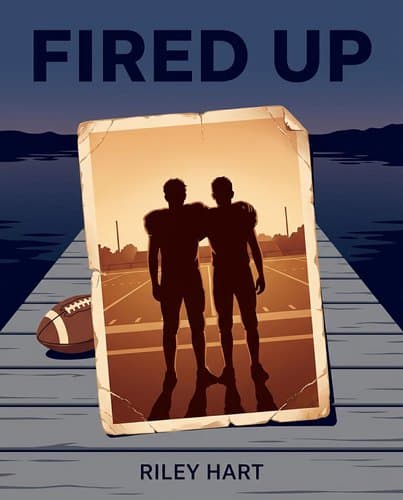
43455707_fired-up
by Riley Hart
When football strips away the identity you built around it, what remains is the self you've been hiding — and the one man who never believed your performance…
In Brief
When football strips away the identity you built around it, what remains is the self you've been hiding — and the one man who never believed your performance might be the only person who can show you who you actually are.
Key Ideas
Unconscious Details Reveal Honest Feelings
The specific, unchosen details you've memorized about someone — things you never meant to notice, like the exact arrangement of three moles on a bicep — are often more honest about your feelings than anything you've consciously decided to feel.
Suppressed Identity Becomes Others' Crisis
Suppression doesn't stay contained: the energy required to deny who you are externalizes, eventually becoming someone else's crisis, someone else's punch, someone else's explanation to give to a crying sibling in a truck.
Being Truly Known Feels Threatening
The person who refuses to perform back at you — who calls out your avoidance, who won't be dazzled by what you represent — is offering something rarer than admiration: the possibility of being actually known. Most people find that more threatening than flattering.
Becoming Yourself Requires Solitary Arrivals
Coming out (in any sense — to yourself, to others, about who you are or what you want) is not a single moment that fixes things. It's a series of arrivals, and the most important one happens alone, without an audience, after the crisis has passed.
Loss of Role Exposes Your Self
A persona built around a role doesn't survive the loss of that role cleanly. What surfaces when the role disappears isn't failure — it's the question you've been postponing about who you are without it.
Who Should Read This
Readers interested in Novels and Contemporary Authors, looking for practical insights they can apply to their own lives.
Fired Up
By Riley Hart
11 min read
Why does it matter? Because the man performing confidence for everyone has been performing it for himself the longest.
You think you're picking up a story about a disgraced quarterback crawling back to his hometown after the tabloids finish with him. And you are — but only on the surface. The real story started ten years earlier, on a dock at eighteen, when Ashton Carmichael kissed his rival, blamed it on the alcohol, and spent the next decade building an entire life inside the silence around that moment. The career. The women. The bravado. All of it constructed in the space where a truth he couldn't name kept pressing against the walls. Beau never forgot what that kiss told him about himself. Ash never acknowledged it. And everything that followed — every headline, every record, every woman he slept with to prove something to himself — was just one man running from the only person who'd ever refused to be impressed by the performance. This is the story of what it costs to finally stop running. And what you find when you do.
Ten Years of Running From a Single Dock Kiss
On the night of his high school graduation, Beau Campbell sat alone at the end of a dock outside Fever Falls, Ohio. He'd stayed behind while everyone left (taking community college classes while Ash headed to USC), and was still there when the loudest person at the party materialized out of the dark and sat down beside him.
Ash said something unexpectedly kind about Beau's younger brother Kenny, the one nobody thought to ask about. That small surprise caught Beau open enough that when Ash leaned in and kissed him, he didn't pull back. The kiss lasted maybe half a minute. Then Ash jerked away, announced he was suddenly very drunk, and jogged back toward the party lights with a cheerful goodbye over his shoulder.
Beau spent that night on a wet dock, touching his lips, working out what the kiss had told him about himself. The understanding was new and sharp and true, and he would spend the next ten years learning to live with it.
Ash went to USC. Then the NFL. First-round pick, Rookie of the Year, MVP, championship quarterback for the Los Angeles Avalanche — ten years of being exactly the person the headlines described: parties, women, scandals, tabloid nicknames multiplying with every season. By the time the book opens, a hotel-room exposé has ended his career, his agent is delivering the verdict (no team will touch him, not the Avalanche, not Houston, not anyone), and every sportswriter in the country has an opinion on what he threw away.
Here's the detail that rewrites it: when Ash privately takes stock of the wreckage, the thing that scares him is that he doesn't care as much as he should. He should be devastated. Football has been his whole identity: the game his late father (who adopted him) taught him, the career he built his life around. But somewhere in the last ten years the engine quit, and he kept going on momentum alone.
You see the shape of what happened when you picture him back in Fever Falls, standing inside his childhood home for the first time in eight years, a house he paid a cleaning crew to maintain but never once entered after his parents died, family photos of swimming and hiking and laughing covering every wall. His first instinct is to rub the ache in his chest and then decide it isn't there.
The football career, the women, the constant noise — not what you throw away when you had everything. What you build when you need to outrun something you discovered at eighteen on a dock and refused to face.
The Person Who Refuses to Be Fooled Is the One You Can Never Stop Thinking About
Everyone in Ash's orbit performs. His coaches praise him loudly. Friends laugh at every joke. The women come and go wanting the quarterback, not the man. After a decade of this, Ash has lost the ability to tell real warmth from the version people aim at someone famous, which is why Beau Campbell, the one person who never faked it, has lived rent-free in his head since he was sixteen.
The evidence is in a moment that shouldn't matter. At their first dinner back in Fever Falls, Ash drinks four rounds and says what he's been carrying for a decade: he spent their entire shared childhood trying to earn Beau's approval and never did. Not a complaint. A confession. The words come out because alcohol loosened them, but the weight has been there since high school. Beau was surrounded by everyone performing for Ash, and he never joined in. He frowned when Ash was being an idiot. He looked away when Ash said something hollow. Beau's good opinion couldn't be bought with charm or a jersey number, and Ash — who had never encountered anything he couldn't buy with those things — kept trying anyway.
Ash can feel Beau frowning without looking at him. He explains this to Beau directly: he remembers what it feels like. He registered Beau's disapproval so acutely, for so many years, that it became a physical sense. That's not annoyance. That's attachment.
Beau's disapproval was never indifference. Beau watched every one of Ash's NFL games. Recorded them when he was working. For ten years he told himself it was rivalry, competitive surveillance — something other than what it was. When he finally admits it to Ash at a pizza table, confessing that he could never have accomplished what Ash did even with the scholarships he turned down, he's not complimenting Ash. He's confessing that he spent a decade watching the person he claimed not to care about. Two men, a continent apart, quietly accounting for each other.
Back in Fever Falls, at the firehouse or across the counter at Campbell's Confections, Ash's performance equipment shuts down. The jokes don't land as quickly. The deflections don't stick. When Beau calls something admirable, Ash goes quiet. When Beau looks away during a genuine moment, Ash notices. He can barely form a sentence when Beau casually mentions going to the bathroom. He lost his football career and it hurt less than the distance from one stubborn firefighter in Ohio.
Underneath the banter, that's the story: a man who survived every crowd by performing for it, now facing someone who won't watch the show, discovering that being truly seen is what he's always wanted and the most frightening thing he's ever faced.
At Some Point the Body Stops Cooperating With the Story the Mind Has Been Telling
Four drinks in on a Saturday night, Ash is on his phone watching Beau and Lincoln at a gay club, tracking for a flash of Beau dancing with someone else and hating every second of it. This is the system: get drunk enough that desire blurs into noise, go home with a woman, wake up in the morning without anything you have to name. It had worked, mostly, for ten years. Then Beau came back.
Ash leaves the bar, picks up a woman outside, and follows her into an alley with the logic of someone trying to outrun himself one more time. He urges his own body to cooperate, Beau's laugh cycling through his head, the smiley-face tattoo he's had memorized since they were sixteen. His body doesn't cooperate. He walks away from the alley and vomits.
The body has its own arithmetic. Then he calls Beau. Not to say any of this — he's screaming "fuck you" over and over down the phone, which is what grief sounds like when it has no other vocabulary. Beau lets him. When Ash says he tried, that he can't make it go away, Beau answers: "Because it's who you are." Ash says no. The no is hollow, audible even to him.
What follows — Beau arriving on Bishop Street, the childhood bedroom, Ash on his knees saying he doesn't know how to be gay while Beau holds him — isn't a romantic turning point so much as a pressure system releasing. The real stakes aren't whether they'll end up together. They're whether Ash can say who he is before circumstances say it for him. Football's already gone, stripped by scandal. A body that stops cooperating in alleys takes care of the rest. What's left, once both are gone, is just Ash: exactly what he's been afraid of, and exactly what Beau has been waiting for.
The Man Who Has Never Learned to Perform Is the Hardest One to Lie To
Why does a man who handled ten years of press conferences and tabloid scandals nearly swerve into oncoming traffic when a twenty-year-old asks him one question?
Kenny Campbell (Beau's younger brother, who has Down syndrome and works at the family bakery) is in Ash's car on the way to a football game when he asks: "Is Beau your boyfriend?" Ash's hands go sweaty, he drifts into the wrong lane, gets honked at. Then "No" flies out before he can stop it.
Unlike everyone Ash has ever charmed, Kenny has no angle. He just wants to know. When the "No" lands, he doesn't argue or press. He simply says: Ash makes Beau happy. Beau is a hero. Heroes deserve to be happy. He wouldn't be afraid if he loved someone. He loves Lori, his girlfriend. Then he gets out of the car.
Ash sits in the parking lot with a lie that felt wrong the second it left his lips. Kenny didn't try to catch him in anything — he stated four facts and left. What makes it impossible to shake: there was no trap. Just the truth, said plainly by the one person in the book who doesn't know how to say it any other way.
Later, when Ash comes out to Kenny, Kenny asks: "But you love him. Why can't that be simple?" Ash's honest answer: he doesn't know either. The closet survives on complicated justifications. Kenny doesn't have the vocabulary for any of them — which means he can't be fooled by them.
Your Silence Doesn't Stay Private — It Becomes Someone Else's Wound
Someone else always pays for your silence eventually. In Ash's case, the bill arrives five days after tabloids photograph him kissing Beau at a gay club in Fever Falls. Ash has vanished to a lake house with a smashed phone. Beau is still in town, absorbing the fallout alone.
The scene that crystallizes this happens outside Kenny's college. Reporters have cornered him, stammering and overwhelmed, peppering him with questions about Ash's sex life while cameras roll. Beau shoves through and pulls his brother away, but before they reach the truck, a reporter drops the cruelest version of what Ash's silence made room for: that the whole thing was a strategy. The football field, the coaching job with Kenny's special-needs team, the stable small-town boyfriend. All of it engineered to make Ash too sympathetic for any franchise to reject without looking homophobic. The accusation lands because it can't immediately be disproven: Ash never explained himself. He left no story in the air. So someone else wrote one.
Beau knows Ash wouldn't do that. He says so. But then the reporter adds that Ash's agent has been talking to the Texas Tigers, a franchise Ash had been quietly negotiating with for weeks, and Ash never mentioned it. Beau's foot catches on the sidewalk. His grip on Kenny tightens, and then his fist connects with the reporter's face. Cameras catch it: Beau mid-punch, Kenny in tears beside him.
In the truck afterward, once Kenny has steadied his breathing, he asks quietly whether Ash is still Beau's boyfriend. Beau's instinct, always, is to absorb the hard answers for the people he loves. This time he doesn't. "No, Kenny. Ash isn't my boyfriend anymore." The silence Ash chose — the disappearing act, the smashed phone, five days of unanswered calls — forced that sentence into existence. Ash didn't say it. But it got said.
Coming Out Isn't the Rescue — It's the Arrival
Kenny shoves his phone at Beau before he can get a word out. He's babbling and shaking, and it takes Beau a moment to make sense of the screen. An Instagram post from Ashton Carmichael. And attached to it, a photograph.
The photo is of the two of them, shot from behind during high school: silhouettes against a football field sunset, Ash with his arm around Beau's shoulders and a football in Beau's hand. Beau doesn't remember the day or know who took it. What he notices is the condition of the print — corners bent, paper faded, handled so many times the image has softened. That's not a souvenir. That's a confession he didn't know how to make.
The post is the first time Ash has publicly named himself: a gay man who spent years running from himself, who confused football with identity because his late father taught him the game, who found one person who saw through the performance and then fled him too. He ends with a joke aimed at Beau by nickname. Bravado is the only frame Ash has for this much fear. The joke is how he says he's terrified.
Beau drives to the dock.
Ash is already there when he arrives — waiting, which is its own statement. He was always the one who ran. Ash meets him with the line Beau said to him on this same dock at eighteen, the hide-and-seek tease, returned. They trade each other's words back and forth, echoing the original night, until the echoing becomes its own tenderness: two people finally arriving in the same place at the same time.
Beau makes a commitment he couldn't have made earlier: he'll go wherever Ash's career takes him. Not because Ash needs him to. Choosing Ash is choosing himself. He has spent his whole life carrying other people and calling it love. This time he names what he wants.
Ash has already called his agent. He isn't going anywhere.
That night, for the first time in ten years, neither of them leaves. It's a small thing. It's not a small thing.
Six months later, in the dark, with no one left to perform for, Ash says quietly that he likes being gay. He recalls telling Beau he didn't want to be, and names the distance: that's not him anymore. Beau asks whether he likes it or loves it, an old argument between them. Ash closes it. The dock was where they arrived. This is where they live.
The Worn Photo in His Pocket: What He Was Carrying the Whole Time
The photograph gives away everything. Not because Ash posted it — but because of what it revealed: he'd been carrying it for ten years, privately, in some pocket close enough to his body that the corners wore soft. That's not a souvenir. That's a confession he didn't know how to make. Two silhouettes at sunset on a football field, one arm around the other's shoulders, a moment Beau had entirely forgotten. Ash had never been able to let it go.
The book ends at the dock. Same night air, same water. Ash is already there when Beau arrives, which tells you everything: the man who always ran is waiting. Six months later, in the dark, Ash says quietly that he likes being gay. Nobody asked him to — that's the point. That's not a rescue. That's what arrival sounds like.
Notable Quotes
“Did you ever think I don't want to be?”
“Did you ever fucking think I don't want to be gay, Beau? I wouldn't have had a career if I'd been gay, and who the fuck am I if I'm not Ashton Carmichael, football player!”
“Who the fuck am I, Beau?”
Frequently Asked Questions
- What is Fired Up about?
- Fired Up (2019) follows a man whose identity has been built entirely around football, and what happens when that role can no longer contain who he actually is. The novel explores his relationship with someone who refuses to be impressed by his performance, examining how suppression externalizes, the necessity of surrendering constructed personas to be truly known, and why coming out—to yourself or others—unfolds as a series of arrivals rather than a single transformative moment. The story ultimately questions what remains of our identity when the role defining us disappears.
- What do specific details reveal about our true feelings in Fired Up?
- Involuntary observations about others—the specific, unchosen details you remember—reveal authentic feelings more honestly than deliberate declarations. The book states: "the specific, unchosen details you've memorized about someone — things you never meant to notice, like the exact arrangement of three moles on a bicep — are often more honest about your feelings than anything you've consciously decided to feel." These unguarded details demonstrate genuine emotion better than any constructed narrative. The novel suggests suppressed feelings surface through such unconscious noticing and remembering.
- How does suppression affect others in Fired Up?
- In Fired Up, suppression doesn't remain isolated to the individual experiencing it. The book emphasizes: "Suppression doesn't stay contained: the energy required to deny who you are externalizes, eventually becoming someone else's crisis, someone else's punch, someone else's explanation to give to a crying sibling in a truck." The novel demonstrates that unexpressed parts of ourselves inevitably impact those around us, transforming personal denial into others' pain and burden. This concept shows why authentic self-knowledge matters not just personally but relationally, as suppression creates cascading effects on loved ones.
- Is coming out a single transformative moment in Fired Up?
- No, coming out is not a single moment. The book argues: "Coming out (in any sense — to yourself, to others, about who you are or what you want) is not a single moment that fixes things. It's a series of arrivals, and the most important one happens alone, without an audience, after the crisis has passed." The novel presents self-discovery and disclosure as ongoing processes rather than fixed events. The most significant moment of coming out occurs privately after external crises resolve, suggesting that true self-acceptance requires solitude and time away from public performance.
Related Book Summaries



Read the full summary of 43455707_fired-up on InShort